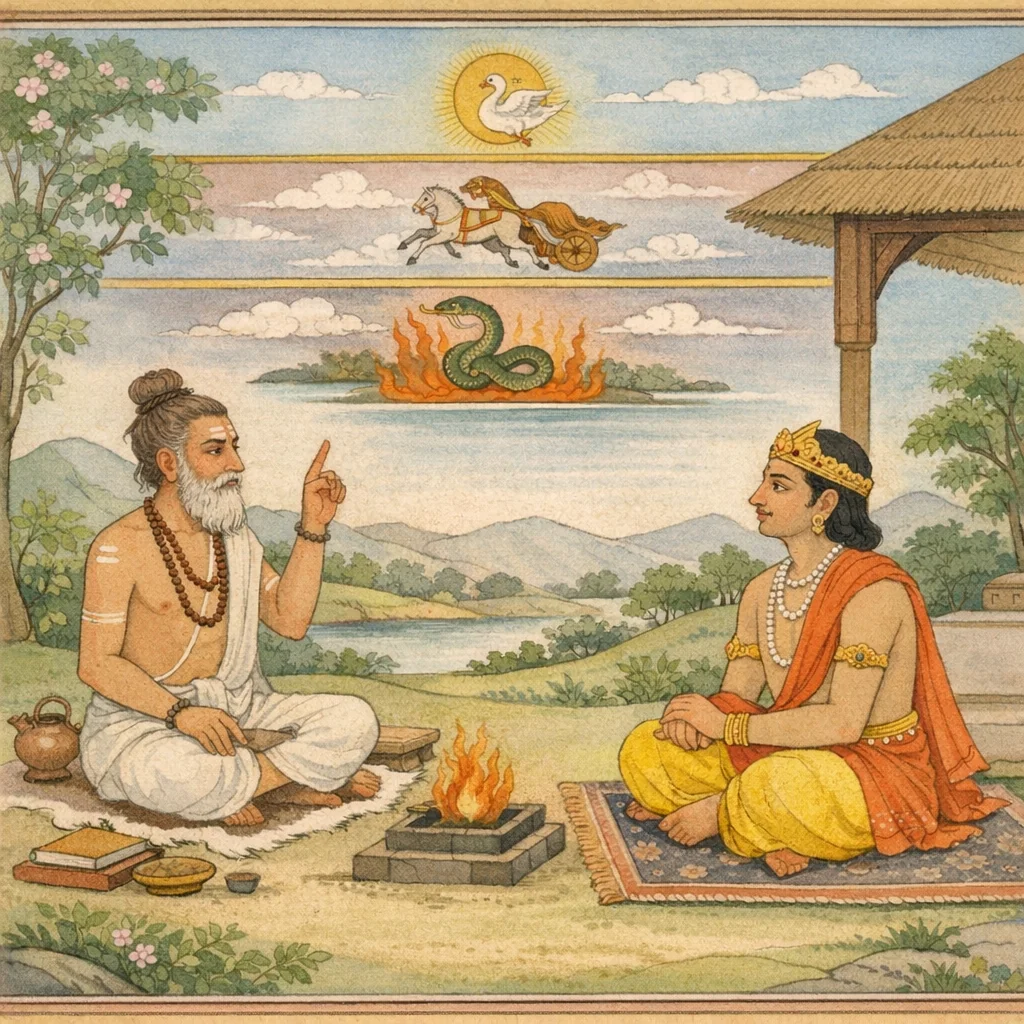
Adhyaya 314
Adhyāya 314 — हिमवदाश्रमः, शक्तिक्षेपकथा, तथा स्वाध्यायविधिः (Himalayan Hermitage, the Myth of the Thrown Spear, and Rules of Vedic Study)
Upa-parva: Mokṣa-dharma (Mokṣadharma-parvan) — Pedagogy of Self-Knowledge and Transmission of Veda
Bhīṣma continues a didactic narrative that opens with a self-possessed figure departing silently northward toward the wintry mountain, while Nārada simultaneously journeys to Himavat—portrayed as a sacralized landscape resonant with celestial music, apsarās, kiṃnaras, and auspicious birdlife. The chapter then embeds a mythic episode: Skanda (Kumāra) casts a śakti (spear) to the earth, challenging any superior power to lift or even shake it; the worlds are distressed, and Viṣṇu demonstrates strength by shaking the blazing weapon, causing the earth to tremble, yet it remains unlifted—thereby underscoring Skanda’s exceptional potency. Prahlāda attempts to lift it, fails, and falls senseless, after which the narrative shifts to another Himalayan locus where Mahādeva performs severe austerity; the region is guarded by Pāvaka (fire) in an enclosure called Ādityabandhana, inaccessible to hostile beings. The focus then moves to Vyāsa teaching the Vedas in seclusion to his principal disciples (Sumantu, Vaiśaṃpāyana, Jaimini, Paila) and receiving Śuka, who reports his dialogue with King Janaka. After the disciples request a boon concerning the establishment and dissemination of the Vedas, Vyāsa responds with a normative code: sacred knowledge is to be given to a devoted, disciplined, and examined student; instruction must not be granted to the untested, unvowed, or ethically unreliable. The chapter closes by framing Vedic study as a major duty instituted for divine praise and social welfare, warning against disparaging a learned brāhmaṇa and against unethical questioning or teaching, and urging responsible service to students as part of svādhyāya procedure.
Chapter Arc: राजा जनक, मोक्षधर्म के सूक्ष्म पथ पर, याज्ञवल्क्य से पूछते हैं—सत्त्व, रज, तम से युक्त मनुष्यों की गति क्या है और कौन-सा मार्ग अविनाशी पद तक ले जाता है? → याज्ञवल्क्य अव्यक्त-स्वरूप भगवान् के अनेक रूपों में प्राकट्य का संकेत देकर गुणों की त्रिविध सत्ता को जगत-चक्र का आधार बताते हैं; फिर जनक का प्रश्न और तीखा होता है—देह छूटते समय जीव की उत्क्रान्ति किस प्रकार होती है, और कर्म-गुण के अनुसार कौन-सा लोक प्राप्त होता है? → गुण-प्रधानता का निर्णायक विधान उद्घाटित होता है—सात्त्विक का ‘उत्तम स्थान’, राजस का ‘मध्यम’ और तामस का ‘अधोगति’; साथ ही पुण्य-पाप के संयोग-वियोग से मनुष्य-योनि, ऊर्ध्व-लोक, अधः-गति तथा ‘पुण्यपापवियुक्त’ महात्माओं के शाश्वत, अव्यय, अक्षय, अमृत पद का प्रतिपादन। → प्रकृति को अचेतन मानकर भी यह स्पष्ट किया जाता है कि परम-तत्त्व के अधिष्ठान से वही सृष्टि-स्थिति-प्रलय करती है; प्रकृति अपने प्रभाव से जीव को असंख्य रूपों में प्रकट करती है, और गुणों के द्वन्द्व-संनिपात का यथार्थ वर्णन सुनाकर याज्ञवल्क्य जनक के प्रश्नों को क्रमबद्ध उत्तर में बाँध देते हैं।
Shlokas
Verse 1
अपन काता बछ। 2 चतुर्दशाधिकत्रिशततमो< ध्याय: सात्त्विक, राजस और तामस प्रकृतिके मनुष्योंकी गतिका वर्णन तथा राजा जनकके प्रश्न याज़्वल्क्य उवाच एते प्रधानस्य गुणास्त्रय: पुरुषसत्तम । कृत्स्नस्य चैव जगतस्तिष्ठन्त्यनपगा: सदा,याज्ञवल्क्यजी कहते हैं--पुरुषप्रवर! सत्त्व, रज और तम--ये तीन प्रकृतिके गुण हैं, जो सम्पूर्ण जगतमें सदा विद्यमान रहते हैं। कभी उससे अलग नहीं होते हैं
Yājñavalkya said: “O best of men, the three qualities of primordial Nature—sattva, rajas, and tamas—abide perpetually. They pervade the whole universe and never depart from it.”
Verse 2
अव्यक्तरूपो भगवान् शतथा च सहस्रधा । शतधा सहस्रधा चैव तथा शतसहस्रधा
Yājñavalkya said: “The Blessed Lord is of unmanifest form, yet He appears in manifold ways—by hundreds and by thousands; indeed, by hundreds of thousands as well.”
Verse 3
सात््विकस्योत्तमं स्थानं राजसस्येह मध्यमम्
Yājñavalkya said: “For one established in sattva, the highest state is attained; but for one dominated by rajas, the result here is only a middling station.”
Verse 4
केवलेनेह पुण्येन गतिमूर्ध्वामवाप्रुयात्
Yājñavalkya said: “By mere merit alone in this world, one may attain an upward course—rising to higher states of existence.”
Verse 5
दन्द्धमेषां त्रयाणां तु संनिपातं च तत्त्वतः
Yājñavalkya said: “I shall explain, in accordance with the truth, the firm and exact conjunction of these three.”
Verse 6
सत्त्वस्य तु रजो दृष्ट रजसश्न तमस्तथा,सत्त्गगुणके साथ रजोगुण, रजोगुणके साथ तमोगुण, तमोगुणके साथ सत्त्वगुण तथा सत्त्गगुणके साथ अव्यक्त (जीवात्मा)-का सम्मिश्रण देखा जाता है (यह दो तत्त्वोंका संयोग या मेल ही द्वन्द्द है)। जीवात्मा जब सत्त्वगुणसे संयुक्त होता है, तब देवलोकको प्राप्त होता है
Yājñavalkya said: One observes rajas mingled with sattva, tamas mingled with rajas, and again sattva mingled with tamas; and with sattva there is also association with the Unmanifest (Avyakta), here taken as the subtle principle of the individual self. This mutual conjunction of two principles is called “dvandva” (duality). When the individual self is conjoined with sattva, it attains the worlds of the gods.
Verse 7
तमसशक्ष् तथा सत्त्वं सत्त्वस्याव्यक्तमेव च | अव्यक्त: सत्त्वसंयुक्तो देवलोकमवाप्नुयात्,सत्त्गगुणके साथ रजोगुण, रजोगुणके साथ तमोगुण, तमोगुणके साथ सत्त्वगुण तथा सत्त्गगुणके साथ अव्यक्त (जीवात्मा)-का सम्मिश्रण देखा जाता है (यह दो तत्त्वोंका संयोग या मेल ही द्वन्द्द है)। जीवात्मा जब सत्त्वगुणसे संयुक्त होता है, तब देवलोकको प्राप्त होता है
Yājñavalkya said: “In the interplay of the guṇas, one observes conjunctions—tamas with rajas, rajas with tamas, tamas with sattva, and even sattva with the Unmanifest (Avyakta), the subtle self-principle. This mutual joining of two factors is what is meant by ‘dvandva’ (duality). When the individual self is conjoined with sattva, it attains the world of the gods.”
Verse 8
रज:सत्त्वसमायुक्तो मानुषेषु प्रपद्यते रजस्तमोभ्यां संयुक्तस्तिर्यग्योनिषु जायते,रजोगुण और सत्त्वगुणसे संयुक्ति होनेपर वह मनुष्य-लोकमें जाता है तथा रजोगुण और तमोगुणसे संयुक्त होनेपर वह पशु-पक्षी आदिकी योनियोंमें जन्म ग्रहण करता है
Yājñavalkya explains that the soul’s next embodiment follows the predominance of the guṇas: when rajas is conjoined with sattva, one is born among human beings; but when rajas is conjoined with tamas, one is born into the wombs of animals and birds.
Verse 9
राजसैस्तामसै: सत्त्वैर्युक्तो मानुषमाप्तुयात् । पुण्यपापवियुक्तानां स्थानमाहुर्महात्मनाम् । शाश्व॒तं चाव्ययं चैवमक्षयं चामृतं च तत्,राजस, तामस और सात्विक तीनों भावोंसे युक्त होनेपर जीवको मनुष्ययोनिकी प्राप्ति होती है। जो पुण्य और पाप दोनोंसे रहित हैं, उन महात्मा पुरुषोंके लिये सनातन, अविकारी, अक्षय और अमृतपदकी प्राप्ति बतायी गयी है
Yājñavalkya said: When the embodied being is conjoined with the three dispositions—rajas, tamas, and sattva—it attains a human birth. But for those great-souled ones who are free from both merit and sin, the sages declare a state that is eternal, unchanging, imperishable, and deathless.
Verse 10
ज्ञानिनां सम्भवं श्रेष्ठ स्थानमव्रणमच्युतम् । अतीन्द्रियमबीजं च जन्ममृत्युतमोनुदम्,जहाँ किसी प्रकारका कष्ट नहीं है, जहाँसे कभी पतन नहीं होता है, जो इन्द्रियातीत है, जहाँ बन्धनमें डालनेवाला कोई कारण नहीं है तथा जो जन्म, मृत्यु और अज्ञानका विनाश करनेवाला है, वह श्रेष्ठ स्थान (परमपद) ज्ञानियोंको ही प्राप्त हो सकता है
Yājñavalkya said: The highest goal attainable by the wise is that supreme state—unwounded and undecaying, never falling away—beyond the reach of the senses and without any seed that could generate bondage again. It dispels the darkness of ignorance and brings an end to the cycle of birth and death.
Verse 11
अव्यक्तस्थं परं यत् तत् पृष्टस्ते5हं नराधिप । स एष प्रकृतिस्थो हि तत्स्थ इत्यभिधीयते,नरेश्वर! तुमने जो अव्यक्त प्रकृतिमें स्थित परमतत्त्वके विषयमें मुझसे प्रश्न किया था, उसके उत्तरमें यह निवेदन है कि यह परमतत्त्व प्राकृत शरीरमें स्थित होनेसे ही प्रकृतिस्थ कहलाता है
Yājñavalkya said: “O king, you asked me about that supreme Reality which abides in the Unmanifest. In reply I state this: that very Supreme is called ‘situated in Prakṛti’ because, indeed, it is present within Prakṛti and abides there.”
Verse 12
अचेतना चैव मता प्रकृतिश्वापि पार्थिव | एतेनाधिछिता चैव सृजते संहरत्यपि,पृथ्वीनाथ! प्रकृति अचेतन मानी गयी है। इस परमतत्त्वद्वारा अधिष्ठित होकर ही वह सृष्टि एवं संहार करती है
Yājñavalkya said: “O king, Prakṛti (material nature) is indeed regarded as insentient. Yet, when presided over and empowered by this Supreme Principle, she brings forth creation and also withdraws it again in dissolution. Thus, the world-process is not random: inert nature functions only under the governance of the highest reality.”
Verse 13
जनक उवाच अनादिनिधनावेतावुभावेव महामते । अमूर्तिमन्तावचलावप्रकम्प्यगुणागुणौ
Janaka said: “O great-minded one, these two indeed are without beginning and without end—formless, unmoving, unshakable, and beyond the pairs of ‘with qualities’ and ‘without qualities.’”
Verse 14
जनकने पूछा--महामते! प्रकृति और पुरुष दोनों आदि-अन्तसे रहित, मूर्तिहीन और अचल हैं। दोनों अपने-अपने गुणमें स्थिर रहनेवाले और दोनों ही निर्गुण हैं ।। अग्राह्मावृषिशार्दटूल कथमेको हाचेतन: । चेतनावांस्तथा चैक: क्षेत्रज्ञ इति भाषितः,मुनिश्रेष्ठ! वे दोनों ही बुद्धि-अगोचर हैं। फिर इन दोनोंमेंसे एक प्रकृतिको आपने अचेतन क्यों बताया है? तथा दूसरेको चेतन एवं क्षेत्रज्ञ कैसे कहा है?
Janaka said: “O great-minded sage! Both Prakṛti and Puruṣa are without beginning or end, formless and unmoving. Each abides in its own nature, and yet both are spoken of as beyond qualities. O tiger among seers, if both are beyond grasp and beyond the reach of intellect, why do you call one—Prakṛti—insentient, and the other sentient and the ‘knower of the field’ (kṣetrajña)? Explain, O best of sages, how this distinction is to be understood.”
Verse 15
त्वं हि विप्रेन्द्र कार्त्स्न्येन मोक्षधर्ममुपाससे । साकलल्यं मोक्षधर्मस्य श्रोतुमिच्छामि तत्त्वतः,विप्रवर! आप पूर्णरूपसे मोक्षधर्मका सेवन करते हैं, इसलिये आपहीके मुँहसे मैं सम्पूर्ण मोक्ष-धर्मका यथावत् रूपसे श्रवण करना चाहता हूँ
Janaka said: “O best of Brahmins, you practice the dharma of liberation in its entirety. Therefore, from your own lips I wish to hear, in full and as it truly is, the complete teaching of mokṣa-dharma.”
Verse 16
अस्तित्वं केवलत्वं च विनाभावं तथैव च । दैवतानि च मे ब्रूहि देहं यान्याश्रितानि वै,आप पुरुषके अस्तित्व, केवलत्व और प्रकृतिसे पृथक सत्ताका स्पष्टीकरण कीजिये और देहका आश्रय ग्रहण करनेवाले जो देवता हैं, उनका तत्त्व भी मुझे समझाइये
Janaka said: “Explain to me the meaning of existence, of absolute aloneness, and likewise of non-existence. Also tell me about the deities that take refuge in the body—what their true nature is.”
Verse 17
तथैवोत्क्रामिण: स्थान देहिनो वै विपद्यत: । कालेन यद्धि प्राप्रोति स्थानं तत् प्रतब्रवीहि मे,तथा मरनेवाले जीवके प्राणोंका जब उत्क्रमण होता है, उस समय उसे समयानुसार किस स्थानकी प्राप्ति होती है? इसपर भी प्रकाश डालिये
Janaka said: “In the same way, when an embodied being is perishing and the life-breath departs, what destination does it attain in due course, according to time and circumstance? Tell me clearly what ‘place’ it reaches at death.”
Verse 18
सांख्यज्ञानं च तत्त्वेन पृथग्योगं तथैव च । अरिष्टानि च तत्त्वानि वक्तुमरहसि सत्तम । विदितं सर्वमेतत् ते पाणावामलकं यथा,साधुशिरोमणे! साथ ही पृथक्-पृथक् सांख्य और योगके ज्ञानका तथा मृत्युसूचक लक्षणोंका यथार्थरूपसे वर्णन कीजिये; क्योंकि ये सारी बातें आपको हाथपर रखे हुए आँवलेके समान ज्ञात हैं
Janaka said: “Explain to me, in their true nature, the knowledge of Sāṅkhya and, separately, the discipline of Yoga; and also describe accurately the ominous signs that foretell death. O best of the good, you are fit to speak of these—since all this is as clear to you as an āmalaka fruit resting in the palm of your hand.”
Verse 26
कोटिशकक्ष करोत्येष प्रत्यगात्मानमात्मना । यह ऐश्वर्यशालिनी प्रकृति अपने ही प्रभावसे जीवको सैकड़ों, हजारों, लाखों और करोड़ों रूपोंमें प्रकट कर देती है
Yājñavalkya said: “This sovereign Power (Prakṛti), by its own inherent efficacy, fashions the one indwelling Self into countless manifestations—hundreds, thousands, lakhs, and even crores—so that the single living principle appears as many.”
Verse 33
तामसस्याधरमं स्थान प्राहुरध्यात्मचिन्तका: । अध्यात्म-शास्त्रका चिन्तन करनेवाले विद्वान् कहते हैं कि सात््विक पुरुषको उत्तम, रजोगुणीको मध्यम और तमोगुणीको अधम स्थानकी प्राप्ति होती है
Yājñavalkya said: Those who contemplate the inner Self and reflect upon the teachings of spiritual science declare that one in whom sattva prevails attains the highest state; one ruled by rajas attains a middling state; and one overwhelmed by tamas reaches the lowest state. Thus destiny is not chance, but the ethical fruit of one’s dominant qualities and inner discipline.
Verse 46
पुण्यपापेन मानुष्यमधर्मेणाप्यधोगतिम् । केवल पुण्य करनेसे मनुष्य ऊर्ध्वलोकमें गमन करता है, पुण्य और पाप दोनोंके अनुष्ठानसे मर्त्यलोकमें जन्म लेता है तथा केवल पापाचार करनेपर उसे अधोगतिमें गिरना पड़ता है
Yājñavalkya said: By the mixture of merit and demerit a being attains human birth; and by conduct opposed to dharma—still more—one falls to lower states. This teaching sets forth moral causality: pure merit elevates, mixed deeds bind one to rebirth in the mortal world, and persistent sin leads downward.
Verse 53
सत्त्वस्य रजसश्वैव तमसश्न शृणुष्व मे । अब मैं सत्त्व, रज और तम--इन तीनों गुणोंके द्वन्द्र और संनिपात-का यथार्थरूपसे वर्णन करता हूँ, सुनो
Yājñavalkya said: “Listen to me as I set forth the true nature of the three guṇas—sattva, rajas, and tamas—explaining how they oppose one another and how they also combine in various mixtures.”
Verse 314
इति श्रीमहाभारते शान्तिपर्वणि मोक्षधर्मपर्वणि याज्ञवल्क्यजनकसंवादे चतुर्दशाधिकत्रिशततमो<5ध्याय:
Thus, in the Śrī Mahābhārata, within the Śānti Parva—specifically the Mokṣa-dharma section—ends the dialogue between Yājñavalkya and King Janaka, concluding the three-hundred-and-fourteenth chapter.
Frequently Asked Questions
The chapter frames the dilemma of access versus protection in sacred learning: whether knowledge should be widely spread for welfare, yet restricted to qualified students to prevent misuse, distortion, or social harm.
Vedic instruction is a disciplined trust: a teacher should examine character and vows as gold is tested, teach according to a student’s capacity and correct recitation, and treat learning as service-oriented rather than indiscriminate or coercive.
Yes: the text explicitly positions the Vedas as instituted by Svayaṃbhū for divine praise and public good, warns that disrespecting a Veda-knowing brāhmaṇa leads to decline, and states that unethical teaching or questioning results in hostility or adverse outcomes—thereby giving a normative consequence-structure to the discourse.