Adhyaya 238
Adhyātma-krama: Indriya–Manas–Buddhi–Ātman Hierarchy and Citta-Prasāda (आध्यात्मक्रमः)
Upa-parva: Mokṣa-dharma Parva (Liberation Teachings Sub-book)
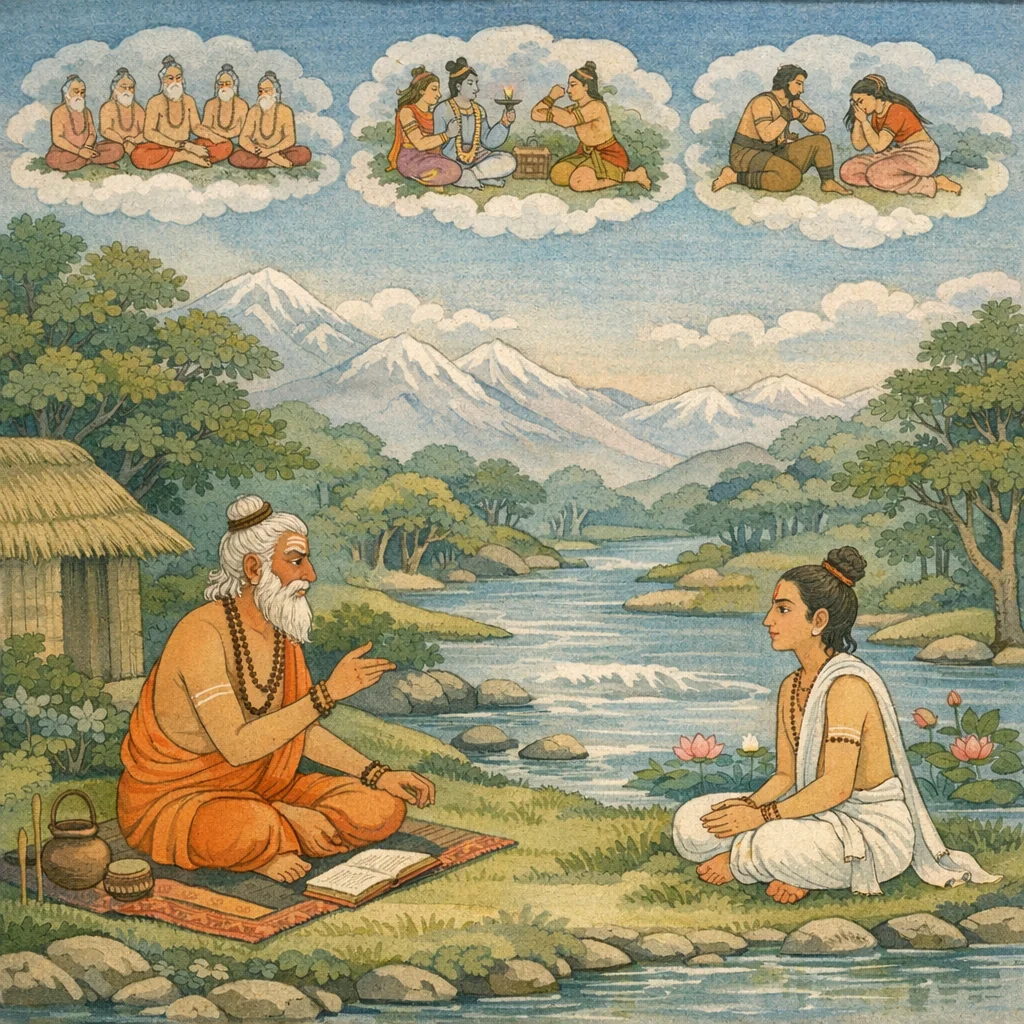
Vyāsa outlines an interior hierarchy that explains agency and liberation. The embodied knower (kṣetrajña) is associated with prakṛti’s modifications, yet is not recognized by them, while itself cognizes them (1). Action occurs through the sixfold apparatus—mind plus senses—likened to a charioteer controlling disciplined horses (2). A graded ontological ladder is stated: sense-objects exceed the senses, mind exceeds objects, intellect exceeds mind, and beyond intellect stands the great self; beyond the great is the unmanifest, and beyond the unmanifest is the deathless (amṛta), described as the final limit and highest course (3–4). Though hidden in all beings, ātman is apprehended by subtle, refined intellect among truth-seers (5). Practice is then prescribed: merge the mind-and-senses into the inner self through medhā (penetrative intelligence), reducing proliferative thought (6). Through cessation of distraction and a mind perfected by knowledge, the calm practitioner attains the deathless state (7). Conversely, a person with unstable memory and unmastered senses reaches mortality through self-surrender to impulses (8). The text recommends abandoning all intentions, placing mind in sattva; settled in sattva one becomes ‘kālaṃjara’ (beyond time/decay) (9). With clarity of mind, the ascetic relinquishes good and evil, abides in self, and tastes unbounded well-being (10). Signs of clarity are given by similes: satisfied sleep and a lamp steady in windless air (11). With purified diet and sustained practice across both halves of the night, one sees the self in the self (12). The discourse is labeled a Vedic ‘secret’ and self-verifying instruction, extracted like butter from curd or fire from wood (13–15). Strong eligibility restrictions follow: it is not for the unquiet, undisciplined, non-studious, insincere, malicious, or merely argumentative; it is for the calm, praiseworthy, devoted son or compliant student, and must not be told to others (16–18). The teaching is valued above material gifts, and is aligned with what sages ‘saw’ and what is sung in Vedānta; Vyāsa commits to explain what is asked (19–20).
Chapter Arc: Vyasa resumes the Moksha-dharma discourse by naming the knot that binds seekers: if action (karma) truly yields siddhi, why does doubt arise—does success belong to karma, to knowledge, or to something else altogether? → Competing explanations are set against each other: some declare human effort (pauruṣa) the cause of outcomes, others praise destiny/daiva, and still others point to svabhāva (nature). The teaching sharpens by adding kāla (Time) as a decisive factor, warning that people mistakenly split these forces as if they were independent and absolute. → The chapter’s pivot is the synthesis: pauruṣa (effort), daiva (the given/ordained), and kāla-svabhāva (time-driven nature) interweave in every result—confusion comes from isolating one and denying the others. From this lens, even ‘knowledge vs. action’ is reframed as a question of proper discernment rather than rivalry. → Yuga-dharma is outlined to show how the same pursuit of the good changes its outer form across ages: in Kṛta the mind is settled and tapas predominates; in later yugas doubt increases and practices diversify. Varṇa-appropriate ‘yajñas’ are listed (e.g., japa for the twice-born), emphasizing that discipline must match capacity and era. The discourse closes by enumerating the full causal chain—creation, time, steadfastness, Vedas, doer, deed, act, and fruit—as the answer to the inquiry.
Shlokas
Verse 1
भीकम (2 अमान अष्टात्रिशर्दाधिकद्विशततमो< ध्याय: नाना प्रकारके भूतोंकी समीक्षापूर्वक कर्मतत्त्वका विवेचन, युगधर्मका वर्णन एवं कालका महत्त्व व्यास उवाच एषा पूर्वतरा वृत्तित्राह्मणस्य विधीयते । ज्ञानवानेव कर्माणि कुर्वन् सर्वत्र सिध्यति,व्यासजी कहते हैं--बेटा! यह ब्राह्मणकी अत्यन्त प्राचीनकालसे चली आयी हुई वृत्ति है, जो शास्त्रविहित है। ज्ञानवान् मनुष्य ही सर्वत्र कर्म करता हुआ सिद्धि प्राप्त करता है
Vyāsa said: “My child, this is the most ancient, time-honored mode of life prescribed for a brāhmaṇa. Only a person endowed with true knowledge—while continuing to act—attains success everywhere.”
Verse 2
तत्र चेन्न भवेदेवं संशय: कर्मसिद्धये । कि तु कर्म स्वभावो<यं ज्ञानं कर्मेति वा पुन:,यदि कर्ममें संशय न हो तो वह सिद्धि देनेवाला होता है। यहाँ संदेह यह होता है कि क्या यह कर्म स्वभावसिद्ध है अथवा ज्ञानजनित?
If, in this matter, there were no doubt, then action would indeed be a direct means to attainment. But the doubt arises here: is this action something that proceeds merely from one’s innate nature, or is it to be understood as action grounded in knowledge once again?
Verse 3
तत्र वेदविधि: स स्याज्ज्ञानं चेत् पुरुष प्रति । उपपच्त्युपलब्धिभ्यां वर्णयिष्यामि तच्छुणु,उपर्युक्त संशय होनेपर यह कहा जाता है कि यदि वह पुरुषके लिये वैदिक विधानके अनुसार कर्त्तव्य हो तो ज्ञानजन्य है, अन्यथा स्वाभाविक है। मैं युक्ति और फल-प्राप्तिके सहित इस विषयका वर्णन करूँगा, तुम उसे सुनो
Vyāsa said: “In this matter, it is said that it becomes a Vedic injunction for a person if it is grounded in knowledge; otherwise, it is merely natural (spontaneous). I shall explain this to you with reasoning and with reference to the resulting attainment—listen to it.”
Verse 4
पौरुषं कारणं केचिदाहु: कर्मसु मानवा: । दैवमेके प्रशंसन्ति स्वभावमपरे जना:,कुछ मनुष्य कर्मोमें पुरुषार्थको कारण बताते हैं। कोई-कोई दैव (प्रारब्ध अथवा भावी) की प्रशंसा करते हैं और दूसरे लोग स्वभावके गुण गाते हैं
Vyāsa said: Some people declare human effort to be the decisive cause behind actions. Others praise destiny (the force of what is allotted by fate), while still others extol one’s own nature as the governing factor.
Verse 5
पौरुषं कर्म दैवं च कालवृत्तिस्वभावत: । त्रयमेतत् पृथग्भूतमविवेक॑ तु केचन,कितने ही मनुष्य पुरुषार्थद्वारा की हुई क्रिया, दैव और कालगत स्वभाव-इन तीनोंको कारण मानते हैं। कुछ लोग इन्हें पृथक्-पृथक् प्रधानता देते हैं अर्थात् इनमेंसे एक प्रधान है और दूसरे दो अप्रधान कारण हैं--ऐसा कहते हैं और कुछ लोग इन तीनोंको पृथक् न करके इनके समुच्चयको ही कारण बताते हैं
Vyāsa said: Human effort expressed as action, destiny, and the natural course of time—these three are spoken of as distinct causes. Yet some, lacking discernment, treat them as separate and assign primary power to one while reducing the other two; whereas others do not separate them, but regard their combined operation as the true cause behind events.
Verse 6
एतदेवं च नैवं च न चोभे नानुभे तथा । कर्मस्था विषयं ब्रूयु: सत्त्वस्था: समदर्शिन:,कुछ कर्मनिष्ठ विचारक घट-पट आदि विषयोंके सम्बन्धमें कहते हैं कि “यह ऐसा ही है।' दूसरे कहते हैं कि यह ऐसा नहीं है।” तीसरोंका कहना है कि “ये दोनों ही सम्भव हैं अर्थात् यह ऐसा है और नहीं भी है।” अन्य लोग कहते हैं कि 'ये दोनों ही मत सम्भव नहीं हैं' परंतु सत्त्वगुणमें स्थित हुए योगी पुरुष सर्वत्र समस्वरूप ब्रह्मको ही कारणरूपमें देखते हैं
Vyāsa said: Those fixed in action and disputation speak of an object as “It is so,” “It is not so,” “It is both,” or “It is neither.” But the yogins established in sattva, seeing with equal vision, discern everywhere the one Brahman alone as the causal ground behind all appearances.
Verse 7
त्रेतायां द्वापरे चैव कलिजाशक्ष ससंशया: । तपस्विन: प्रशान्ताश्न सत्त्वस्थाश्न कृते युगे,त्रेता,द्वापप तथा कलियुगके मनुष्य परमार्थके विषयमें संशयशील होते हैं; परंतु सत्ययुगके लोग तपस्वी और सत्त्वगुणी होनेके-कारण-प्रशान्त (संशयरहित) होते हैं
Vyāsa said: In the Tretā and Dvāpara ages—and likewise among those born in the Kali age—people are beset by doubt regarding the highest good. But in the Kṛta (Satya) age, people are ascetic, inwardly tranquil, and established in purity; therefore they remain calm and free from such uncertainty.
Verse 8
अपृथग्दर्शना: सर्वे ऋक्सामसु यजु:षु च । कामद्वेषौ पृथक् कृत्वा तप: कृत उपासते,सत्ययुगमें सभी द्विज ऋग्वेद, यजुर्वेद और सामवेद--इन तीनोंमें भेददृष्टि न रखते हुए राग-द्वेषको मनसे हटाकर तपस्याका आश्रय लेते हैं
Vyāsa said: In the age of truth, all the twice-born viewed the Ṛg, Sāma, and Yajus traditions without sectarian separation. Setting aside desire and aversion, they embraced austerity and lived in disciplined spiritual practice—showing that inner purification, not rivalry of schools, is the basis of dharma.
Verse 9
तपोधर्मेण संयुक्तस्तपोनित्य: सुसंशित: । तेन सर्वानिवाप्रोति कामान् यान् मनसेच्छति,जो मनुष्य तपस्यारूप धर्मसे संयुक्त हो पूर्णतया संयमका पालन करते हुए सदा तपमें ही तत्पर रहता है, वह उसीके द्वारा अपने मनसे जिन-जिन कामनाओंको चाहता है, उन सबको प्राप्त कर लेता है
Whoever is joined to the dharma of austerity, steadfast in complete self-restraint and ever intent upon tapas, by that very tapas attains all the desires that the mind may wish.
Verse 10
तपसा तदवाप्रोति यद् भूत्वा सृजते जगत् । तद् भूतश्न॒ ततः सर्वभूतानां भवति प्रभु:,तपस्यासे मनुष्य उस ब्रह्मभावको प्राप्त कर लेता है, जिसमें स्थित होकर वह सम्पूर्ण जगत्की सृष्टि करता है, अतः ब्रह्मभावको प्राप्त व्यक्ति समस्त प्राणियोंका प्रभु हो जाता है
By tapas a person attains that state of Brahman in which, established, one brings forth the whole world. Therefore, one who has reached Brahmanhood becomes lord over all beings.
Verse 11
तदुक्तं वेदवादेषु गहनं वेददर्शिभि: । वेदान्तेषु पुनर्व्यक्ते कर्मयोगेन लक्ष्यते,वह ब्रह्म वेदके कर्मकाण्डोंमें गुप्तरूपसे प्रतिपादित हुआ है; अतः वेदज्ञ विद्वानोंद्वारा भी वह अज्ञात ही रहता है। किंतु वेदान्तमें उसी ब्रह्मका स्पष्टरूपसे प्रतिपादन किया गया है और निष्काम कर्मयोगके द्वारा उस ब्रह्मका साक्षात्कार किया जा सकता है
Vyāsa said: That Reality has been spoken of in the Vedic portions dealing with ritual, but in a hidden and profound manner, so that even seers learned in the Veda may fail to recognize it. Yet in the Vedānta it is taught again with clarity; and through the discipline of selfless action (karma-yoga) it can be directly realized.
Verse 12
आलम्भयज्ञा: क्षत्राश्न॒ हविर्यज्ञा विश: स्मृता: । परिचारयज्ञा: शूद्राश्षन जपयज्ञा द्विजातय:
Vyāsa said: “For Kṣatriyas, the sacrifice characterized by ‘ālambha’ is prescribed; for the Vaiśyas, offerings of oblations (havis) are remembered as their sacrifice. For Śūdras, service and attendance are their sacrifice; and for the twice-born, the sacrifice of recitation (japa) is enjoined.”
Verse 13
क्षत्रिय आलम्भ- यज्ञ करनेवाले होते हैं, वैश्य हविष्यप्रधान यज्ञ करनेवाले माने गये हैं, शूद्र सेवारूप यज्ञ करनेवाले और ब्राह्मण जपयज्ञ करनेवाले होते हैं ।। परिनिषछितकार्यों हि स्वाध्यायेन द्विजो भवेत् । कुर्यादन्यन्न वा कुर्यान्मैत्रो ब्राह्मण उच्यते,क्योंकि ब्राह्मण वेदोंके स्वाध्यायसे ही कृतकृत्य हो जाता है। वह और कोई कार्य करे या न करे, सब प्राणियोंके प्रति मैत्रीभाव रखनेवाला होनेके कारण ही वह ब्राह्मण कहलाता है
Vyāsa said: Kṣatriyas are those whose sacrifice is expressed through decisive action and the taking up of arms; Vaiśyas are regarded as performers of sacrifices in which oblations and material offerings are primary; Śūdras perform sacrifice in the form of service; and Brāhmaṇas perform sacrifice through recitation and inward discipline (japa). For a twice-born becomes one who has fulfilled his proper task through Vedic self-study alone. Whether he undertakes other works or does not, he is called a Brāhmaṇa because he abides in friendliness and goodwill toward all living beings.
Verse 14
त्रेतादौ केवला वेदा यज्ञा वर्णाश्रमास्तथा । संरोधादायुषस्त्वेते व्यस्यन्ते द्वापरे युगे
Vyāsa said: “In the beginning of the Tretā age, the Vedas alone were in their undivided form, and so too were the sacrificial rites and the system of social classes and life-stages. But as human lifespan becomes constrained, these are arranged and distributed in the Dvāpara age.”
Verse 15
सत्ययुग और त्रेतामें वेद, यज्ञ तथा वर्णाश्रम धर्म विशुद्ध रूपमें पालित होते हैं, परंतु द्वापरयुगमें लोगोंकी आयुका हास होनेके कारण ये भी क्षीण होने लगते हैं ।। द्वापरे विप्लवं यान्ति वेदा: कलियुगे तथा । दृश्यन्ते नापि दृश्यन्ते कलेरन्ते पुन: किल,द्वापपर और कलियुगमें वेद प्रायः लुप्त हो जाते हैं। कलियुगके अन्तिम भागमें तो वे कभी कहीं दिखायी देते हैं और कभी दिखायी भी नहीं देते हैं
Vyāsa explains that in the Satya and Tretā ages the Vedas, sacrificial rites, and the disciplines of social and spiritual order (varṇa and āśrama) are upheld in a pure and intact form. But in the Dvāpara age, as human lifespan declines, these institutions begin to weaken. In Dvāpara—and even more so in Kali—the Vedas fall into disorder and near-disappearance; and toward the very end of Kali, they are said to appear only intermittently, as if visible in some places and times and absent in others. The ethical warning is clear: when human vitality and discipline diminish, the foundations of dharma—learning, ritual responsibility, and ordered life—become fragile and must be consciously protected.
Verse 16
उत्सीदन्ति स्वधर्माक्ष तत्राधर्मेण पीडिता: । गवां भूमेश्च ये चापामोषधीनां च ये रसा:,उस समय अधर्मसे पीड़ित हो सभी वर्णोके स्वधर्म नष्ट हो जाते हैं। गौ, जल, भूमि और ओषधियोंके रस भी नष्टप्राय हो जाते हैं
Vyāsa said: “O Akṣa, when people are oppressed by adharma, their own ordained duties (svadharma) collapse. In such a time, even the vital supports of life—cattle, the earth, water, and the nourishing essences of herbs—decline and become as though destroyed.”
Verse 17
अधर्मान्त्हिता वेदा वेदधर्मास्तथा55 श्रमा: । विक्रियन्ते स्वधर्मस्था: स्थावराणि चराणि च,वेद, वैदिक धर्म तथा स्वधर्मपरायण आश्रम--ये सभी उस समय अधर्मसे आच्छादित हो अदृश्य हो जाते हैं और स्थावर-जंगम सभी प्राणी अपने धर्मसे विकृत हो जाते हैं; अर्थात् सबमें विकार उत्पन्न हो जाता है
Vyāsa said: “When unrighteousness prevails, the Vedas become as though hidden, and the Vedic duties—along with the established orders of life—are obscured. Then even beings that ordinarily abide in their own proper nature and duty, whether immobile or moving, become distorted from their dharma; a pervasive moral and natural disorder arises in all.”
Verse 18
यथा सर्वाणि भूतानि वृष्टिभौमानि वर्षति । सृजते सर्वतो$ज्रानि तथा वेदा युगे युगे,जैसे वर्षा भूतलके समस्त प्राणियोंको उत्पन्न करती है और सर्व ओरसे उनके अंगोंको पुष्ट करती है, उसी प्रकार वेद प्रत्येक युगमें सम्पूर्ण योगाड़ोंका पोषण करते हैं
Vyāsa said: “Just as rain, falling upon the earth, brings forth all living beings and nourishes their limbs on every side, so too do the Vedas, age after age, sustain and strengthen all the disciplines of yoga—supporting life, order, and right conduct in every era.”
Verse 19
निश्चितं कालनानात्वमनादिनिधनं च यत् । कीर्तितं यत् पुरस्तान्मे सूते यच्चात्ति च प्रजा:,इसी प्रकार निश्चय ही कालके भी अनेक रूप हैं। उसका न आदि है और न अन्त। वही प्रजाकी सृष्टि करता है और अन्तमें वही सबको अपना ग्रास बना लेता है। यह बात मैंने तुमको पहले ही बता दी है
Vyāsa said: “It is certain that Time has many forms. It has neither beginning nor end. It is Time that brings forth creatures, and in the end it is Time that devours all. This I have already told you before.”
Verse 20
यच्चेदं प्रभव: स्थान भूतानां संयमो यम: । स्वभावेनैव वर्तन्ते द्वन्द्रसृष्टानि भूरिश:,यह जो काल नामक तत्त्व है, वही प्राणियोंकी उत्पत्ति, पालन, संहार और नियन्त्रण करनेवाला है। उसीमें द्वन्धयुक्त असंख्य प्राणी स्वभावसे ही निवास करते हैं
Vyāsa said: “That very principle called Time is the source and abiding ground of beings, and it is also their restraint and governance. Within it, countless creatures—brought forth under the conditions of opposing pairs—continue to exist and act according to their own inherent nature.”
Verse 21
सर्ग: कालो धृतिर्वेदा: कर्ता कार्य क्रियाफलम् । एतत् ते कथितं तात यन्मां त्वं परिपृच्छसि,तात! तुमने मुझसे जो कुछ पूछा था, उसके अनुसार मैंने तुम्हारे समक्ष सर्ग, काल, धारणा, वेद, कर्ता, कार्य और क्रियाफलके विषयमें ये सब बातें कही हैं
Vyāsa said: “Dear child, just as you asked, I have explained to you creation and emanation (sarga), time (kāla), sustaining steadiness and order (dhṛti), the Vedas, the agent (kartā), the work to be done (kārya), and the fruit of action (kriyā-phala).”
Verse 237
इस प्रकार श्रीमहाभारत शान्तिपर्वके अन्तर्गत मोक्षधर्यपर्वमें शुकदेवका अनुप्रश्नविषयक दो सौ सैतीसवाँ अध्याय पूरा हुआ
Thus ends the two-hundred-and-thirty-seventh chapter on Śukadeva’s follow-up questions, within the Mokṣadharma section of the Śānti Parva of the Śrī Mahābhārata.
Verse 238
इति श्रीमहाभारते शान्तिपर्वणि मोक्षधर्मपर्वणि शुकानुप्रश्ने अष्टात्रिंशदधिकद्विशततमो<ध्याय:
Thus, in the Śrī Mahābhārata, within the Śānti Parva—specifically the Mokṣadharma section—ends the two-hundred-and-thirty-eighth chapter, in the context of Śuka’s follow-up inquiry.
Frequently Asked Questions
How to explain agency and liberation through a graded inner architecture—senses, objects, mind, intellect, and the higher self—so that practice can shift identification from prakṛti’s changes to the deathless principle.
Withdraw and integrate mind-and-senses into the inner self, abandon proliferating intentions, stabilize cognition in sattva, and cultivate citta-prasāda—illustrated by the steady lamp and satisfied sleep.
Yes; it is explicitly marked as rahasya and restricted to calm, disciplined, sincere recipients (devoted son or compliant student), while excluding the unquiet, undisciplined, insincere, malicious, or merely disputatious.