Adhyaya 211
जनकस्य मोक्षमार्गप्रश्नः तथा पञ्चशिखोपदेश-प्रस्तावः | Janaka’s Path to Liberation: Prelude to Pañcaśikha’s Instruction
Upa-parva: Mokṣa-dharma Anuśāsana (Liberation-Oriented Instruction) — Janaka–Pañcaśikha Discourse Unit
Yudhiṣṭhira asks Bhīṣma by what conduct Janaka, the dharma-knowing king of Mithilā, attained mokṣa after abandoning ordinary enjoyments (1). Bhīṣma responds by citing an ancient narrative as evidentiary precedent (2). Janaka is portrayed as engaged in inquiry into post-mortem rites and metaphysical outcomes, yet unsatisfied despite the presence of a hundred teachers offering divergent dharmas and viewpoints (3–5). The sage Pañcaśikha—presented within a Kapila-associated, Sāṃkhya-identified lineage—arrives, characterized as settled in renunciation, free of doubt, and seeking the rare, enduring happiness described by seers (6–10). The discourse introduces epistemic and metaphysical scrutiny: distinctions between kṣetra and kṣetrajña (field and knower), the perception of the one imperishable brahman in many forms, and the formation of Pañcaśikha’s authority through lineage narrative (11–16). Pañcaśikha challenges the court’s teachers with reasoning, and Janaka, drawn to his analysis, follows him and receives instruction in the “highest mokṣa” associated with Sāṃkhya (17–19). The teaching proceeds through graded nirveda—disenchantment with social identity, then with action, then universally (20)—and critiques the instability of karmic goals and the fragility of empirical existence (21–47). The chapter closes with Janaka’s astonishment and intent to question further, marking the transition to continued philosophical examination (48).
Chapter Arc: गुरु शिष्य को संसार-चक्र का रहस्य दिखाने के लिए चार प्रकार के भूतों—स्थावर और चर—की उत्पत्ति को ‘अव्यक्त’ से ‘व्यक्त’ होने की प्रक्रिया के रूप में उठाते हैं, मानो अदृश्य बीज में छिपे वृक्ष को दृष्टि के सामने लाना हो। → उपमा-श्रृंखला से यह तनाव गहराता है कि जीव कैसे अनादि चक्र में बँधता है: पीपल के सूक्ष्म बीज में महावृक्ष की तरह, अव्यक्त में व्यक्त जगत निहित है; और अचेतन लोहे का चुंबक की ओर खिंचना जैसे, वैसे ही स्वभाव-हेतु से देह-मन प्रवृत्तियाँ जीव को कर्म की ओर धकेलती हैं। → जीव की बन्धन-यंत्रणा का निर्णायक सूत्र उद्घाटित होता है: तृष्णा और अहंकार के अधीन होकर जीव कर्म-संग्रह करता है; कार्य-कारण के संयोग में काल भी हेतु बनता है; और इसी से ‘अनादिनिधनं महत्’ संसार-चक्र चलता रहता है। → विवेकी के लिए उपाय स्पष्ट किया जाता है—सत्त्व/क्षेत्र और क्षेत्रज्ञ का भेद जानकर अभ्यास से ऐसी युक्ति प्राप्त हो कि प्रकृति में पुनः न लौटे; ज्ञानाग्नि से क्लेश-दग्ध होने पर बीज-भुने की तरह पुनर्जन्म की अंकुरण-शक्ति नष्ट हो जाती है।
Shlokas
Verse 1
ऑपनआक्रात [छ। अ्--क्ाजण एकादशाधिकद्वधिशततमो<्ध्याय: संसारचक्र और जीवात्माकी स्थितिका वर्णन गुरुर्वाच चतुर्विधानि भूतानि स्थावराणि चराणि च । अव्यक्तप्रभवान्याहुरव्यक्तनिधनानि च । अव्यक्तलक्षणं विद्यादव्यक्तात्मात्मकं मन:,गुरुजी कहते हैं--वत्स! जरायुज, अण्डज, स्वेदज और उद्धिज्ज--ये चार प्रकारके जो स्थावर और जड़म प्राणी हैं, वे सब अव्यक्तसे उत्पन्न हुए बताये गये हैं और अव्यक्तमें ही उन सबका लय होता है। जिसका कोई लक्षण व्यक्त न हो उसे अव्यक्त समझना चाहिये। मन अव्यक्त प्रकृतिके समान ही त्रिगुणात्मक है
Bhīṣma said: The teacher said—“Dear child, beings are of four kinds, whether immobile or mobile. They are said to arise from the Unmanifest and to dissolve back into the Unmanifest. That which has no manifest mark should be understood as ‘Unmanifest’. The mind, too, is of the nature of the Unmanifest—constituted by the three guṇas.”
Verse 2
यथाश्व॒त्थकणीकायामन्तर्भूतो महाद्रुम: । निष्पन्नो दृश्यते व्यक्तमव्यक्तात् सम्भवस्तथा,जैसे पीपलके छोटे-से बीजमें एक विशाल वृक्ष अव्यक्तरूपसे समाया हुआ है, जो बीजके उगनेपर वृक्षरूपमें परिणत हो प्रत्यक्ष दिखायी देता है, उसी प्रकार अव्यक्तसे व्यक्त जगतकी उत्पत्ति होती है
Bhīṣma said: Just as a mighty tree lies hidden, unmanifest, within the tiny seed of the aśvattha (sacred fig), and when it sprouts it becomes manifest and is clearly seen, so too the manifest world arises from the unmanifest.
Verse 3
अभिद्रवत्ययस्कान्तमयो निश्चेतनं यथा । स्वभावहेतुजा भावा यद्वदन्यदपीदृशम्,जिस प्रकार लोहा अचेतन होनेपर भी चुम्बककी ओर खिंच जाता है, वैसे ही शरीरके उत्पन्न होनेपर प्राणीके स्वाभाविक संस्कार तथा अविद्या, काम, कर्म आदि दूसरे गुण उसकी ओर खिंच आते हैं
Bhīṣma said: “Just as iron, though insentient, runs toward a magnet, so too, when a body comes into being, the living being’s innate dispositions—together with ignorance, desire, and the momentum of past action and the like—are drawn toward it and fasten upon it.”
Verse 4
तद्वदव्यक्तजा भावा: कर्तु: कारणलक्षणा: । अचेतनाश्रेतयितु: कारणादभिसंहता:,इसी प्रकार उस अव्यक्तसे उत्पन्न हुए उपर्युक्त कारणस्वरूप भाव अचेतन होनेपर भी चेतनकताके सम्बन्धसे चेतन-से होकर जानना आदि क्रियाके हेतु बन जाते हैं
Bhishma said: Likewise, the states and principles that arise from the Unmanifest—though themselves insentient—bear the marks of causality and, when gathered together as the instruments of the agent, become causes for acts such as knowing, because they are connected with a conscious support.
Verse 5
न भूर्न खं द्यौर्भूतानि नर्षयो न सुरासुरा: । नान्यदासीदृते जीवमासेदुर्न तु संहतम्,पहले पृथ्वी, आकाश, स्वर्ग, भूतगण, ऋषिगण तथा देवता और असुरगण इनमेंसे कोई नहीं था। चेतनके सिवा दूसरी किसी वस्तुकी सत्ता ही नहीं थी। जड-चेतनका संयोग भी नहीं था
Bhīṣma said: In the beginning there was neither earth, nor sky, nor heaven; neither the hosts of beings, nor the seers, nor the gods and asuras. Nothing else existed apart from the living conscious principle. Even the conjunction of the inert and the conscious had not yet come to be.
Verse 6
पूर्व नित्यं सर्वगतं मनोहेतुमलक्षणम् । अज्ञानकर्म निर्दिषप्टमेतत् कारणलक्षणम्,आत्मा सबके पहले विद्यमान था। वह नित्य, सर्वगत, मनका भी हेतु और लक्षणरहित है। यह कारणस्वरूप समस्त जगत् अज्ञानका कार्य बताया गया है
Bhishma said: The Self existed before all else—eternal, all-pervading, the very ground that gives rise to mind, and yet without any defining mark. This entire causal basis of the world is taught to be connected with ignorance and action (karma), as the characteristic condition from which manifest existence proceeds.
Verse 7
तत्कारणैहिं संयुक्त कार्यसंग्रहकारकम् । येनैतद् वर्तते चक्रमनादिनिधनं महत्,इन कारणोंसे युक्त होकर जीव कर्मोंका संग्रह करता है। कर्मोंसे वासना और वासनाओंसे पुनः कर्म होते हैं। इस प्रकार यह अनादि, अनन्त महान् संसार-चक्र चलता रहता है
Bhishma said: Endowed with those causal factors, the embodied being accumulates and stores up actions. From actions arise latent impressions and cravings, and from those cravings actions are born again. Thus the great wheel of worldly existence—without beginning and without end—continues to turn.
Verse 8
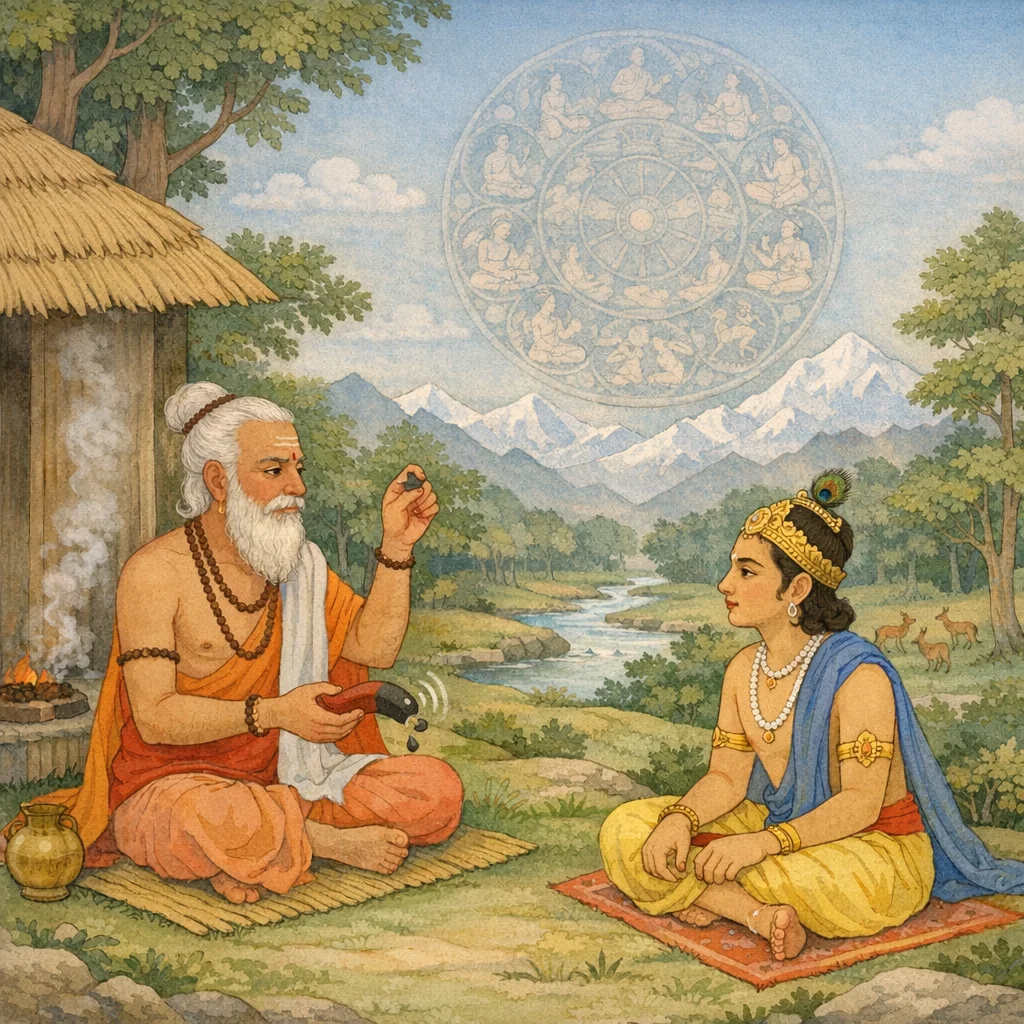
अव्यक्तनाभं व्यक्तारं विकारपरिमण्डलम् । क्षेत्रज्ञाधिष्ठितं चक्र स्निग्धाक्षं वर्तते ध्रुवम्,यह जन्म-मरणका प्रवाहरूप संसार चक्रके समान घूम रहा है। अव्यक्त उसकी नाभि है। व्यक्त (देह और इन्द्रिय आदि) उसके अरे हैं। सुख-दुःख, इच्छा आदि विकार इसकी नेमि हैं। आसक्ति धुरा है। यह चक्र निश्चितरूपसे घूमता रहता है। क्षेत्रज्ञ (जीवात्मा) इस चक्रपर चालक बनकर बैठा हुआ है
Bhishma said: “This wheel of worldly becoming turns unceasingly and with certainty. Its hub is the Unmanifest; its spokes are the manifest forms—body and senses. Its rim is made of the modifications such as pleasure and pain, desire and the like. Its axle is attachment, and upon it sits the knower of the field (the individual self) as the driver. Thus the stream of birth and death keeps revolving.”
Verse 9
स्निग्धत्वात् तिलवत् सर्व चक्रेडस्मिन् पीड्यते जगत् । तिलपीडैरिवाक्रम्य भोगैरज्ञानसम्भवै:,जैसे तेली लोग तेलसे युक्त होनेके कारण तिलोंको कोल्हूमें पेरते हैं, उसी प्रकार यह सारा जगत् आसत्तिग्रस्त होनेके कारण अज्ञानजनित भोगोंद्वारा दबा-दबाकर इस संसारचक्रमें पेरा जा रहा है
Bhishma said: Because of its clinging attachment—like sesame seeds rich with oil—this whole world is pressed within the wheel of worldly becoming. As sesame is crushed in an oil-press, so beings are repeatedly ground down by pleasures born of ignorance, and thus are made to revolve in the cycle of saṃsāra.
Verse 10
कर्म तत् कुरुते तर्षादहंकारपरिग्रहात् । कार्यकारणसंयोगे स हेतुरुपपादित:,जीव अहंकारके अधीन होकर तृष्णाके कारण कर्म करता है और वह कर्म आगामी कार्य-कारण-संयोगमें हेतु बन जाता है
Bhishma said: Driven by craving, and under the sway of ego-identification, the living being performs action. That very action, within the chain of causes and effects, is established as a further cause—binding the doer again to subsequent outcomes.
Verse 11
नाभ्येति कारणं कार्य न कार्य कारणं तथा । कार्याणां तूपकरणे कालो भवति हेतुमान्,न तो कारण कार्यमें प्रवेश करता है और न कार्य कारणमें। कार्य करते समय काल ही उनकी सिद्धि और असिद्धिमें हेतु होता है
Bhīṣma said: “A cause does not enter into its effect, nor does an effect enter into its cause. In the actual execution of actions, it is Time (Kāla) that becomes the determining factor for their success or failure—not the cause merging into the effect.”
Verse 12
हेतुयुक्ता: प्रकृतयो विकाराश्न: परस्परम् | अन्योन्यमभिवर्तन्ते पुरुषाधिष्ठिता: सदा,हेतुसहित आठों प्रकृतियाँ और सोलह विकार--ये पुरुषसे अधिष्ठित हो सदा एक- दूसरेसे मिलते और सृष्टिका विस्तार करते हैं
Bhīṣma said: “The principle constituents of Prakṛti, together with their evolutes, operate with definite causes and continually act upon one another. Ever presided over by the Puruṣa (the conscious principle), they mutually combine and interact, and thus the unfolding of creation proceeds.”
Verse 13
राजसैस्तामसैर्भावैर्युतो हेतुबलान्वित: । क्षेत्रज्ञगेवानुयाति पांसुर्वातेरितो यथा,राजस और तामसभावोंसे युक्त हेतुबलसे प्रेरित सूक्ष्मशरीर क्षेत्रज्ञ जीवात्माके साथ- साथ ठीक उसी तरह दूसरे स्थूल शरीरमें चला जाता है, जैसे वायुद्वारा उड़ायी हुई धूल उसीके साथ-साथ एक स्थानसे दूसरे स्थानको जाती है
Bhīṣma said: “Endowed with rajasic and tamasic dispositions, and driven by the force of its causal impulses, the subtle body follows along with the knower of the field (the individual self) and passes into another gross body—just as dust, stirred up by the wind, is carried from one place to another along with it.”
Verse 14
नच तै: स्पृश्यते भावैर्न ते तेन महात्मना | सरजस्को5रजस्कश्न नैव वायुर्भवेद् यथा,जैसे धूलके उड़नेसे वायु न तो धूलसे लिप्त होती है और न अलिप्त ही रहती है। उसी प्रकार न तो उन राजस, तामस आदि भावोंसे जीवात्मा लिप्त होता है और न अलिप्त ही रहता है
Bhīṣma said: “The great Self is not touched by those states of being; nor does it become wholly defined by them. Just as the wind, though moving amid rising dust, is neither truly smeared by the dust nor can it be called absolutely untouched in a practical sense, so too the individual self is not essentially tainted by rajas, tamas, and the like—yet, in embodied life, it appears connected with them through their effects.”
Verse 15
तथैतदन्तरं विद्यात् सत्त्वक्षेत्रज्ञयोर्बुध: । अभ्यासात् स तथा युक्तो न गच्छेत् प्रकृतिं पुन:,अत: विवेकी पुरुषको क्षेत्र और क्षेत्रज्षका यह अन्तर जान लेना चाहिये। इन दोनोंके तादात्म्यका-सा अभ्यास हो जानेसे जीव ऐसा हो गया है कि उसे अपने शुद्ध स्वरूपका पता ही नहीं लगता
Bhīṣma said: “Thus a wise person should understand this inner distinction between sattva (the mind’s luminous disposition) and the kṣetrajña (the knower of the field, the Self). When, through long habit, one has come to identify the two as though they were one, the embodied being—so bound by that misjoining—fails to return to the clarity of its own pure nature and is drawn back again into Prakṛti (conditioned nature).”
Verse 16
संदेहमेतमुत्पन्नमच्छिनद् भगवानृषि: । तथा वार्ता समीक्षेत कृतलक्षणसम्मिताम्,(भीष्मजी कहते हैं--) इस प्रकार उन महर्षि भगवान् गुरुदेवने शिष्यके उत्पन्न हुए इस संदेहको काट डाला। अतः विद्वान पुरुष ऐसे उपायोंपर दृष्टि रखे, जो क्रियाद्वारा उद्देश्यकी सिद्धिमें सहायक हों
Bhīṣma said: Thus the blessed great ṛṣi, the revered preceptor, cut away the doubt that had arisen in his disciple. Therefore a learned man should examine those well-marked means that, through right action, aid the attainment of the intended end.
Verse 17
बीजान्यग्न्युपदग्धानि न रोहन्ति यथा पुन: । ज्ञानदग्धैस्तथा क्लेशैरनत्मा सम्पद्यते पुनः:,जैसे आगमें भूने हुए बीज नहीं उगते, उसी प्रकार ज्ञानरूपी अग्निसे अविद्यादि सब क्लेशोंके दग्ध हो जानेपर जीवात्माको फिर इस संसारमें जन्म नहीं लेना पड़ता
Bhīṣma said: “Just as seeds scorched by fire do not sprout again, so too, when the afflictions born of ignorance are burned up by the fire of true knowledge, the embodied being does not return to take birth in this world.”
Verse 290
इस प्रकार श्रीमह्ाा भारत शान्तिपर्वके अन्तर्गत मोक्षधर्मपर्वमें श्रीकृष्णसम्बन्धी अध्यात्मतत्त्वका निरूपणविषयक दो सौ दसवाँ अध्याय पूरा हुआ
Thus concludes the two hundred and tenth chapter of the Mokṣadharma section within the Śānti Parva of the Śrī Mahābhārata, a chapter devoted to expounding the spiritual principles connected with Śrī Kṛṣṇa.
Verse 2331
इति श्रीमहाभारते शान्तिपर्वणि मोक्षधर्मपर्वणि वार्ष्णेया ध्यात्मक थने एकादशाधिकद्विशततमो<ध्याय:
Thus ends the two-hundred-and-eleventh chapter in the Mokṣadharma section of the Śānti Parva of the Śrī Mahābhārata, in the subsection concerning the spiritual teaching connected with the Vārṣṇeya lineage. (Colophon)
Frequently Asked Questions
How Janaka attained mokṣa—specifically, what mode of conduct and understanding enabled liberation while disengaging from ordinary human enjoyments and courtly attachments.
Liberation is framed as arising from disciplined discrimination and progressive disenchantment: karmic and worldly pursuits are shown as unstable, while inquiry into the knower (kṣetrajña) and the limits of doctrinal claims reorients the seeker toward the imperishable.
No explicit phalaśruti formula appears in this chapter; the meta-function is structural—Bhīṣma legitimizes the teaching by presenting it as an authoritative ancient precedent and by marking Janaka’s continued questioning as the narrative bridge to further instruction.