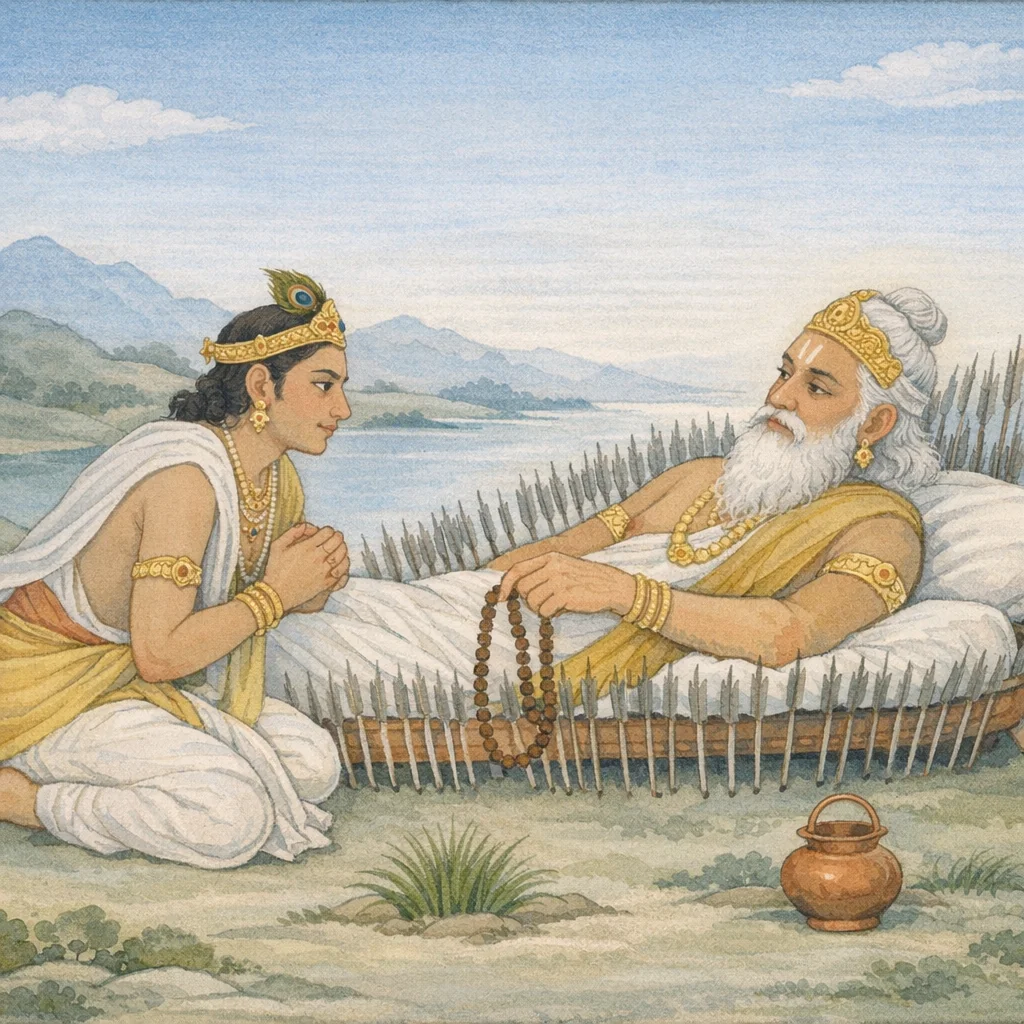
Adhyaya 197
मनुरुवाच — इन्द्रिय-मनः-ज्ञान-क्रमः (Manu on the hierarchy of senses, mind, and knowledge)
Upa-parva: Mokṣa-dharma Parva (Liberation Discourse Unit)
Manu explains that cognition and post-mortem becoming (bhava–abhava) are conditioned by knowledge conjoined with the senses, illustrated through dream-experience. Using the analogy of reflection in clear water, he argues that when the sensory apparatus is tranquil and undisturbed, the knowable is apprehended by knowledge; when the senses are agitated, the knowable is not seen. Ignorance (ajñāna) produces non-discernment (abuddhi), which corrupts the mind and its internal factors; immersion in objects strengthens craving, whereas purity turns one away from objects. Knowledge arises with the exhaustion of sinful action, enabling self-recognition as in a mirror. The chapter stresses that unrestrained senses generate distress while regulated senses support well-being; therefore one should withdraw the self from sensory forms. A hierarchy is stated: senses < mind < buddhi < knowledge < the higher principle (param). The discourse further describes emanation from the unmanifest (avyakta) into knowledge, buddhi, and mind linked with the auditory and other faculties, and teaches relinquishment of sound and other sense-objects as a route to liberation. Solar imagery depicts emanation and reabsorption; the inner self enters the body, engages the five sense-qualities, and withdraws. Finally, it presents a state beyond touch, hearing, taste, sight, smell, and discursiveness, where sattva enters the supreme, and notes the subtle witness that ‘sees’ these layers though they do not apprehend one another.
Chapter Arc: युधिष्ठिर, अब तक सुनी हुई धर्मकथाओं से तृप्त होते हुए भी, एक सूक्ष्म संशय लेकर भीष्म से पूछते हैं—जप करने वालों को कौन-सा फल मिलता है और वे किस लोक/अवस्था को प्राप्त होते हैं। → भीष्म उत्तर को केवल ‘फल’ की सूची तक सीमित नहीं रखते; वे चेतावनी देते हैं कि कामादि विकारों से दूषित बुद्धि मन को चंचल बनाती है, और वही चंचलता साधक को अधोगति—नरक या नाना योनियों—की ओर ढकेल सकती है। जप-मार्ग का मूल्यांकन अब नैतिक-मानसिक शुद्धि की कसौटी पर आ टिकता है। → मुख्य बिंदु यह उभरता है कि जप का फल यांत्रिक उच्चारण से नहीं, बल्कि मन-समाधि और इन्द्रिय-जय से सुनिश्चित होता है; दूषित बुद्धि के कारण ‘बहुत-से नरकों की प्राप्ति’ का कथन इसी हेतु है—जप भी तब तक फलदायी नहीं जब तक काम-क्रोध आदि से बुद्धि मुक्त न हो। → अध्याय जप को ध्यान-योग की देहलीज़ के रूप में प्रतिष्ठित करता है—जप से बल/संस्कार-संचय, उससे ध्यान की सिद्धि, और अंततः मन-इन्द्रियों पर विजय की दिशा। साथ ही यह स्पष्ट करता है कि पतन का कारण बाह्य कर्म नहीं, भीतर की आसक्ति और अविवेक है। → भीष्म की बात आगे के लिए द्वार खोलती है—यदि बुद्धि कामादि से दूषित हो तो पतन निश्चित है; तो शुद्धि की ठोस प्रक्रिया, विवेक-स्थापन और मनोनिग्रह की क्रमिक साधना आगे कैसे विस्तार पाएगी?
Shlokas
Verse 1
पम्प छा अकाल षण्णवर्त्याधेकशततमोब् ध्याय: जपयज्ञके विषयमें युधिषिरका प्रश्न, उसके उत्तरमें जप और ध्यानकी महिमा और उसका फल युधिछिर उवाच चातुराश्रम्यमुक्त ते राजधर्मास्तथैव च । नानाश्रयाश्न॒ बहव इतिहासा: पृथग्विधा:,युधिष्ठिरने पूछा--पितामह! आपने चार आश्रमों तथा राजधर्मोंका वर्णन किया एवं अनेकानेक विषयोंसे सम्बन्ध रखनेवाले बहुत-से भिन्न-भिन्न इतिहास भी सुनाये अफ--कात सप्तनवर्त्याधिकशततमो< ध्याय: जापकमें दोष आनेके कारण उसे नरककी प्राप्ति युधिछिर उवाच गतीनामुत्तमा प्राप्ति: कथितां जापकेष्विह । एकैवैषा गतिस्तेषामुत यान्त्यपरामपि युधिष्ठिरने पूछा--पितामह! आपने यहाँ जापकोंके लिये गतियोंमें उत्तम गतिकी प्राप्ति बतायी है। क्या उनके लिये एकमात्र यही गति है? या वे किसी दूसरी गतिको भी प्राप्त होते हैं?
Yudhiṣṭhira said: “Grandfather, you have explained the system of the four stages of life, and likewise the duties of kings; and you have also narrated many diverse histories connected with many different themes. Again, you have declared here that practitioners devoted to japa attain the highest of destinies. Is that the only destiny for them, or do they sometimes reach another fate as well?”
Verse 2
श्रुतास्त्वत्त: कथाश्रैव धर्मयुक्ता महामते । संदेहो5स्ति तु कश्चिन्मे तद् भवान् वक्तुमहति,महामते! मैंने आपके मुखसे अनेक धर्मयुक्त कथाएँ सुनी हैं; फिर भी मेरे मनमें एक संदेह रह गया है, उसे आप मुझे बतानेकी कृपा करें भीष्म उवाच शृणुष्वावहितो राजन् जापकानां गति विभो । यथा गच्छन्ति निरयाननेकान् पुरुषर्षभ
Yudhiṣṭhira said: “O great-minded one, I have heard from you many accounts grounded in dharma; yet a certain doubt remains in my mind. Please deign to explain it to me, O wise one.” Bhīṣma said: “Listen attentively, O king, O lord. I shall tell you the course and destiny of those who practice japa—how they may come to fall into various hells, O best of men.”
Verse 3
जापकानां फलावाप्तिं श्रोतुमिच्छामि भारत । किंफलं जपतामुक्तं क्व वा तिष्ठन्ति जापका:,भरतनन्दन! अब मैं यह सुनना चाहता हूँ कि जप करनेवालोंको फलकी प्राप्ति कैसे होती है? जापकोंके जपका फल क्या बताया गया है अथवा जप करनेवाले पुरुष किन लोकोंमें स्थान पाते हैं? भीष्मजीने कहा--राजन्! तुम सावधान होकर जापकोंकी गतिका वर्णन सुनो। प्रभो! पुरुषप्रवर! अब मैं यह बता रहा हूँ कि वे किस तरह नाना प्रकारके नरकोंमें पड़ते हैं" २ ।। यथोक्तपूर्व पूर्व यो नानुतिषछतति जापक: । एकदेशक्रियश्चात्र निरयं स च गच्छति जो जापक जैसा पहले बताया गया है, उसी तरह नियमोंका ठीक-ठीक पालन नहीं करता, एकदेशका ही अनुष्ठान करता है अर्थात् किसी एक ही नियमका पालन करता है, वह नरकमें पड़ता है
Yudhiṣṭhira said: “O Bhārata, I wish to hear how those who practice japa attain its results. What fruit is declared for those who repeat the sacred formula, and in what worlds do the practitioners of japa abide?” Bhīṣma replied: “O King, listen attentively as I describe the destiny of japa-practitioners. A person who is called a jāpaka but does not follow the discipline as previously prescribed—performing only a partial observance here—goes to hell.”
Verse 4
जप्यस्य च विधिं कृत्स्नं वक्तुमहसि मेडनघ । जापका इति किज्चैतत् सांख्ययोगक्रियाविधि:,अनघ! आप मुझे जपकी सम्पूर्ण विधि भी बताइये। “जापक” इस पदसे क्या तात्पर्य है? क्या यह सांख्ययोग, ध्यानयोग अथवा क्रियायोगका अनुष्ठान है? अवमानेन कुरुते न प्रीयति न हृष्यति । ईदृशो जापको याति निरयं नात्र संशय: जो अवहेलनापूर्वक जप करता है, उसके प्रति प्रेम या प्रसन्नता नहीं प्रकट करता है, ऐसा जापक भी नि:संदेह नरकमें ही पड़ता है
Yudhiṣṭhira said: “O sinless one, you should tell me in full the complete procedure of japa. And what, precisely, is meant by the term ‘jāpaka’? Is it an observance belonging to Sāṅkhya, to Yoga (meditation), or to ritual discipline (kriyā)? One who performs japa with contempt—showing neither loving regard nor gladness—such a ‘jāpaka’ surely goes to hell; of this there is no doubt.”
Verse 5
कि यज्ञविधिरेवैष किमेतज्जप्यमुच्यते । एतनमे सर्वमाचक्ष्व सर्वज्ञो हसि मे मतः,अथवा यह जप भी कोई यज्ञकी ही विधि है? जिसका जप किया जाता है, वह क्या वस्तु है? आप यह सारी बातें मुझे बताइये; क्योंकि आप मेरी मान्यताके अनुसार सर्वज्ञ हैं अहड्कारकृतश्चैव सर्वे निरयगामिन: । परावमानी पुरुषो भविता निरयोपग: जपके कारण अपनेमें बड़प्पनका अभिमान करनेवाले सभी जापक नरकगामी होते हैं। दूसरोंका अपमान करनेवाला जापक भी नरकमें ही पड़ता है
Yudhiṣṭhira said: “Is this itself a procedure of sacrifice? And what is it that is called ‘to be recited’ (japya)? Tell me all of this in full, for in my view you are omniscient. For those who perform recitation with ego—taking pride in themselves—are all bound for hell; and a man who demeans others will likewise fall into hell.”
Verse 6
भीष्म उवाच अत्राप्युदाहरन्तीममितिहासं पुरातनम् । यमस्य यत् पुरावृत्तं कालस्य ब्राह्णस्य च,भीष्मजीने कहा--राजन्! इस विषयमें विद्वान् पुरुष उस प्राचीन इतिहासका उदाहरण दिया करते हैं, जो पूर्वकालमें यम, काल और ब्राह्मणके बीचमें घटित हुआ था अभिध्यापूर्वकं जप्यं कुरुते यश्च मोहित: । यत्राभिध्यां स कुरुते तं वै निरयमृच्छति जो मोहित हो फलकी इच्छा रखकर जप करता है, वह जिस फलका चिन्तन करता है, उसीके उपयुक्त नरकमें पड़ता है
Bhishma said: “Here too the learned cite an ancient precedent—an old account of what once occurred involving Yama, Kāla, and a Brāhmaṇa. One who, deluded, performs japa with prior fixation on a desired result—whatever object of craving he meditates upon, to a hell corresponding to that very craving he indeed goes.”
Verse 7
सांख्ययोगौ तु यायुक्तौ मुनिभिमोक्षदर्शिभि: । संन्यास एव वेदान्ते वर्तते जपन॑ प्रति,मोक्षदर्शी मुनियोंने जो सांख्य और योगका वर्णन किया है, उनमेंसे वेदान्त (सांख्य)-में तो जपका संन्यास (त्याग) ही बताया गया है अशथैश्चर्यप्रवृत्तेषु जापकस्तत्र रज्यते । स एव निरयस्तस्य नासौ तस्मात् प्रमुच्यते
Bhishma said: The seers who have realized liberation have taught both Sāṅkhya and Yoga as valid disciplines. Yet in Vedānta (here, the Sāṅkhya-oriented vision), with regard to japa, the true rule is renunciation—letting go of attachment even to the practice’s outward forms and rewards. When a person devoted to japa becomes entangled in pursuits of wealth and worldly advantage, that very attachment becomes his hell; he is not freed from it.
Verse 8
वेदवादाश्न निर्वत्ता: शान्ता ब्रह्मण्यवस्थिता: । सांख्ययोगौ तु यायुक्तौ मुनिभि: समदर्शिभि:,यदि जप करनेवाले साधकको अणिमा आदि एऐकश्वर्य प्राप्त हों और वह उनमें अनुरक्त हो जाय तो वह ही उसके लिये नरक है, वह उससे छुटकारा नहीं पाता है ।। रागेण जापको जप्यं कुरुते तत्र मोहितः । यत्रास्य राग: पतति तत्र तत्रोपपद्यते जो जापक मोहके वशीभूत हो विषयासक्तिपूर्वक जप करता है, वह जिस फलमें उसकी आसक्ति होती है, उसीके अनुरूप शरीरको प्राप्त होता है। इस प्रकार उसका पतन हो जाता है
Bhishma said: Those who have gone beyond mere disputation about the Vedas become inwardly fulfilled, tranquil, and firmly established in Brahman. Such seers of equal vision properly unite Sāṅkhya and Yoga. But if a practitioner of japa becomes deluded by attachment and performs the repetition with craving for its fruits, then wherever his desire falls, there he is born again—taking a body in accordance with the very object of his attachment. Thus attachment turns spiritual practice into a cause of downfall rather than liberation.
Verse 9
यथा संश्रूयते राजन् कारणं चात्र वक्ष्यते,दुर्बद्धिरकृतप्रज्ञश्नले मनसि तिष्ठति । चलामेव गति याति निरयं वा नियच्छति जिसकी बुद्धि भोगोंमें आसक्तिके कारण दूषित है तथा जो विवेकशील नहीं है, वह जापक यदि मनके चंचल रहते हुए ही जप करता है तो विनाशशील गतिको प्राप्त होता है अथवा नरकमें गिरता है। अर्थात् विनाशशील या स्वर्गांदि विचलित स्वभाववाले लोकोंको प्राप्त होता है या तिर्यक्-योनियोंमें जाता है
Bhīṣma said: “O King, it is heard thus—and I shall also state the reason here. A person of misguided understanding, lacking true discernment, remains with a restless, wavering mind. Such a one, even while engaged in japa, attains only an unstable, perishable course of destiny, or else is driven down into hell.”
Verse 10
सत्यमग्निपरीचारो विविक्तानां च सेवनम्,सत्य, अग्निहोत्र, एकान्तसेवन, ध्यान तपस्या, दम, क्षमा, अनसूया, मिताहार, विषयोंका संकोच, मितभाषण तथा शम--यह प्रवर्तक यज्ञ है। अब निवर्तक यज्ञका वर्णन सुनो; जिसके अनुसार जप करनेवाले ब्रह्मचारी साधकके सारे कर्म निवृत्त हो जाते हैं (अर्थात् उसे मोक्ष प्राप्त हो जाता है) अकृतप्रज्ञको बालो मोहं गच्छति जापक: । स मोहान्निरयं याति तत्र गत्वानुशोचति जो विवेकशून्य मूढ़ जापक मोहग्रस्त हो जाता है, वह उस मोहके कारण नरकमें गिरता है और उसमें गिरकर निरन्तर शोकमग्न रहता है
Bhishma said: A childish practitioner who lacks mature discernment falls into delusion while performing japa. Driven by that delusion, he goes to a hellish state; and having gone there, he grieves continually. The teaching warns that spiritual disciplines like japa must be grounded in right understanding and self-mastery; otherwise, practice becomes another form of ignorance that leads to suffering rather than liberation.
Verse 11
ध्यानं तपो दम: क्षान्तिरनसूया मिताशनम् । विषयप्रतिसंहारो मितजल्पस्तथा शम:,सत्य, अग्निहोत्र, एकान्तसेवन, ध्यान तपस्या, दम, क्षमा, अनसूया, मिताहार, विषयोंका संकोच, मितभाषण तथा शम--यह प्रवर्तक यज्ञ है। अब निवर्तक यज्ञका वर्णन सुनो; जिसके अनुसार जप करनेवाले ब्रह्मचारी साधकके सारे कर्म निवृत्त हो जाते हैं (अर्थात् उसे मोक्ष प्राप्त हो जाता है) दृढ्ग्राही करोमीति जाप्यं जपति जापक: । न सम्पूर्णो न संयुक्तो निरयं सो5नुगच्छति “मैं निश्चय ही जपका अनुष्ठान पूरा करूँगा,” ऐसा दृढ़ आग्रह रखकर जो जापक जपमें प्रवृत्त होता है, परंतु न तो उसमें अच्छी तरह संलग्न होता है और न उसे पूरा ही कर पाता है, वह नरकमें गिरता है
Bhishma said: Meditation, austerity, self-restraint, forbearance, freedom from envy, moderation in food, withdrawal from sense-objects, measured speech, tranquility, truthfulness, the fire-offering (agnihotra), and living in seclusion—this is the “activating” sacrifice (pravartaka-yajña), the discipline that sets one upon the path. Now hear of the “withdrawing” sacrifice (nivartaka-yajña), by whose rule of japa the celibate practitioner’s actions come to cessation (leading toward liberation). But if a reciter, clinging to a rigid resolve—“I will certainly complete this japa”—takes up the prescribed repetition, yet neither truly applies himself nor brings it to completion, he falls into a state of ruin (naraka).
Verse 12
एष प्रवर्तको यज्ञो निवर्तकमथो शृणु । यथा निवर्तते कर्म जपतो ब्रह्मचारिण:,सत्य, अग्निहोत्र, एकान्तसेवन, ध्यान तपस्या, दम, क्षमा, अनसूया, मिताहार, विषयोंका संकोच, मितभाषण तथा शम--यह प्रवर्तक यज्ञ है। अब निवर्तक यज्ञका वर्णन सुनो; जिसके अनुसार जप करनेवाले ब्रह्मचारी साधकके सारे कर्म निवृत्त हो जाते हैं (अर्थात् उसे मोक्ष प्राप्त हो जाता है) युधिषछ्िर उवाच अनिवृत्तं परं यत्तदव्यक्तं ब्रह्मणि स्थितम् । तद्भूतो जापकः कस्मात् स शरीरमिहाविशेत्
Bhishma said: “This is the ‘activating’ sacrifice (pravartaka-yajña); now listen to the ‘withdrawing’ sacrifice (nivartaka-yajña), by whose method the actions of a brahmacārin devoted to japa come to cessation.” Yudhishthira said: “That supreme reality which is un-withdrawn, unmanifest (avyakta), and established in Brahman—if the practitioner of japa becomes one with That, why would he enter a body here again?”
Verse 13
एतत् सर्वमशेषेण यथोक्तं परिवर्तयेत् । निवृत्तं मार्गमासाद्य व्यक्ताव्यक्तमनाश्रयम्,इन मनोनिग्रह आदि पूर्वोक्त सभी साधनोंका निष्कामभावसे अनुष्ठान करके उन्हें प्रवृत्तिके विपरीत निवृत्तिमार्गमें बदल डाले। निवृत्तिमार्ग तीन तरहका है-व्यक्त, अव्यक्त और अनाश्रय, उस मार्गका आश्रय लेकर स्थिरचित्त हो जाय युधिष्ठिरने पूछा--जो कभी निवृत्त न होनेवाला सनातन अव्यक्त ब्रह्म है, उस गायत्रीके जपमें स्थित रहने-वाला एवं उससे भावित हुआ जापक किस कारणसे यहाँ शरीरमें प्रवेश करता है अर्थात् पुनर्जन्म ग्रहण करता है? ।। भीष्म उवाच दुष्प्रज़्ैनेन निरया बहव: समुदाहता: । प्रशस्तं जापकत्वं च दोषाश्रैते तदात्मका:
Bhishma said: “Having performed, without selfish motive, all the disciplines previously described, one should wholly transform them—turning away from the path of outward activity and entering the path of renunciation (nivṛtti). Taking refuge in that renunciant way—spoken of as connected with the manifest (vyakta), the unmanifest (avyakta), and the supportless (anāśraya)—one should become steady in mind. Yet, when understanding is faulty, many hellish destinies are declared; and even the otherwise praiseworthy state of being a mantra-repeater becomes tainted, for the practitioner then becomes shaped by those very defects.”
Verse 14
कुशोच्चयनिषण्ण: सन् कुशहस्त: कुशै: शिखी । कुशै: परिवृतस्तस्मिन् मध्ये छन्न: कुशैस्तथा,निवृत्तिमार्गपर पहुँचनेकी विधि यह है--जपकर्ताको कुशासनपर बैठना चाहिये। उसे अपने हाथमें भी कुश रखना चाहिये। शिखामें भी कुश बाँध लेना चाहिये, वह कुशोंसे घिरकर बैठे और मध्यभागमें भी कुशोंसे आच्छादित रहे
Bhishma said: “Let the practitioner sit upon a seat made of kuśa grass, holding kuśa in the hand, and with the topknot (śikhā) bound with kuśa. Let him sit encircled by kuśa, and likewise have the central space covered with kuśa.”
Verse 15
विषयेभ्यो नमस्कुर्याद् विषयान्न च भावयेत् । साम्यमुत्पाद्य ममसा मनस्येव मनो दधत्,विषयोंको दूरसे ही नमस्कार करे और कभी उनका अपने मनमें चिन्तन न करे। मनसे समताकी भावना करके मनका मनमें ही लय करे
Bhishma said: One should offer a distant salutation to sense-objects—acknowledging them without intimacy—and should not dwell on them in thought. Having generated equanimity within the mind, one should place the mind in the mind itself, letting it settle back into its own ground.
Verse 16
तद् धिया ध्यायति ब्रह्म जपन् वै संहिताम् हिताम् । संन्यस्यत्यथवा तां वै समाधौ पर्यवस्थित:
Bhīṣma said: With a disciplined mind he contemplates Brahman and recites the beneficial sacred saṃhitā. Or else, renouncing all else, he remains steadily established in samādhi—absorbed in inner stillness and truth.
Verse 17
फिर बुद्धिके द्वारा परब्रह्म परमात्माका ध्यान करे तथा सर्व-हितकारिणी वेदसंहिताका एवं प्रणव और गायत्री मन्त्रका जप करे। फिर समाधिमें स्थित होनेपर उस संहिता एवं गायत्री मन्त्र आदिके जपको भी त्याग दे ।। ध्यानमुत्पादयत्यत्र संहिताबलसंश्रयात् । शुद्धात्मा तपसा दान्तो निवृत्तद्वेषकामवान्
Bhīṣma explains that, supported by the power of Vedic recitation, a seeker generates inner contemplation. Purified in mind, disciplined through tapas, self-controlled, and withdrawn from hatred and desire, he becomes fit for deep meditation—eventually even letting go of reliance on repeated formulas as absorption becomes steady.
Verse 18
अरागमोहो निर्दनद्धी न शोचति न सज्जते । न कर्ता कारणानां च न कार्याणामिति स्थिति:
Bhīṣma said: One who is free from passion and delusion, and who has gone beyond the pairs of opposites, neither grieves nor clings. Seeing oneself as neither the doer of causes nor the agent of effects—this is the settled state of inner steadiness.
Verse 19
संहिताके जपसे जो बल प्राप्त होता है, उसका आश्रय लेकर साधक अपने ध्यानको सिद्ध कर लेता है। वह शुद्धचित्त होकर तपके द्वारा मन और इन्द्रियोंको जीत लेता है तथा द्वेष और कामनासे रहित एवं आसक्ति और मोहसे रहित हुआ शीत और उष्ण आदि समस्त दन्द्ोंसे अतीत हो जाता है। अतः वह न तो कभी शोक करता है और न कहीं भी आसक्त होता है। वह कर्मोंका कारण और कार्यका कर्ता नहीं होता (अर्थात् अपनेमें कर्तापनका अभिमान नहीं लाता है) ।। न चाहड्कारयोगेन मनः प्रस्थापयेत् क्वचित् | नचार्थग्रहणे युक्तो नावमानी न चाक्रिय:,वह अहंकारसे मुक्त होकर कहीं भी अपने मनको नहीं लगाता है। वह न तो स्वार्थ- साधनमें संलग्न होता है, न किसीका अपमान करता है और न अकर्मण्य होकर ही बैठता है
Bhīṣma said: One should not set the mind anywhere under the impulse of ego. Nor should one be absorbed in grasping at gain or advantage; one should not demean others, and yet one should not lapse into idle inaction. The disciplined person, free from self-assertion, lives without possessiveness and contempt, acting without vanity and without negligence—thus moving toward inner steadiness and liberation.
Verse 20
ध्यानक्रियापरो युक्तो ध्यानवान् ध्याननिश्चय: । ध्याने समाधिमुत्पाद्य तदपि त्यजति क्रमात्,वह ध्यानरूप क्रियामें ही नित्य तत्पर रहता है, ध्याननिष्ठ हो ध्यानके द्वारा ही तत्त्वका निश्चय कर लेता है, ध्यानमें समाधिस्थ होकर क्रमश: ध्यानरूप क्रियाका भी त्याग कर देता है
Bhīṣma said: One who is disciplined and devoted to the practice of meditation—steadfast in meditation and firm in resolve—brings forth samādhi through meditation; and then, step by step, he relinquishes even that meditative activity itself. The teaching points to an inner ascent where practice culminates in direct realization, and even the means is let go when its purpose is fulfilled.
Verse 21
स वै तस्यामवस्थायां सर्वत्यागकृत: सुखम् । निरिच्छस्त्यजति प्राणान् ब्राह्मीं संविशते तनुम्ू,वह उस अवस्थामें स्थित हुआ योगी निस्संदेह सर्वत्यागरूप निर्बीज समाधिसे प्राप्त होनेवाले दिव्य परमानन्दका अनुभव करता है। वह योगजनित अणिमा आदि सिद्धियोंकी भी इच्छा न रखकर सर्वथा निष्काम हो प्राणोंका परित्याग कर देता है और विशुद्ध परब्रह्म परमात्माके स्वरूपमें प्रवेश कर जाता है
Bhishma said: Established in that state, the yogin experiences the bliss that arises from complete renunciation. Free from all desire, he relinquishes his life-breaths and enters the Brahmic condition—abiding in the pure reality of Brahman.
Verse 22
अथवा नेच्छते तत्र ब्रह्मकायनिषेवणम् । उत्क्रामति च मार्गस्थो नैव क्वचन जायते
Or else, he does not desire there the continued association with the ‘Brahma-body’ (i.e., embodied existence sustained by subtle constituents). Standing on the path of departure, he passes out; and he is not born anywhere again.
Verse 23
अथवा यदि वह परब्रह्मका सायुज्य नहीं प्राप्त करना चाहता तो देवयानमार्गपर स्थित हो ऊपरके लोकोंमें गमन करता है, अर्थात् परब्रह्म परमात्माके परम धाममें चला जाता है। पुनः इस संसारमें कहीं जन्म नहीं लेता ।। आत्मबुद्धया समास्थाय शान्तीभूतो निरामय: । अमृतं विरज: शुद्धमात्मानं॑ प्रतिपद्यते,आत्मस्वरूपका बोध हो जानेसे वह रजोगुणसे रहित निर्मल शान्तस्वरूप योगी अमृतस्वरूप विशुद्ध आत्माको प्राप्त होता है
Bhishma said: Established in the understanding of the Self, becoming tranquil and free from affliction, the yogin attains the immortal Self—stainless, passionless, and pure.
Verse 86
मार्गो तावप्युभावेतौ संश्रितौ न च संश्रितौ । उपनिषदोंके वाक्य निर्वत्ति (परमानन्द), शान्ति तथा ब्रह्मनिष्ठताका बोध करानेवाले हैं (अतः वहाँ जपकी अपेक्षा नहीं है)। समदर्शी मुनियोंने जो सांख्य और योग बताये हैं, वे दोनों मार्ग चित्तशुद्धिके द्वारा ज्ञानप्राप्तिमें उपकारक होनेसे जपका आश्रय लेते हैं, नहीं भी लेते हैं
Bhishma said: “These two paths may be followed with reliance (on a supporting discipline) and also without such reliance. The Upanishadic statements themselves convey the realization of the Supreme Bliss, peace, and steadfastness in Brahman—there, no dependence on repetitive practice is required. But the Sāṅkhya and Yoga taught by even-sighted sages, being helpful for attaining knowledge through purification of the mind, may take recourse to disciplined repetition (japa), and may also proceed without it.”
Verse 96
मन:समाधिरत्रापि तथेन्द्रियजय: स्मृतः । राजन! यहाँ जैसा कारण सुना जाता है, वैसा आगे बताया जायगा। सांख्य और योग --इन दोनों मार्गोंमें भी मनोनिग्रह और इन्द्रियसंयम आवश्यक माने गये हैं
Bhishma said: “Here too, mental absorption (samādhi) and the conquest of the senses are declared essential. O King, the reason as it is heard will be explained further on. In both paths—Sāṅkhya and Yoga—restraint of the mind and discipline of the senses are regarded as indispensable.”
Verse 195
इस प्रकार श्रीमहाभारत शान्तिपर्वके अन्तर्गत गोक्षधर्मपर्वमें ध्यानयोगका वर्णनविषयक एक सौ पज्चानबेवाँ अध्याय पूरा हुआ
Thus ends the one-hundred-and-ninety-fifth chapter, which describes the Yoga of meditation, in the Gokṣa-dharma section within the Śānti Parva of the Śrī Mahābhārata. (This closing colophon marks the completion of a sustained ethical and contemplative teaching, framing meditation as a discipline integral to dharma and inner governance after the devastations of war.)
Verse 196
इति श्रीमहाभारते शान्तिपर्वणि मोक्षधर्मपर्वणि जापकोपाख्याने षण्णवत्यधिकशततमो< ध्याय:
Thus, in the Śrī Mahābhārata, within the Śānti Parva—specifically the Mokṣa-dharma section—ends the chapter known as the “Jāpaka” episode, being the one hundred and ninety-sixth chapter. (This is a colophon marking the close of the chapter rather than a narrative verse.)
Verse 197
भीष्मजीने कहा--राजन्! काम आदिसे बुद्धि दूषित होनेके कारण ही उसके लिये बहुत-से नरकोंकी प्राप्ति अर्थात् नाना योनियोंमें जन्म ग्रहण करनेकी बात कही गयी है। जापक होना तो बहुत उत्तम है। वे उपर्युक्त राग आदि दोष तो उसमें दूषित बुद्धिके कारण ही आते हैं ।। इति श्रीमहाभारते शान्तिपर्वणि मोक्षधर्मपर्वणि जापकोपाख्याने सप्तनवत्यधिकशततमो<ध्याय:
Bhishma said: “O King, it is because the intellect becomes tainted by desire and similar impulses that one is said to fall into many hells—that is, to take birth again and again in diverse wombs. But to be a practitioner of japa is supremely excellent. The faults mentioned above—attachment and the rest—enter even there only when the intellect itself is corrupted.”
Frequently Asked Questions
How a person can move from object-immersion and craving to reliable knowledge and inner stability, given that perception and judgment fluctuate with sensory agitation.
Clarify and regulate the senses and mind so that buddhi and knowledge can function without distortion; as harmful karma is exhausted and sense-objects are relinquished, self-recognition becomes possible.
No explicit phalaśruti formula is stated; the implied benefit is mokṣa-oriented: the cessation of sensory disturbance and discursiveness culminating in entry into the supreme (param).