Adhyaya 149
Gṛdhra–Jambuka Saṃvāda (Dialogue of the Vulture and the Jackal) — On Grief, Kāla, and Resolve
Upa-parva: Mokṣa-dharma (Liberation-oriented Discourses) — Exemplum: Gṛdhra–Jambuka Saṃvāda
Bhīṣma narrates an ancient episode from Vaidīśa: relatives carry a dead child toward the cremation ground, lamenting intensely. A vulture approaches and delivers a stark, reasoned consolation: death is universal; union and separation alternate; lamentation cannot reverse kāla; each being inherits the results of its own acts; therefore one should restrain grief and pursue dharma. As the relatives begin to withdraw, a jackal emerges and censures them for abandoning the child, praising parental attachment and invoking legendary instances of restoration to life; it encourages continued mourning and delay. The vulture rebukes the jackal’s manipulative sentimentality, reiterating the body’s inertness and the futility of tears, urging ethical conduct and detachment. The debate continues as both speakers, motivated by hunger, attempt to influence the mourners. At the climax, Śaṅkara appears, grants life to the child for a fixed term, and also grants the animals relief from hunger. The narrative closes by extracting the didactic point: sustained effort (anirveda), firm resolve (niścaya), and divine favor can swiftly yield results; hearing this dharma–artha–mokṣa-aligned itihāsa is presented as beneficial for well-being here and hereafter.
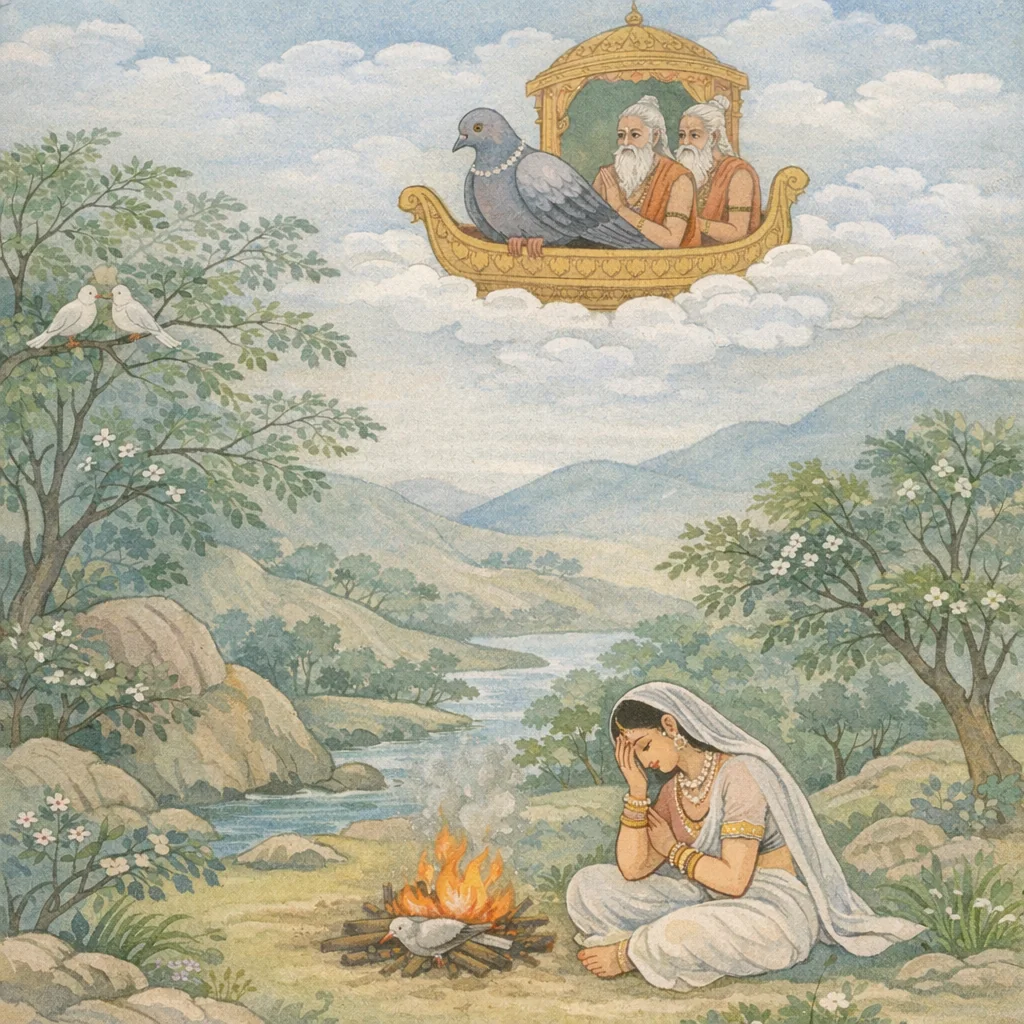
Chapter Arc: Bhishma begins a poignant exemplum: after Shakuni departs, the tale turns to a devoted dove-couple, and the wife’s voice rises in grief as separation strikes the household of love. → The kapotī (dove-wife) recalls her husband’s unwavering tenderness—sweet words, shared play on lovely treetops, even joyous flights through the sky—then confronts the stark truth that for a woman the husband is refuge, joy, and protection; without him, wealth and life feel emptied. → Unable to endure widowhood, the pativratā declares that no truly devoted wife can wish to live without her lord and, after heart-rending lament, enters the blazing fire (hutāśana) in an act of final fidelity. → Beyond the flames, she beholds her husband radiant on a celestial vimāna, adorned and honored among the meritorious; reunited, the pair attain svarga, the narrative sealing their devotion with a transcendent reward.
Shlokas
Verse 1
#.००3८६>- हज है अष्टचत्वारिशर्दाधिकशततमो< ध्याय: कबूतरीका विलाप और अन्निमें प्रवेश तथा उन दोनोंको स्वर्गलोककी प्राप्ति भीष्म उवाच ततो गते शाकुनिके कपोती प्राह दुःखिता । संस्मृत्य सा च भर्तारें रुवती शोककर्शिता,भीष्मजी कहते हैं--युधिष्ठिर! उस बहेलियेके चले जानेपर कबूतरी अपने पतिका स्मरण करके शोकसे कातर हो उठी और दुःखमग्न हो रोती हुई विलाप करने लगी
Bhishma said: When the fowler had gone away, the she-dove, overwhelmed with sorrow, began to lament. Remembering her husband, she wept, her body and mind worn down by grief.
Verse 2
नाहं ते विप्रियं कान्त कदाचिदपि संस्मरे | सर्वापि विधवा नारी बहुपुत्रापि शोचते
Bhīṣma said: “Beloved, I do not recall ever having done anything displeasing to you. Yet every widow, even if she has many sons, still grieves.”
Verse 3
'प्रियतम! आपने कभी मेरा अप्रिय किया हो, इसका मुझे स्मरण नहीं है। सारी स्त्रियाँ अनेक पुत्रोंसे युक्त होनेपर भी पतिहीन होनेपर शोकमें डूब जाती हैं ।। शोच्या भवति बन्धूनां पतिहीना तपस्विनी । लालिताहं त्वया नित्यं बहुमानाच्च पूजिता,“पतिहीन तपस्विनी नारी अपने भाई-बन्धुओंके लिये भी शोचनीय बन जाती है। आपने सदा ही मेरा लाड-प्यार किया और बड़े सम्मानके साथ मुझे आदरपूर्वक रक््खा
Bhishma said: “Beloved, I do not recall that you have ever done anything displeasing to me. Even when a woman has many sons, if she is without a husband she sinks into grief. A husbandless, austere woman becomes an object of pity even to her own kinsmen. You have always cherished me, and out of deep respect you have honored me and kept me with due reverence.”
Verse 4
वर्चनैर्मधुरै: स्निग्धैरसंक्लिष्टमनोहरै: । कन्दरेषु च शैलानां नदीनां निर्झरिषु च,“आपने स्नेहसिक्त, सुखद, मनोहर, तथा मधुर वचनोंद्वारा मुझे आनन्दित किया। मैंने आपके साथ पर्वतोंकी गुफाओंमें नदियोंके तटोंपर, झरनोंके आस-पास तथा वृक्षोंकी सुरम्य शिखाओंपर रमण किया है। आकाशयात्रामें भी मैं सदा आपके साथ सुखपूर्वक विचरण करती रही हूँ
Bhishma said: “With your sweet, affectionate, and untroubled, delightful words you gladdened me. I have roamed with you in the mountain caves and along the rivers, and near their cascading springs.”
Verse 5
ट्रुमाग्रेषु च रम्येषु रमिताहं त्वया सह । आकाशगमने चैव विहृताहं त्वया सुखम्,“आपने स्नेहसिक्त, सुखद, मनोहर, तथा मधुर वचनोंद्वारा मुझे आनन्दित किया। मैंने आपके साथ पर्वतोंकी गुफाओंमें नदियोंके तटोंपर, झरनोंके आस-पास तथा वृक्षोंकी सुरम्य शिखाओंपर रमण किया है। आकाशयात्रामें भी मैं सदा आपके साथ सुखपूर्वक विचरण करती रही हूँ
Bhishma said: “With you I have delighted in lovely places—upon the beautiful tops of trees—and I have enjoyed myself in happiness with you even in journeys through the sky.”
Verse 6
रमामि सम पुरा कान्त तन्मे नास्त्यद्य किज्चन । मितं ददाति हि पिता मितं भ्राता मितं सुत:
Bhishma said: “Beloved, once I lived in comfort and contentment; today I have nothing at all. My father gives only a little, my brother only a little, and my son only a little.”
Verse 7
अमितस्य हि दातारं भर्तारं का न पूजयेत् । 'प्राणनाथ! पहले मैं जिस प्रकार आपके साथ आनन्दपूर्वक रमण करती थी, अब उन सब सुखोंमेंसे कुछ भी मेरे लिये शेष नहीं रह गया है। पिता, भ्राता और पुत्र--ये सब लोग नारीको परिमित सुख देते हैं, केवल पति ही उसे अपरिमित या असीम सुख प्रदान करता है। ऐसे पतिकी कौन स्त्री पूजा नहीं करेगी? ।। नास्ति भर्तसमो नाथो नास्ति भर्त्समं सुखम्
Bhishma said: “Who would not honor a husband who is an inexhaustible giver and sustainer? There is no protector equal to one’s husband, and no happiness equal to that which comes through the husband.”
Verse 8
विसृज्य धनसर्वस्वं भर्ता वै शरणं स्त्रिया: । 'सत्रीके लिये पतिके समान कोई रक्षक नहीं है और पतिके तुल्य कोई सुख नहीं है। उसके लिये तो धन और सर्वस्वको त्यागकर पति ही एकमात्र गति है ।। न कार्यमिह मे नाथ जीवितेन त्वया विना
Bhīṣma said: “Casting aside wealth and all possessions, a woman’s true refuge is her husband. O lord, without you, life itself has no purpose for me in this world.”
Verse 9
एवं विलप्य बहुधा करुणं सा सुदु:ःखिता
Bhishma said: Having lamented in many ways with piteous cries, she remained overwhelmed by intense sorrow—her grief pouring out repeatedly in a manner that evokes compassion and underscores the human cost of suffering.
Verse 10
तततद्रित्राड़दधरं भर्तारें सान्वपश्यत
Bhīṣma said: “Then, in that very manner, she beheld her lord—the bearer of the thunderbolt—standing close by.”
Verse 11
चित्रमाल्याम्बरधरं सर्वाभरणभूषितम्
Bhīṣma said: “(He was) clad in a garment and garlands of variegated beauty, and adorned with every kind of ornament.”
Verse 12
विमानशतकोटीभिरावृतं पुण्यकर्मभि: । उसने विचित्र हार और वस्त्र धारण कर रकक््खे थे और वह सब प्रकारके आभूषणोंसे विभूषित था। अरबों पुण्यकर्मी पुरुषोंसे युक्त विमानोंने उसे घेर रक्खा था ।। ततः स्वर्ग गत: पक्षी विमानवरमास्थित: । कर्मणा पूजितत्तत्र रेमे स सह भार्यया,इस प्रकार श्रेष्ठ विमानपर बैठा हुआ वह पक्षी अपनी स्त्रीके सहित स्वर्गलोकको चला गया और अपने सत्कर्मसे पूजित हो वहाँ आनन्दपूर्वक रहने लगा
Bhishma said: Surrounded by hundreds of crores of celestial chariots filled with meritorious beings, the bird then ascended to heaven, seated upon an excellent aerial car. Honoured there for the virtue of his deeds, he lived joyfully in that world together with his wife.
Verse 86
पतिहीना तु का नारी सती जीवितुमुत्सहेत् । “नाथ! अब तुम्हारे बिना यहाँ इस जीवनसे भी क्या प्रयोजन है? ऐसी कौन सी पतिव्रता स्त्री होगी, जो पतिके बिना जीवित रह सकेगी?
Bhīṣma said: “What virtuous woman, bereft of her husband, could still bring herself to go on living? In the pativratā ideal, the husband is held to be her chief support and purpose; thus widowhood is cast as an ethical and emotional crisis within that value-world.”
Verse 93
पतिव्रता सम्प्रदीप्तं प्रविवेश हुताशनम् | इस तरह अनेक प्रकारसे करुणाजनक विलाप करके अत्यन्त दु:खमें डूबी हुई वह पतिव्रता कबूतरी उसी प्रज्वलित अग्निमें समा गयी
Bhīṣma said: “The devoted wife-bird, overwhelmed by grief and after uttering many heart-rending laments, entered the blazing fire and was consumed by it—thus displaying the extreme ideal of wifely fidelity (pativratā-dharma), even at the cost of her own life.”
Verse 103
विमानस्थं सुकृतिभि: पूज्यमानं महात्मभि: । तदनन्तर उसने अपने पतिको देखा। वह विचित्र अंगद धारण किये विमानपर बैठा था और बहुत-से पुण्यात्मा महात्मा उसकी भूरि-भूरि प्रशंसा कर रहे थे
Bhīṣma said: “Then she beheld her husband. Seated in a celestial chariot and adorned with wondrous armlets, he was being honored by the meritorious and revered by great-souled men, who praised him again and again.”
Verse 148
इति श्रीमहाभारते शान्तिपर्वणि आपद्धर्मपर्वणि कपोतस्वर्गगमने अष्टचत्वारिंशदिधिकशततमो< ध्याय:,इस प्रकार श्रीमह्याभारत शान्तिपर्वके अन्तर्गत आपद्धर्मपर्वमें कबृतरका स्वर्गगमनविषयक एक सौ अड़तालीसवाँ अध्याय पूरा हुआ
Thus, in the Śrī Mahābhārata, within the Śānti Parva—specifically the section on conduct in times of distress (Āpaddharma)—the one-hundred-and-forty-eighth chapter, concerning the dove’s ascent to heaven, comes to an end. The colophon signals the closure of the moral exemplum: steadfast compassion and self-sacrifice, upheld even under extreme hardship, are affirmed as dharma-bearing and heaven-leading.
Frequently Asked Questions
Whether mourning should prolong attachment to an irreversible loss or be transformed into disciplined acceptance and ethical action—tested through competing counsel that alternately intensifies or restrains grief.
The text juxtaposes consolation by impermanence and karma with the psychology of attachment, finally endorsing perseverance and firm resolve as practical virtues that can coexist with compassion while preventing paralysis by grief.
Yes. The concluding verses characterize the narrative as auspicious and aligned with dharma–artha–mokṣa, stating that one who hears it regularly rejoices in this world and after death, functioning as an explicit benefit-claim for reception and retention.