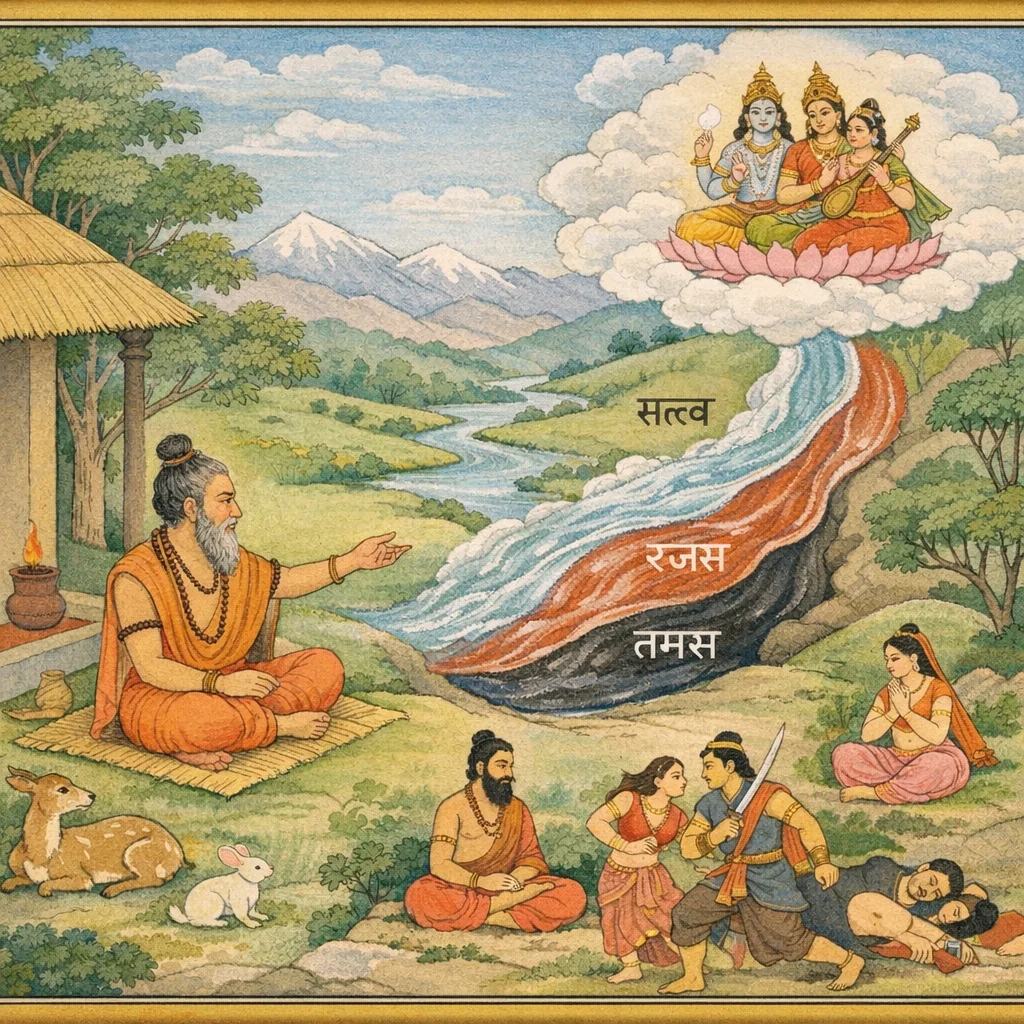
Adhyaya 39
Adhyāya 39 — त्रिगुणविवेकः (Discrimination of the Three Guṇas) and Avyakta-Doctrine
Upa-parva: Guṇa–Prakṛti Upadeśa (Discourse on the Three Guṇas and the Avyakta) — within Āśvamedhika Parva
Brahmā explains that sattva, rajas, and tamas cannot be cleanly described as fully separable entities, since they appear continuous and mutually entangled (anyonyānuṣaṅga). Their interaction produces graded dominance (udreka) and diminution (vyatireka), yielding observable tendencies: tamas-dominance corresponds to downward or inert orientations; rajas-dominance to middling, agitative striving; sattva-dominance to upward, clarifying orientation. The discourse presents illustrative analogies (sunlight as sattva/illumination; distress/heat as rajas; obscuring disturbance as tamas) and extends guṇa-analysis to cosmological and temporal triads (day/night divisions, gifts, sacrifice, worlds, Vedas, knowledges, destinies). It culminates in an avyakta/prakṛti account: the unmanifest is described as tri-guṇic, stable, and the ground of manifestation and dissolution (prabhava–apyaya, pralaya). The chapter closes with a soteriological claim: one who knows the guṇas and the unmanifest “in truth,” discerning their names and functions, becomes released from guṇa-binding and attains a condition described as free from affliction.
Chapter Arc: गुरु शिष्य को जगत् के सूक्ष्म ताने-बाने की ओर ले जाता है—तीन गुणों (सत्त्व, रजस्, तमस्) को पृथक्-पृथक् पूरी तरह कहना कठिन है, क्योंकि वे सदा एक-दूसरे में गुंथे हैं। → वक्ता बताता है कि सभी प्राणी और पदार्थ परस्पर-आश्रित हैं; गुण एक-दूसरे को रंगते, पोषित करते और चलाते हैं। यह उलझन गहराती है कि जब सब कुछ त्रिगुणात्मक है, तो स्थिर सत्य और मुक्ति का मार्ग कहाँ है। → निर्णायक प्रतिपादन होता है: जहाँ सत्त्व रहता है वहाँ रजस् भी रहता है; जहाँ तमस् है वहाँ सत्त्व-रजस् भी किसी न किसी रूप में उपस्थित हैं—तीनों गुण संघात की तरह साथ चलते हैं, कारण से भी और बिना कारण भी। → गुरु गुणों की ‘पर्याय-परिवर्तन’ की व्यवस्था बताता है—लोक में जो कुछ है वह इन्हीं तीन गुणों के भिन्न-भिन्न अनुपातों से प्रकट होता है; ऊर्ध्वस्रोत (देव-योनियाँ) में सत्त्व की अधिकता, अन्यत्र रजस्-तमस् की छाया। प्रकृति के नामों/अवस्थाओं (अव्यक्त आदि) का संकेत देकर अध्यात्मचिन्तक के लिए वर्गीकरण स्थिर किया जाता है।
Shlokas
Verse 1
ऑपनआ कराता बछ। 5 एकोनचत्वारिशोड् ध्याय: सत्त्व आदि गुणोंका और प्रकृतिके नामोंका वर्णन ब्रह्मोवाच नैव शक््या गुणा वक्तुं पृथक्त्वेनैव सर्वश: । अविच्छिन्नानि दृश्यन्ते रज: सत्त्वं तमस्तथा,ब्रह्माजीने कहा--महर्षियो! सत्त्व, रज और तम--इन गुणोंका सर्वथा पृथक्रूपसे वर्णन करना असम्भव है; क्योंकि ये तीनों गुण अविच्छिन्न (मिले हुए) देखे जाते हैं
Brahmā said: “O sages, it is not truly possible to describe the guṇas—sattva, rajas, and tamas—completely as separate and isolated from one another. For in lived experience they are seen as continuous and intermingled, with rajas, sattva, and tamas appearing together.”
Verse 2
अन्योन्यमथ रज्यन्ते हान्योन्यं चार्थजीविन: । अन्योन्यमाश्रया: सर्वे तथान्योन्यानुवर्तिन:,ये सभी परस्पर रँँगे हुए, एक-दूसरेसे अनुप्राणित, अन्योन्याश्रित तथा एक-दूसरेका अनुसरण करनेवाले हैं
Vāyu said: “They are mutually attached and take delight in one another; they live for one another’s welfare and support. All of them depend upon one another, and likewise they follow one another’s lead.”
Verse 3
यावत्सत्त्वं रजस्तावद् वर्तते नात्र संशय: । यावत्तमश्न सत्त्वं च रजस्तावदिहोच्यते,इसमें संदेह नहीं कि इस जगत्में जबतक सत्त्वनुण रहता है, तबतक रजोगुण भी रहता है एवं जबतक तमोगुण रहता है, तबतक सत्त्वमुण और रजोगुणकी भी सत्ता रहती है, ऐसा कहते हैं
Vāyu said: “So long as sattva endures, rajas also operates—of this there is no doubt. And so long as tamas persists, sattva and rajas too are said to be present in this world.”
Verse 4
संहत्य कुर्वते यात्रां सहिता: संघचारिण: । संघातवृत्तयो होते वर्तन्ते हेत्वहेतुभि:,ये गुण किसी निमित्तसे अथवा बिना निमित्तके भी सदा साथ रहते हैं, साथ-ही-साथ विचरते हैं, समूह बनाकर यात्रा करते हैं और संघात (शरीर)-में मौजूद रहते हैं
Vāyu said: “Moving in close union, they undertake their journey together—companions who live and move as a group. Their very mode of existence is bound up with the aggregate (the embodied complex), and they continue to function—sometimes with an evident cause, and sometimes even without any apparent cause.”
Verse 5
उद्रेकव्यतिरिक्तानां तेषामन्योन्यवर्तिनाम् वक्ष्यते तद् यथा न्यूनं व्यतिरिक्तं च सर्वश:,ऐसा होनेपर भी कहीं तो इन उन्नति और अवनतिके स्वभाववाले तथा एक-दूसरेका अनुसरण करनेवाले गुणोंमेंसे किसीकी न््यूनता देखी जाती है और कहीं अधिकता। सो किस प्रकार? यह बताया जाता है
Vāyu-deva said: “Among these qualities—whose nature is to rise and fall and which operate by following one another—one is nevertheless seen to be deficient in some cases and excessive in others. How does this occur? That will now be explained in full.”
Verse 6
व्यतिरिक्तं तमो यत्र तिर्यगू भावगतं भवेत् | अल्पं तत्र रजो ज्ञेयं सत्त्वमल्पतरं तथा,तिर्यग् योनियोंमें जहाँ तमोगुणकी अधिकता होती है, वहाँ थोड़ा रजोगुण और बहुत थोड़ा सत्त्गगुण समझना चाहिये
Vāyu said: “Where, among the animal modes of existence, darkness (tamas) predominates and stands apart as the chief quality, there one should understand passion (rajas) to be only slight, and goodness (sattva) to be slighter still.”
Verse 7
उद्रिक्तं च रजो यत्र मध्यस्रोतोगतं भवेत् । अल्पं तत्र तमो ज्ञेयं सत््वमल्पतरं तथा,मध्यस्रोता अर्थात् मनुष्ययोनिमें, जहाँ रजोगुणकी मात्रा अधिक होती है, वहाँ थोड़ा तमोगुण और बहुत थोड़ा सत्त्गगुण समझना चाहिये
Vāyu said: “In that state of existence which is called the ‘middle current’—the human condition—where the quality of passion (rajas) predominates, one should understand that darkness and inertia (tamas) are present only in a small measure, and clarity and harmony (sattva) in an even smaller measure.”
Verse 8
उद्रिक्त च यदा सत्त्वमूर्ध्वस्रोतोगतं भवेत् । अल्पं तत्र तमो ज्ञेयं रजश्नाल्पतरं तथा,इसी प्रकार ऊर्ध्वस्रोता यानी देवयोनियोंमें जहाँ सत्त्वनुणकी वृद्धि होती है, वहाँ तमोगुण अल्प और रजोगुण अल्पतर जानना चाहिये
Vāyu-deva said: “When the quality of sattva becomes predominant and rises into the ‘upward-flowing’ course—i.e., the higher destinies such as the divine realms—then know that tamas is present there only in a small measure, and rajas in an even smaller measure.”
Verse 9
सत्त्वं वैकारिकी योनिरिन्द्रियाणां प्रकाशिका । न हि सत्त्वातू परो धर्म: कश्चिदन्यो विधीयते,सत्त्वगुण इन्द्रियोंकी उत्पत्तिका कारण है, उसे वैकारिक हेतु मानते हैं। वह इन्द्रियों और उनके विषयोंको प्रकाशित करनेवाला है। सत्त्वमुणसे बढ़कर दूसरा कोई धर्म नहीं बताया गया है
Vāyu said: “Sattva is the transformative (vaikārika) source from which the senses arise; it illumines the senses and makes their objects manifest. Indeed, no other dharma is enjoined as higher than sattva.”
Verse 10
ऊर्ध्व॑ गच्छन्ति सत्त्वस्था मध्ये तिष्ठन्ति राजसा: । जघन्यगुणसंयुक्ता यान्त्यधस्तामसा जना:,सत्त्वगुणमें स्थित पुरुष स्वर्गादि उच्च लोकोंको जाते हैं, रजोगुणमें स्थित पुरुष मध्यमें अर्थात् मनुष्यलोकमें ही रहते हैं और तमोगुणके कार्यरूप निद्रा, प्रमाद एवं आलस्य आदिकमें स्थित हुए तामस मनुष्य अधोगतिको प्राप्त होते--नीच योनियों अथवा नरकोंमें पड़ते हैं
Vāyu said: “Those established in sattva rise upward to higher realms; those dominated by rajas remain in the middle, in the human condition; but people bound to the lowest quality—tamas—fall downward, reaching inferior destinies such as lower births or hellish states.”
Verse 11
तम: शूद्रे रज: क्षत्रे ब्राह्मणे सत्त्वमुत्तमम् । इत्येवं त्रिषु वर्णेषु विवर्तन्ते गुणास्त्रय:,शूद्रमें तमोगुणकी, क्षत्रियमें रजोगुणकी और ब्राह्मणमें सत्त्वगुणकी प्रधानता होती है। इस प्रकार इन तीन वर्णोमें मुख्यतासे ये तीन गुण रहते हैं
Vāyu said: “Darkness and inertia (tamas) predominates in the śūdra; passion and drive (rajas) in the kṣatriya; and the highest clarity and balance (sattva) in the brāhmaṇa. Thus, among these three social orders, the three guṇas are seen to manifest in their characteristic ways.”
Verse 12
दूरादपि हि दृश्यन्ते सहिता: संघचारिण: । तमः सत्त्वं रजश्चैव पृथक्त्वे नानुशुश्रुम,एक साथ चलनेवाले ये गुण दूरसे भी मिले हुए ही दिखायी पड़ते हैं। तमोगुण, सत्त्गगुण और रजोगुण--ये सर्वथा पृथक्-पृथक् हों, ऐसा कभी नहीं सुना
“Even from afar, these qualities appear as if bound together, moving in a single company. We have never heard that tamas, sattva, and rajas exist in a state of complete separation from one another.”
Verse 13
दृष्टवा त्वादित्यमुद्यन्तं कुचराणां भयं भवेत् | अध्वगा: परितप्येयुरुष्णतो दुःखभागिन:,सूर्यको उदित हुआ देखकर दुराचारी मनुष्योंको भय होता है और धूपसे दुःखित राहगीर संतप्त होते हैं
Seeing the Sun rise, fear arises in those who move in crooked ways; and travelers on the road, scorched by the heat, are afflicted and become sharers in suffering. Thus the same sunrise becomes a moral warning to the wicked and a physical trial to the weary.
Verse 14
आदित्य: सन्त्वमुद्रिक्त कुचरास्तु तथा तम: । परितापो5थध्वगानां च रजसो गुण उच्यते,क्योंकि सूर्य सत्त्वगुण प्रधान हैं, दुराचारी मनुष्य तमोगुण प्रधान हैं एवं राहगीरोंको होनेवाला संताप रजोगुण प्रधान कहा गया है
Vāyu said: “The Sun is predominantly endowed with sattva. Those who are of wicked conduct are said to be dominated by tamas. And the wearying heat and distress experienced by travellers on the road is described as a manifestation of rajas.”
Verse 15
प्राकाश्यं सत्त्वमादित्य: संतापो रजसो गुण: । उपप्लवस्तु विज्ञेयस्तामसस्तस्य पर्वसु,सूर्यका प्रकाश सत्त्वनुण है, उनका ताप रजोगुण है और अमावास्याके दिन जो उनपर ग्रहण लगता है, वह तमोगुणका कार्य है
Vāyu said: “The Sun’s radiance is to be understood as the quality of sattva; its burning heat is a manifestation of rajas. But the disturbance that occurs to it at its junctions (such as on the new-moon day, when an eclipse is seen) should be known as the effect of tamas.”
Verse 16
एवं ज्योतिष्षु सर्वेषु निवर्तन्ते गुणास्त्रय: । पर्यायेण च वर्तन्ते तत्र तत्र तथा तथा,इस प्रकार सभी ज्योतियोंमें तीनों गुण क्रमश: वहाँ-वहाँ उस-उस प्रकारसे प्रकट होते और विलीन होते रहते हैं
Thus, in all luminous bodies, the three guṇas repeatedly subside and reappear—taking their turns and manifesting in each place in its own particular way. The teaching is that even what seems steady and radiant is governed by cyclical change in nature, so one should discern the play of qualities rather than mistake it for an unchanging self.
Verse 17
स्थावरेषु तु भावेषु तिर्यग्भावगतं तम: । राजसास्तु विवर्तन्ते स्नेहभावस्तु सात््चिक:,स्थावर प्राणियोंमें तमोगुण अधिक होता है, उनमें जो बढ़नेकी क्रिया है वह राजस है और जो चिकनापन है, वह सात्त्विक है
Vāyu said: “Among beings in the immobile condition, darkness (tamas) predominates. The impulse by which they grow and develop is of rajas, while the quality of unctuousness—cohesion and smooth nourishment—is sāttvika. Thus even in the lowest or most inert states of life, the three guṇas operate in distinct functions, and one should discern their workings rather than judge merely by outward form.”
Verse 18
अहस्त्रिधा तु विज्ञेयं त्रिधा रात्रिविधीयते । मासार्धमासवर्षाणि ऋतव: संधयस्तथा,गुणोंके भेदसे दिनको भी तीन प्रकारका समझना चाहिये। रात भी तीन प्रकारकी होती है तथा मास, पक्ष, वर्ष, ऋतु और संध्याके भी तीन-तीन भेद होते हैं
Vāyu said: “Time should be understood as having threefold divisions: the day is to be known in three ways, and the night too is arranged in three ways. Likewise, the month, the half-month (fortnight), the year, the seasons, and the junctions (twilights) are each spoken of as having threefold distinctions.”
Verse 19
त्रिधा दानानि दीयन्ते त्रिधा यज्ञ: प्रवर्तते । त्रिधा लोकास्त्रिधा देवास्त्रिधा विद्यास्त्रिधा गति:,गुणोंके भेदसे तीन प्रकारसे दान दिये जाते हैं। तीन प्रकारका यज्ञानुष्ठान होता है। लोक, देव, विद्या और गति भी तीन-तीन प्रकारकी होती है
Vāyu-deva said: “Gifts are given in three distinct ways, and sacrifice (yajña) too is undertaken in three ways. Likewise, worlds are threefold, the gods are threefold, knowledge is threefold, and the soul’s course and attainment (gati) is also threefold.”
Verse 20
भूतं भव्यं भविष्यं च धर्मोडर्थ: काम एव च | प्राणापानावुदान श्चाप्येत एव त्रयो गुणा:,भूत, वर्तमान, भविष्य, धर्म, अर्थ, काम, प्राण, अपान और उदान-ये सब त्रिगुणात्मक ही हैं
Vāyu-deva said: “Past, present, and future; and likewise dharma, artha, and kāma; and also the vital currents—prāṇa, apāna, and udāna—all these are, in truth, constituted by the three guṇas.”
Verse 21
पर्यायेण प्रवर्तन्ते तत्र तत्र तथा तथा । यत्किंचिदिह लोके5स्मिन् सर्वमेते त्रयो गुणा:,इस जगत्में जो कोई भी वस्तु भिन्न-भिन्न स्थानोंमें भिन्न-भिन्न प्रकारसे उपलब्ध होती है, वह सब त्रिगुणमय है
Vāyu said: “In due succession they operate—here and there, in this way and that. Whatever exists in this world, in any form and in any place, is entirely constituted by these three guṇas.”
Verse 22
त्रयो गुणा: प्रवर्तन्ते हुव्यक्ता नित्यमेव तु । सत्त्वं रजस्तमश्नैव गुणसर्ग: सनातन:,सर्वत्र तीनों गुणोंकी ही सत्ता है। ये तीनों अव्यक्त और प्रवाहरूपसे नित्य भी हैं। सत्त्व, रज और तम--इन गुणोंकी सृष्टि सनातन है
Vāyu said: “Everywhere, the three guṇas are at work. Though unmanifest, they flow on eternally. Sattva, rajas, and tamas—this origination and interplay of the guṇas is beginningless and everlasting.”
Verse 23
तमो व्यक्त शिवं धाम रजो योनि: सनातन: । प्रकृतिर्विकार: प्रलय: प्रधानं प्रभवाप्ययौ,प्रकृतिको तम, व्यकत, शिव, धाम, रज, योनि, सनातन, प्रकृति, विकार, प्रलय, प्रधान प्रभव, अप्यय, अनुद्रिक्त, अनून, अकम्प, अचल, ध्रुव, सत, असत्ू, अव्यक्त और त्रिगुणात्मक कहते हैं। अध्यात्मतत्त्वका चिन्तन करनेवाले लोगोंको इन नामोंका ज्ञान प्राप्त करना चाहिये
Vāyu-deva said: “That supreme principle is spoken of by many names: as Darkness (tamas), as the Manifest (vyakta), as the Auspicious (śiva), as the Abode (dhāma); as Passion (rajas), as the Eternal Womb or Source (yoniḥ sanātanaḥ); as Nature (prakṛti), as Transformation (vikāra), as Dissolution (pralaya), as the Primal Ground (pradhāna), and as both Origin and Return (prabhava and apyaya). Those who contemplate the truth of the Self should learn and recognize these designations.”
Verse 24
अनुद्रिक्तमनूनं वाप्पकम्पमचलं ध्रुवम् | सदसच्चैव तत् सर्वमव्यक्तं त्रिगुणा स्मृतम् । ज्ञेयानि नामधेयानि नरैरध्यात्मचिन्तकै:,प्रकृतिको तम, व्यकत, शिव, धाम, रज, योनि, सनातन, प्रकृति, विकार, प्रलय, प्रधान प्रभव, अप्यय, अनुद्रिक्त, अनून, अकम्प, अचल, ध्रुव, सत, असत्ू, अव्यक्त और त्रिगुणात्मक कहते हैं। अध्यात्मतत्त्वका चिन्तन करनेवाले लोगोंको इन नामोंका ज्ञान प्राप्त करना चाहिये
Vāyudeva said: “That principle is unagitated, not deficient, unshaken, unmoving, and steadfast. It is spoken of as encompassing both the existent and the non-existent; it is the Unmanifest (Avyakta), remembered as constituted of the three guṇas. Those who contemplate the truth of the Self should understand its many appellations—such as Prakṛti, Darkness (tamas), the Manifest (vyakta), Śiva, Abode (dhāma), Passion (rajas), Womb/Source (yoni), the Eternal (sanātana), Prakṛti, Modification (vikāra), Dissolution (pralaya), the Primal Ground (pradhāna), Origination (prabhava), Reabsorption (apyaya), Unagitated, Not-deficient, Unshaken, Unmoving, Steadfast, Existent (sat), Non-existent (asat), Unmanifest, and Three-guṇa-formed.”
Verse 25
अव्यक्तनामानि गुणांश्व तत्त्वतो यो वेद सर्वाणि गतीक्ष केवला: । विमुक्तदेह: प्रविभागतत्त्ववित् स मुच्यते सर्वगुणै्निरामय:,जो मनुष्य प्रकृतिके इन नामों, सत्त्वादि गुणों और सम्पूर्ण विशुद्ध गतियोंको ठीक-ठीक जानता है, वह गुण-विभागके तत्त्वका ज्ञाता है। उसके ऊपर सांसारिक दु:खोंका प्रभाव नहीं पड़ता। वह देह-त्यागके पश्चात् सम्पूर्ण गुणोंके बन्धनसे छुटकारा पा जाता है
Vāyu said: One who truly understands, as they are in reality, the guṇas whose names are subtle and unmanifest, and who also knows the pure courses of existence, becomes a knower of the principle by which the guṇas are distinguished and apportioned. Such a person is not overpowered by worldly sorrow; and after casting off the body, he is released from the bondage of all guṇas, abiding free from affliction.
Verse 38
इस प्रकार श्रीमह्याभारत आश्वमेधिकपव॑के अन्तर्गत अनुगीतापर्वनें गुरु-शिष्य- संवादविषयक अड़तीसवाँ अध्याय पूरा हुआ
Thus ends the thirty-eighth chapter, which treats the dialogue between teacher and disciple, within the Anugītā section contained in the Aśvamedhika Parva of the revered Mahābhārata.
Verse 39
इति श्रीमहाभारते आश्वमेधिके पर्वणि अनुगीतापर्वणि गुरुशिष्यसंवादे एकोनचत्वारिंशो5ध्याय:
Thus, in the Śrī Mahābhārata, within the Aśvamedhika Parva—specifically the Anugītā section—ends the teacher–disciple dialogue, concluding the thirty-ninth chapter.
Frequently Asked Questions
How to explain observable differences in behavior, perception, and destiny without treating sattva, rajas, and tamas as isolated substances—answering via their continuous intermixture and variable dominance.
Cultivate discriminative awareness of one’s guṇa-patterns: reduce tamasic inertia and confusion, regulate rajasic agitation, and stabilize sattvic clarity to orient conduct toward higher gati and insight.
Yes. The chapter states that one who truly knows the guṇas and the avyakta/prakṛti framework, with correct discrimination of their functions and names, becomes freed from guṇa-bondage and attains a non-afflicted liberated condition.