Adhyaya 37
Devadāru (Dāruvana) Forest: The Delusion of Ritual Pride, the Liṅga Crisis, and the Teaching of Jñāna–Pāśupata Yoga
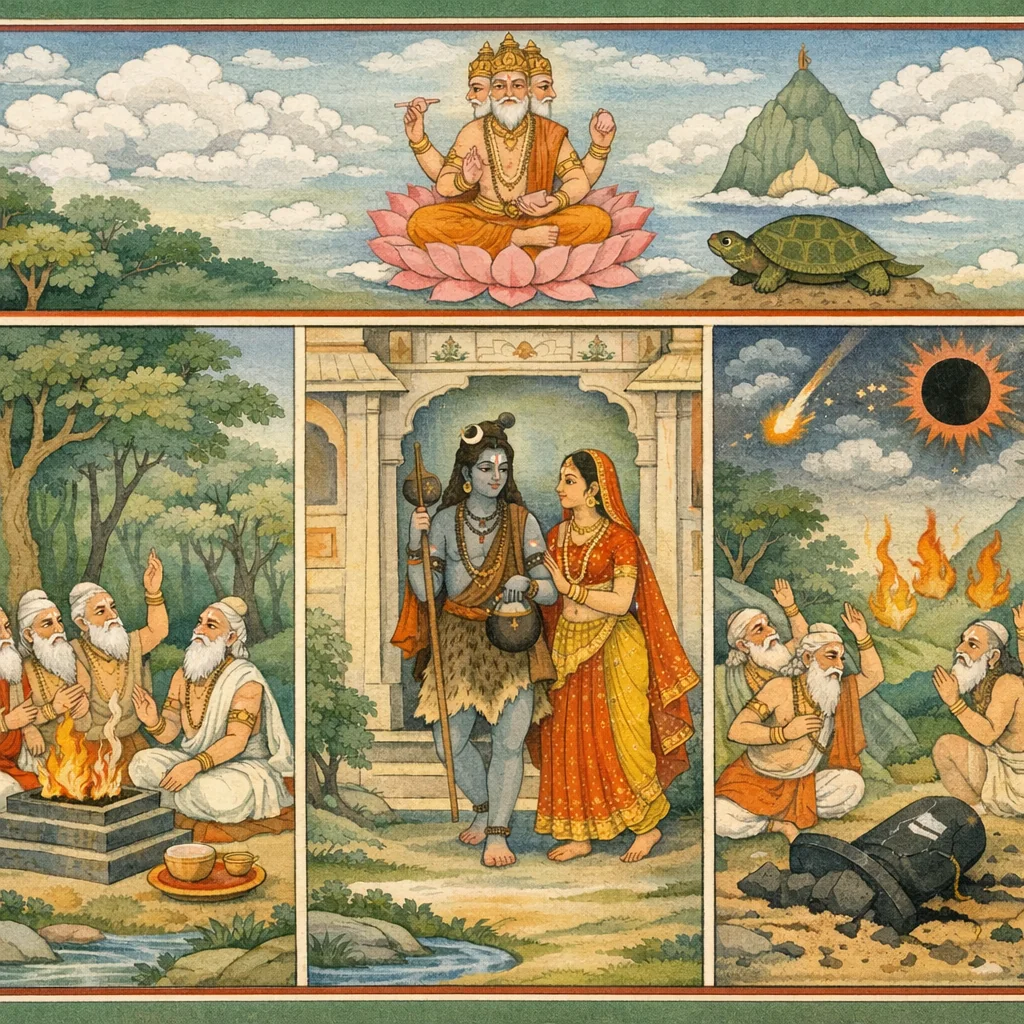
In reply to the sages’ question, Sūta recounts how Śiva, accompanied by Viṣṇu in a feminine guise, enters the Devadāru/Dāruvana forest to expose the sages’ attachment to outward ritual action and ascetic pride. Their households are thrown into delusion; the enraged sages curse Śiva as a naked mendicant, leading to the shocking fall/tearing away of the liṅga and ominous cosmic signs. Terrified, they approach Brahmā, who identifies the visitor as Mahādeva and teaches a non-sectarian vision: Rudra pervades the three guṇas as Agni/Brahmā/Viṣṇu, and the consort is revealed as Nārāyaṇa—affirming Śaiva–Vaiṣṇava unity. Brahmā prescribes restoration by fashioning and worshipping a liṅga, reciting the Śatarudrīya, and chanting Vedic Śaiva mantras. Śiva returns with the Goddess; the sages offer long hymns, receive a theophany, and ask for an enduring path of worship. Śiva then teaches the hierarchy of means: Yoga is incomplete without pure knowledge (jñāna); Sāṃkhya joined with Yoga grants liberation; and the secret Pāśupata vow is bestowed for those devoted to jñāna-yoga. The chapter ends with continued contemplative inquiry, the Goddess’ blazing manifestation, realization of Śiva–Śakti unity, and the promise of merit for recitation, leading into further adhyātma instruction on liberating practice.
Shlokas
Verse 1
इती श्रीकूर्मपुराणे षट्साहस्त्र्यां संहितायामुपरिविभागे षट्त्रिशो ऽध्यायः ऋषय ऊचुः कथं दारुवनं प्राप्तो भगवान् गोवृषध्वजः / मोहयामास विप्रेन्द्रान् सूत वक्तुमिहार्हसि
The sages said: “How did the Blessed Lord—whose banner bears the bull—come to the Daru Forest? And how did he bewilder the foremost of brāhmaṇas there? O Sūta, you ought to tell us here.”
Verse 2
सूत उवाच पुरा दारुवन् रम्ये देवसिद्धनिषेविते / सपुत्रदारा मुनयस्तपश्चेरुः सहस्रशः
Sūta said: Long ago, in the delightful Daruvana forest, frequented by gods and perfected beings, thousands of sages—together with their sons and wives—performed austerities.
Verse 3
प्रवृत्तं विविधं कर्म प्रकुर्वाणा यथाविधि / यजन्ति विविधैर्यज्ञैस्तपन्ति च महर्षयः
Engaged in the manifold duties of action, performing them according to rule, the great sages worship through various sacrifices and also practice austerity.
Verse 4
तेषां प्रवृत्तिविन्यस्तचेतसामथ शूलधृक् / ख्यापयन् स महादोषं ययौ दारुवनं हरः
Then Hara, the bearer of the trident, seeing that their minds were fixed on outward activity, set out for the Daru forest to expose to them their great fault.
Verse 5
कृत्वा विश्वगुरुं विष्णुं पार्श्वे देवो महेश्वरः / ययौ निवृत्तविज्ञानस्थापनार्थं च शङ्करः
Having placed Vishnu—the World-Teacher—at his side, the Lord Maheshvara (Shiva) set forth; and Shankara went with the purpose of establishing the wisdom of renunciation (nivṛtti-jñāna).
Verse 6
आस्थाय विपुलं वेशमूनविंशतिवत्सरः / लीलालसो महाबाहुः पीनाङ्गश्चारुलोचनः
Assuming a splendid attire, he appeared as a youth not yet twenty years of age—playful in demeanor, mighty-armed, broad-limbed and well-built, with beautiful eyes.
Verse 7
चामीकरवपुः श्रीमान् पूर्णचन्द्रनिभाननः / मत्तमातङ्गगामनो दिग्वासा जगदीश्वरः
Golden-bodied and radiant with auspicious splendor, his face like the full moon; moving with the majestic gait of an intoxicated elephant—clad in the quarters themselves—he is the Lord of the universe.
Verse 8
कुशेशयमयीं मालं सर्वरत्नैरलङ्कृताम् / दधानो भगवानीशः समागच्छति सस्मितः
Bearing a garland made of lotus-flowers, adorned with every kind of jewel, the Blessed Lord—Īśa Himself—approached, smiling gently.
Verse 9
यो ऽनन्तः पुरुषो योनिर्लोकानामव्ययो हरिः / स्त्रीवेषं विष्णुरास्थाय सो ऽनुगच्छति शूलिनम्
That imperishable Hari—Vishnu—who is the endless Supreme Person and the very womb-source of the worlds, assumes a woman’s guise and follows Śūlin (Shiva, the bearer of the trident).
Verse 10
सम्पूर्णचन्द्रवदनं पीनोन्नतपयोधरम् / शुचिस्मितं सुप्रसन्नं रणन्नुपुरकद्वयम्
Her face was like the full moon; her bosom full and uplifted. With a pure, gentle smile and a serene, gracious countenance, she wore a pair of anklets that jingled as she moved.
Verse 11
सुपीतवसनं दिव्यं श्यामलं चारुलोचनम् / उदारहंसचलनं विलासि सुमनोहरम्
Clad in splendid yellow garments, radiant and divine—dark-hued, with beautiful eyes—he moved with the graceful gait of a noble swan; playful in bearing and utterly enchanting to the mind.
Verse 12
एवं स भगवानीशो देवदारुवने हरः / चचार हरिणा भिक्षां मायया मोहयन् जगत्
Thus that Blessed Lord—Īśa, Hara—wandered in the Devadāru forest, begging alms with a deer as his guise/companion, and by his māyā he bewildered the world.
Verse 13
दृष्ट्वा चरन्तं विश्वेशं तत्र तत्र पिनाकिनम् / मायया मोहिता नार्यो देवदेवं समन्वयुः
Seeing the Lord of the universe roaming about here and there as the wielder of the Pināka bow, the women—bewildered by Māyā—followed after the God of gods.
Verse 14
विस्त्रस्तवस्त्राभरणास्त्यक्त्वा लज्जां पतिव्रताः / सहैव तेन कामार्ता विलासिन्यश्चरन्तिहि
Their garments and ornaments dishevelled, casting aside modesty—though bound by wifely vows—those pleasure-seeking women, tormented by desire, wandered about in dalliance along with him indeed.
Verse 15
ऋषीणां पुत्रका ये स्युर्युवानो जितमानसाः / अन्वगच्छन् हृषीकेशं सर्वे कामप्रपीडिताः
The young sons of the sages—though disciplined and self-controlled—followed after Hṛṣīkeśa, the Lord of the senses, all of them tormented by the force of desire.
Verse 16
गायन्ति नृत्यन्ति विलासबाह्या नारीगणा मायिनमेकमीशम् / दृष्ट्वा सपत्नीकमतीवकान्त- मिच्छन्त्यथालिङ्गनमाचरन्ति
Singing and dancing with playful gestures, the companies of women beheld the one Supreme Lord—Īśvara, the wondrous Enchanter who wields Māyā. Though His divine consort stood beside Him, He appeared exquisitely handsome; and, overcome with longing, they sought to embrace Him and did so.
Verse 17
पदे निपेतुः स्मितमाचरन्ति गायन्ति गीतानि मुनीशपुत्राः / आलोक्य पद्मापतिमादिदेवं भ्रूभङ्गमन्ये विचरन्ति तेन
Some fell at His feet; some smiled in delighted reverence; the sons of the great sages sang hymns. And upon beholding Padmāpati—the Primeval God—others moved about with knitted brows, struck by that overwhelming sight.
Verse 18
आसामथैषामपि वासुदेवो मायी मुरारिर्मनसि प्रविष्टः / करोति भोगान् मनसि प्रवृत्तिं मायानुभूयन्त इतिव सम्यक्
For these beings as well, Vāsudeva—Murāri, wielder of Māyā—having entered the mind, brings about experiences (bhoga) and the mind’s outward movement. Thus they undergo Māyā, as it were, in full accordance with its proper working.
Verse 19
विभाति विश्वामरभूतभर्ता स माधवः स्त्रीगणमध्यविष्टः / अशेषशक्त्यासनसंनिविष्टो यथैकशक्त्या सह देवदेवः
Mādhava—the supporter of the whole world, of the gods, and of all beings—shines forth, seated in the midst of the hosts of Śaktis. Established upon the throne of limitless powers, He is as the God of gods abiding together with the one supreme Śakti.
Verse 20
करोति नृत्यं परमप्रभावं तदा विरूढः पुनरेव भूयः / ययौ समारुह्य हरिः स्वभावं तदीशवृत्तामृतमादिदेवः
Then He performed a dance of supreme power; and, rising up once again, Hari—the Primordial God—ascended to His own natural state and departed, leaving behind the nectar-like account of the Lord’s divine conduct.
Verse 21
दृष्ट्वा नारीकुलं रुद्रं पुत्राणामपि केशवम् / मोहयन्तं मुनिश्रेष्ठाः कोपं संदधिरे भृशम्
Seeing Rudra bewilder the womenfolk, and Keśava (Viṣṇu) delude even their sons, the foremost sages were seized by fierce wrath.
Verse 22
अतीव परुषं वाक्यं प्रोचुर्देवं कपर्दिनम् / शेषुश्च शापैर्विविधैर्मायया तस्य मोहिताः
They spoke exceedingly harsh words to the god Kapardin (Śiva); and the others too—bewildered by his Māyā—assailed him with various curses.
Verse 23
तपांसि तेषां सर्वेषां प्रत्याहन्यन्त शङ्करे / यथादित्यप्रकाशेन तारका नभसि स्थिताः
Before Śaṅkara, the austerities of them all were rendered powerless—just as the stars in the sky are outshone by the radiance of the sun.
Verse 24
ते भग्नतपसो विप्राः समेत्य वृषभध्वजम् / को भवानिति देवेशं पृच्छन्ति स्म विमोहिताः
Those brāhmaṇa sages, their austerities disrupted, approached the Bull-bannered Lord (Śiva) and, bewildered, asked the Lord of the gods: “Who are you?”
Verse 25
सो ऽब्रवीद् भगवानीशस्तपश्चर्तुमिहागतः / इदानीं भार्यया देशे भवद्भिरिह सुव्रताः
Then the Blessed Lord, Īśvara, said: “I have come here to practice austerity. Now, O you of excellent vows, I shall remain in this land together with my wife, in your very presence.”
Verse 26
तस्य ते वाक्यमाकर्ण्य भृग्वाद्या मुनिपुङ्गवाः / ऊचुर्गृहीत्वा वसनं त्यक्त्वा भार्यां तपश्चर
Hearing your words, the foremost sages—Bhṛgu and the others—spoke: “Take up the ascetic garment, renounce your wife, and practice tapas (austerity).”
Verse 27
अथोवाच विहस्येशः पिनाकी नीललोहितः / संप्रेक्ष्य जगतो योनिं पार्श्वस्थं च जनार्दनम्
Then the Lord—bearer of the Pināka, blue-and-ruddy in hue—smiled and spoke, after looking upon the Womb of the universe and upon Janārdana standing at his side.
Verse 28
कथं भवद्भिरुदितं स्वभार्यापोषणोत्सुकैः / त्यक्तव्या मम भार्येति धर्मज्ञैः शान्तमानसैः
How could you—intent on maintaining your own wives—say that “my wife should be abandoned,” you who know dharma and whose minds are tranquil?
Verse 29
ऋषय ऊचुः व्यभिचाररता नार्यः संत्याज्याः पतिनेरिताः / अस्माभिरेषा सुभगा तादृशी त्यागमर्हति
The sages said: “Women who delight in adultery should be abandoned, as enjoined for husbands. In our view, this fortunate woman too—being of that kind—deserves to be cast off.”
Verse 30
महादेव उवाच न कदाचिदियं विप्रा मनसाप्यन्यमिच्छति / नाहमेनामपि तथा विमुञ्चामि कदाचन
Mahādeva said: “O brāhmaṇas, she never at any time—even in her mind—desires anyone else; and likewise I too never at any time abandon her.”
Verse 31
ऋषय ऊचुः दृष्ट्वा व्यभिचरन्तीह ह्यस्माभिः पुरुषाधम / उक्तं ह्यसत्यं भवता गम्यतां क्षिप्रमेव हि
The sages said: “Seeing your misconduct here, O vilest of men, we know it well. You have spoken falsehood; therefore depart at once—quickly.”
Verse 32
एवमुक्ते महादेवः सत्यमेव मयेरितम् / भवतां प्रतिभात्येषेत्युक्त्वासौ विचचार ह
When this was said, Mahādeva (Śiva) replied: “Indeed, what I have spoken is truth alone. If it appears right to you,”—having said so, he went on his way.
Verse 33
सो ऽगच्छद्धरिणा सार्धं मुनिन्द्रस्य महात्मनः / वसिष्ठस्याश्रमं पुण्यं भिक्षार्थो परमेश्वरः
Then the Supreme Lord, Parameśvara, seeking alms, went together with the deer to the holy hermitage of the great sage Vasiṣṭha, foremost among sages.
Verse 34
दृष्ट्वा समागतं देवं भिक्षमाणमरुन्धती / वसिष्ठस्य प्रिया भार्या प्रत्युद्गम्य ननाम नम्
Seeing the divine one arrive as a mendicant seeking alms, Arundhatī—the beloved wife of Vasiṣṭha—went forward to welcome him and bowed down in reverence.
Verse 35
प्रक्षाल्य पादौ विमलं दत्त्वा चासनमुत्तमम् / संप्रेक्ष्य शिथिलं गात्रमभिघातहतं द्विजैः / संधयामास भैषज्यैर्विष्णा वदना सती
Having washed his feet until they were clean and offering an excellent seat, Satī—whose face shone with Viṣṇu-like radiance—observed his limbs grown slack, injured by the blows of the twice-born, and set them right with healing remedies.
Verse 36
चकार महतीं पूजां प्रार्थयामास भार्यया / को भवान् कुत आयातः किमाचारो भवानिति / उवाच तां महादेवः सिद्धानां प्रवरो ऽस्म्यहम्
He performed a great act of worship and, together with his wife, made reverent supplication: “Who are you? From where have you come? What is your rule of conduct?” Then Mahādeva said to her, “I am the foremost among the Siddhas.”
Verse 37
यदेतन्मण्डलं शुद्धं भाति ब्रह्ममयं सदा / एषैव देवता मह्यं धारयामि सदैव तत्
That pure maṇḍala which ever shines, filled with Brahman—this alone is my chosen Deity; I steadily hold and contemplate that, at all times.
Verse 38
हत्युक्त्वा प्रययौ श्रीमाननुगृह्य पतिव्रताम् / ताडयाञ्चक्रिरे दण्डैर्लोष्टिभिर्मुष्टिभिद्विजाः
Having uttered those harsh words, the illustrious one departed, after showing favor to the chaste wife. Then the brahmins began to beat the offender with sticks, clods of earth, and their fists.
Verse 39
दृष्ट्वा चरन्तं गिरिशं नग्नं विकृतलक्षणम् / प्रोचुरेतद् भवांल्लिङ्गमुत्पाटयतु दुर्मते
Seeing Girīśa (Śiva) wandering about naked and bearing a strange, altered appearance, they spoke thus: “Let this wicked-minded one tear out his liṅga!”
Verse 40
तानब्रवीन्महायोगी करिष्यामीति शङ्करः / युष्माकं मामके लिङ्गे यदि द्वेषो ऽभिजायते
Śaṅkara, the great Yogin, said to them, “I shall do it. If, with regard to my liṅga, hatred arises among you …”
Verse 41
इत्युक्त्वोत्पाटयामास भगवान् भगनेत्रहा / नापश्यंस्तत्क्षणेनेशं केशवं लिङ्गमेव च
Having spoken thus, the Blessed Lord—Bhaganetra-hā, the slayer of Bhaga’s eye—at once tore it away; and in that very moment they no longer saw the Lord Keśava, nor anything else at all—only the Liṅga remained.
Verse 42
तदोत्पाता बभूवुर्हि लोकानां भयशंसिनः / न राजते सहस्रांशुश्चचाल पृथिवी पुनः / निष्प्रभाश्च ग्रहाः सर्वे चुक्षुभे च महोदधिः
Then indeed there arose dreadful portents that threatened the peoples with fear: the thousand-rayed Sun no longer shone; the earth trembled again; all the planets became lusterless; and the great ocean heaved in agitation.
Verse 43
अपश्यच्चानुसूयात्रेः स्वप्नं भार्या पतिव्रता / कथयामास विप्राणां भयादाकुलितेक्षणा
Anusūyā, the devoted wife of Atri, beheld a dream; and with eyes troubled by fear, she recounted it to the brāhmaṇa sages.
Verse 44
तेजसा भासयन् कृत्स्नं नारायणसहायवान् / भिक्षमाणः शिवो नूनं दृष्टो ऽस्माकं गृहेष्विति
“Surely Śiva has been seen in our houses—begging alms—illumining everything with his radiance, and attended by Nārāyaṇa as his companion.”
Verse 45
तस्या वचनमाकर्ण्य शङ्कमाना महर्षयः / सर्वे जग्मुर्महायोगं ब्रह्माणं विश्वसंभवम्
Hearing her words, the great seers—now filled with doubt—went together to Brahmā, the great master of yoga, the source from whom the universe arises.
Verse 46
उपास्यमानममलैर्योगिभिर्ब्रह्मवित्तमैः / चतुर्वेदैर्मूर्तिमद्भिः सावित्र्या सहितं प्रभुम्
I worship that sovereign Lord who is adored by stainless yogins, foremost among the knowers of Brahman—He who is embodied as the four Vedas and who is attended by Sāvitrī (the Gāyatrī mantra).
Verse 47
आसीनमासने रम्ये नानाश्चर्यसमन्विते / प्रभासहस्रकलिले ज्ञानैश्वर्यादिसंयुते
Seated upon a delightful throne adorned with many marvels, suffused with the radiance of a thousand splendors, He was endowed with knowledge, sovereign power, and the other divine excellences.
Verse 48
विभ्राजमानं वपुषा सस्तितं शुभ्रलोचनम् / चतुर्मुखं महाबाहुं छन्दोमयमजं परम्
Radiant in body, well-established and steady, with brilliant white eyes—four-faced and mighty-armed—(he beheld) the Supreme, unborn Reality, constituted of the Vedas’ sacred metres (chandas).
Verse 49
विलोक्य वेदपुरुषं प्रसन्नवदनं शुभम् / शिरोभिर्धरणीं गत्वा तोषयामासुरीश्वरम्
Beholding the Veda‑Puruṣa—auspicious and serene-faced—she bowed down so that her head touched the earth, and thus satisfied Īśvara, the Lord of all beings.
Verse 50
तान् प्रसन्नमना देवश्चतुर्मूर्तिश्चतुर्मुखः / व्याजहार मुनिश्रेष्ठाः किमागमनकारणम्
Then the god Brahmā—four-faced and manifest in four aspects—his mind serene, addressed those foremost of sages: “What is the reason for your coming?”
Verse 51
तस्य ते वृत्तमखिलं ब्रह्मणः परमात्मनः / ज्ञापयाञ्चक्रिरे सर्वे कृत्वा शिरसि चाञ्जलिम्
Then, with hands joined in reverence upon their heads, they all fully reported to Brahmā—the Supreme Self (Paramātman)—everything that had occurred concerning Him, the Lord.
Verse 52
ऋषय ऊचुः कश्चिद् दारुवनं पुण्यं पुरुषो ऽतीवशोभनः / भार्यया चारुसर्वाङ्ग्या प्रविष्टो नग्न एव हि
The sages said: “A certain man, exceedingly handsome, entered the holy Daru forest—indeed, he came in naked—accompanied by his wife, whose limbs were all graceful and beautiful.”
Verse 53
मोहयामास वपुषा नारीणां कुलमीश्वरः / कन्यकानां प्रिया चास्य दूषयामास पुत्रकान्
Assuming a captivating form, that powerful Lord deluded the households of women; and, becoming dear to the maidens, He led the young sons into corruption.
Verse 54
अस्माभिर्विविधाः शापाः प्रदत्ताश्च पराहताः / ताडितो ऽस्माभिरत्यर्थं लिङ्गन्तु विनिपातितम्
“By us, many kinds of curses were uttered and hurled forth; and, striking with great force, the Liṅga itself was knocked down and made to fall.”
Verse 55
अन्तर्हितश्च भगवान् सभार्यो लिङ्गमेव च / उत्पाताश्चाभवन् घोराः सर्वभूतभयङ्कराः
Then the Blessed Lord, together with His consort, vanished from sight—and the very Liṅga too. There arose dreadful portents, terrifying to all beings.
Verse 56
क एष पुरुषो देव भीताः स्म पुरुषोत्तम / भवन्तमेव शरणं प्रपन्ना वयमच्युत
O Lord, who is this Person? O Supreme Person, we are afraid. O Acyuta, we have taken refuge in You alone as our shelter.
Verse 57
त्वं हि वेत्सि जगत्यस्मिन् यत्किञ्चिदपि चेष्टितम् / अनुग्रहेण विश्वेश तदस्माननुपालय
You alone know every movement and every intention in this world. Therefore, O Lord of the universe, by Your gracious favor, protect us.
Verse 58
विज्ञापितो मुनिगणैर्विश्वात्मा कमलोद्भवः / ध्यात्वा देवं त्रिशूलाङ्कं कृताञ्जलिरभाषत
Thus addressed by the multitude of sages, the Lotus-born (Brahmā), the indwelling Self of the universe, meditated upon the God marked with the trident (Śiva). With folded hands, he then spoke.
Verse 59
ब्रह्मोवाच हा कष्टं भवतामद्य जातं सर्वार्थनाशनम् / धिग्बलं धिक् तपश्चर्या मिथ्यैव भवतामिह
Brahmā said: “Alas! A grievous calamity has befallen you today—one that destroys every purpose. Fie upon mere might! Fie upon austerity! Here, for you, it has proved utterly futile.”
Verse 60
संप्राप्य पुण्यसंस्कारान्निधीनां परमं निधिम् / उपेक्षितं वृथाचारैर्भवद्भिरिह मोहितैः
Having attained, through meritorious impressions, the supreme Treasure among all treasures, you—deluded here—have neglected it, being given over to vain and fruitless conduct.
Verse 61
काङ्क्षन्ते योगिनो नित्यं यतन्तो यतयो निधिम् / यमेव तं समासाद्य हा भवद्भिरुपेक्षितम्
Ever striving, the ascetic yogins constantly long for that Treasure; yet, having reached that very One, alas—you have neglected Him.
Verse 62
यजन्ति यज्ञैर्विविधैर्यत्प्राप्त्यैर्वेदवादिनः / महानिधिं समासाद्य हा भवद्भिरुपेक्षितम्
The Veda-debaters perform many kinds of sacrifices in order to attain That; yet, having come upon a great treasure, alas—it has been neglected by you.
Verse 63
यं समासाद्य देवानैमैश्वर्यमखिलं जगत् / तमासाद्याक्षयनिधिं हा भवद्भिरुपेक्षितम्
Having reached Him, the gods obtained lordship over the entire universe; yet, having come to that very One—an imperishable treasure—alas, He has been neglected by you.
Verse 64
यत्समापत्तिजनितं विश्वेशत्वमिदं मम / तदेवोपेक्षितं दृष्ट्वा निधानं भाग्यवर्जितैः
This lordship over the universe that is mine—born of samāpatti (perfect yogic absorption)—that very treasure is seen to be neglected by those who are devoid of good fortune.
Verse 65
यस्मिन् समाहितं दिव्यमैश्वर्यं यत् तदव्ययम् / तमासाद्य निधिं ब्राह्म हा भवद्भिर्वृथाकृतम्
That in which the divine lordly power is gathered and established—imperishable as it is—having reached that treasure, O Brāhmaṇa, alas, you have acted in vain (by not truly taking refuge in it).
Verse 66
एष देवो महादेवो विज्ञेयस्तु महेश्वरः / न तस्य परमं किञ्चित् पदं समधिगम्यते
This Deva is to be known as Mahādeva—indeed, as Maheśvara. For Him, no higher or ultimate station whatsoever can be fully reached or comprehended.
Verse 67
देवतानामृषीणां च पितॄणां चापि शाश्वतः / सहस्रयुगपर्यन्ते प्रलये सर्वदेहिनाम् / संहरत्येष भगवान् कालो भूत्वा महेश्वरः
At the time of dissolution, when a thousand yugas have run their course, this eternal Lord—becoming Time itself as Maheśvara—withdraws into Himself all embodied beings, including the gods, the seers, and the ancestors.
Verse 68
एष चैव प्रजाः सर्वाः सृजत्येकः स्वतेजसा / एष चक्री च वज्री च श्रीवत्सकृतलक्षणः
He alone, by his own innate splendor, creates all beings. He is the bearer of the discus and the thunderbolt, marked with the auspicious Śrīvatsa emblem.
Verse 69
योगी कृतयुगे देवस्त्रेतायां यज्ञ उच्यते / द्वापरे भगवान् कालो धर्मकेतुः कलौ युगे
In the Kṛta Yuga the Divine is spoken of as the Yogi; in the Tretā He is called Yajña, the Lord of sacrifice. In the Dvāpara He is the Blessed Time (Kāla), and in the Kali Yuga He is Dharma-ketu, the banner and sign of Dharma.
Verse 70
रुद्रस्य मूर्तयस्तिस्त्रो याभिर्विश्वमिदं ततम् / तमो ह्यग्नी रजो ब्रह्मा सत्त्वं विष्णुरिति प्रभुः
Rudra has three manifestations by which this entire universe is pervaded: as tamas he is Agni, as rajas he is Brahmā, and as sattva he is Viṣṇu—the sovereign Lord.
Verse 71
मूर्तिरन्या स्मृता चास्य दिग्वासा वै शिवा ध्रुवा / यत्र तिष्ठति तद् ब्रह्म योगेन तु समन्वितम्
Another form of Him is remembered as Shiva—the steadfast, auspicious One—clad in the quarters as His garment. Wherever He abides, that indeed is Brahman, fulfilled and realized through Yoga.
Verse 72
या चास्य पार्श्वगा भार्या भवद्भिरभिवीक्षिता / सा हि नारायणो देवः परमात्मा सनातनः
And the consort who stands at His side, whom you have just beheld—she indeed is Lord Nārāyaṇa: the eternal, supreme Self, Paramātman.
Verse 73
तस्मात् सर्वमिदं जातं तत्रैव च लयं व्रजेत् / स एव मोहयेत् कृत्स्नं स एव परमा गतिः
From Him this entire universe is born, and into Him alone it dissolves. He alone bewilders all beings, and He alone is the supreme goal, the highest refuge.
Verse 74
सहस्रशीर्षा पुरुषः सहस्राक्षः सहस्रपात् / एकशृङ्गो महानात्मा पुराणो ऽष्टाक्षरो हरिः
That Supreme Puruṣa has a thousand heads, a thousand eyes, and a thousand feet—one-horned (unique and single-pointed), the Great Self, the Ancient One: Hari, expressed as the sacred eight-syllabled mantra.
Verse 75
चतुर्वेदश्चतुर्मूर्तिस्त्रिमूर्तिस्त्रिगुणः परः / एकमूर्तिरमेयात्मा नारायण इति श्रुतिः
He is the Four Vedas; He is four-formed; He is the Trimūrti and the transcendent Lord beyond the three guṇas. Though appearing in many forms, His essential form is One—immeasurable in Self-nature. Thus the Śruti declares: “He is Nārāyaṇa.”
Verse 76
ऋतस्य गर्भो भगवानापो मायातनुः प्रभुः / स्तूयते विविधैर्मन्त्रैर्ब्राह्मणैर्धर्ममोक्षिभिः
The Blessed Lord—womb of Ṛta (cosmic order), the very Waters (Āpaḥ), the sovereign whose body is Māyā—is praised with manifold Vedic mantras by Brahmins devoted to Dharma and liberation.
Verse 77
संहृत्य सकलं विश्वं कल्पान्ते पुरुषोत्तमः / शेते योगामृतं पीत्वा यत् तद् विष्णोः परं पदम्
At the end of the aeon, the Supreme Person withdraws the entire universe; having drunk the nectar of Yoga, He reposes in that supreme state—Vishnu’s highest abode.
Verse 78
न जायते न म्रियते वर्धते न च विश्वसृक् / मूलप्रकृतिरव्यक्ता गीयते वैदिकैरजः
It is not born, it does not die, it does not grow, nor is it the creator of the universe. It is sung of by the Vedic seers as the unborn, unmanifest Root-Nature (Mūla-Prakṛti).
Verse 79
ततो निशायां वृत्तायां सिसृक्षुरखिलञ्जगत् / अजस्य नाभौ तद् बीजं क्षिपत्येष महेश्वरः
Then, when the night had passed, desiring to bring forth the entire universe, this Maheshvara casts that seed into the navel of the Unborn (Brahmā).
Verse 80
तं मां वित्त महात्मानं ब्रह्माणं विश्वतो मुखम् / महान्तं पुरुषं विश्वमपां गर्भमनुत्तमम्
Know Me as that great-souled Brahman, the All-faced Lord— the Great Person who is the universe itself, the unsurpassed “Womb of the Waters” (Apāṃ-garbha), the supreme source from which creation arises.
Verse 81
न तं विदाथ जनकं मोहितास्तस्य मायया / देवदेवं महादेवं भूतानामीश्वरं हरम्
Deluded by His māyā, you do not recognize that Progenitor—Hara—who is the God of gods, Mahādeva, the sovereign Lord of all beings.
Verse 82
एष देवो महादेवो ह्यनादिर्भगवान् हरः / विष्णुना सह संयुक्तः करोति विकरोति च
This very Deva is Mahādeva—Hara, the blessed Lord, truly beginningless. United with Viṣṇu, He brings forth creation and also effects transformation and dissolution.
Verse 83
न तस्य विद्यते कार्यं न तस्माद् विद्यते परम् / स वेदान् प्रददौ पूर्वं योगमायातनुर्मम
For Him there is no obligatory work to be done, and beyond Him nothing higher exists. In the beginning He bestowed the Vedas—He whose very body is my own Yogamāyā.
Verse 84
स मायी मायया सर्वं करोति विकरोति च / तमेव मुक्तये ज्ञात्वा व्रजेत शरणं भवम्
That Lord, the wielder of māyā, by His māyā brings all things into being and also transforms and dissolves them. Knowing Him alone as the means to liberation, one should take refuge in Bhava (Śiva).
Verse 85
इतीरिता भगवता मरीचिप्रमुखा विभुम् / प्रणम्य देवं ब्रह्माणं पृच्छन्ति स्म सुदुः खिताः
Thus instructed by the Blessed Lord, the sages headed by Marīci bowed to the divine Brahmā, the mighty one, and—deeply distressed—began to question him.
Verse 86
मुनय ऊचुः कथं पश्येम तं देवं पुनरेव पिनाकिनम् / ब्रूहि विश्वामरेशान त्राता त्वं शरणैषिणाम्
The sages said: “How may we behold that God—Pinākin (Śiva), bearer of the bow—once again? Tell us, O Lord of the gods of the universe; you are the protector of those who seek refuge.”
Verse 87
पितामह उवाच यद् दृष्टं भवता तस्य लिङ्गं भुवि निपातितम् / तल्लिङ्गानुकृतीशस्य कृत्वा लिङ्गमनुत्तमम्
Pitāmaha (Brahmā) said: “That liṅga which you saw—fallen down upon the earth—having fashioned an unsurpassed liṅga as an imitation of that very liṅga of Īśa (Śiva)…”
Verse 88
पूजयध्वं सपत्नीकाः सादरं पुत्रसंयुताः / वैदिकैरेव नियमैर्विविधैर्ब्रह्मचारिणः
“Honor (them) with reverence—together with your wives and accompanied by your sons—(and let) the brahmacārins (act) only according to the various Vedic disciplines and observances.”
Verse 89
संस्थाप्य शाङ्करैर्मन्त्रैरृग्यजुः सामसंभवैः / तपः परं समास्थाय गृणन्तः शतरुद्रियम्
Having duly established the rite with Śaiva mantras born of the Ṛg, Yajus, and Sāma Vedas, they undertook the highest austerity and recited the Śatarudrīya hymn in praise of Rudra.
Verse 90
समाहिताः पूजयध्वं सपुत्राः सह बन्धुभिः / सर्वे प्राञ्जलयो भूत्वा शूलपाणिं प्रपद्यथ
With minds composed, worship Him—together with your sons and kinsmen. All of you, with joined palms, take refuge in Śūlapāṇi, the Lord who bears the trident.
Verse 91
ततो द्रक्ष्यथ देवेशं दुर्दर्शमकृतात्मभिः / यं दृष्ट्वा सर्वमज्ञानमधर्मश्च प्रणश्यति
Then you shall behold the Lord of the gods—hard to perceive for those whose inner self is undisciplined. Upon seeing Him, all ignorance and all unrighteousness (adharma) are destroyed.
Verse 92
ततः प्रणम्य वरदं ब्रह्माणममितौजसम् / जग्मुः संहृष्टमनसो देवदारुवनं पुनः
Then, having bowed down to Brahmā—the bestower of boons, of immeasurable splendor—they set out again for the Devadāru forest, their minds filled with joy.
Verse 93
आराधयितुमारब्धा ब्रह्मणा कथितं यथा / अजानन्तः परं देवं वीतरागा विमत्सराः
They began the discipline of worship exactly as Brahmā had instructed; though they did not yet recognize the Supreme Lord, they were free from attachment and free from envy.
Verse 94
स्थण्डिलेषु विचित्रेषु पर्वतानां गुहासु च / नदीनां च विविक्तेषु पुलिनेषु शुभेषु च
In diverse, secluded open grounds, in the caves of mountains, and on the auspicious, solitary sandbanks along rivers—there one should dwell and practice contemplation.
Verse 95
शैवालभोजनाः केचित् केचिदन्तर्जलेशयाः / केचिदभ्रावकाशास्तु पादाङ्गुष्ठाग्रविष्ठिताः
Some live on algae for food; some lie submerged within the waters; some remain exposed beneath the open sky; and some stand poised, balanced upon the tips of their great toes.
Verse 96
दन्तो ऽलूखलिनस्त्वन्ये ह्यश्मकुट्टास्तथा परे / शाकपर्णाशिनः केचित् संप्रक्षाला मरीचिपाः
Some live on what they can chew with their teeth alone; others pound their food in a mortar, and others crush it with stones. Some subsist on vegetables and leaves; some eat only after thoroughly washing what they take; and some sustain themselves by drinking only the sun’s rays—utterly austere tapas.
Verse 97
वृक्षमूलनिकेताश्च शिलाशय्यास्तथा परे / कालं नयन्ति तपसा पूजयन्तो महेश्वरम्
Dwelling at the roots of trees, and others resting upon bare stone as their bed, they pass their time in austerity—worshipping Maheśvara (Śiva) with disciplined tapas.
Verse 98
ततस्तेषां प्रसादार्थं प्रपन्नार्तिहरो हरः / चका भगवान् बुद्धिं प्रबोधाय वृषध्वजः
Then, to bestow His grace upon them, Hara—the remover of the distress of those who take refuge—stirred their understanding; the Blessed Lord, the Bull-bannered One (Vṛṣadhvaja), awakened their discriminative intellect.
Verse 99
देवः कृतयुगे ह्यस्मिन् शृङ्गे हिमवतः शुभे / देवदारुवनं प्राप्तः प्रसन्नः परमेश्वरः
In this Kṛta Yuga, the God—Parameśvara, serene and gracious—came to the auspicious peak of Himavat and arrived at the Devadāru forest.
Verse 100
भस्मपाण्डुरदिग्धाङ्गो नग्नो विकृतलक्षणः / उल्मुकव्यग्रहस्तश्च रक्तपिङ्गललोचनः
His limbs were smeared with sacred ash, made pale as cinders; unclothed, he bore unconventional outward marks of austere renunciation. With hands holding a burning brand and eyes of reddish-brown, he appeared in a fierce ascetic guise.
Verse 101
क्वचिच्च हसते रौद्रं क्वचिद् गायति विस्मितः / क्वचिन्नृत्यति शृङ्गारी क्वचिद्रौति मुहुर्मुहुः
At one moment he laughs with a fierce, wrathful air; at another he sings in bewildered astonishment. Now he dances, struck by erotic fancy; and again and again he breaks into weeping.
Verse 102
आश्रमे ऽभ्यागतो भिक्षां याचते च पुनः पुनः / मायां कृत्वात्मनो रूपं देवस्तद् वनमागतः
Having come to the hermitage, he begged for alms again and again. Assuming a form of his own through māyā, that Deva arrived in that forest.
Verse 103
कृत्वा गिरिसुतां गौरीं पार्श्वेदेवः पिनाकधृक् / सा च पूर्ववद् देवेशी देवदारुवनं गता
Bearing the Pināka bow, Śiva—known there as Pārśvadeva—manifested Gaurī, the Daughter of the Mountain; and that Goddess, the Lady of the gods, then went once again, as before, to the Devadāru forest.
Verse 104
दृष्ट्वा समागतं देवं देव्या सह कपर्दिनम् / प्रणेमुः शिरसा भूमौ तोषयामासुरीश्वरम्
Seeing the Lord Kapardin (Śiva) arrive together with the Goddess, they bowed with their heads to the ground and thereby pleased the Lord of the gods.
Verse 105
वैदिकैर्विविधैर्मन्त्रैः सूक्तैर्माहेश्वरैः शुभैः / अथर्वशिरसा चान्ये रुद्राद्यैर्ब्रह्मभिर्भवम्
With diverse Vedic mantras and auspicious Mahāśaiva hymns, and others with the Atharvaśiras, they worshipped Bhava (Śiva) through sacred formulas such as the Rudra-mantras and related Brahma-hymns.
Verse 106
नमो देवादिदेवाय महादेवाय ते नमः / त्र्यम्बकाय नमस्तुभ्यं त्रिशूलवरधारिणे
Salutations to You, the God of gods, the Great Lord Mahādeva. Salutations to You, O Tryambaka, the Three‑eyed One, bearer of the excellent trident.
Verse 107
नमो दिग्वाससे तुभ्यं विकृताय पिनाकिने / सर्वप्रणतदेहाय स्वयमप्रणतात्मने
Salutations to You, the sky-clad One (Digvāsas)—O wondrous, awe-inspiring Lord who bears the bow Pināka; to You whose very body is bowed to by all, yet whose own Self bows to none.
Verse 108
अन्तकान्तकृते तुभ्यं सर्वसंहरणाय च / नमो ऽस्तु नृत्यशीलाय नमो भैरवरूपिणे
Salutations to You, the slayer of Death, and to You who bring about the dissolution of all. Homage to You who delight in the cosmic dance; homage to You who assume the form of Bhairava.
Verse 109
नरनारीशरीराय योगिनां गुरवे नमः / नमो दान्ताय शान्ताय तापसाय हराय च
Salutations to Him whose body is both man and woman—the Guru of the yogins. Salutations again to Hara: the self-restrained, the serene, the ascetic.
Verse 110
विभीषणाय रुद्राय नमस्ते कृत्तिवाससे / नमस्ते लेलिहानाय शितिकण्ठाय ते नमः
Salutations to You, the awe-inspiring Rudra—O wearer of the skin-garment. Salutations to You who blaze forth like consuming fire; salutations to You, O Blue-throated One (Śitikaṇṭha)—again and again, my homage to You.
Verse 111
अघोरघोररूपाय वामदेवाय वै नमः / नमः कनकमालाय देव्याः प्रियकराय च
Salutations to Vāmadeva, whose form is both gentle and terrible. Salutations also to Kanakamālā, beloved of the Goddess and the giver of her delight.
Verse 112
गङ्गासलिलधाराय शम्भवे परमेष्ठिने / नमो योगाधिपतये ब्रह्माधिपतये नमः
Salutations to Śambhu, the Supreme Lord, upon whom the stream of Gaṅgā’s waters descends. Homage to the Lord of Yoga; homage to the Lord of Brahman, the Absolute.
Verse 113
प्राणाय च नमस्तुभ्यं नमो भस्माङ्गरागिने / नमस्ते घनवाहाय दंष्ट्रिणे वह्निरेतसे
Salutation to you as Prāṇa, the very life-breath; salutations to you who are smeared with sacred ash. Salutations to you who ride upon the clouds; salutations to the tusk-fanged One, whose seed is Fire.
Verse 114
ब्रह्मणश्च शिरो हर्त्रे नमस्ते कालरूपिणे / आगतिं ते न जनीमो गतिं नैव च नैव च / विश्वेश्वर महादेव यो ऽसि सो ऽसि नमो ऽस्तु ते
Salutations to you—the remover of Brahmā’s head, whose very form is Time. We do not know your coming, nor indeed your going. O Lord of the universe, O Mahādeva—whatever you are, that you are; obeisance to you.
Verse 115
नमः प्रमथनाथाय दात्रे च शुभसंपदाम् / कपालपाणये तुभ्यं नमो मीढुष्टमाय ते / नमः कनकलिङ्गाय वारिलिङ्गाय ते नमः
Salutations to the Lord of the Pramathas, bestower of auspicious prosperity. Salutations to you who bear the skull in your hand; salutations to you, O most gracious giver of boons. Salutations to the Golden Liṅga; salutations to you as the Water-Liṅga.
Verse 116
नमो वह्न्यर्कलिङ्गाय ज्ञानलिङ्गाय ते नमः / नमो भुजङ्गहाराय कर्णिकारप्रियाय च / किरीटिने कुण्डलिने कालकालाय ते नमः
Salutations to You as the Liṅga of fire and sun; salutations to You as the Liṅga of spiritual knowledge. Salutations to the One who wears serpents as an ornament, and to the One dear to the karṇikāra blossoms. Salutations to the crowned Lord, the wearer of earrings—salutations to You, Kālakāla, the Death of Death, who transcends Time.
Verse 117
वामदेव महेशान देवदेव त्रिलोचन / क्षम्यतां यत्कृतं मोहात् त्वमेव शरणं हि नः
O Vāmadeva, O Maheśāna, O God of gods, O Three-eyed Lord—may whatever has been done in delusion be forgiven. You alone are truly our refuge.
Verse 118
चरितानि विचित्राणि गुह्यानि गहनानि च / ब्रह्मादीनां च सर्वेषां दुर्विज्ञेयो ऽसि शङ्कर
Your deeds are wondrous—secret and profoundly unfathomable; even for Brahmā and all the other gods you remain difficult to comprehend, O Śaṅkara.
Verse 119
अज्ञानाद् यदि वा ज्ञानाद् यत्किञ्चित्कुरुते नरः / तत्सर्वं भगवानेन कुरुते योगमायया
Whether out of ignorance or out of knowledge, whatever a person does—everything of that is accomplished by the Lord Himself, through His power of Yoga-māyā.
Verse 120
एवं स्तुत्वा महादेवं प्रहृष्टेनान्तरात्मना / ऊचुः प्रणम्य गिरिशं पश्यामस्त्वां यथा पुरा
Thus, having praised Mahādeva with their inmost hearts filled with joy, they bowed to Girīśa and said: “May we behold you, just as we did before.”
Verse 121
तेषां संस्तवमाकर्ण्य सोमः मोमविभूषणः / स्वमेव परमं रूपं दर्शयामास शङ्करः
Hearing their hymn of praise, Soma—adorned with the crescent moon—Śaṅkara revealed to them His own supreme form.
Verse 122
तं ते दृष्ट्वाथ गिरिशं देव्या सह पिनाकिनम् / यथा पूर्वं स्थिता विप्राः प्रणेमुर्हृष्टमानसाः
Then, on seeing Girīśa—Śiva, wielder of the Pināka bow—together with the Goddess, those brāhmaṇa sages, standing as before, bowed down in reverence with hearts filled with joy.
Verse 123
ततस्ते मुनयः सर्वे संस्तूय च महेश्वरम् / भृग्वङ्गिरोवसिष्ठास्तु विश्वामित्रस्तथैव च
Then all those sages, having offered praises to Maheśvara, stood there—Bhṛgu, Aṅgiras, Vasiṣṭha, and likewise Viśvāmitra as well.
Verse 124
गौतमो ऽत्रिः सुकेशश्च पुलस्त्यः पुलहः क्रतुः / मरीचिः कश्यपश्चापि संवर्तश्च महातपाः / प्रणम्य देवदेवेशमिदं वचनमब्रुवन्
Gautama, Atri, Sukeśa, Pulastya, Pulaha, Kratu, Marīci, Kaśyapa, and Saṃvarta—great ascetics—bowed down to the Lord of lords, and then spoke these words.
Verse 125
कथं त्वां देवदेवेश कर्मयोगेन वा प्रभो / ज्ञानेन वाथ योगेन पूजयामः सदैव हि
O Lord of the gods, O Supreme Lord—how indeed may we worship You always: by Karma-yoga, or by knowledge (jñāna), or else by Yoga?
Verse 126
केन वा देवमार्गेण संपूज्यो भगवानिह / किं तत् सेव्यमसेव्यं वा सर्वमेतद् ब्रवीहि नः
By what divine path should the Blessed Lord be perfectly worshipped here? What is to be followed and what is to be avoided? Tell us all of this.
Verse 127
देवदेव उवाच एतद् वः संप्रवक्ष्यामि गूढं गहनमुत्तमम् / ब्रह्मणे कथितं पूर्वमादावेव महर्षयः
Devadeva said: “I shall now declare to you this supreme teaching—secret, profound, and most excellent—which was formerly taught to Brahmā at the very beginning, O great sages.”
Verse 128
सांख्ययोगो द्विधा ज्ञेयः पुरुषाणां हि साधनम् / योगेन सहितं सांख्यं पुरुषाणां विमुक्तिदम्
Sāṃkhya and Yoga are to be understood as twofold as the means for embodied beings. Yet Sāṃkhya, when joined with Yoga, becomes the giver of liberation for persons.
Verse 129
न केवलेन योगेन दृश्यते पुरुषः परः / ज्ञानं तु केवलं सम्यगपवर्गफलप्रदम्
The Supreme Person is not realized by yoga alone; rather, true knowledge alone—when perfectly established—bestows the fruit of liberation (apavarga).
Verse 130
भवन्तः केवलं योगं समाश्रित्य विमुक्तये / विहाय सांख्यं विमलमकुर्वन्त परिश्रमम्
You relied only on Yoga for the sake of liberation; abandoning the pure and stainless Sāṃkhya, you undertook mere toil.
Verse 131
एतस्मात् कारणाद् विप्रानृणां केवलधर्मिणाम् / आगतो ऽहमिमं देशं ज्ञापयन् मोहसंभवम्
For this very reason, O Brahmins—men devoted solely to dharma—I have come to this land to make known the source and arising of moha, delusion.
Verse 132
तस्माद् भवद्भिर्विमलं ज्ञानं कैवल्यसाधनम् / ज्ञातव्यं हि प्रयत्नेन श्रोतव्यं दृश्यमेव च
Therefore you should cultivate stainless, pure knowledge—the means to kaivalya, liberating aloneness. Indeed it must be realized with effort: learned through listening, and also directly seen for oneself.
Verse 133
एकः सर्वत्रगो ह्यात्मा केवलश्चितिमात्रकः / आनन्दो निर्मलो नित्यं स्यादेतत् सांख्यदर्शनम्
The Ātman is one, all-pervading, and solitary—nothing but pure consciousness. It is bliss, stainless and eternal: this is the vision of Sāṃkhya.
Verse 134
एतदेव परं ज्ञानमेष मोक्षो ऽत्र गीयते / एतत् कैवल्यममलं ब्रह्मभावश्च वर्णितः
This alone is the supreme knowledge; this is the liberation proclaimed here. This is stainless Kaivalya, also described as the state of Brahman (brahma-bhāva).
Verse 135
आश्रित्य चैतत् परमं तन्निष्ठास्तत्परायणाः / पश्यन्ति मां महात्मानो यतयो विश्वमीश्वरम्
Taking refuge in this Supreme Reality—steadfast in it and wholly devoted to it—the great-souled ascetics behold Me, Īśvara, who pervades and governs the entire universe.
Verse 136
एतत् तत् परमं ज्ञानं केवलं सन्निरञ्जनम् / अहं हि वेद्यो भगवान् मम मूर्तिरियं शिवा
This indeed is the supreme knowledge—pure, exclusive, and stainless. I alone am the Blessed Lord to be known; and this Śivā is My very manifestation (form).
Verse 137
बहूनि साधनानीह सिद्धये कथितानि तु / तेषामभ्यधिकं ज्ञानं मामकं द्विजपुङ्गवाः
Many disciplines (sādhanas) have indeed been taught here for attaining spiritual accomplishment (siddhi). Yet, O best of the twice-born, superior to them all is the knowledge that is Mine—the Lord’s own wisdom.
Verse 138
ज्ञानयोगरताः शान्ता मामेव शरणं गताः / ये हि मां भस्मनिरता ध्यायन्ति सततं हृदि
Those devoted to the Yoga of knowledge—peaceful and having taken refuge in Me alone—indeed, those who, absorbed in sacred ash (bhasma), meditate upon Me constantly within the heart.
Verse 139
मद्भक्तिपरमा नित्यं यतयः क्षीणकल्मषाः / नाशयाम्यचिरात् तेषां घोरं संसारसागरम्
Those ascetics who are ever established in devotion to Me, whose impurities have been worn away—I swiftly destroy for them the dreadful ocean of worldly becoming (saṃsāra).
Verse 140
प्रशान्तः संयतमना भस्मोद्धूलितविग्रहः / ब्रह्मचर्यरतो नग्नो व्रतं पाशुपतं चरेत्
Calm and tranquil, with the mind restrained, his body dusted with sacred ash (bhasma); devoted to celibacy, and unclad (free from possessions and social display), one should undertake the Pāśupata vow.
Verse 141
निर्मितं हि मया पूर्वं व्रतं पाशुपतं परम् / गुह्याद् गुह्यतमं सूक्ष्मं वेदसारं विमुक्तये
Indeed, in ancient times I Myself established the supreme Pāśupata vow—more secret than the secret, subtle in its inner method, the very essence of the Veda—meant for final liberation.
Verse 142
यद् वा कौपीनवसनः स्याद् वैकवसनो मुनिः / वेदाभ्यासरतो विद्वान् ध्यायेत् पशुपतिं शिवम्
Or else, clothed only in a loincloth—or wearing a single garment—the sage, learned and devoted to the recitation and study of the Vedas, should meditate upon Śiva, Paśupati, the Lord of beings.
Verse 143
एष पाशुपतो योगः सेवनीयो मुमुक्षुभिः / भस्मच्छन्नैर्हि सततं निष्कामैरिति विश्रुतिः
This is the Pāśupata Yoga, to be diligently practiced by those who seek liberation. Tradition declares that it is to be followed constantly by those who are smeared with sacred ash and who are free from selfish desire.
Verse 144
वीतरागभयक्रोधा मन्मया मामुपाश्रिताः / बहवो ऽनेन योगेन पूता मद्भावमागताः
Free from attachment, fear, and anger—absorbed in Me and taking refuge in Me—many have been purified by this very Yoga and have attained My state of being.
Verse 145
अन्यानि चैव शास्त्राणि लोके ऽस्मिन् मोहनानितु / वेदवादविरुद्धानि मयैव कथितानि तु
And other treatises also exist in this world—indeed, delusive in nature—contrary to the doctrines of the Veda; yet they, too, were proclaimed by Me alone.
Verse 146
वामं पाशुपतं सोमं लाकुलं चैव भैरवम् / असेव्यमेतत् कथितं वेदवाह्यं तथेतरम्
The Vāma, the Pāśupata, the Sauma, the Lākula, and the Bhairava paths have been declared unfit to be followed, for they stand outside the Veda and likewise oppose proper Vedic conduct.
Verse 147
वेदमुर्तिरहं विप्रा नान्यशास्त्रार्थवेदिभिः / ज्ञायते मत्स्वरूपं तु मुक्त्वा वेदं सनातनम्
O Brahmins, I am verily embodied as the Veda. My true nature is not known by those who merely know the meanings of other treatises; it is known only through the eternal Veda—and not by abandoning it.
Verse 148
स्थापयध्वमिदं मार्गं पूजयध्वं महेश्वरम् / अचिरादैश्वरं ज्ञानमुत्पत्स्यति न संशयः
Establish this sacred path and worship Mahēśvara. Before long, the knowledge born of the Lord, bestowed by Īśvara, will arise—of this there is no doubt.
Verse 149
मयि भक्तिश्च विपुला भवतामस्तु सत्तमाः / ध्यातमात्रो हि सान्निध्यं दास्यामि मुनिसत्तमाः
O best among the virtuous, may abundant devotion to Me arise in you. For by mere remembrance and meditation, O best of sages, I shall grant you My immediate presence.
Verse 150
इत्युक्त्वा भगवान् सोमस्तत्रैवान्तरधीयत / तो ऽपि दारुवने तस्मिन् पूजयन्ति स्म शङ्करम् / ब्रह्मचर्यरताः शान्ता ज्ञानयोगपरायणाः
Having spoken thus, the blessed Soma disappeared right there. And they, in that Daru-forest, continued to worship Śaṅkara—devoted to brahmacarya, tranquil in mind, and wholly intent upon the yoga of knowledge.
Verse 151
समेत्य ते महात्मानो मुनयो ब्रह्मवादिनः / वितेनिरे बहून् वादान्नध्यात्मज्ञानसंश्रयान्
Having assembled, those great-souled sages—expounders of Brahman—set forth many discussions grounded in the knowledge of the inner Self (adhyātma-jñāna).
Verse 152
किमस्य जगतो मूलमात्मा चास्माकमेव हि / को ऽपि स्यात् सर्वभावानां हेतुरीश्वर एव च
“What is the root of this universe? And is the Self (Ātman) truly our very own? Who could be the cause of all states of existence? It is the Lord (Īśvara) alone.”
Verse 153
इत्येवं मन्यमानानां ध्यानमार्गावलम्बिनाम् / आविरासीन्महादेवी देवी गिरिवरात्मजा
As those who were established on the path of meditation thought in this way, the Great Goddess—the divine daughter of the best of mountains—manifested before them.
Verse 154
कोटिसूर्यप्रतीकाशा ज्वालामालासमावृता / स्वभाभिर्विमलाभिस्तु पूरयन्ती नभस्तलम्
Blazing with the splendor of ten million suns, wreathed all around with garlands of flame, she—by her own stainless radiances—was filling the entire expanse of the sky.
Verse 155
तामन्वपश्यन् गिरिजाममेयां ज्वालासहस्रान्तरसन्निविष्टाम् / प्रणेमुरेकामखिलेशपत्नीं जानन्ति ते तत् परमस्य बीजम्
Beholding that immeasurable Girijā (Pārvatī), abiding within a thousand flames, they bowed to the One—consort of the Lord of all. Those who truly know, recognize in her the supreme seed (bīja) of the Highest.
Verse 156
असमाकमेषा परमेशपत्नी गतिस्तथात्मा गगनाभिधाना / पश्यन्त्यथात्मानमिदं च कृत्स्नं तस्यामथैते मुनयश्च विप्राः
She is our supreme refuge—the consort of Parameśvara—known as “Gaganā,” sky-like and all-pervading, and indeed the very Self. In Her, these sages and brahmins behold the Self and also this entire universe in its totality.
Verse 157
निरीक्षितास्ते परमेशपत्न्या तदन्तरे देवमशेषहेतुम् / पश्यन्ति शंभुं कविमीशितारं रुद्रं बृहन्तं पुरुषं पुराणम्
As they were being observed by the consort of the Supreme Lord, in that very interval they beheld the God who is the cause of all causes—Śambhu, the seer-poet and sovereign ruler: Rudra, the Vast One, the primeval Puruṣa.
Verse 158
आलोक्य देवीमथ देवमीशं प्रणेमुरानन्दमवापुरग्र्यम् / ज्ञानं तदैशं भगवत्प्रसादा- दाविर्बभौ जन्मविनाशहेतु
Beholding the Goddess and the Lord, they bowed down and attained supreme bliss. Then, by the grace of the Blessed Lord, divine knowledge manifested—knowledge that is the cause of the destruction of rebirth.
Verse 159
इयं हि सा जगतो योनिरेका सर्वात्मिका सर्वनियामिका च / माहेश्वरीशक्तिरनादिसिद्धा व्योमाभिधाना दिवि राजतीव
She indeed is the one womb of the universe—present as the Self of all and the regulator of all. This Maheshvarī Power, beginningless and ever-established, known as “Vyomā” (Space), shines in the heavens as though sovereignly enthroned.
Verse 160
अस्या महत्परमेष्ठी परस्ता- न्महेश्वरः शिव एको ऽथ रुद्रः / चकार विश्वं परशक्तिनिष्ठां मायामथारुह्य स देवदेवः
Beyond mahat and beyond the supreme Creator (Parameṣṭhin) stands the one Maheśvara—Śiva, indeed Rudra. Mounting Māyā that abides in the Parā-śakti, that God of gods brought forth the universe.
Verse 161
एको देवः सर्वभूतेषु गूढो मायी रुद्रः सकलो निष्कलश्च / स एव देवी न च तद्विभिन्न- मेतज्ज्ञात्वा ह्यमृतत्वं व्रजन्ति
One God alone—hidden within all beings—is Rudra, wielder of māyā, both with attributes and beyond attributes. He Himself is the Goddess (Śakti) and is not different from Her. Knowing this truth, indeed, people attain immortality.
Verse 162
अन्तर्हितो ऽभूद् भगवानथेशो देव्या भर्गः सह देवादिदेवः / आराधयन्ति स्म तमेव देवं वनौकसस्ते पुनरेव रुद्रम्
Then the Blessed Lord—Īśa, the radiant Bharga, the God of gods—became invisible together with the Goddess. Thereupon those forest-dwellers again worshipped that very Deity, Rudra Himself.
Verse 163
एतद् वः कथितं सर्वं देवदेवविचेष्टितम् / देवदारुवने पूर्वं पुराणे यन्मया श्रुतम्
Thus I have told you all of this—the wondrous deeds of the God of gods—as I previously heard them in the Purāṇa, concerning the Devadāru forest.
Verse 164
यः पठेच्छृणुयान्नित्यं मुच्यते सर्वपातकैः / श्रावयेद् वा द्विजान् शान्तान् स याति परमां गतिम्
Whoever regularly recites this or listens to it is freed from all sins; and whoever causes calm, twice-born (dvija) persons to hear it attains the supreme goal.
Frequently Asked Questions
Their minds are said to be fixed on outward action and austerity-as-status; the episode exposes that ritual correctness and tapas, without inner discernment and surrender, can become moha (delusion) rather than liberation.
It states that yoga alone does not yield realization of the Supreme; liberation is granted by perfectly established knowledge (jñāna). Sāṃkhya-style discernment, when joined with yogic discipline, becomes liberating.
Brahmā presents Rudra as pervading the universe through guṇa-forms (including Viṣṇu as sattva) and explicitly identifies the consort at Śiva’s side as Nārāyaṇa, grounding a strong unity theology rather than sectarian separation.
The sages are instructed to fashion an imitation liṅga, establish worship with Vedic Śaiva mantras, practice austerity, and recite the Śatarudrīya, culminating in renewed darśana and the arising of Īśvara-given knowledge.
A secret, liberative discipline emphasizing restraint, ash-bearing, celibacy, minimal clothing/possessions, and constant meditation on Paśupati—presented as Pāśupata Yoga supportive of the yoga of knowledge.