Adhyaya 36
Tīrtha-Māhātmya: Mahālaya, Kedāra, Rivers and Fords, and Devadāru Forest (Akṣaya-Karma Doctrine)
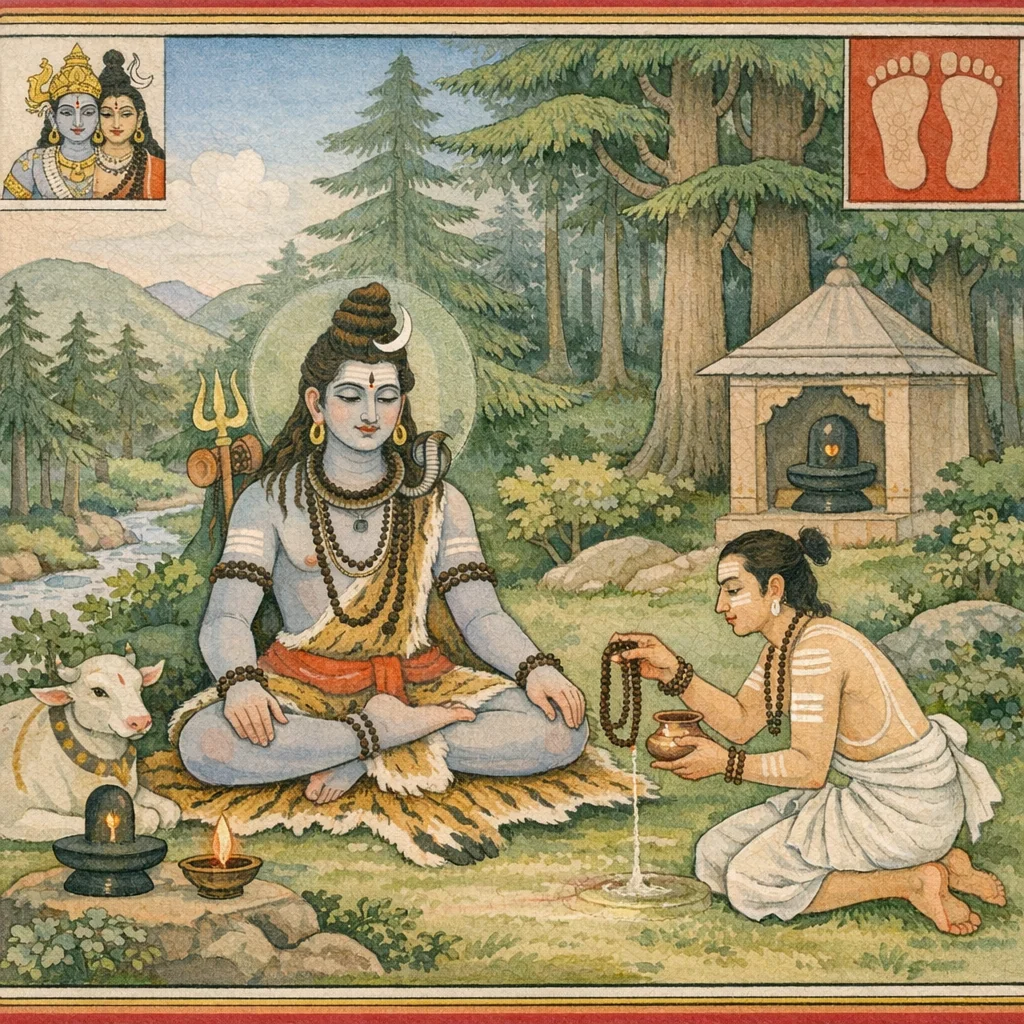
After the previous chapter’s close, Sūta continues the teaching on tīrthas, declaring Mahālaya an exceedingly secret sanctuary of Mahādeva, marked by Rudra’s footprint as a sign for doubters. The chapter then presents a structured pilgrimage through sacred sites—Kedāra, Plakṣāvataraṇa, Kanakhala, Mahātīrtha, Śrīparvata, the Godāvarī and Kāverī, and many other fords—linking each to rites such as bathing, tarpaṇa, śrāddha, dāna, homa, and japa, and to their fruits: destruction of sin, heaven, Brahmaloka, Śvetadvīpa, nearness to Rudra, yogic success, and akṣaya (undiminishing) merit. Ethical and yogic prerequisites are stressed: tīrtha-fruit belongs to the disciplined, pure, non-greedy practitioner established in brahmacarya. The narrative culminates in the Devadāru forest, where Mahādeva grants boons of perpetual sanctity, Gaṇapatya status for worshippers, and freedom from rebirth for those who die there; even remembering the tīrtha removes sins. It closes by universalizing sacred geography: wherever Śiva or Viṣṇu is present, Gaṅgā and all tīrthas are present, affirming Śaiva–Vaiṣṇava harmony and preparing for further sacred-topographical and liberating instruction.
Shlokas
Verse 1
इति श्रीकूर्मपुराणे षट्साहस्त्र्यां संहितायामुपरिविभागे पञ्चत्रिंशो ऽध्यायः सूत उवाच इदनमन्यते परं स्थानं गुह्याद् गुह्यतमं महत् / महादेवस्य देवस्य महालयमिति श्रुतम्
Thus, in the Śrī Kūrma Purāṇa, in the six-thousand-verse compendium, in the latter division, the thirty-fifth chapter concludes. Sūta said: “This is regarded as the supreme abode—vast, and more secret than the secret—known by tradition as Mahālaya, the great sanctuary of the god Mahādeva.”
Verse 2
तत्र देवादिदेवेन रुद्रेण त्रिपुरारिणा / शिलातले पदं न्यस्तं नास्तिकानां निदर्शनम्
There, Rudra—the God of gods, the destroyer of Tripura—set a footprint upon a stone-slab, as a clear sign meant for the unbelievers.
Verse 3
तत्र पुशुपताः शान्ता भस्मोद्धूलितविग्रहाः / उपासते महादेवं वेदाध्ययनतत्पराः
There, the tranquil Pāśupata devotees, their bodies dusted with sacred ash, worship Mahādeva, steadfastly devoted to the study and recitation of the Vedas.
Verse 4
स्नात्वा तत्र पदं शार्वं दृष्ट्वा भक्तिपुरः सरम् / नमस्कृत्वाथ शिरसा रुद्रसामीप्यमाप्नुयात्
Having bathed there, and having beheld Śarva’s sacred footprint and the lake before Bhaktipura, one should bow the head in reverence; thereby one attains nearness to Rudra.
Verse 5
अन्यच्च देवदेवस्य स्थानं शंभोर्महात्मनः / केदारमिति विख्यातं सिद्धानामालयं शुभम्
And further, there is a holy seat of the God of gods—great-souled Śambhu (Śiva)—renowned as Kedāra, an auspicious dwelling-place of the Siddhas.
Verse 6
तत्र स्नात्वा महादेवमभ्यर्च्य वृषकेतनम् / पीत्वा चैवोदकं शुद्धं गाणपत्यमवाप्नुयात्
There, having bathed and worshipped Mahādeva—Śiva whose banner bears the bull—and having drunk that pure water as well, one attains the blessed state (or world) of Gaṇapati.
Verse 7
श्राद्धदानादिकं कृत्वा ह्यक्ष्यं लभते फलम् / द्विजातिप्रवरैर्जुष्टं योगिभिर्यतमानसैः
Having performed śrāddha rites and acts of charity and the like, one truly gains imperishable merit—merit nurtured and affirmed in the company of the foremost among the twice-born and of yogins whose minds are disciplined in spiritual striving.
Verse 8
तीर्थं प्लक्षावतरणं सर्वपापविनाशनम् / तत्राभ्यर्च्य श्रीनिवासं विष्णुलोके महीयते
The sacred ford called Plakṣāvataraṇa destroys all sins. One who worships Śrīnivāsa there is honored in Viṣṇu’s world.
Verse 9
अन्यं मगधराजस्य तीर्थं स्वर्गगतिप्रदम् / अक्षयं विन्दति स्वर्गं तत्र गत्वा द्विजोत्तमः
In the realm of the king of Magadha there is another sacred ford that grants passage to heaven. Having gone there, the best of the twice-born attains an imperishable heaven.
Verse 10
तीर्थं कनखलं पुण्यं महापातकनाशनम् / यत्र देवेन रुद्रेण यज्ञो दक्षस्य नाशितः
Kanakhala is a holy pilgrimage-place, rich in merit and destructive of great sins—where the god Rudra brought Dakṣa’s sacrificial rite to ruin.
Verse 11
तत्र गङ्गामुपस्पृश्य शुचिर्भावसमन्वितः / मुच्यते सर्वपापैस्तु ब्रह्मलोकं लभेन्मृतः
There, having ritually touched the Gaṅgā, one becomes pure and endowed with a consecrated inner disposition; he is freed from all sins, and upon death attains Brahmaloka.
Verse 12
महातीर्थमिति ख्यातं पुण्यं नारायणप्रियम् / तत्राभ्यर्च्य हृषीकेशं श्वेतद्वीपं निगच्छति
This sacred place is renowned as “Mahātīrtha”—a meritorious tīrtha dear to Nārāyaṇa. Having worshipped Hṛṣīkeśa there, one attains Śvetadvīpa.
Verse 13
अन्यच्च तीर्थप्रवरं नाम्ना श्रीपर्वतं शुभम् / तत्र प्राणान् परित्यज्य रुद्रस्य दयितो भवेत्
Further, there is an auspicious foremost tīrtha called Śrīparvata. Whoever relinquishes the life-breath there becomes dear to Rudra (Śiva).
Verse 14
तत्र सन्निहितो रुद्रो देव्या सह महेश्वरः / स्नानपिण्डादिकं तत्र कृतमक्षय्यमुत्तमम्
There, Rudra—Mahēśvara—abides in person together with the Goddess. Therefore, whatever is performed there—such as sacred bathing and piṇḍa-offerings and related rites—becomes supremely excellent and yields imperishable merit.
Verse 15
गोदावरी नदी पुण्या सर्वपापविनाशनी / तत्र स्नात्वा पितॄन् देवांस्तर्पयित्वा यथाविधि / सर्वपापविसुद्धात्मा गोसहस्रफलं लभेत्
The river Godāvarī is holy, the destroyer of all sins. Having bathed there and duly offered tarpaṇa—water-libations—to the ancestors and the gods according to rule, one is purified of every sin and gains merit equal to gifting a thousand cows.
Verse 16
पवित्रसलिला पुण्या कावेरी विपुला नदी / तस्यां स्नात्वोदकं कृत्वा मुच्यते सर्वपातकैः / त्रिरात्रोपोषितेनाथ एकरात्रोषितेन वा
The Kaverī is a vast river whose waters are purifying and holy. Having bathed in her and performed the water-offering rite, one is freed from all sins—whether one has observed a fast for three nights, or even kept observance for a single night.
Verse 17
द्विजातीनां तु कथितं तीर्थानामिह सेवनम् / यस्य वाङ्मनसो शुद्धे हस्तपादौ च संस्थितौ / अलोलुपो ब्रह्मचारो तीर्थानां फलमाप्नुयात्
Here the practice of resorting to the tīrthas has been taught for the twice-born. One whose speech and mind are pure, whose hands and feet are disciplined, who is free from greed, and who lives in brahmacarya—such a person truly attains the fruit of the tīrthas.
Verse 18
स्वामितीर्थं महातीर्थं त्रिषु लोकेषु विश्रुतम् / तत्र सन्निहितो नित्यं स्कन्दो ऽमरनमस्कृतः
Svāmī-tīrtha is a great sacred ford, renowned throughout the three worlds. There Skanda—ever adored by the immortals—abides continually in manifest presence.
Verse 19
स्नात्वा कुमारधारायां कृत्वा देवादितर्पणम् / आराध्य षण्मुखं देवं स्कन्देन सह मोदते
Having bathed in the sacred stream called Kumāra-dhārā and performed tarpaṇa—libations to the gods and the rest—one who duly worships the six-faced Lord, Ṣaṇmukha, rejoices in the company of Skanda.
Verse 20
नदी त्रैलोक्यविख्याता ताम्रपर्णोति नामतः / तत्र स्नात्वा पितॄन् भक्त्या तर्पयित्वा यथाविधि / पापकर्तॄनपि पितॄस्तारयेन्नात्र संशयः
There is a river famed throughout the three worlds, known as Tāmraparṇī. Having bathed there and, with devotion, duly offered tarpaṇa to the Pitṛs according to the prescribed rite, one can deliver even ancestors who were doers of sin—of this there is no doubt.
Verse 21
चन्द्रतीर्थमिति ख्यातं कावेर्याः प्रभवे ऽक्षयम् / तीर्थं तत्र भवेद् वस्तुं मृतानां स्वर्गतिर्ध्रुवा
At the source of the Kāverī there is an imperishable sacred ford known as Candratīrtha. Whoever departs from life there attains a sure passage to heaven.
Verse 22
विन्ध्यपादे प्रपश्यन्ति देवदेवं सदाशिवम् / भक्त्या ये ते न पश्यन्ति यमस्य सदनं द्विजाः
At Vindhyapāda they behold Sadāśiva, the God of gods. Those who behold him there with devotion do not see the abode of Yama, O twice-born sages.
Verse 23
देविकायां वृषो नाम तीर्थं सिद्धनिषेवितम् / तत्र स्नात्वोदकं दत्वा योगसिद्धिं च विन्दति
On the river Devikā is a sacred ford named Vṛṣa, frequented by siddhas. Bathing there and offering water as arghya, one also attains success in Yoga.
Verse 24
दशाश्वमेधिकं तीर्थं सर्वपापविनाशनम् / दशानामश्वमेधानां तत्राप्नोति फलं नरः
This sacred ford called Daśāśvamedhika destroys all sins. Whoever visits it gains merit equal to that of ten Aśvamedha sacrifices.
Verse 25
पुण्डरीकं महातीर्थं ब्राह्मणैरुपसेवितम् / तत्राभिगम्य युक्तात्मा पौण्डरीकफलं लभेत्
Puṇḍarīka is a great sacred ford, frequented by Brāhmaṇas. Reaching it with a disciplined, integrated mind, one gains the spiritual merit known as the “Puṇḍarīka fruit.”
Verse 26
तीर्थेभ्यः परमं तीर्थं ब्रह्मतीर्थमिति श्रुतम् / ब्रह्माणमर्चयित्वा तु ब्रह्मलोके महीयते
Among all sacred fords, the supreme is said to be the Brahma-tīrtha. Worshipping Brahmā there, one is honored and exalted in Brahma-loka.
Verse 27
सरस्वत्या विनशनं प्लक्षप्रस्त्रवणं शुभम् / व्यासतीर्थं परं तीर्थं मैनाकं च नगोत्तमम् / यमुनाप्रभवं चैव सर्वपापविशोधनम्
“These are: the place where the Sarasvatī disappears, the auspicious spring at Plakṣa, Vyāsa’s ford—the supreme tīrtha—Mount Maināka, best of mountains, and the source-region of the Yamunā; all of these purify and cleanse every sin.”
Verse 28
पितॄणां दुहिता देवी गन्धकालीति विश्रुता / तस्यां स्नात्वा दिवं याति मृतो जातिस्मरो भवेत्
The Goddess, renowned as Gandhakālī, is said to be the daughter of the Pitṛs, the ancestral Fathers. By bathing in her sacred waters one attains heaven; and even the departed may become a rememberer of former births.
Verse 29
कुबेरतुङ्गं पापघ्नं सिद्धचारणसेवितम् / प्राणांस्तत्र परित्यज्य कुबेरानुचरो भवेत्
Kuberatuṅga is a sin-destroying holy place, frequented by Siddhas and Cāraṇas. One who relinquishes life there becomes an attendant of Kubera.
Verse 30
उमातुङ्गमिति ख्यातं यत्र सा रुद्रवल्लभा / तत्राभ्यर्च्य महादेवीं कोसहस्रफलं लभेत्
That place is renowned as Umātuṅga, where she—the beloved of Rudra—abides. Worshipping Mahādevī there, one gains merit equal to a hundred thousand (ordinary acts of worship).
Verse 31
भृगुतुङ्गे तपस्तप्तं श्राद्धं दानं तथा कृतम् / कुलान्युभयतः सप्त पुनातीति श्रुतिर्मम
At Bhṛgutunga, austerity is practiced; and śrāddha rites and charitable giving are also performed. This is my sacred teaching: such acts purify seven generations of one’s family on both sides, paternal and maternal.
Verse 32
काश्यपस्य महातीर्थं कालसर्पिरिति श्रुतम् / तत्र श्राद्धानि देयानि नित्यं पापक्षयेच्छया
Kāśyapa’s great sacred ford is known by tradition as Kālasarpa. There one should regularly offer śrāddha rites, with the wish to bring about the destruction of sins.
Verse 33
दशार्णायां तथा दानं श्राद्धं होमस्तथा जपः / अक्षयं चाव्ययं चैव कृतं भवति सर्वदा
Likewise, in the land of Daśārṇā, whatever is performed—charitable giving, śrāddha for the ancestors, homa as fire-offering, and japa as sacred recitation—ever becomes inexhaustible and imperishable in its fruit.
Verse 34
तीर्थं द्विजातिभिर्जुष्टं नाम्ना वै कुरुजाङ्गलम् / दत्त्वा तु दानं विधिवद् ब्रह्मलोके महीयते
There is a sacred ford named Kurujāṅgala, resorted to by the twice-born. One who gives charity there in due rite is honored in Brahmā’s world, Brahmaloka.
Verse 35
वैतरण्यां महातीर्थे स्वर्णवेद्यां तथैव च / धर्मपृष्ठे च सरसि ब्रह्मणः परमे शुभे
At the great sacred ford of the Vaitaraṇī, and likewise at Svarṇavedī; and at the lake called Dharmapṛṣṭha—supremely auspicious, belonging to Brahmā—holy bathing and worship there bestow great merit.
Verse 36
भरतस्याश्रमे पुण्ये पुण्ये श्राद्धवटे शुभे / महाह्रदे च कौशिक्यां दत्तं भवति चाक्षयम्
Whatever is given in the holy āśrama of Bharata—at the auspicious Śrāddha-vaṭa, and at the great lake upon the Kauśikī—becomes an akṣaya gift, its merit unfailing and imperishable.
Verse 37
मुञ्जपृष्ठे पदं न्यस्तं महादेवेन धीमता / हिताय सर्वभूतानां नास्तिकानां निदर्शनम्
Upon the back of muñja-grass, the wise Mahādeva set down His footprint—an auspicious sign for the welfare of all beings, and a clear proof to correct the unbelievers.
Verse 38
अल्पेनापि तु कालेन नरो धर्मपरायणः / पाप्मानमुत्सृजत्याशु जीर्णां त्वचमिवोरगः
Even in a short time, one devoted to dharma swiftly casts off sin—just as a serpent sheds its worn-out skin.
Verse 39
नाम्ना कनकनन्देति तीर्थं त्रैलोक्यविश्रुतम् / उदीच्यां मुञ्जपृष्ठस्य ब्रह्मर्षिगणसेवितम्
There is a sacred tīrtha famed throughout the three worlds, known as Kanakanandā. It lies in the northern region of Muñjapṛṣṭha and is revered and frequented by hosts of brahmarṣis, divine seers.
Verse 40
तत्र स्नात्वा दिवं यान्ति सशरीरा द्विजातयः / दत्तं चापि सदा श्राद्धमक्षयं समुदाहृतम् / ऋणैस्त्रिभिर्नरः स्नात्वा मुच्यते क्षीणकल्मषः
Having bathed there, the twice-born are said to ascend to heaven with their very bodies. The Śrāddha performed there is always declared to yield imperishable fruit. By bathing there, a man—his sins worn away—is freed from the three debts to gods, sages, and ancestors.
Verse 41
मानसे सरसि स्नात्वा शक्रस्यार्धासनं लभेत् / उत्तरं मानसं गत्वा सिद्धिं प्राप्नोत्यनुत्तमाम्
Having bathed in Lake Mānasa, one attains a seat equal to half the dignity of Śakra (Indra). Going to the northern Mānasa, one obtains the unsurpassed spiritual accomplishment (siddhi).
Verse 42
तस्मान्निर्वर्तयेच्छ्राद्धं यथाशक्ति यथाबलम् / कामान् सलभते दिव्यान् मोक्षोपायं च विन्दति
Therefore one should duly perform the Śrāddha according to one’s capacity and strength; by doing so, one attains divine fulfillments of worthy desires and also finds the means to liberation (mokṣa).
Verse 43
पर्वतो हिमवान्नाम नानाधातुविभूषितः / योजनानां सहस्राणि सो ऽशीतिस्त्वायतो गिरिः / सिद्धचारणसंकीर्णो देवर्षिगणसेवितः
There is a mountain named Himavān (the Himalaya), adorned with many kinds of minerals and ores. In extent it stretches for eighty thousand yojanas. It is thronged with Siddhas and Cāraṇas, and is frequented and revered by hosts of divine seers (Devarṣis).
Verse 44
तत्र पुष्करिणी रम्या सुषुम्ना नाम नामतः / तत्र गत्वा द्विजो विद्वान् ब्रह्महत्यां विमुञ्चति
There is a delightful sacred lake there, known by the name Suṣumnā. Having gone there, a learned twice-born (brāhmaṇa) becomes freed from the sin of brahma-hatyā (the killing of a brāhmaṇa).
Verse 45
श्राद्धं भवति चाक्षय्यं तत्र दत्तं महोदयम् / तारयेच्च पितॄन् सम्यग् दश पूर्वान् दशापरान्
The Śrāddha performed there becomes imperishable; whatever is given there yields great spiritual uplift. Indeed, one properly delivers one’s Pitṛs—ten generations before and ten generations after.
Verse 46
सर्वत्र हिमवान् पुण्यो गङ्गा पुण्या समन्ततः / नद्यः समुद्रगाः पुण्याः समुद्रश्च विशेषतः
In every way the Himavat (Himalaya) is holy; the Gaṅgā is holy on all sides. The rivers that flow into the ocean are holy, and the ocean itself is especially holy.
Verse 47
बदर्याश्रममासाद्य मुच्यते कलिकल्मषात् / तत्र नारायणो देवो नरेणास्ते सनातनः
Having reached Badarī-āśrama, one is freed from the defilements of the Kali age. There the god Nārāyaṇa abides eternally together with Nara.
Verse 48
अक्षयं तत्र दानं स्यात् जप्यं वापि तथाविधम् / महादेवप्रियं तीर्थं पावनं तद् विशेषतः / तारयेच्च पितॄन् सर्वान् दत्त्वा श्राद्धं समाहितः
In that place, any dāna becomes merit inexhaustible, and likewise any japa performed there bears unfailing fruit. That sacred tīrtha is especially purifying and dear to Mahādeva. Performing Śrāddha there with a collected mind, one delivers all one’s ancestors.
Verse 49
देवदारुवनं पुण्यं सिद्धगन्धर्वसेवितम् / महादेवेन देवेन तत्र दत्तं महद् वरं
The Deodar Forest is sacred and meritorious, attended by Siddhas and Gandharvas. There the great god Mahādeva bestowed a mighty boon.
Verse 50
मोहयित्वा मुनीन् सर्वान् पुनस्तैः संप्रपूजितः / प्रसन्नो भगवानीशो मुनीन्द्रान् प्राह भावितान्
Having first bewildered all the sages, and then being worshipped again by them, the Blessed Lord—Īśa—now pleased, addressed those foremost of ascetics whose minds had been refined by devotion and discipline.
Verse 51
इहाश्रमवरे रम्ये निवसिष्यथ सर्वदा / मद्भावनासमायुक्तास्ततः सिद्धिमवाप्स्यथ
In this delightful and excellent hermitage you shall dwell always; and, united with contemplation upon Me, you will thereafter attain siddhi—perfection.
Verse 52
ये ऽत्र मामर्चयन्तीह लोके धर्मपरा जनाः / तेषां ददामि परमं गाणपत्यं हि शाश्वतम्
Those in this world who, devoted to dharma, worship Me here—to them I grant the supreme and eternal Gaṇapatya state, lordship among the Gaṇas.
Verse 53
अत्र नित्यं वसिष्यामि सह नारायणेन च / प्राणानिह नरस्त्यक्त्वा न भूयो जन्म विन्दति
Here I shall dwell forever, together with Nārāyaṇa. Whoever relinquishes the life-breath here does not attain birth again.
Verse 54
संस्मरन्ति च ये तीर्थं देशान्तरगता जनाः / तेषां च सर्वपापानि नाशयामि द्विजोत्तमाः
O best of the twice-born, even those who have gone to other lands—if they merely remember this sacred tīrtha—I destroy all their sins.
Verse 55
श्राद्धं दानं तपो होमः पिण्डनिर्वपणं तथा / ध्यानं जपश्च नियमः सर्वमत्राक्षयं कृतम्
Here, śrāddha, charity, austerity, fire-offerings, the offering of piṇḍa, as well as meditation, japa, and disciplined observances—everything performed becomes imperishable in merit (akṣaya).
Verse 56
तस्मात् सर्वप्रयत्नेन द्रष्टव्यं हि द्विजातिभिः / देवदारुवनं पुण्यं महादेवनिषेवितम्
Therefore, with every possible effort, the twice-born should go and behold the holy Devadāru forest, sanctified by the continual presence and worship of Mahādeva (Śiva).
Verse 57
यत्रेस्वरो महादेवो विष्णुर्वा पुरुषोत्तमः / तत्र सन्निहिता गङ्गातीर्थान्यायतनानि च
Wherever the Lord is present—whether as Mahādeva (Śiva) or as Viṣṇu, the Supreme Person (Puruṣottama)—there the Gaṅgā and all her sacred fords, along with holy shrines and sanctuaries, are truly present.
Frequently Asked Questions
Beyond bathing and offerings, it conditions tīrtha-fruit on inner discipline—purity of speech and mind, controlled limbs, freedom from greed, and brahmacarya—so the pilgrimage becomes a moral-yogic practice rather than mere travel.
It articulates samanvaya: sacredness is not confined to a sectarian map but inheres in divine presence itself, allowing Śaiva and Vaiṣṇava worship to be read as convergent paths within one sacral cosmology.
The footprint functions as a tangible ‘pramāṇa-like’ sign for skeptics, anchoring the invisible sanctity of the tīrtha in a visible marker while also emphasizing Rudra’s direct immanence in the landscape.