Adhyaya 33
Prāyaścitta for Theft, Forbidden Foods, Impurity, and Ritual Lapses; Tīrtha–Vrata Remedies; Pativratā Mahātmyam via Sītā and Agni
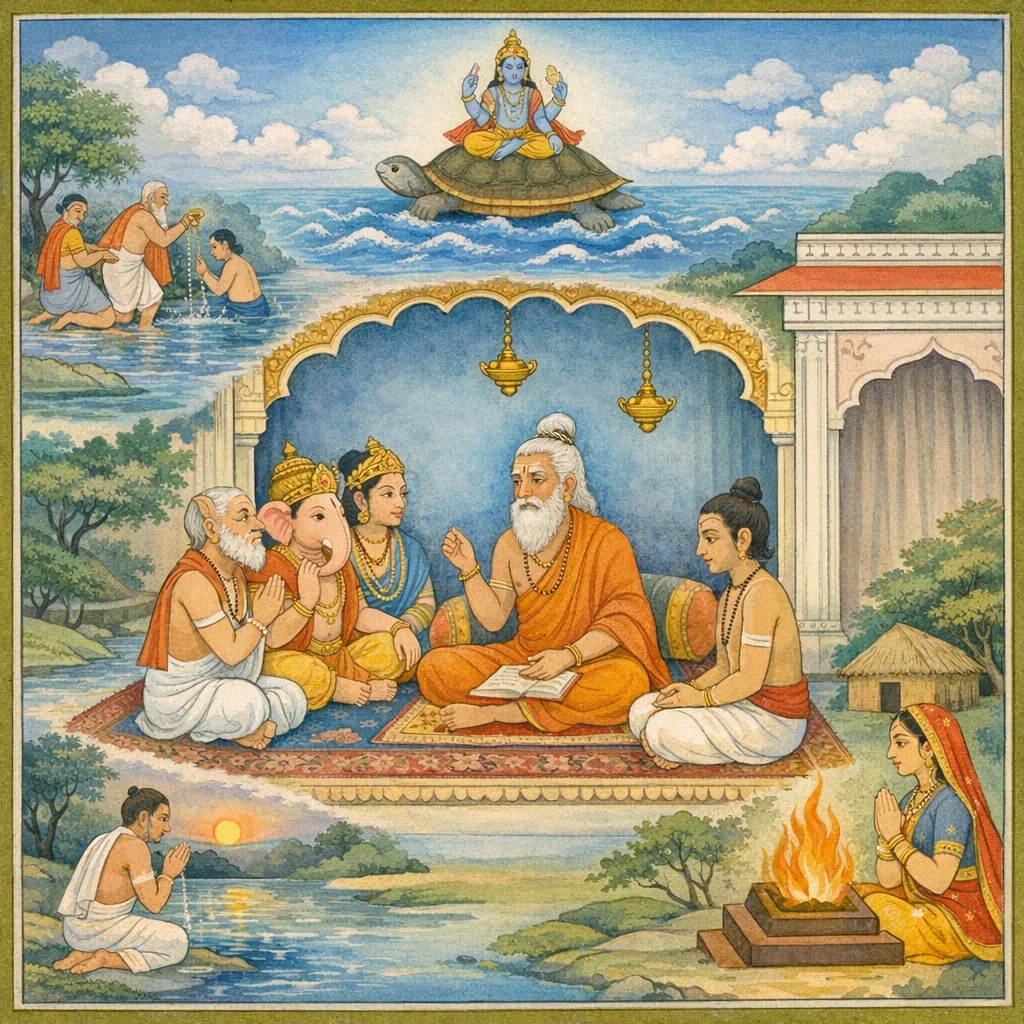
Continuing the Uttara-bhāga’s dharma teaching, Vyāsa sets out a graded system of prāyaścitta, matching each offense with specific purificatory disciplines—Cāndrāyaṇa, (Mahā-)Sāṃtapana, (Ati-)Kṛcchra, Taptakṛcchra, Prājāpatya, fasting regimens, pañcagavya, and mantra-japa. The chapter moves from property violations (abduction, theft of water and goods) to dietary and contact impurities (impure meats, excreta/urine, defiled water, forbidden foods, leftovers, and caṇḍāla-contact), then to lapses in nitya-karma (Sandhyā, agnihotra upkeep, the fuel-stick rite) and social-ritual breaches (paṅkti distribution, vrātya status, remedies for apāṅktya). From juridical detail it turns toward devotional remedies—pilgrimage to tīrthas, worship, lunar-day vrata, and gifts—affirming that surrender and regulated worship can dissolve even heavy sin. The conclusion praises women’s expiation through pativratā-dharma, illustrated by the Sītā–Agni episode (māyā-Sītā substitution and fire as witness), and ends with Vyāsa’s emphasis: this dharma, joined to jñāna-yoga and worship of Maheśvara, grants direct vision of Mahādeva.
Shlokas
Verse 1
इति श्रीकूर्मपुराणे षट्साहस्त्र्यां संहितायामुपरिविभागे द्वात्रिशो ऽध्यायः व्यास उवाच मनुष्याणां तु हरणं कृत्वा स्त्रीणां गृहस्य च / वापीकूपजलानां च शुध्येच्चान्द्रायणेन तु
Thus, in the Śrī Kūrma Purāṇa, in the Ṣaṭsāhasrī Saṃhitā, in the latter division, the thirty-third chapter. Vyāsa said: “Having committed the wrongful taking of human beings, of women, of a household, and also of the water of wells and reservoirs, one is purified by undertaking the Cāndrāyaṇa (lunar) expiation.”
Verse 2
द्रव्याणामल्पसाराणां स्तेयं कृत्वान्यवेश्मतः / चरेत् सांतपनं कृच्छ्रं तन्निर्यात्यात्मशुद्धये
If one steals items of little value from another’s house, one should perform the Sāntapana Kṛcchra, a purificatory austerity. By that observance the sin is expiated and the self is made pure.
Verse 3
धान्यान्नधनचौर्यं तु कृत्वा कामाद् द्विजोत्तमः / स्वजातीयगृहादेव कृच्छ्रार्धेन विशुद्ध्यति
But if a foremost among the twice-born, driven by desire, steals grain, food, or wealth from the house of one belonging to his own social group, he becomes purified by performing half of the Kṛcchra penance.
Verse 4
भक्षभोज्यापहरणे यानशय्यासनस्य च / पुष्पमूलफलानां च पञ्चगव्यं विशोधनम्
When foods meant for chewing or eating are unlawfully taken, and likewise a vehicle, a bed, or a seat—and also flowers, roots, and fruits—the prescribed purification is pañcagavya, the five cow-products.
Verse 5
तृणकाष्ठद्रुमाणां च शुष्कान्नस्य गुडस्य च / चैलचर्मामिषाणां च त्रिरात्रं स्यादभोजनम्
For wrongful dealing with grass, firewood, and trees, and with dry provisions and jaggery, and likewise with cloth, leather, and meat, the ordained expiation is to abstain from food for three nights.
Verse 6
मणिमुक्ताप्रवालानां ताम्रस्य रजतस्य च / अयः कांस्योपलानां च द्वादशाहं कणाशनम्
For impurity arising from contact with gems, pearls, and corals, as well as copper and silver, and also iron, bell-metal (kāṃsya), and stones, one should observe for twelve days the discipline of eating only grains (kaṇa).
Verse 7
कार्पासकीटजोर्णानां द्विशफैकशफस्य च / पक्षिगन्धौषधीनां च रज्वाश्चैव त्र्यहं पयः
For remnants produced by the cotton-worm (silkworm), for the dead bodies of cloven-hoofed and single-hoofed animals, and likewise for birds, fragrant substances, medicinal herbs, and ropes, purification is effected by the use of milk for three days.
Verse 8
नरमांसाशनं कृत्वा चान्द्रायणमथाचरेत् / काकं चैव तथा श्वानं जग्ध्वा हस्तिनमेव च / वराहं कुक्कुटं चाथ तप्तकृच्छ्रेण शुध्यति
Having eaten human flesh, one should thereafter undertake the Cāndrāyaṇa vow. But having eaten a crow, a dog, an elephant, a boar, or a cock, one is purified by performing the Taptakṛcchra penance.
Verse 9
क्रव्यादानां च मांसानि पुरीषं मूत्रमेव च / गोगोमायुकपीनां च तदेव व्रतमाचरेत् / उपोष्य द्वादशाहं तु कूष्माण्डैर्जुहुयाद् घृतम्
If one has consumed the flesh of carrion-eaters, or excrement or urine, or likewise impure substances connected with the cow and with gomāyuka and pīna, one should undertake that very expiatory observance. Having fasted for twelve days, one should offer ghee (ghṛta) into the sacred fire, using kūṣmāṇḍa (ash-gourd/pumpkin) as the oblation.
Verse 10
नकुलोलूकमार्जारं जग्ध्वा सांतपनं चरेत् / श्वापदोष्ट्रखराञ्जग्ध्वा तप्तकृच्छ्रेण शुद्ध्यति / व्रतवच्चैव संस्कारं पूर्वेण विधिनैव तु
Having eaten a mongoose, an owl, or a cat, one should undertake the Sāṃtapana expiatory observance. Having eaten a wild carnivore, a camel, or a donkey, one is purified by the Taptakṛcchra penance. And the concluding rite (saṃskāra) should likewise be performed as for a vow, precisely according to the earlier stated procedure.
Verse 11
बकं चैव बलाकं च हंसं कारण्डवं तथा / चक्रवाकं प्लवं जग्घ्वा द्वादशाहमभोजनम्
Having eaten a crane, a heron, a swan, a kāraṇḍava duck, a cakravāka (ruddy goose), or a plava water-bird, one should undertake a penance of twelve days without food.
Verse 12
कपोतं टिट्टिभं चैव शुकं सारसमेव च / उलूकं जालपादं च जग्ध्वाप्येतद् व्रतं चरेत्
Having eaten the flesh of a pigeon, a ṭiṭṭibha (sandpiper), a parrot, a sārasa crane, an owl, or a jālapāda water-bird, one should thereafter undertake and observe this expiatory vow.
Verse 13
शिशुमारं तथा चाषं मत्स्यमांसं तथैव च / जग्ध्वा चैव कटाहारमेतदेव चरेद् व्रतम्
Having eaten śiśumāra, and also cāṣa, and likewise fish-flesh, and then subsisting only on kaṭāhāra (a simple, restricted fare), one should observe this very vow.
Verse 14
कोकिलं चैव मत्स्यांश्च मण्डुकं भुजगं तथा / गोमूत्रयावकाहारो मासेनैकेन शुद्ध्यति
Having eaten a cuckoo, fish, a frog, or a snake, one becomes purified within a single month by subsisting on barley-gruel (yāvaka) together with cow’s urine (gomūtra).
Verse 15
जलेचरांश्च जलजान् प्रत्तुदान्नखविष्किरान् / रक्तपादांस्तथा जग्ध्वा सप्ताहं चैतदाचरेत्
Having eaten creatures that move in water, beings born of water, those that strike with the beak, those that scatter food with their claws, and also red-footed birds, one should undertake this observance for seven days as expiation.
Verse 16
शुनो मांसं शुष्कमांसमात्मार्थं च तथा कृतम् / भुक्त्वा मासं चरेदेतत् तत्पापस्यापनुत्तये
Having eaten dog’s flesh, dried meat, or meat prepared for one’s own gratification, one should undertake this observance for a month, in order to remove the sin arising from that act.
Verse 17
वार्ताकं भुस्तृणं शिग्रुं खुखुण्डं करकं तथा / प्राजापत्यं चरेज्जग्ध्वा शङ्खं कुम्भीकमेव च
Having eaten vārtāka (brinjal), bhustṛṇa-grass, śigru (drumstick/moringa), khukhuṇḍa, karaka, as well as the plants called śaṅkha and kumbhīka, one should undertake the Prājāpatya penance for purification.
Verse 18
पलाण्डुं लशुनं चैव भुक्त्वा चान्द्रायणं चरेत् / नालिकां तण्डुलीयं च प्राजापत्येन शुद्ध्यति
Having eaten onions and garlic, one should undertake the Cāndrāyaṇa vow as expiation. But for eating nālikā and taṇḍulīya (certain greens), one is purified by performing the Prājāpatya penance.
Verse 19
अश्मान्तकं तथा पोतं तप्तकृच्छ्रेण शुद्ध्यति / प्राजापत्येन शुद्धिः स्यात् कक्कुभाण्डस्य भक्षणे
If one has eaten aśmāntaka or pota, one becomes purified by observing the Taptakṛcchra penance; but if one has eaten kakkubhāṇḍa, purification is attained through the Prājāpatya vow.
Verse 20
अलाबुं किंशुकं चैव भुक्त्वा चैतद् व्रतं चरेत् / उदुम्बरं च कामेन तप्तकृच्छ्रेण शुद्ध्यति
Having eaten bottle-gourd (alābu) and the kiṃśuka (palāśa) flower, one should observe this vow. But if, out of desire, one eats udumbara (cluster-fig), one is purified by the austerity called Taptakṛcchra.
Verse 21
वृथा कृसरसंयावं पायसापूपसंकुलम् / भुक्त्वा चैवं विधं त्वन्नं त्रिरात्रेण विशुद्ध्यति
If one has eaten improperly and without due purpose a meal of kṛsara and saṃyāva, mixed with pāyasa and āpūpa, then—having consumed such food—one becomes purified after three nights of prescribed discipline.
Verse 22
पीत्वा क्षीराण्यपेयानि ब्रह्मचारी समाहितः / गोमूत्रयावकाहारो मासेनैकेन शुद्ध्यति
A brahmacārin, steady and self-controlled, who drinks milk and other permitted liquids, and lives on cow’s urine and barley-gruel (yāvaka), becomes purified within a single month.
Verse 23
अनिर्दशाहं गोक्षीरं माहिषं चाजमेव च / संधिन्याश्च विवत्सायाः पिबन् क्षीरमिदं चरेत्
One should not drink cow’s milk within ten days after calving; nor should one drink buffalo-milk or goat-milk. If one drinks the milk of a cow in heat (seeking union) or of a cow that has lost her calf, one should undertake this observance as an expiation.
Verse 24
एतेषां च विकाराणि पीत्वा मोहेन मानवः / गोमूत्रयावकाहारः सप्तरात्रेण शुद्ध्यति
If a person, through delusion, drinks the prepared derivatives of these (impure substances), then by subsisting on cow’s urine and yāvaka-gruel as the diet, one becomes purified within seven nights.
Verse 25
भुक्त्वा चैव नवश्राद्धे मृतके सूतके तथा / चान्द्रायणेन शुद्ध्येत ब्राह्मणस्तु समाहितः
If a Brāhmaṇa has eaten during the nine-day śrāddha, or during death-impurity (mṛtaka) or birth-impurity (sūtaka), then—self-restrained and attentive—he should be purified by performing the Cāndrāyaṇa expiation.
Verse 26
यस्याग्नौ हूयते नित्यं न यस्याग्रं न दीयते / चान्द्रायणं चरेत् सम्यक् तस्यान्नप्राशने द्विजः
A twice-born should not partake of the food of one who, though he performs the daily fire-offering, does not offer the first portion. If he has eaten it, he should duly undertake the Cāndrāyaṇa expiatory vow.
Verse 27
अभोज्यानां तु सर्वेषां भुक्त्वा चान्नमुपस्कृतम् / अन्तावसायिनां चैव तप्तकृच्छ्रेण शुद्ध्यति
If one has eaten any forbidden food, or food prepared in connection with those called antyāvasāyin (the most excluded), one is purified by the penance known as Taptakṛcchra.
Verse 28
चाण्डालान्नं द्विजो भुक्त्वा सम्यक् चान्द्रायणं चरेत् / बुद्धिपूर्वं तु कृच्छ्राब्दं पुनः संस्कारमेव च
If a twice-born man eats the food of a Caṇḍāla, he should duly perform the Cāndrāyaṇa penance. But if he did so knowingly, he must undertake the Kṛcchra penance for a year, and then undergo re-sanctification (renewal of the saṃskāra rites) again.
Verse 29
असुरामद्यपानेन कुर्याच्चान्द्रायणव्रतम् / अभोज्यान्नं तु भुक्त्वा च प्राजापत्येन शुद्ध्यति
For drinking liquor unfit for the sacred (asura-madya), one should undertake the Cāndrāyaṇa vow. And if one has eaten what ought not to be eaten, one is purified by performing the Prājāpatya expiation.
Verse 30
विण्मूत्रपाशनं कृत्वा रेतसश्चैतदाचरेत् / अनादिष्टेषु चैकाहं सर्वत्र तु यथार्थतः
After passing urine and feces, and likewise after the discharge of semen, one should observe this same rule of purification. Where no specific injunction is given, it should be followed for a single day—this is the true principle to be applied everywhere.
Verse 31
विड्वराहखरोष्ट्राणां गोमायोः कपिकाकयोः / प्राश्य मूत्रपुरीषाणि द्विजश्चान्द्रायणं चरेत्
If a twice-born man consumes the urine or feces of a boar, donkey, camel, cow, jackal, monkey, or crow, he should perform the Cāndrāyaṇa observance as an expiation.
Verse 32
अज्ञानात् प्राश्य विण्मूत्रं सुरासंस्पृष्टमेव च / पुनः संस्कारमर्हन्ति त्रयो वर्णा द्विजातयः
If, through ignorance, a twice-born person has eaten excrement or urine, or anything that has come into contact with liquor, then the twice-born of the three varṇas become fit to undergo the rites of re-sanctification (saṃskāra) again.
Verse 33
क्रव्यादां पक्षिणां चैव प्राश्य मूत्रपुरीषकम् / महासांतपनं मोहात् तथा कुर्याद् द्विजोत्तमः / भासमण्डूककुररे विष्किरे कृच्छ्रमाचरेत्
If a twice-born man, through delusion, eats the excrement or urine of flesh-eating birds, he should perform the Mahā-sāṃtapana penance. And if he eats a bhāsa-bird, a frog, a kurara-bird, or a viṣkira-bird, he should undertake the Kṛcchra penance.
Verse 34
प्राजापत्येन शुद्ध्येत ब्राहामणोच्छिष्टभोजने / क्षत्रिये तप्तकृच्छ्रं स्याद् वैश्ये चैवातिकृच्छ्रकम् / शूद्रोच्छिष्टं द्विजो भुक्त्वा कुर्याच्चान्द्रायणव्रतम्
If one eats the leftovers of a brāhmaṇa, one is purified by performing the Prājāpatya expiation. If the leftovers are those of a kṣatriya, one should undertake the Taptakṛcchra penance; if of a vaiśya, the Atikṛcchra penance. But if a twice-born person eats the leftovers of a śūdra, he should perform the Cāndrāyaṇa vow.
Verse 35
सुराभाण्डोदरे वारि पीत्वा चान्द्रायणं चरेत् / शुनोच्छिष्टं द्विजो भुक्त्वा त्रिरात्रेण विशुद्ध्यति / गोमूत्रयावकाहारः पीतशेषं च रागवान्
If one drinks water that has remained in the interior of a liquor-vessel, one should undertake the Cāndrāyaṇa penance. A twice-born who eats food left by a dog is purified in three nights, living on barley-gruel mixed with cow’s urine and drinking only the measured remainder, with disciplined restraint.
Verse 36
अपो मूत्रपुरीषाद्यैर्दूषिताः प्राशयेद् यदा / तदा सांतपनं प्रोक्तं व्रतं पापविशोधनम्
When water has been defiled by urine, feces, and the like, and one still drinks it, the observance called Sāṃtapana is prescribed—an expiatory vow that cleanses sin.
Verse 37
चाण्डालकूपभाण्डेषु यदि ज्ञानात् पिबेज्जलम् / चरेत् सांतपनं कृच्छ्रं ब्राह्मणः पापशोधनम्
If a brāhmaṇa knowingly drinks water from the well or vessel of a caṇḍāla, he should undertake the Sāṃtapana-kṛcchra as an expiation to purify that sin.
Verse 38
चाण्डालेन तु संस्पृष्टं पीत्वा वारि द्विजोत्तमः / त्रिरात्रेण विशुद्ध्येत पञ्चगव्येन चैव हि
But if a twice-born man of excellent conduct drinks water that has been touched by a caṇḍāla, he is purified after three nights—indeed, by also taking pañcagavya.
Verse 39
महापातकिसंस्पर्शे भुङ्क्ते ऽस्नात्वा द्विजो यदि / बुद्धिपूर्वं तु मूढात्मा तप्तकृच्छ्रं समाचरेत्
If a twice-born man eats without bathing after coming into contact with a perpetrator of a great sin (mahāpātaka), then—if he did so knowingly, though deluded in mind—he should undertake the penance called Taptakṛcchra.
Verse 40
स्पृष्ट्वा महापातकिनं चाण्डालं वा रजस्वलाम् / प्रमादाद् भोजनं कृत्वा त्रिरात्रेण विशुद्ध्यति
If, through inadvertence, one touches a perpetrator of a great sin, a caṇḍāla, or a menstruating woman, and then eats, one is purified after three nights of expiatory observance.
Verse 41
स्नानार्हे यदि भुञ्जीत अहोरात्रेण शुद्ध्यति / बुद्धिपूर्वं तु कृच्छ्रेण भगवानाह पद्मजः
If one eats at a time when one ought to bathe, one becomes purified within a day and a night. But if it is done deliberately, purification is attained only through the Kṛcchra penance—so declared the Blessed Padmaja (Brahmā).
Verse 42
शुष्कपर्युषितादीनि गवादिप्रतिदूषितम् / भुक्त्वोपवासं कुर्वोत कृच्छ्रपादमथापि वा
If one has eaten food that is dry, stale and the like, or food contaminated by cows and similar animals, one should perform a fast (upavāsa); or else one may also undertake the penitential observance known as a Kṛcchra.
Verse 43
संवत्सरान्ते कृच्छ्रं तु चरेद् विप्रः पुनः पुनः / अज्ञातभुक्तशुद्ध्यर्थं ज्ञातस्य तु विशेषतः
At the end of each year, a brāhmaṇa should repeatedly undertake the Kṛcchra penance, for purification from food eaten unknowingly (in an impure or improper manner)—and all the more when the transgression is known.
Verse 44
व्रात्यानां यजनं कृत्वा परेषामन्त्यकर्म च / अभिचारमहीनं च त्रिभिः कृच्छ्रैर्विशुद्ध्यति
Having performed a sacrificial rite for vrātyas, carried out the last rites (antya-karman) for others, and also undertaken harmful sorcery (abhicāra), one becomes purified by observing three Kṛcchra penances.
Verse 45
ब्राह्मणादिहतानां तु कृत्वा दाहादिकाः क्रियाः / गोमूत्रयावकाहारः प्राजापत्येन शुद्ध्यति
But in cases of impure death—beginning with one slain by a brāhmaṇa—after performing the rites such as cremation and the rest, one is purified by undertaking the Prājāpatya expiation, subsisting on cow’s urine and yāvaka-gruel as food.
Verse 46
तैलाभ्यक्तो ऽथवा कुर्याद् यदि मूत्रपुरीषके / अहोरात्रेण शुद्ध्येत श्मश्रुकर्म च मैथुनम्
If, while anointed with oil, one happens to pass urine or stool, one is purified after a full day and night; likewise, purification is prescribed after shaving (grooming the beard) and after sexual intercourse.
Verse 47
एकाहेन विवाहाग्निं परिहार्य द्विजोत्तमः / त्रिरात्रेण विशद्ध्येत त्रिरात्रात् षडहं पुनः
O best of the twice-born: after setting aside the householder’s wedding fire for one day, he is purified in three nights; and after those three nights, he should again observe a further six days of restraint and purificatory discipline.
Verse 48
दशाहं द्वादशाहं वा परिहार्य प्रमादतः / कृच्छ्रं चान्द्रायणं कुर्यात् तत्पापस्यापनुत्तये
Having first abstained—because of an inadvertent lapse—for ten days or for twelve days, one should perform the Kṛcchra and the Cāndrāyaṇa penances for the removal of that sin.
Verse 49
पतिताद् द्रव्यमादाय तदुत्सर्गेण शुद्ध्यति / चरेत् सांतपनं कृच्छ्रमित्याह भगवान् प्रभुः
Having taken some property from a fallen person (patita), one is purified by relinquishing it (giving it up, returning it). One should also undertake the Sāntapana Kṛcchra penance—thus declared the Blessed Lord, the Supreme Master.
Verse 50
अनाशकनिवृत्तास्तु प्रव्रज्यावसितास्तथा / चरेयुस्त्रीणि कृच्छ्राणि त्रीणि चान्द्रायणानि च
But those who have ceased the discipline of fasting, and likewise those who have lapsed from the renunciant’s vow, should undertake three Kṛcchra penances and also three Cāndrāyaṇa observances as expiation.
Verse 51
पुनश्च जातकर्मादिसंकारैः संस्कृता द्विजाः / शुद्ध्येयुस्तद् व्रतं सम्यक् चरेयुर्धर्मवर्धनाः
Again, the twice-born—refined by the sacraments beginning with the birth-rite (jātakarma) and the rest—should become purified; and, as increasers of dharma, they should duly practice that vow in the proper manner.
Verse 52
अनुपासितसंध्यस्तु तदहर्यापको वसेत् / अनश्नन् संयतमना रात्रौ चेद् रात्रिमेव हि
If one has failed to perform the Sandhyā worship, one should live through that day on mere subsistence. With the mind restrained and without eating, if the lapse occurs at night, then one should fast for that very night.
Verse 53
अकृत्वा समिदाधानं शुचिः स्नात्वा समाहितः / गायत्र्यष्टसहस्रस्य जप्यं कुर्याद् विशुद्धये
Without performing the rite of placing the fuel-sticks (samidh) in the sacred fire, one should—being pure, having bathed, and with a collected mind—perform japa of eight thousand recitations of the Gāyatrī mantra for complete purification.
Verse 54
उपासीत न चेत् संध्यां गृहस्थो ऽपि प्रमादतः / स्नात्वा विशुद्ध्यते सद्यः परिश्रान्तस्तु संयमात्
If, through negligence, even a householder does not perform the Sandhyā worship, then—having bathed—he becomes purified at once; but one who is exhausted through self-restraint should do so after regaining steadiness.
Verse 55
वेदोदितानि नित्यानि कर्माणि च विलोप्य तु / स्नातकव्रतलोपं तु कृत्वा चोपवसेद् दिनम्
If one has neglected the eternal daily rites enjoined by the Veda, and has also lapsed in the observances of a snātaka, one should undertake upavāsa—fasting for a single day.
Verse 56
संवत्सरं चरेत् कृच्छ्रमग्न्युत्सादी द्विजोत्तमः / चान्द्रायणं चरेद् व्रात्यो गोप्रदानेन शुद्ध्यति
A noble twice-born who has allowed his sacred fires (agni) to fall into neglect should undertake the Kṛcchra penance for one year. One who has become a vrātya should perform the Cāndrāyaṇa vow; by the gift of a cow he is purified.
Verse 57
नास्तिक्यं यदि कुर्वोत प्राजापत्यं चरेद् द्विजः / देवद्रोहं गुरुद्रोहं तप्तकृच्छ्रेण शुद्ध्यति
If a twice-born person commits nāstikya—unbelief—he should undertake the Prājāpatya penance. For hostility toward the gods and toward one’s teacher, he is purified by performing the Taptakṛcchra austerity.
Verse 58
उष्ट्रयानं समारुह्य खरयानं च कामतः / त्रिरात्रेण विशुद्ध्येत् तु नग्नो वा प्रविशेज्जलम्
If one, of one’s own choice, mounts a camel-vehicle or a donkey-vehicle, one is purified after three nights; alternatively, one should enter water unclothed for a purificatory bath.
Verse 59
षष्ठान्नकालतामासं संहिताजप एव च / होमाश्च शाकला नित्यमपाङ्क्तानां विशोधनम्
For those who have become apāṅktya (unfit to sit in the communal row for meals and rites), purification is prescribed by keeping for a month the discipline of the “sixth-meal time,” by japa-recitation of the Saṃhitā, and by the constant performance of Śākala homas—these are the means of their cleansing.
Verse 60
नीलं रक्तं वसित्वा च ब्राह्मणो वस्त्रमेव हि / अहोरात्रोषितः स्नातः पञ्चगव्येन शुद्ध्यति
If a brāhmaṇa has worn a blue or red garment, then—after observing restraint for a full day and night and then bathing—he is purified by the rite of pañcagavya.
Verse 61
वेदधर्मपुराणानां चण्डालस्य तु भाषणे / चान्द्रायणेन शुद्धिः स्यान्न ह्यन्या तस्य निष्कृतिः
If a Caṇḍāla recites or speaks the Vedas, Dharma-texts, or Purāṇas, purification is attained only by performing the Cāndrāyaṇa penance; for him there is no other expiation.
Verse 62
उद्बन्धनादिनिहतं संस्पृश्य ब्राह्मणः क्वचित् / चान्द्रायणेन शुद्धिः स्यात् प्राजापत्येन वा पुनः
If a brāhmaṇa should at any time touch one who has been killed by hanging or a similar violent death, purification is attained by performing the Cāndrāyaṇa penance, or again by the Prājāpatya expiation.
Verse 63
उच्छिष्टो यद्यनाचान्तश्चाण्डालादीन् स्पृशेद् द्विजः / प्रमादाद् वै जपेत् स्नात्वा गायत्र्यष्टसहस्रकम्
If a twice-born person, while in a state of ucchiṣṭa after eating and without having performed ācamana, were to touch a Caṇḍāla or the like through inadvertence, then—after bathing—he should recite the Gāyatrī eight thousand times as expiation.
Verse 64
द्रुपदानां शतं वापि ब्रह्मचारी समाहितः / त्रिरात्रोपोषितः सम्यक् पञ्चगव्येन शुद्ध्यति
Even if a disciplined and composed brahmacārin has incurred a fault equal to a hundred ‘drupada’ offences, if he duly observes a three-night fast, he is purified through the rite of pañcagavya.
Verse 65
चण्डालपतितादींस्तु कामाद् यः संस्पृशेद् द्विजः / उच्छिष्टस्तत्र कुर्वोत प्राजापत्यं विशुद्धये
If a twice-born man (dvija), driven by desire, touches a Caṇḍāla, a fallen one (patita), and the like, he becomes impure thereby; for purification he should perform the Prājāpatya expiation.
Verse 66
चाण्डालसूतकशवांस्तथा नारीं रजस्वलाम् / स्पृष्ट्वा स्नायाद् विशुद्ध्यर्थं तत्स्पृष्टं पतितिं तथा
Having touched a Caṇḍāla, one under sūtaka impurity (from birth or death), or a corpse, and likewise a woman in her menstrual period, one should bathe for purification; and in the same way, whatever they have touched should also be purified.
Verse 67
चाण्डालसूतकशवैः संस्पृष्टं संस्पृशेद् यदि / प्रमादात् तत आचम्य जपं कुर्यात् समाहितः
If through inadvertence one touches something that has been touched by a Caṇḍāla, by one in sūtaka impurity, or by a corpse, then one should perform ācamana afterward and, with a collected mind, undertake japa (mantra-repetition) for purification.
Verse 68
तत् स्पृष्टस्पर्शिनं स्पृष्ट्वा बुद्धिपूर्वं द्विजोत्तमः / आचमेत् तद् विशुद्ध्यर्थं प्राह देवः पितामहः
Having knowingly touched one who has touched an impure person, the best of the twice-born should perform ācamana for purification—so declared the divine Grandfather, Brahmā.
Verse 69
भुञ्जानस्य तु विप्रस्य कदाचित् संस्त्रवेद् गुदम् / कृत्वा शौचं ततः स्नायादुपोष्य जुहुयाद् घृतम्
If, while eating, a brāhmaṇa happens to have a discharge from the anus, then—having performed cleansing (śauca)—he should bathe; thereafter, observing a fast, he should offer ghee (ghṛta) into the sacred fire.
Verse 70
चाण्डालान्त्यशवं स्पृष्ट्वा कृच्छ्रं कुर्याद् विशुद्धये / स्पृष्ट्वाभ्यक्तस्त्वसंस्पृश्यमहोरात्रेण शुद्ध्यति
Having touched a Cāṇḍāla, an outcaste, or a corpse, one should undertake the Kṛcchra penance for complete purification. But if, after such contact, one has bathed and anointed oneself, then by touching an ‘untouchable’ one is purified within a day and a night.
Verse 71
सुरां स्पृष्ट्वा द्विजः कुर्यात् प्राणायामत्रयं शुचिः / पलाण्डुं लशुनं चैव घृतं प्राश्य ततः शुचिः
Having touched intoxicating liquor, a twice-born man—after becoming clean—should perform the triad of breath-restraints (three prāṇāyāmas). And after eating onion and garlic, he should eat ghee; then he becomes clean (ritually purified).
Verse 72
ब्राह्मणस्तु शुना दष्टस्त्र्यहं सायं पयः पिबेत् / नाभेरूर्ध्वं तु दष्टस्य तदेव द्विगुणं भवेत्
If a Brāhmaṇa is bitten by a dog, he should, for three days, drink milk in the evening. But if the bite is above the navel, that same observance becomes double in measure.
Verse 73
स्यादेतत् त्रिगुणं बाह्वोर्मूर्ध्नि च स्याच्चतुर्गुणम् / स्नात्वा जपेद् वा सावित्रीं श्वभिर्दष्टो द्विजोत्तमः
If he is bitten by dogs, the foremost of the twice-born should perform this purificatory act threefold for bites on the arms, and fourfold for bites on the head; or else, after bathing, he should repeat the Sāvitrī (Gāyatrī-mantra) for purification.
Verse 74
अनिर्वर्त्य महायज्ञान् यो भुङ्क्ते तु द्विजोत्तमः / अनातुरः सति धने कृच्छ्रार्धेन स शुद्ध्यति
If a foremost twice-born, without having duly performed the great sacrifices, nonetheless eats and enjoys the fruits of livelihood, then—provided he is not in distress and has the means—he becomes purified by undertaking half of the Kṛcchra penance.
Verse 75
आहिताग्निरुपस्थानं न कुर्याद् यस्तु पर्वणि / ऋतौ न गच्छेद् भार्यां वा सो ऽपि कृच्छ्रार्धमाचरेत्
If one who has established the sacred fires fails, on a festival or new‑moon observance day, to perform the prescribed attendance and worship of the fires, or if, when the proper season comes, he does not approach his wife, he too should undertake half of the Kṛcchra penance.
Verse 76
विनाद्भिरप्सु नाप्यार्तः शरीरं सन्निवेश्य च / सचैलो जलमाप्लुत्य गामालभ्य विशुद्ध्यति
If a person is distressed and cannot perform the rite with the prescribed waters, then, having composed body and mind, he should immerse himself in water even while clothed; and by offering a cow as a gift/ritual oblation, he becomes purified.
Verse 77
बुद्धिपूर्वं त्वभ्युदितो जपेदन्तर्जले द्विजः / गायत्र्यष्टसहस्रं तु त्र्यहं चोपवसेद् व्रती
Rising before sunrise with mindful resolve, the twice-born should recite japa while standing within water. As an observant votary, he should repeat the Gāyatrī eight thousand times and also undertake a three-day fast.
Verse 78
अनुगम्येच्छया शूद्रं प्रेतीभूतं द्विजोत्तमः / गायत्र्यष्टसहस्रं च जप्यं कुर्यान्नदीषु च
If a śūdra, moved by his own desire, follows a brahmin—the best of the twice-born—when he is connected with a preta-state (ritual impurity through contact with the dead), then the brahmin should expiate by reciting the Gāyatrī eight thousand times, performing this japa while standing in rivers.
Verse 79
कृत्वा तु शपथं विप्रो विप्रस्य वधसंयुतम् / मृषैव यावकान्नेन कुर्याच्चान्द्रायणं व्रतम्
If a Brahmin, having sworn an oath connected with the killing of a Brahmin, speaks falsely, then he should perform the expiatory Cāndrāyaṇa vow, subsisting on yāvaka food (barley-based fare).
Verse 80
पङ्क्त्यां विषमदानं तु कृत्वा कृच्छ्रेण शुद्ध्यति / छायां श्वपाकस्यारुह्य स्नात्वा संप्राशयेद् घृतम्
In a ceremonial row-feast (paṅkti), if one has made an improper or unequal distribution of food-gifts, one is purified by undertaking the Kṛcchra penance. Then, having stepped into the shadow of a śvapāka (an outcaste/caṇḍāla) and bathed, one should ritually partake of ghee.
Verse 81
ईक्षेदादित्यमशुचिर्दृष्ट्वाग्निं चन्द्रमेव वा / मानुषं चास्थि संस्पृश्य स्नानं कृत्वा विशुद्ध्यति
If one is in a state of impurity (āśauca), then after looking upon the Sun—or after seeing fire or the Moon—or after touching a human bone, one becomes purified by bathing.
Verse 82
कृत्वा तु मिथ्याध्ययनं चरेद् भैक्षं तु वत्सरम् / कृतघ्नो ब्राह्मणगृहे पञ्च संवत्सरं व्रती
If one has pursued false study—deceptive or improper recitation and learning—one should, as penance, live on alms for a year. A thankless person should, as an observer of vows, dwell in a brāhmaṇa’s house for five years in disciplined service.
Verse 83
हुङ्कारं ब्राह्मणस्योक्त्वा त्वङ्कारं च गरीयसः / स्नात्वानश्नन्नहः शेषं प्रणिपत्य प्रसादयेत्
If one has addressed a brāhmaṇa with the contemptuous “huṅ”, or used the familiar “tvaṃ” toward a venerable superior, then—having bathed—one should abstain from food for the rest of the day and, bowing down, seek that person’s pardon.
Verse 84
ताडयित्वा तृणेनापि कण्ठं बद्ध्वापि वाससा / विवादे वापि निर्जित्य प्रणिपत्य प्रसादयेत्
Even if one has struck another with only a blade of grass, or bound his neck with a cloth, or even defeated him in a dispute, one should bow down and seek to appease him, asking forgiveness.
Verse 85
अवगूर्य चरेत् कृच्छ्रमतिकृच्छ्रं निपातने / कृच्छ्रातिकृच्छ्रौ कुर्वोत विप्रस्योत्पाद्य शोणितम्
If one has slain a brāhmaṇa, one should undertake the Kṛcchra and the Ati-kṛcchra penances. If one has caused a brāhmaṇa’s blood to flow, one should likewise perform both Kṛcchra and Ati-kṛcchra as expiation for purification.
Verse 86
गुरोराक्रोशमनृतं कृत्वा कुर्याद् विशोधनम् / एकरात्रं त्रिरात्रं वा तत्पापस्यापनुत्तये
Having reviled one’s guru with untruthful speech, one should perform a purificatory expiation—fasting for one night or for three nights—so that that sin may be removed.
Verse 87
देवर्षोणामभिमुखं ष्ठीवनाक्रोशने कृते / उल्मुकेन दहेज्जिह्वां दातव्यं च हिरण्यकम्
If one spits or hurls abuse while facing the divine sages (devarṣi), one should atone by branding the tongue with a firebrand (symbolically), and one should also give gold as a compensatory gift.
Verse 88
देवोद्याने तु यः कुर्यान्मूत्रोच्चारं सकृद् द्विजः / छिन्द्याच्छिश्नं तु शुद्ध्यर्थं चरेच्चान्द्रायणं तु वा
If a twice-born man (dvija) urinates even once in a divine garden (the temple-grove), then for purification he should cut off his penis—or else he should undertake the expiatory observance of the Cāndrāyaṇa vow.
Verse 89
देवतायतने मूत्रं कृत्वा मोहाद् द्विजोत्तमः / शिश्नस्योत्कर्तनं कृत्वा चान्द्रायणमथाचरेत्
If, through delusion, the best of the twice-born urinates within a deity’s shrine, he should perform the expiation of cutting off the penis, and then undertake the vow of Cāndrāyaṇa.
Verse 90
देवतानामृषीणां च देवानां चैव कुत्सनम् / कृत्वा सम्यक् प्रकुर्वोत प्राजापत्यं द्विजोत्तमः
Having duly performed the expiation for reviling the deities and the sages, the best of the twice-born should then properly undertake the Prājāpatya penance.
Verse 91
तैस्तु संभाषणं कृत्वा स्नात्वा देवान् समर्चयेत् / दृष्ट्वा वीक्षेत भास्वन्तं स्म्वत्वा विशेश्वरं स्मरेत्
After conversing with them, one should bathe and then duly worship the gods. Having beheld the radiant Sun, one should gaze upon it and, remembering Viśeśvara (the Supreme Lord), keep Him in mind.
Verse 92
यः सर्वभूताधिपतिं विश्वेशानं विनिन्दति / न तस्य निष्कृतिः शक्या कर्तुं वर्षशतैरपि
Whoever reviles the Lord of all beings—the Sovereign of the universe, Viśveśāna—for him no expiation can be accomplished, even over hundreds of years.
Verse 93
चान्द्रायणं चरेत् पूर्वं कृच्छ्रं चैवातिकृच्छ्रकम् / प्रपन्नः शरणं देवं तस्मात् पापाद् विमुच्यते
First, one should undertake the Cāndrāyaṇa vow, and also the Kṛcchra and Atikṛcchra austerities. Having surrendered and taken refuge in the Deva, one is thereby released from that sin.
Verse 94
सर्वस्वदानं विधिवत् सर्वपापविशोधनम् / चान्द्रायणं चविधिना कृच्छ्रं चैवातिकृच्छ्रकम्
The duly performed gift of one’s entire possessions purifies all sins; likewise, when undertaken according to rule, the Cāndrāyaṇa vow, the Kṛcchra penance, and the Ati-kṛcchra penance also cleanse sin.
Verse 95
पुण्यक्षेत्राभिगमनं सर्वपापविनाशनम् / देवताभ्यर्चनं नॄणामशेषाघविनाशनम्
Going to sacred pilgrimage-places destroys all sins; and for human beings, the worship of the deities destroys every trace of wrongdoing.
Verse 96
अमावस्यां तिथिं प्राप्य यः समाराधयेच्छिवम् / ब्राह्मणान् भोजयित्वा तु सर्वपापैः प्रमुच्यते
On the Amāvasyā (new-moon) day, whoever devoutly worships Śiva and then feeds Brāhmaṇas is released from all sins.
Verse 97
कृष्णाष्टम्यां महादेवं तथा कृष्णचतुर्दशीम् / संपूज्य ब्राह्मणमुखे सर्वपापैः प्रमुच्यते
By duly worshipping Mahādeva on the Kṛṣṇāṣṭamī and again on the Kṛṣṇa-caturdaśī, and by offering that worship through the mouth (as the honored recipient) of a brāhmaṇa, one is released from all sins.
Verse 98
त्रयोदश्यां तथा रात्रौ सोपहारं त्रिलोचनम् / दृष्ट्वेशं प्रथमे यामे मुच्यते सर्वपातकैः
On the thirteenth lunar day, at night, one who beholds the Three-eyed Lord (Śiva) with offerings—having seen that Lord in the first watch of the night—is released from all sins.
Verse 99
उपोषितश्चतुर्दश्यां कृष्णपक्षे समाहितः / यमाच धर्मराजाय मृत्यवे चान्तकाय च
Having fasted on the fourteenth lunar day of the dark fortnight, steady and self-collected, one should worship Yama—Dharma-rāja—also as Mṛtyu (Death) and as Antaka (the Ender).
Verse 100
वैवस्वताय कालाय सर्वभूतक्षयाय च / प्रत्येकं तिलसंयुक्तान् दद्यात् सप्तोदकाञ्जलीन् / स्नात्वा नद्यां तु पूर्वाह्ने मुच्यते सर्वपातकैः
For Vaivasvata (Yama), for Kāla (Time), and for the dissolution of all beings, one should offer seven water-libations in joined palms, each time mixed with sesame. Having bathed in a river in the forenoon, one is released from all sins.
Verse 101
ब्रह्मचर्यमधः शय्यामुपवासं द्विजार्चनम् / व्रतेष्वेतेषु कुर्वोत शान्तः संयतमानसः
Let him observe brahmacarya, sleep upon the ground, undertake fasting, and worship the twice-born, the learned Brāhmaṇas. While performing these vows, he should remain tranquil, with his mind restrained and well-governed.
Verse 102
अमावस्यायां ब्रह्माणं समुद्दिश्य पितामहम् / ब्राह्मणांस्त्रीन् समभ्यर्च्य मुच्यते सर्वपातकैः
On the new-moon day (amāvasyā), dedicating one’s rite to Brahmā, the Grandfather (Pitāmaha), and reverently worshipping three Brāhmaṇas, one is freed from all sins.
Verse 103
षष्ठ्यामुपोषितो देवं शुक्लपक्षे समाहितः / सप्तम्यामर्चयेद् भानुं मुच्यते सर्वपातकैः
Having fasted on the sixth lunar day in the bright fortnight (śukla-pakṣa), with a collected mind, one should worship Bhānu, the Sun, on the seventh; thereby one is freed from all sins.
Verse 104
भरण्यां च चतुर्थ्यां च शनैश्चरदिने यमम् / पूजयेत् सप्तजन्मोत्थैर्मुच्यते पातकैर्नरः
On the Bharaṇī nakṣatra day, on the fourth lunar day (caturthī), and on the day of Śanaiścara (Saturday), a man should worship Yama; by doing so he is freed from sins accumulated across seven births.
Verse 105
एकादश्यां निराहारः समभ्यर्च्य जनार्दनम् / द्वादश्यां शुक्लपक्षस्य महापापैः प्रमुच्यते
Fasting without food on Ekādaśī and duly worshiping Janārdana, one is freed from great sins on the bright-fortnight Dvādaśī.
Verse 106
तपो जपस्तीर्थसेवा देवब्राह्मणपूजनम् / ग्रहणादिषु कालेषु महापातकशोधनम्
Austerity, mantra-recitation, service at sacred tīrthas, and worship of the gods and Brahmins—when done at times such as eclipses—become a means to cleanse even the great sins (mahāpātakas).
Verse 107
यः सर्वपापयुक्तो ऽपि पुण्यतीर्थेषु मानवः / नियमेन त्यजेत् प्राणान् स मुच्येत् सर्वपातकैः
Even a man burdened with every sin—if, at sacred and meritorious tīrthas, he relinquishes his life in a disciplined, rule-bound way—is released from all acts that bring spiritual downfall.
Verse 108
ब्रह्मघ्नं वा कृतघ्नं वा महापातकदूषितम् / भर्तारमुद्धरेन्नारी प्रविष्टा सह पावकम्
Even if her husband is a slayer of a brāhmaṇa, an ingrate, or one tainted by great sins, a wife may yet redeem him—by entering the purifying fire along with him.
Verse 109
एतदेव परं स्त्रीणां प्रायश्चित्तं विदुर्बुधाः / सर्वपापसमुद्भूतौ नात्र कार्या विचारणा
The wise know this alone to be the highest expiation (prāyaścitta) for women; since it arises as the remedy for all sins, there is no need for further deliberation here.
Verse 110
पतिव्रता तु या नारी भर्तृशुश्रूषणोत्सुका / न तस्या विद्यते पापमिह लोके परत्र च
But the woman who stands firm in the vow of a faithful wife (pativratā), eager in devoted service to her husband—no sin is found in her, either in this world or in the world beyond.
Verse 111
पतिव्रता धर्मरता रुद्राण्येव न संशयः / नास्याः पराभवं कर्तुं शक्नोतीह जनः क्वचित्
She is pativratā, devoted to dharma—without doubt she is like Rudrāṇī herself, the consort of Rudra. No one anywhere in this world can bring about her defeat or humiliation.
Verse 112
यथा रामस्य सुभगा सीता त्रैलोक्यविश्रुता / पत्नी दाशरथेर्देवी विजिग्ये राक्षसेश्वरम्
Just as Sītā—beloved of Rāma and famed throughout the three worlds—Divine Queen and wife of Rāma, Daśaratha’s son, overcame the lord of the Rākṣasas.
Verse 113
रामस्य भार्यां विमलां रावणो राक्षसेश्वरः / सीतां विशालनयनां चकमे कालचोदितः
Rāvaṇa, lord of the Rākṣasas, driven onward by the force of Kāla (Time), conceived desire for Sītā—Rāma’s spotless wife, the wide-eyed one.
Verse 114
गृहीत्वा मायया वेषं चरन्तीं विजने वने / समाहर्तुं मतिं चक्रे तापसः किल कामिनीम्
Assuming a guise by means of māyā, she wandered in a lonely forest; and the ascetic—so it is told—resolved in his mind to approach and win that alluring woman.
Verse 115
विज्ञाय सा च तद्भावं स्मृत्वा दाशरथिं पतिम् / जगाम शरणं वह्निमावसथ्यं शुचिस्मिता
Understanding his intent and remembering her husband—Rāma, the son of Daśaratha—she, whose smile was pure, went to seek refuge in the sacred Fire within the sacrificial enclosure.
Verse 116
उपतस्थे महायोगं सर्वदोषविनाशनम् / कृताञ्जली रामपत्नी शाक्षात् पतिमिवाच्युतम्
With palms joined in reverence, Sītā, Rāma’s wife, worshipped that Great Yoga—the destroyer of all faults—approaching Acyuta, the Unfailing Lord, as though her husband stood before her in person.
Verse 117
नमस्यामि महायोगं कृतान्तं गहनं परम् / दाहकं सर्वभूतानामीशानं कालरूपिणम्
I bow to the Great Yoga—Kṛtānta, Death itself—supreme and unfathomable; the one who burns up all beings, Īśāna, the Lord whose very form is Time (Kāla).
Verse 118
नमस्ये पावकं देवं साक्षिणं विश्वतोमुखम् / आत्मानं दीप्तवपुषं सर्वभूतहृदी स्थितम्
I bow to Pāvaka, the divine Fire—the all-seeing Witness with faces turned in every direction; to that radiant Self, the Ātman, abiding in the heart of every being.
Verse 119
प्रपद्ये शरणं वह्निं ब्रह्मण्यं ब्रह्मरूपिणम् / भूतेशं कृत्तिवसनं शरण्यं परमं पदम्
I take refuge in Vahni, Agni—the sacred Fire—devoted to Brahman and embodying Brahman; the Lord of beings, clad in a skin-garment; the supreme Refuge, the highest Goal and Abode.
Verse 120
ॐ प्रपद्ये जगन्मूर्तिं प्रभवं सर्वतेजसाम् / महायोगेश्वरं वह्निमादित्यं परमेष्ठिनम्
Om. I take refuge in Him whose form is the universe, the source of all splendors—the great Lord of Yoga: the Divine Fire, the Sun, the Supreme Ordainer.
Verse 121
प्रपद्ये शरणं रुद्रं महाग्रासं त्रिशूलिनम् / कालाग्निं योगिनामीशं भोगमोक्षफलप्रदम्
I seek refuge in Rudra—the mighty Devourer, the Trident-bearer; the Time-fire itself, the Lord of yogins, who grants the fruits of both worldly enjoyment and liberation.
Verse 122
प्रपद्ये त्वां विरूपाक्षं भुर्भुवः स्वः स्वरूपिणम् / हिरण्यमये गृहे गुप्तं महान्तममितौजसम्
I take refuge in You, O Virūpākṣa, whose very form is the three worlds—Bhūḥ, Bhuvaḥ, and Svaḥ; hidden within the golden abode (the luminous heart), You are the Great One, of immeasurable splendor.
Verse 123
वैश्वानरं प्रपद्ये ऽहं सर्वभूतेष्ववस्थितम् / हव्यकव्यवहं देवं प्रपद्ये वह्निमीश्वरम्
I take refuge in Vaiśvānara—the cosmic Fire abiding within all beings. I take refuge in that divine Lord Agni, the carrier of offerings for gods and ancestors, the sovereign Flame.
Verse 124
प्रपद्ये तत्परं तत्त्वं वरेण्यं सवितुः स्वयम् / भर्गमग्निपरं ज्योती रक्ष मां हव्यवाहन
I take refuge in that Supreme Reality—the most excellent, Savitṛ himself—whose purifying radiance is the highest light, centered in Agni. O Havyavāhana, bearer of oblations, protect me.
Verse 125
इति वह्न्यष्टकं जप्त्वा रामपत्नी यशस्विनी / ध्यायन्ती मनसा तस्थौ राममुन्मीलितेक्षणा
Thus, having recited the eight-versed hymn to Fire (Vahny-aṣṭaka), Sītā—the illustrious wife of Rāma—stood firm, meditating inwardly within her mind, while Rāma looked on with eyes opened wide.
Verse 126
अथावसथ्याद् भगवान् हव्यवाहो महेश्वरः / आविरासीत् सुदीप्तात्मा तेजसा प्रदहन्निव
Then, from that dwelling-place, the blessed Havyavāhana—Mahēśvara—manifested, his inner being blazing brightly, as though scorching everything with his radiance.
Verse 127
स्वष्ट्वा मायामयीं सीतां स रावणवधेप्सया / सीतामादाय धर्मिष्ठां पावको ऽन्तरधीयत
To bring about Rāvaṇa’s destruction, Agni (Pāvaka) fashioned a Sītā made of māyā; then he took away the supremely righteous Sītā and vanished from sight.
Verse 128
तां दृष्ट्वा तादृशीं सीतां रावणो राक्षसेश्वरः / समादाय ययौ लङ्कां सागरान्तरसंस्थिताम्
Seeing Sītā in that very state, Rāvaṇa—the lord of the Rākṣasas—seized her and went to Laṅkā, which lay situated beyond the ocean.
Verse 129
कृत्वाथ रावणवधं रामो लक्ष्मणसंयुतः / मसादायाभवत् सीतां शङ्काकुलितमानसः
Having slain Rāvaṇa, Rāma—accompanied by Lakṣmaṇa—approached Sītā, his mind unsettled and troubled by doubt.
Verse 130
सा प्रत्ययाय भूतानां सीता मायामीय पुनः / विवेश पावकं दीप्तं ददाह ज्वलनो ऽपि ताम्
Then Sītā—once more taking up her own divine power of māyā—entered the blazing, radiant fire to establish certainty for all beings; and even the Fire-god burned her (in appearance).
Verse 131
दग्ध्वा मायामयीं सीतां भगवानुग्रदीधितिः / रामायादर्शयत् सीतां पावको ऽभूत् सुरप्रियः
Having burned the Sītā fashioned of māyā, the Blessed Fire—of fierce radiance—then revealed the true Sītā to Rāma; thus Agni became dear to the gods.
Verse 132
प्रगृह्य भर्तुश्चरणौ कराभ्यां सा सुमध्यमा / चकार प्रणतिं भूमौ रामाय जनकात्मजा
Taking hold of her husband’s feet with both hands, that slender-waisted Janaka’s daughter, Sītā, bowed down to Rāma, prostrating upon the ground.
Verse 133
दृष्ट्वा हृष्टमना रामो विस्मयाकुललोचनः / ननाम वह्निं सिरसा तोषयामास राघवः
Seeing it, Rāma—his mind delighted and his eyes stirred with wonder—bowed to Agni with his head; thus did Rāghava gratify the Fire-god.
Verse 134
उवाच वह्नेर्भगवान् किमेषा वरवर्णिनी / दग्धा भगवता पूर्वं दृष्टा मत्पार्श्वमागता
The Blessed Lord spoke to Agni: “Who is this fair-complexioned, beautiful woman? She was formerly burned by the Lord; now, having been seen, she has come to my side.”
Verse 135
तमाह देवो लोकानां दाहको हव्यवाहनः / यथावृत्तं दाशरथिं भूतानामेव सन्निधौ
Then the god Havyavāhana—Agni, the burner of worlds—addressed Daśarathi (Rāma), recounting the event exactly as it had occurred, in the very presence of the assembled beings.
Verse 136
इयं सा मिथिलेशेन पार्वतीं रुद्रवल्लभाम् / आराध्य लब्धा तपसा देव्याश्चात्यन्तवल्लभा
This very woman was obtained by the lord of Mithilā through austerity, after worshipping Pārvatī—beloved of Rudra; and she became the Goddess’s exceedingly dear one.
Verse 137
भर्तुः शुश्रूषणोपेता सुशीलेयं पतिव्रता / भवानीपार्श्वमानीता मया रावणकामिता
“She is devoted to serving her husband, virtuous in conduct, and steadfast in wifely fidelity. Yet I—Rāvaṇa—driven by desire, brought her near to Bhavānī (Pārvatī), longing for her.”
Verse 138
या नीता राक्षसेशेन सीता भगवताहृता / मया मायामयी सृष्टा रावणस्य वधाय सा
That Sītā who was carried off by the lord of the Rākṣasas was, in truth, taken away by the Blessed Lord; and I created a Sītā made of māyā for the purpose of slaying Rāvaṇa.
Verse 139
तदर्थं भवता दुष्टो रावणो राक्षसेश्वरः / मयोपसंहृता चैव हतो लोकविनाशनः
For that very purpose, the wicked Rāvaṇa, lord of the Rākṣasas, was brought to his end by me and slain—he who was the destroyer of the worlds.
Verse 140
गृहाण विमलामेनां जानकीं वचनान्मम / पश्य नारायणं देवं स्वात्मानं प्रभवाव्ययम्
Accept, at my word, this spotless Jānakī. Behold Nārāyaṇa, the Divine Lord—your very own Self—source of all, yet imperishable.
Verse 141
इत्युक्त्वा भगवांश्चण्डो विश्चार्चिर्विश्वतोमुखः / मानितो राघवेणाग्निर्भूतैश्चान्तरधीयत
Having spoken thus, that blessed Agni—fierce, blazing with universal radiance, and facing in all directions—being duly honored by Rāghava, vanished from sight along with his elemental hosts.
Verse 142
एतते पतिव्रतानां वैं माहात्म्यं कथितं मया / स्त्रीणां सर्वाघशमनं प्रायश्चित्तमिदं स्मृतम्
Thus have I declared the greatness of the pativratās, women devoted in fidelity to their husbands. This is remembered as an expiation for women, one that pacifies and removes every sin.
Verse 143
अशेषपापयुक्तस्तु पुरुषो ऽपि सुसंयतः / स्वदेहं पुण्यतीर्थेषु त्यक्त्वा मुच्येत किल्बिषात्
Even a man burdened with every kind of sin—if he is well-restrained—by relinquishing his body at holy tīrthas, is said to be freed from guilt and transgression.
Verse 144
पृथिव्यां सर्वतीर्थेषु स्नात्वा पुण्येषु वा द्विजः / मुच्यते पातकैः सर्वैः समस्तैरपि पूरुषः
A dvija (twice-born), having bathed at all the sacred tīrthas on earth—or even at any single meritorious holy place—becomes freed from all sins; indeed, a person is released from every accumulated transgression.
Verse 145
व्यास उवाच इत्येष मानवो धर्मो युष्माकं कथितो मया / महेशाराधनार्थाय ज्ञानयोगं च शाश्वतम्
Vyāsa said: “Thus have I declared to you the universal dharma of humankind, together with the eternal Yoga of knowledge, meant for the worship and propitiation of Maheśa (Śiva).”
Verse 146
यो ऽनेन विधिना युक्तं ज्ञानयोगं समाचरेत् / स पश्यति महादेवं नान्यः कल्पशतैरपि
Whoever, disciplined by this very method, faithfully practises the Yoga of knowledge—he beholds Mahādeva directly; another does not attain that vision even in hundreds of kalpas.
Verse 147
स्थापयेद् यः परं धर्मं ज्ञानं तत्पारमेश्वरम् / न तस्मादधिको लोके स योगी परमो मतः
He who establishes the highest Dharma—namely, that knowledge which is of the Supreme Lord (Parameśvara)—has no one superior to him in the world; he is regarded as the supreme yogin.
Verse 148
य संस्थापयितुं शक्तो न कुर्यान्मोहितो जनः / स योगयुक्तो ऽपि मुनिर्नात्यर्थं भगवत्प्रियः
A person who is capable of establishing (dharma, right order, or a sacred foundation) yet—deluded—does not do so: even if he is a sage endowed with yoga, he is not greatly dear to the Blessed Lord.
Verse 149
तस्मात् सदैव दातव्यं ब्राह्मणेषु विशेषतः / धर्मयुक्तेषु शान्तेषु श्रद्धया चान्वितेषु वै
Therefore one should always give, especially to brāhmaṇas—those established in dharma, tranquil in conduct, and endowed with faith (śraddhā).
Verse 150
यः पठेद् भवतां नित्यं संवादं मम चैव हि / सर्वपापविनिर्मुक्तो गच्छेत परमां गतिम्
Whoever regularly recites this dialogue of Mine for your benefit is freed from all sins and attains the supreme state.
Verse 151
श्राद्धे वा दैविके कार्ये ब्राह्मणानां च सन्निधौ / पठेत नित्यं सुमनाः श्रोतव्यं च द्विजातिभिः
At a Śrāddha (ancestral rite) or in a divine religious observance, and in the presence of brāhmaṇas, one should recite this regularly with a serene mind; and it should also be listened to by the twice-born.
Verse 152
योर्ऽथं विचार्य युक्तात्मा श्रावयेद् ब्राह्मणान् शुचीन् / स दोषकञ्चुकं त्यक्त्वा याति देवं महेश्वरम्
Having reflected on its meaning, the disciplined and integrated-minded person should cause pure brāhmaṇas to hear this teaching. Casting off the cloak of faults, he goes to the Divine Lord—Mahēśvara.
Verse 153
एतावदुक्त्वा भगवान् व्यासः सत्यवतीसुतः / समाश्वास्य मुनीन् सूतं जगाम च यथागतम्
Having said only this much, the venerable Vyāsa, son of Satyavatī, consoled the sages and instructed Sūta; then he departed, returning the way he had come.
Frequently Asked Questions
It uses a graded mapping: lighter faults receive pañcagavya, short fasts, or three-night restraints; heavier dietary/contact violations prescribe Sāṃtapana/Taptakṛcchra; major breaches (e.g., knowingly eating caṇḍāla food, severe impurities) escalate to Cāndrāyaṇa or year-long Kṛcchra, often paired with re-sanctification and mantra-japa.
Japa functions as a compensatory purifier when ritual conditions are compromised—most explicitly via repeated prescriptions of 8,000 Gāyatrī recitations (often with bathing/standing in water), restoring ritual fitness alongside bodily disciplines like fasting.
It pivots from rule-based expiation to a devotional-ethical exemplar: pativratā-dharma is presented as a uniquely potent purifier for women, and Sītā’s fire-witness episode dramatizes purity, divine protection, and the salvific power of steadfast dharma—integrating ethics, myth, and soteriology.
Dharma and expiation are framed as preparatory purification that enables stable practice of the ‘eternal yoga of knowledge’ directed to Maheśvara; the chapter’s closing verses explicitly link disciplined observance and recitation to direct vision of Mahādeva.