Adhyaya 34
Tīrtha-māhātmya and Rudra’s Samanvaya Teaching (Maṅkaṇaka Episode)
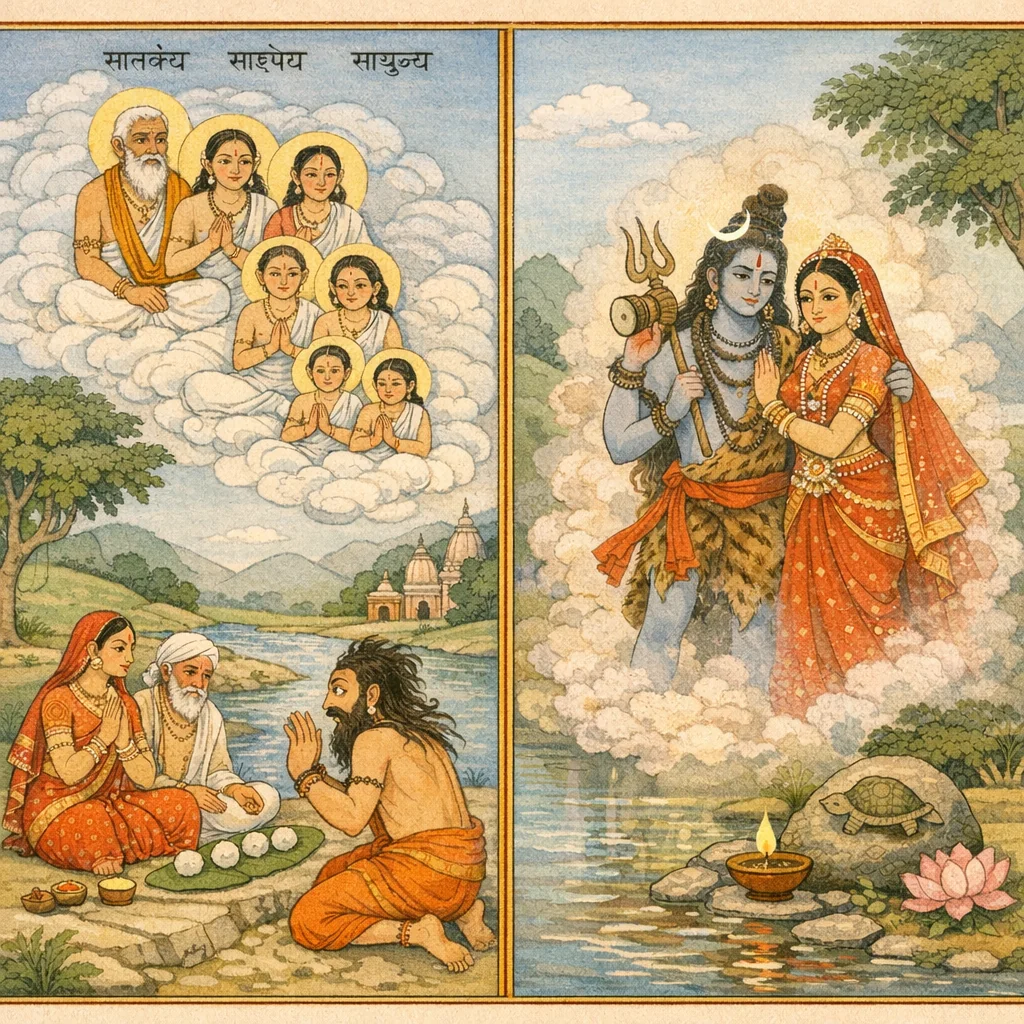
Continuing the sages’ questions to Romaharṣaṇa about famed holy places, this chapter begins a tīrtha-māhātmya sequence, listing major pilgrimage centers and praising the purifying power of sacred bathing, japa, homa, śrāddha, and dāna, said to uplift a family through generations. Prayāga is extolled, then the teaching turns to Gayā, the Pitṛ-beloved secret tīrtha where piṇḍadāna delivers the ancestors and supports mokṣa, stressing the duty of able descendants to go. The survey widens to many sites—Prabhāsa, Tryambaka, Someshvara, Vijaya, Ekāmra, Virajā, Puruṣottama, Gokarṇa and Uttara-Gokarṇa, Kubjāmra, Kokāmukha, Śālagrāma, Aśvatīrtha (Hayāśiras), and Puṣkara—each linked with fruits such as sālokya, sārūpya, sāyujya, Brahmaloka, and Viṣṇuloka. The narrative then shifts to Saptasārasvata: Maṅkaṇaka’s tapas and pride draw Rudra’s corrective theophany; with Devī, Rudra reveals a terrifying universal form and teaches a unitive metaphysics of prakṛti/māyā, puruṣa, īśvara, and kāla, declaring the triad Viṣṇu–Brahmā–Rudra to be grounded in one imperishable Brahman. The chapter closes by affirming bhakti-yoga as the means to realize this truth, while the tīrtha remains a locus of purification.
Shlokas
Verse 1
इती श्रीकूर्मपुराणे षट्साहस्त्र्यां संहितायामुपरिविभागे त्रयस्त्रिशो ऽध्यायः ऋषय ऊचुः तीर्थानि यानि लोके ऽस्मिन् विश्रुतानि माहन्ति च / तानि त्वं कथयास्माकं रोमहर्षण सांप्रतम्
Thus, in the Śrī Kūrma Purāṇa, in the six-thousand-verse Saṃhitā, in the latter division, begins the thirty-third chapter. The sages said: “O Romaharṣaṇa, tell us now about those sacred pilgrimage places (tīrthas) in this world that are renowned and greatly revered.”
Verse 2
रोमहर्षण उवाच शृणुध्वं कथयिष्ये ऽहं तीर्थानि विविधानि च / कथितानि पुराणेषु मुनिभिर्ब्रह्मवादिभिः
Romaharṣaṇa said: “Listen. I shall relate the many kinds of sacred tīrthas, as taught in the Purāṇas by sages who expound Brahman, the highest truth.”
Verse 3
यत्र स्नानं जपो होमः श्राद्धदानादिकं कृतम् / एकैकशो मुनिश्रेष्ठाः पुनात्यासप्तमं कुलम्
O best of sages, wherever bathing, japa (mantra-recitation), homa (fire-offering), and rites such as śrāddha and charitable gifts are performed—even each act by itself—one purifies a family down to the seventh generation.
Verse 4
पञ्चयोजनविस्तीर्णं ब्रह्मणः परमेष्ठिनः / प्रयागं प्रथितं तीर्थं तस्य माहात्म्यमीरितम्
Prayāga—renowned as the sacred tīrtha of Brahmā, the Supreme Lord (Parameṣṭhin)—extends for five yojanas. Now its greatness (māhātmya) is being proclaimed.
Verse 5
अन्यच्च तीर्थप्रवरं कुरूणां देववन्दितम् / ऋषीणामाश्रमैर्जुष्टं सर्वपापविशोधनम्
“And further, there is a most excellent sacred tīrtha of the Kurus—revered even by the gods—frequented by the hermitages of seers, and a purifier that washes away every sin.”
Verse 6
तत्र स्नात्वा विशुद्धात्मा दम्भमात्सर्यवर्जितः / ददाति यत्किञ्चिदपि पुनात्युभयतः कुलम्
Having bathed there, one whose mind is purified—free from hypocrisy and envy—if he gives even a little in charity, he sanctifies both lineages: the family of birth and the family of marriage.
Verse 7
गयातीर्थं परं गुह्यं पितॄणां चाति वल्लभम् / कृत्वा पिण्डप्रदानं तु न भूयो जायते नरः
Gayā-tīrtha is supremely holy and deeply hidden, exceedingly dear to the Pitṛs (ancestral spirits). Having offered the piṇḍas there, a man is not born again.
Verse 8
सकृद् गयाभिगमनं कृत्वा पिण्डं ददाति यः / तारिताः पितरस्तेन यास्यन्ति परमां गतिम्
Whoever, having gone to Gayā even once, offers the piṇḍa there—by him the forefathers are delivered, and they attain the supreme state.
Verse 9
तत्र लोकहितार्थाय रुद्रेण परमात्मना / शिलातले पदं न्यस्तं तत्र पितॄन् प्रसादयेत्
There, for the welfare of the worlds, Rudra—the Supreme Self, Paramātman—set down his footprint upon a stone-slab. At that very spot one should propitiate the Pitṛs.
Verse 10
गयाभिगमनं कर्तुं यः शक्तो नाभिगच्छति / शोचन्ति पितरस्तं वै वृथा तस्य परिश्रमः
One who is able to undertake the pilgrimage to Gayā yet does not go—his ancestors indeed grieve for him; all his other exertions become fruitless.
Verse 11
गायन्ति पितरो गाथाः कीर्तयन्ति महर्षयः / गयांयास्यतियः कश्चित् सो ऽस्मान् संतारयिष्यति
The forefathers sing hymns, and the great sages proclaim: “Whoever will go to Gayā—he will carry us across and deliver us (from the bondage of the ancestral state).”
Verse 12
यदि स्यात् पातकोपेतः स्वधर्मरतिवर्जितः / गयां यास्यति वंश्यो यः सो ऽस्मान् संतारयिष्यति
Even if a descendant is laden with sin and has fallen away from delight in his own dharma, if he goes to Gayā, he will ferry us—the ancestors—across the ocean of suffering.
Verse 13
एष्टव्या बहवः पुत्राः शीलवन्तो गुणान्विताः / तेषां तु समवेतानां यद्येको ऽपि गयां व्रजेत्
One should desire many sons—virtuous in conduct and endowed with good qualities—for if, among them all, even a single one goes to Gayā, the family’s ancestral purpose is fulfilled through the rites performed there.
Verse 14
तस्मात् सर्वप्रयत्नेन ब्राह्मणस्तु विशेषतः / प्रदद्याद् विधिवत् पिण्डान् गयां गत्वा समाहितः
Therefore, with every possible effort—especially a brāhmaṇa—having gone to Gayā and becoming inwardly collected, one should offer the piṇḍas in the proper ritual manner.
Verse 15
धन्यास्तु खलु ते मर्त्या गयायां पिण्डदायिनः / कुलान्युभयतः सप्त समुद्धृत्याप्नुयात् परम्
Blessed indeed are those mortals who offer piṇḍas at Gayā; having uplifted seven lineages on both sides—paternal and maternal—they attain the Supreme state.
Verse 16
अन्यच्च तीर्थप्रवरं सिद्धावासमुदाहृतम् / प्रभासमिति विख्यातं यत्रास्ते भगवान् भवः
And there is yet another foremost sacred ford, proclaimed as the abode of the siddhas, the perfected ones. It is famed by the name Prabhāsa, where the Blessed Lord Bhava—Śiva—abides.
Verse 17
तत्र स्नानं तपः श्राद्धं ब्राह्मणानां च पूजनम् / कृत्वा लोकमवाप्नोति ब्रह्मणो ऽक्षय्यमुत्तमम्
There, having performed sacred bathing, austerity (tapas), the śrāddha rites for the ancestors, and the honoring of the brāhmaṇas, one attains the supreme, imperishable realm of Brahman.
Verse 18
तीर्थं त्रैयम्बकं नाम सर्वदेवनमस्कृतम् / पूजयित्वा तत्र रुद्रं ज्योतिष्टोमफलं लभेत्
There is a sacred ford called Traiyambaka, revered and saluted by all the gods. Having worshipped Rudra there, one gains merit equal to that of the Jyotiṣṭoma Soma-sacrifice.
Verse 19
सुवर्णाक्षं महादेवं समभ्यर्च्य कपर्दिनम् / ब्राह्मणान् पूजयित्वा तु गाणपत्यं लभेद् ध्रुवम्
Having duly worshipped Mahādeva—the golden-eyed Lord, Kapardin (the matted-haired One)—and then honoring the brāhmaṇas, one surely attains the Gaṇapatya state, becoming a member of Śiva’s divine retinue.
Verse 20
सोमेश्वरं तीर्थवरं रुद्रस्य परमेष्ठिनः / सर्वव्याधिहरं पुण्यं रुद्रसालोक्यकारणम्
Someshvara is the most excellent of sacred fords, belonging to Rudra, the Supreme Lord. Holy and removing all afflictions, it becomes a cause for attaining Rudra’s sālokya—dwelling in the same divine realm as Rudra.
Verse 21
तीर्थानां परमं तीर्थं विजयं नाम शोभनम् / तत्र लिङ्गं महेशस्य विजयं नाम विश्रुतम्
Among all sacred pilgrimage-places, the most supreme is the splendid tīrtha called Vijaya. There, the liṅga of Maheśa is established—renowned throughout the world by the name “Vijaya.”
Verse 22
षण्मासान् नियताहारो ब्रह्मचारी समाहितः / उषित्वा तत्र विप्रेन्द्रा यास्यन्ति परमं पदम्
Dwelling there for six months—restrained in diet, established in brahmacarya, and inwardly collected—those best of brāhmaṇas shall attain the supreme state.
Verse 23
अन्यच्च तीर्थप्रवरं पूर्वदेशे सुशोभनम् / एकाम्रं देवदेवस्य गाणपत्यफलप्रदम्
And there is yet another foremost and splendid sacred ford in the eastern region—Ekāmra, belonging to the God of gods (Īśvara), which bestows the fruits associated with the Gaṇapatya path, devotion to Gaṇeśa.
Verse 24
दत्त्वात्र शिवभक्तानां किञ्चिच्छश्वन्महीं शुभाम् / सार्वभौमो भवेद् राजा मुमुक्षुर्मोक्षमाप्नुयात्
Here, by giving to devotees of Śiva even a small portion of auspicious land as an enduring gift, a king becomes a universal sovereign; and one who seeks liberation attains mokṣa.
Verse 25
महानदीजलं पुण्यं सर्वपापविनाशनम् / ग्रहणे समुपस्पृश्य मुच्यते सर्वपातकैः
The water of a great river is sacred and destroys all sins. By performing ritual ablution in it at the time of an eclipse, one is freed from every kind of grave sin.
Verse 26
अन्या च विरजा नाम नदी त्रैलोक्यविश्रुता / तस्यां स्नात्वा नरो विप्रा ब्रह्मलोके महीयते
And there is another river named Virajā, renowned throughout the three worlds. O brāhmaṇas, a person who bathes in her is honored and exalted in the realm of Brahmā (Brahmaloka).
Verse 27
तीर्थं नारायणस्यान्यन्नाम्ना तु पुरुषोत्तमम् / तत्र नारायणः श्रीमानास्ते परमपूरुषः
There is another sacred tīrtha of Nārāyaṇa, renowned by the name “Puruṣottama.” There the glorious Nārāyaṇa abides as the Supreme Person.
Verse 28
पूजयित्वा परं विष्णुं स्नात्वा तत्र द्विजोत्तमः / ब्राह्मणान् पूजयित्वा तु विष्णुलोकमवाप्नुयात्
Having worshiped the Supreme Viṣṇu and bathed there, the best of the twice-born—after honoring the brāhmaṇas—indeed attains the world of Viṣṇu (Viṣṇuloka).
Verse 29
तीर्थानां परमं तीर्थं गोकर्णं नाम विश्रुतम् / सर्वपापहरं शंभोर्निवासः परमेष्ठिनः
Among all tīrthas, the supreme holy place is renowned as Gokarṇa—destroyer of every sin, the very abode of Śambhu (Śiva), the highest Lord.
Verse 30
दृष्ट्वा लिंङ्गं तु देवस्य गोकर्णेश्वरमुत्तमम् / ईप्सितांल्लभते कामान् रुद्रस्य दयितो भवेत्
Having beheld the Lord’s supreme Gokarṇeśvara liṅga, one gains the desires one longs for and becomes dear to Rudra (Śiva).
Verse 31
उत्तरं चापि गोकर्णं लिङ्गं देवस्य शूलिनः / महादेवस्यार्चयित्वा शिवसायुज्यमाप्नुयात्
Likewise, at Uttara-Gokarṇa is the liṅga of the trident-bearing Lord. By worshiping Mahādeva there, one attains sāyujya—complete union and communion with Śiva.
Verse 32
तत्र देवो महादेवः स्थाणुरित्यभिविश्रुतः / तं दृष्ट्वा सर्वपापेभ्यो मुच्यते तत्क्षणान्नरः
There, the God Mahādeva is renowned by the name Sthāṇu. The very moment a person beholds Him, he is instantly released from all sins.
Verse 33
अन्यत् कुब्जाम्रमतुलं स्थानं विष्णोर्महात्मनः / संपूज्य पुरुषं विष्णुं श्वेतद्वीपे महीयते
There is yet another incomparable holy place of great-souled Viṣṇu, known as Kubjāmra. By duly worshipping Puruṣa Viṣṇu there, one is honoured and attains exalted status in Śvetadvīpa.
Verse 34
यत्र नारायणो देवो रुद्रेण त्रिपुरारिणा / कृत्वा यज्ञस्य मथनं दक्षस्य तु विसर्जितः
Where Lord Nārāyaṇa Himself—together with Rudra, the slayer of Tripura—having churned and set to order Dakṣa’s sacrifice, then departed from it.
Verse 35
समन्ताद् योजनं क्षेत्रं सिद्धर्षिगणवन्दितम् / पुण्यमायतनं विष्णोस्तत्रास्ते पुरुषोत्तमः
All around, extending for a yojana, lies a sacred region revered by hosts of Siddhas and Ṛṣis. It is the holy sanctuary of Viṣṇu; there the Supreme Person, Puruṣottama, abides.
Verse 36
अन्यत् कोकामुखं विष्णोस्तीर्थमद्भुतकर्मणः / मृतो ऽत्र पातकैर्मुक्तो विष्णुसारूप्यमाप्नुयात्
There is yet another sacred ford of Viṣṇu called Kokāmukha, renowned for its wondrous power. One who dies there is freed from sins and attains sārūpya-mukti, likeness of form with Viṣṇu.
Verse 37
शालग्रामं महातीर्थं विष्णोः प्रीतिविवर्धनम् / प्राणांस्तत्र नरस्त्यक्त्वा हृषीकेषं प्रपश्यति
Śālagrāma is a supreme tīrtha, ever increasing the delight of Lord Viṣṇu. One who relinquishes the life-breath there beholds Hṛṣīkeśa, the Lord of the senses.
Verse 38
अश्वतीर्थमिति ख्यातं सिद्धावासं सुपावनम् / आस्ते हयशिरा नित्यं तत्र नारायणः स्वयम्
It is famed as Aśvatīrtha, a supremely pure abode of the siddhas. There Nārāyaṇa Himself ever abides in the form of Hayāśiras, the Horse-headed Lord.
Verse 39
तीर्थं त्रैलोक्यविख्यातं ब्रह्मणः परमेष्ठिनः / पुष्करं सर्वपापघ्नं मृतानां ब्रह्मलोकदम्
Puṣkara is the sacred tīrtha renowned throughout the three worlds, belonging to Brahmā Paramēṣṭhin, the Supreme Lord of beings. It destroys all sins, and for those who die there it grants attainment of Brahmaloka.
Verse 40
मनसा संस्मरेद् यस्तु पुष्करं वै द्विजोत्तमः / पूयते पातकैः सर्वैः शक्रेण सह मोदते
O best of the twice-born, whoever truly remembers Puṣkara within the mind is purified of all sins and rejoices in the company of Śakra (Indra).
Verse 41
तत्र देवाः सगन्धर्वाः सयक्षोरगराक्षसाः / उपासते सिद्धसङ्घा ब्रह्मणं पद्मसंभवम्
There the gods—together with the Gandharvas, Yakṣas, Nāgas, and Rākṣasas—and the hosts of siddhas worship Brahmā, the lotus-born creator.
Verse 42
तत्र स्त्रात्वा भवेच्छुद्धो ब्रह्माणं परमेष्ठिनम् / पूजयित्वा द्विजवरान् ब्रह्माणं संप्रपष्यति
Bathing there, one becomes purified; then, having worshipped Brahmā, the Supreme Lord of beings, and having honored the foremost Brāhmaṇas, one beholds Brahmā directly.
Verse 43
तत्राभिगम्य देवेशं पुरुहूतमनिन्दितम् / सुरूपो जायते मर्त्यः सर्वान् कामानवाप्नुयात्
Having gone there and approached the Lord of the gods—Puruhūta, the blameless One—a mortal becomes radiant and well-formed, and may obtain all desired aims.
Verse 44
सप्तसारस्वतं तीर्थं ब्रह्माद्यैः सेवितं परम् / पूजयित्वा तत्र रुद्रमश्वमेधफलं लभेत्
Having worshipped Rudra at the supremely sacred Saptasārasvata Tīrtha—revered and frequented even by Brahmā and the other gods—one attains the merit equal to that of an Aśvamedha sacrifice.
Verse 45
यत्र मङ्कणको रुद्रं प्रपन्नः परमेश्वरम् / आराधयामास हरं पञ्चक्षरपरायणः
There, Maṅkaṇaka—having taken refuge in Rudra, the Supreme Lord—worshipped Hara with single-minded devotion, wholly devoted to the five-syllabled mantra.
Verse 46
नमः शिवायेति मुनिः जपन् पञ्चाक्षरं परम् / आराधयामास शिवं तपसा गोवृषध्वजम्
Repeating the supreme five-syllabled mantra—“namaḥ śivāya”—the sage, engaged in japa, worshipped Lord Śiva through austerity, Him whose emblem is the bull.
Verse 47
प्रजज्वालाथ तपसा मुनिर्मङ्कणकस्तदा / ननर्त हर्षवेगेन ज्ञात्वा रुद्रं समागतम्
Then the sage Maṅkaṇaka blazed with the heat of tapas; and, knowing that Rudra had arrived, he danced, swept up in a rush of joy.
Verse 48
तं प्राह भगवान् रुद्रः किमर्थं नर्तितं त्वया / दृष्ट्वापि देवमीशानं नृत्यति स्म पुनः पुनः
Then the blessed Lord Rudra said to him: “For what purpose have you danced? Even after beholding the Lord, Īśāna, you continue to dance again and again.”
Verse 49
सो ऽन्वीक्ष्य भगवानीशः सगर्वं गर्वशान्तये / स्वकं देहं विदार्यास्मै भस्मराशिमदर्शयत्
Seeing him swollen with pride, the Blessed Lord Īśa, to quell that arrogance, tore open His own body and showed him a heap of ashes.
Verse 50
पश्येमं मच्छरीरोत्थं भस्मराशिं द्विजोत्तम / माहात्म्यमेतत् तपसस्त्वादृशो ऽन्यो ऽपि विद्यते
“Behold this heap of ashes that has arisen from my own body, O best of the twice-born. Such is the majesty of tapas; indeed, another like you is also to be found.”
Verse 51
यत् सगर्वं हि भवता नर्तितं मुनिपुङ्गव / न युक्तं तापसस्यैतत् त्वत्तोप्यत्राधिको ह्यहम्
“O foremost of sages, the way you danced here in arrogance is not proper for an ascetic. In this matter, I am indeed superior even to you.”
Verse 52
इत्याभाष्य मुनिश्रेष्ठं स रुद्रः किल विश्वदृक् / आस्थाय परमं भावं ननर्त जगतो हरः
Thus, having addressed the foremost of sages, Rudra—the all-seeing—entered the supreme state of divine exaltation and danced as Hara, the Lord of the universe.
Verse 53
सहस्रशीर्षा भूत्वा सहस्राक्षः सहस्रपात् / दंष्ट्राकरालवदनो ज्वालामाली भयङ्करः
Becoming thousand-headed, thousand-eyed, and thousand-footed, he appeared with a mouth made dreadful by protruding fangs—garlanded with flames, terrifying to behold.
Verse 54
सो ऽन्वपश्यदशेषस्य पार्श्वे तस्य त्रिशूलिनः / विशाललोचनमेकां देवीं चारुविलासिनीम् / सूर्यायुतसमप्रख्यां प्रसन्नवदनां शिवाम्
Then he beheld, at the side of that Trident-bearing Lord who is the All, a single Goddess—wide-eyed and graceful in her charming play—radiant like ten thousand suns, serene-faced, auspicious, and benevolent.
Verse 55
सस्मितं प्रेक्ष्य विश्वेशं तिष्ठन्तीममितद्युतिम् / दृष्ट्वा संत्रस्तहृदयो वेपमानो मुनीश्वरः / ननाम शिरसा रुद्रं रुद्राध्यायं जपन् वशी
Seeing Viśveśvara standing there—radiant with immeasurable splendor and smiling gently—the lordly sage trembled within; his heart shook with awe and fear. Self-controlled, he bowed his head to Rudra and began to recite the Rudra-hymn, the Rudrādhyāya.
Verse 56
प्रसन्नो भगवानीशस्त्र्यम्बको भक्तवत्सलः / पूर्ववेषं स जग्राह देवी चान्तर्हिताभवत्
Pleased, the Blessed Lord—Īśa, the three-eyed Tryambaka, ever affectionate to His devotees—assumed His former appearance; and the Goddess disappeared from sight.
Verse 57
आलिङ्ग्य भक्तं प्रणतं देवदेवः स्वयंशिवः / न भेतव्यं त्वया वत्स प्राह किं ते ददाम्यहम्
Embracing the devoted worshipper who had bowed down, the God of gods—Śiva himself—said: “Do not fear, dear child. Tell me—what shall I grant you?”
Verse 58
प्रणम्य मूर्ध्ना गिरिशं हरं त्रिपुरसूदनम् / विज्ञापयामास तदा हृष्टः प्रष्टुमना मुनिः
Bowing with his head, the sage paid homage to Girīśa—Hara, the slayer of Tripura—and then, delighted and eager to inquire, he respectfully submitted his request.
Verse 59
नमो ऽस्तु ते महादेव महेश्वर नमो ऽस्तु ते / किमेतद् भगवद्रूपं सुघोरं विश्वतोमुखम्
Homage to you, O Mahādeva; homage to you, O Maheśvara. What is this form of the Blessed Lord—so awe-inspiring and terrifying—whose faces are turned in every direction?
Verse 60
का च सा भगवत्पार्श्वे राजमाना व्यवस्थिता / अन्तर्हितेव सहसा सर्वमिच्छामि वेदितुम्
Who was that radiant one, standing resplendent at the Blessed Lord’s side? She vanished all at once as if concealed—about everything I wish to know.
Verse 61
इत्युक्ते व्याजहारमं तथा मङ्कणकं हरः / महेशः स्वात्मनो योगं देवीं च त्रिपुरानलः
When this was said, Hara—Mahādeva, the Burner of Tripura—then spoke, addressing Maṅkaṇaka, and expounded the Yoga of his own inner Self, together with the Goddess (Devī).
Verse 62
अहं सहस्रनयनः सर्वात्मा सर्वतोमुखः / दाहकः सर्वपापानां कालः कालकरो हरः
I am the Thousand‑Eyed One; the Self of all, facing every direction. I burn away all sins; I am Time, the maker of Time, and Hara, the Remover.
Verse 63
मयैव प्रेर्यते कृत्स्नं चेतनाचेतनात्मकम् / सो ऽन्तर्यामी स पुरुषो ह्यहं वै पुरुषोत्तमः
By Me alone is this entire universe impelled—everything, sentient and insentient. That is the Inner Ruler (Antaryāmin); that is the Person (Puruṣa). Indeed, I am that very Puruṣottama, the Supreme Person.
Verse 64
तस्य सा परमा माया प्रकृतिस्त्रिगुणात्मिका / प्रोच्यते मुनिर्भिशक्तिर्जगद्योनिः सनातनी
His supreme Māyā—namely Prakṛti, constituted of the three guṇas—is declared by the sages to be the eternal Power (Śakti), the womb from which the universe arises.
Verse 65
स एष मायया विश्वं व्यामोहयति विश्ववित् / नारायणः परो ऽव्यक्तो मायारूप इति श्रुतिः
He, knower of the whole universe, through His Māyā causes this world to be deluded. Nārāyaṇa is the Supreme, the Unmanifest (Avyakta); the Śruti declares that He is of the nature of Māyā—as its Lord and power.
Verse 66
एवमेतज्जगत् सर्वं सर्वदा स्थापयाम्यहम् / योजयामि प्रकृत्याहं पुरुषं पञ्चविंशकम्
Thus I continually uphold this entire universe at all times; and through Prakṛti I join and set in operation the twenty‑fifth principle, Puruṣa.
Verse 67
तथा वै संगतो देवः कूटस्थः सर्वगो ऽमलः / सृजत्यशेषमेवेदं स्वमूर्तेः प्रकृतेरजः
Thus the Lord—though associated with manifestation—remains unchanging, all-pervading, and stainless; and, unborn, He brings forth this entire universe without remainder from His own form, namely Prakṛti (Nature).
Verse 68
स देवो भगवान् ब्रह्मा विश्वरूपः पितामहः / तवैतत् कथितं सम्यक् स्त्रष्ट्वत्वं परमात्मनः
That very deity—Bhagavān Brahmā, the Grandfather of the worlds, whose form is the entire cosmos—has been rightly described by you as the Supreme Self’s power of creation.
Verse 69
एको ऽहं भगवान् कलो ह्यनादिश्चान्तकृद् विभुः / समास्थाय परं भावं प्रोक्तो रुद्रो मनीषिभिः
“I alone am the Blessed Lord—Time itself: beginningless, all-pervading, and the bringer of dissolution. Abiding in the supreme state of being, I am declared by the wise to be Rudra.”
Verse 70
मम वै सापरा शक्तिर्देवी विद्येति विश्रुता / दृष्टा हि भवता नूनं विद्यादेहस्त्वहं ततः
Indeed, My higher power is renowned as the Goddess called Vidyā (Sacred Knowledge). Surely she has now been seen by you; therefore I am the very embodied form of that Knowledge (the Vidyā-body).
Verse 71
एवमेतानि तत्त्वानि प्रधानपुरुषेश्वराः / विष्णुर्ब्रह्मा च भगवान् रुद्रः काल इति श्रुतिः
Thus are these principles (tattvas) taught—Pradhāna, Puruṣa, and Īśvara. And the sacred tradition (śruti) also speaks of Viṣṇu, Brahmā, and the Blessed Lord Rudra, as well as Time (Kāla).
Verse 72
त्रयमेतदनाद्यन्तं ब्रह्मण्येव व्यवस्थितम् / तदात्मकं तदव्यक्तं तदक्षरमिति श्रुतिः
This triad—without beginning or end—abides in Brahman alone. The śruti declares it to be of That very essence: That is the Unmanifest (Avyakta), and That is the Imperishable (Akṣara).
Verse 73
आत्मानन्दपरं तत्त्वं चिन्मात्रं परमं पदम् / आकाशं निष्कलं ब्रह्म तस्मादन्यन्न विद्यते
The supreme Reality is founded in the bliss of the Self; it is pure Consciousness alone (cin-mātra), the highest state. It is the all-pervading, sky-like Brahman, partless and without division—apart from That, nothing else exists.
Verse 74
एवं विज्ञाय भवता भक्तियोगाश्रयेण तु / संपूज्यो वन्दनीयो ऽहं ततस्तं पश्य शाश्वतम्
Thus, having understood (this truth) by taking refuge in bhakti-yoga, you should worship and bow to Me; then, behold that Eternal One.
Verse 75
एतावदुक्त्वा भगवाञ्जगामादर्शनं हरः / तत्रैव भक्तियोगेन रुद्रामाराधयन्मुनिः
Having said only this much, the Blessed Lord Hara vanished from sight. There itself, the sage continued to worship Rudra through the yoga of devotion.
Verse 76
एतत् पवित्रमतुलं तीर्थं ब्रह्मर्षिसेवितम् / संसेव्य ब्राह्मणो विद्वान् मुच्यते सर्वपातकैः
This peerless, purifying sacred ford (tīrtha) is attended by the great Brahmarṣis. A learned brāhmaṇa, by duly resorting to it, is released from all sins.
Frequently Asked Questions
The chapter praises sites such as Prayāga and Gayā (ancestral deliverance through piṇḍadāna), Prabhāsa/Tryambaka/Someshvara/Vijaya/Ekāmra (Śaiva merit and states like Gaṇapatya affiliation and Rudra-sālokya), Puruṣottama and other Viṣṇu-tīrthas like Kokāmukha and Śālagrāma (Viṣṇuloka, sārūpya), and Puṣkara (Brahmaloka), presenting a spectrum of bhukti–mukti results.
It places Viṣṇu, Rudra/Śiva, and Brahmā tīrthas in one salvific map and culminates in Rudra’s teaching that the triad and kāla rest in one imperishable Brahman, while also acknowledging Devī as Vidyā-Śakti—thus aligning bhakti, ritual, and Vedānta.
Rudra describes the supreme as partless, all-pervading pure consciousness (Brahman) and frames the manifest universe as moved through māyā/prakṛti; liberation is oriented toward realizing/“beholding” the Eternal through refuge in bhakti-yoga, implying non-dual grounding with devotional access.
It integrates both: tīrtha acts (bathing, śrāddha, dāna) are praised for purification and lineage welfare, while the Maṅkaṇaka episode explicitly elevates inner transformation—humility, devotion, and knowledge of tattvas—as essential to final realization.