Adhyaya 37
The Destiny of Those Who Die Through Fasting & the Procedure of Udakumbha-dāna
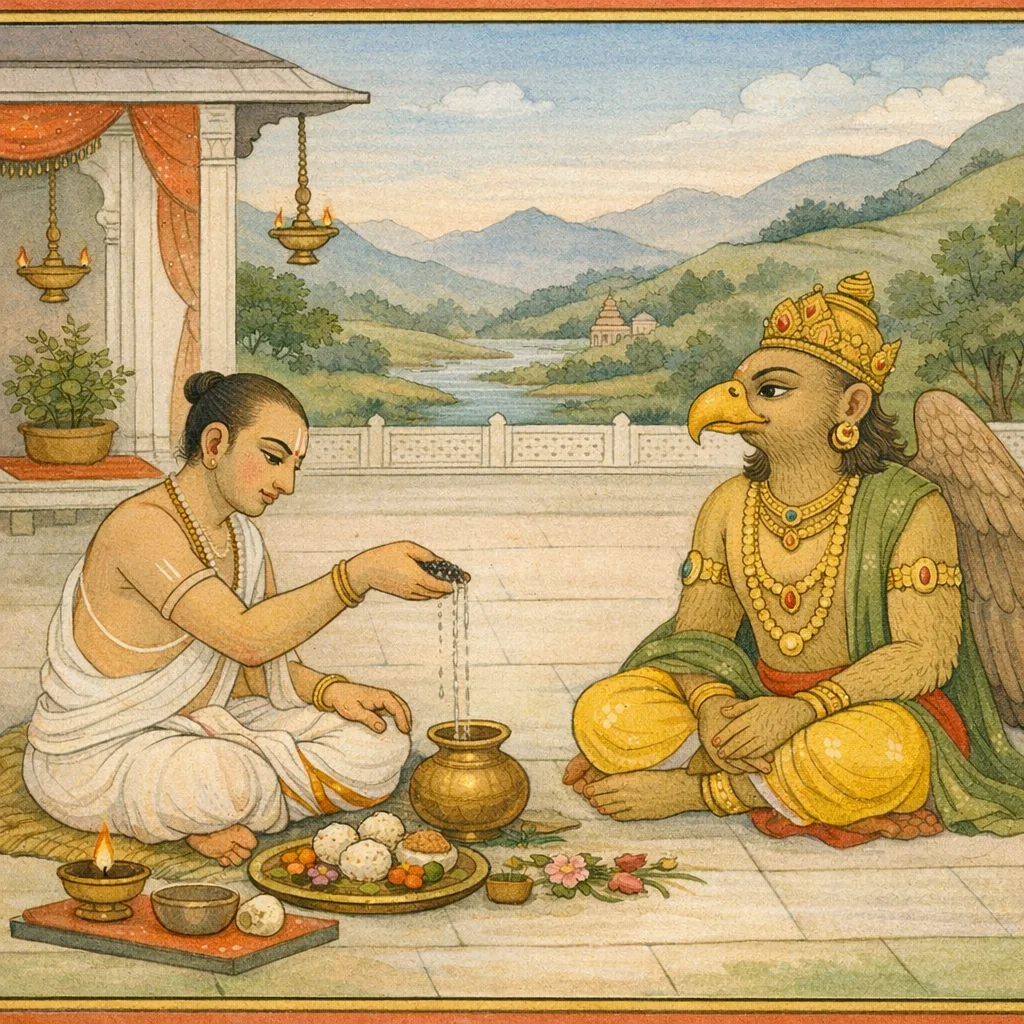
Continuing the Preta Kalpa’s ritual and ethical guidance for post-death transition, Garuḍa asks Janārdana (Śrī Kṛṣṇa/Viṣṇu) for a precise account of udakumbha-dāna—its marks, conditions of completion, proper recipients, and timing—especially for acts that satisfy the preta. Viṣṇu reaffirms the truth of gifting a water pot with the preta in view, accompanied by food and drink, as a liberative support for the departed’s journey. The chapter lays out a ritual calendar: gifts on the twelfth day, at six months, over a three-fortnight interval, and at year’s end; along with daily water offerings mixed with sesame and the placing of water pots with cooked food on purified ground. It integrates the 16-offering/16-śrāddha scheme, assigns offerings to sixteen Brāhmaṇas, and prescribes a year-long daily offering (Dṛḍhāhvaya). Finally, it tightens dharma criteria: gifts must be given to learned, well-conducted, Veda-aligned recipients, bridging to later teachings on sustained śrāddha discipline and the transfer of merit.
Shlokas
Verse 1
ऽनशनमृत गतिनिरूपणं नाम षट्त्रिंशो ऽध्यायः तार्क्ष्य उवाच / उदकुम्भप्रदानं मे कथयस्व यथातथम् / विधिना केन कर्तव्या कृतिरेषा जनार्दन
“(This is) the chapter called ‘The description of the destiny of those who die through fasting.’ Tārkṣya (Garuda) said: ‘Tell me truly, just as it is, about the gift of a water-pot (udakumbha-dāna). By what prescribed rite should this act be performed, O Janārdana?’”
Verse 2
किंलक्षणाः केन पूर्णाः कस्य देया जनार्दन / कस्मिन् काले प्रदातव्या प्रेततृप्तिप्रसाधकाः
O Janārdana, what are the defining marks of these offerings, with what should they be properly completed, to whom should they be given, and at what time should they be offered—those acts that bring satisfaction to the preta, the departed spirit?
Verse 3
श्रीकृष्ण उवाच / सत्यं पुनः प्रवक्ष्यामि उदकुम्भप्रदानकम् / प्रेतोद्देशेन दातव्या अन्नपानीयसंयुताः / विशेषेण महापक्षिन् प्रेतमुक्तिप्रदायकाः
Śrī Kṛṣṇa said: I shall again speak the truth about the giving of a water-pot (udakumbha-dāna). Such gifts should be made with the preta in mind, accompanied by offerings of food and drink. Especially, O great-winged one (Garuda), they bestow liberation upon the preta.
Verse 4
द्वादशाहे च पण्मासे त्रैपक्षे वापि वत्सरे / उदकुम्भाः प्रदातव्या मार्गे तस्य सुखाय वै
On the twelfth day, at the completion of six months, during the three-fortnight period, or at the end of the year, water-pots should be given in charity; truly, this brings him comfort on his journey after death.
Verse 5
अहन्यहनि दातव्या उदकुम्भास्तिलैर्युताः / सुलिप्ते भूमिभागे तु पक्कान्नजलपूरिताः
Day after day, one should offer water-pots mixed with sesame seeds; and on a well-smeared, purified spot of ground, one should place pots filled with water along with cooked food.
Verse 6
प्रेतस्य तत्र दातव्यं भाजनञ्च यदृच्छया / सुप्रीतस्तेन दत्तेन प्रेतो याम्यैः स गच्छति
There, one should give the preta a vessel (a bowl or container) as one is able. Pleased by what has been offered, the preta then proceeds along with Yama’s attendants.
Verse 7
द्वादशाहे विशेषेण उदकम्भान् प्रदापयेत् / विधिना तत्र सङ्कल्पय घटान् द्वादशसंख्यकान्
In particular, on the twelfth-day rite, one should give water-pots in charity; and there, according to the prescribed procedure, one should make a formal saṅkalpa for twelve water-jars, numbering twelve.
Verse 8
एकाषि बर्धनी तत्र पक्वान्नफलपूरिता / विष्णुमुद्दिश्य दातव्या संकल्प्य ब्राह्मणे शुभे
On Ekādaśī, one should prepare a ritual vessel or tray filled with cooked food and fruits; after making a proper saṅkalpa, it should be given to a worthy, auspicious Brāhmaṇa, dedicating the gift to Lord Viṣṇu.
Verse 9
एको वै धर्मराजाय तेन तुष्टेन मुक्तिभाक् / चित्रगुप्ताय चैकं तु गतस्तत्र सुखी भवेत्
If one makes a single proper offering to Dharmarāja (Yama), then, when he is pleased, one becomes a recipient of liberation. And if one makes a single proper offering to Chitragupta, upon reaching that realm one becomes happy.
Verse 10
षोडशाद्याः प्रदातव्या माषान्नजलपूरिताः
Beginning with the prescribed sixteen offerings, they should be given—filled with black-gram food (māṣa) and water.
Verse 11
उक्त्रान्तिश्राद्धमारभ्य श्राद्धषोडषोडशकस्य तु / षोडशब्राह्मणानान्तु एकैकं विनिवदयेत्
Beginning with the funeral śrāddha, and throughout the full set of the sixteen śrāddhas, one should respectfully offer the rite and its gifts to sixteen Brāhmaṇas, assigning them one by one.
Verse 12
एकादशाहात्प्रभृति देयो नित्यं दृढाह्वयः / पक्वान्नजलपूर्णो हि यावत् संवत्सरं दिनम्
From the eleventh day onward, one should give daily the offering called Dṛḍhāhvaya—consisting of cooked food and water—continuing each day for a full year.
Verse 13
जलपात्राणि वृद्धानि दत्तानिघटकानि च / एका वै वर्धनी तत्र तस्यां पात्रन्तु वंशजम्
Old water-vessels and donated pots should also be offered. Among them there is one vessel called the “vardhanī”; in that vessel one should designate a worthy recipient from one’s own lineage—that is, make the offering with the rightful family beneficiary in view.
Verse 14
वस्त्रेणाच्छादयेत् तान्तु पूजयित्वा सुगन्धिभिः / ब्राह्मणेभ्यो विशेषेण जलपूर्णानि दापयेत्
One should cover it with a cloth and, having worshiped it with fragrant offerings, should especially give to the Brāhmaṇas vessels filled with water.
Verse 15
अहन्यहनि सङ्कल्प्य विधिपूर्वं खगेश्वर / ब्राह्मणाय कुलीनाय वेदवृत्तयुताय च
O Lord of birds (Garuda), having made the proper daily saṅkalpa and followed the prescribed rite, one should give the offering to a well-born Brāhmaṇa who lives by the Veda and is endowed with Vedic conduct.
Verse 16
विद्यावृत्तवते देयं मूर्खे तन्न कदाचन / समर्थो वेदवृत्ताढ्यस्तारणे तरणे ऽपि च
Charity should be given to one who is learned and of good conduct, never to a fool. The capable person—rich in Vedic knowledge and right discipline—becomes a true support, both in helping one cross over and in the very act of crossing.
Frequently Asked Questions
It is performed with explicit preta-intent (preta-uddeśa) and saṅkalpa, offering water pots—often mixed with sesame—placed on a purified ground along with cooked food; the gifts are then given as charity to qualified Brāhmaṇas, especially emphasized on the twelfth day and other calendrical milestones.
The chapter presents Yama (Dharmarāja) and Chitragupta as karmic-juridical authorities: even a single properly made offering that pleases Yama is said to support liberation, while an offering to Chitragupta is described as producing well-being/happiness upon reaching their domain—signaling reconciliation within the moral accounting of the afterlife.
Because the rite’s completion (saṃpatti) is tied to dharma: a Veda-living, good-conduct recipient is treated as a ‘true support’ for crossing (tāraṇa) and the act of crossing itself, whereas giving to the unqualified is explicitly discouraged as ritually and ethically unsound.