Adhyaya 64
Strīlakṣaṇa: Auspicious Marks, Domestic Ideals, and Saubhāgya Practices
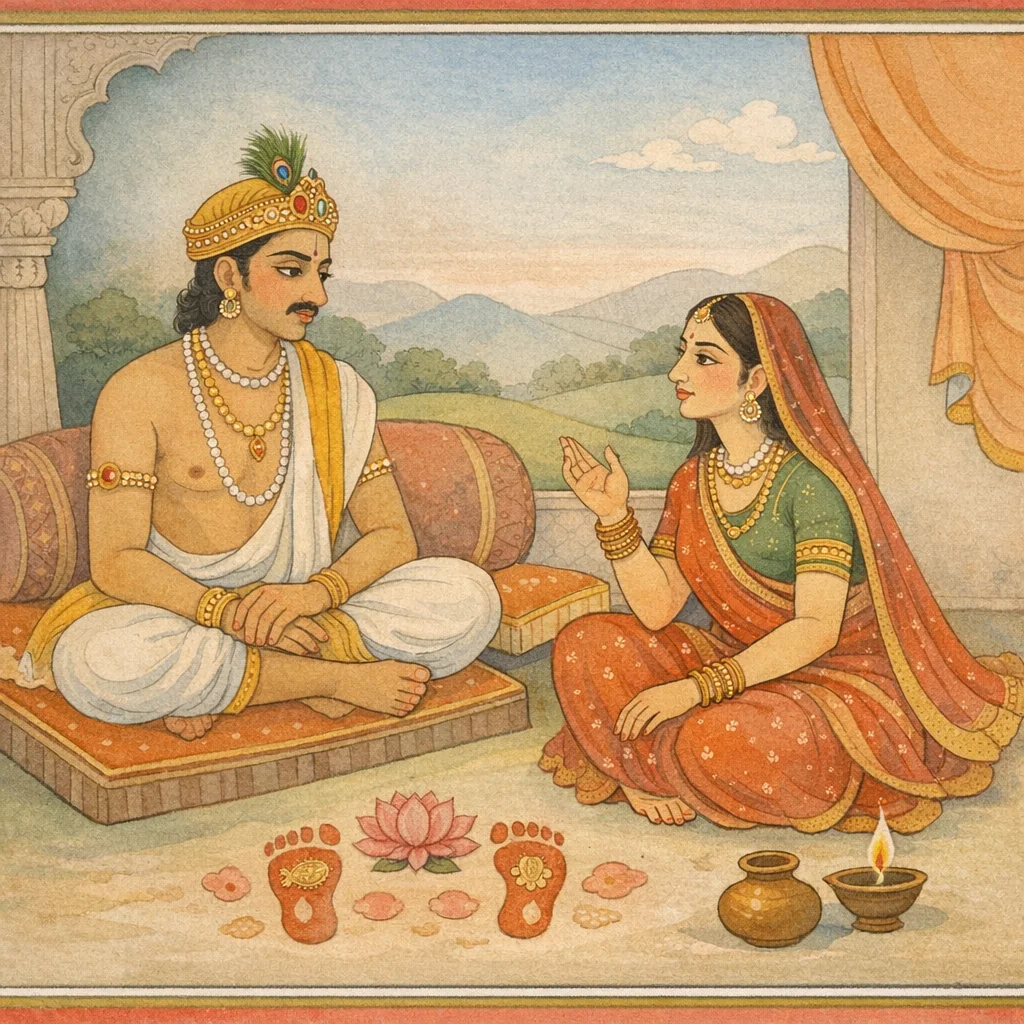
Continuing its Ācāra-focused instruction, Hari sets out a lakṣaṇa-based appraisal of feminine auspiciousness and its believed effects on lineage, prosperity, and marital stability. The chapter first lists bodily signs—curly hair, facial form, a right-turning navel, complexion, and the color of the palms—linking some to upliftment and the stature of a pativratā, while warning that other combinations foretell widowhood or sorrow. It then turns to omens in red/black lines and states a normative domestic ethic: a wife should advise wisely in work, assist capably in execution, nurture with motherly affection, and remain auspicious in conjugal life. Further verses describe palm and foot marks (aṅkuśa, cakra, lotus, fish, plough, and the “wall-and-gate” line) as signs of rising to queenship or royal marriage, contrasted with traits said to lead to servitude or marital harm. The chapter closes with saubhāgya and comfort practices such as oiling the eyes, teeth, skin, and feet, and with detailed praise of auspicious feet and bodily features, framing bodily discipline and household harmony as dharmic supports.
Shlokas
Verse 1
पुंल्लक्षणनिरूपणं नाम त्रिषष्टितमो ऽध्यायः हरिरुवाच / यस्यास्तु कुञ्चिताः केशा मुखं च परिमण्डलम् / नाभिश्च दक्षिणावर्ता सा कन्या कुलवर्धिनी
Hari said: “That maiden whose hair is naturally curly, whose face is well-rounded, and whose navel turns to the right is one who increases and uplifts her family line.”
Verse 2
या च काञ्चनवर्णाभा रक्तहस्तसरोरुहा / सहस्राणां तु नारीणां भवेत्सापि पतिव्रता
A woman who shines with a golden complexion and whose hands—whose lotus-like palms—are red, even among thousands of women, is to be regarded as pativratā, a wife devoted to her husband.
Verse 3
वक्रकेशा च या कन्या मण्डलाक्षी च या भवेत् / भर्ता च म्रियते तस्या नियतं दुः खभागिनी
A maiden whose hair is curly, and one who has round eyes—her husband dies; she is certainly destined to partake of sorrow.
Verse 4
पूर्णचन्द्रमुखी कन्या बालसूर्यसमप्रभा / विशालनेत्रा बिम्बोष्ठी सा कन्या लभते सुखम्
A maiden with a face like the full moon, radiant like the rising sun—wide-eyed and with lips like the bimba fruit—such a girl attains happiness.
Verse 5
रेखाभिर्बहुभिः क्लेशं स्वल्पाभिर्धनहीनता / रक्ताभिः सुखमाप्नोति कृष्णाभिः प्रेष्यतांव्रजेत्
With many lines (upon the body) one meets distress; with few lines there is want of wealth. With red lines one attains happiness; with black lines one falls into servitude.
Verse 6
कार्ये च मन्त्री सत्स्त्री स्यात्सती (खी) स्यात्करणेषु च / स्त्रेहेषु भार्या माता स्याद्वेश्या च शयने शुभा
In matters of work, a wife should be like a wise counsellor; in carrying out tasks, a devoted and capable helpmate. In affection, she should be like a mother; and in the bedchamber, an auspicious beloved.
Verse 7
अङ्कुशं कुण्डलं चक्रं यस्याः पाणितले भवेत् / पुत्रं प्रसूयते नारी नरेन्द्रं लभते पतिम्
A woman whose palm bears the marks of a goad (aṅkuśa), an earring (kuṇḍala), and a discus (cakra) gives birth to a son and obtains a king as her husband.
Verse 8
यस्यास्तु रोमशौ पार्श्वौ रोमशौ च पयोधरौ / अन्नतौ चाधरोष्ठौ च क्षिप्रं मारयते पतिम्
A woman whose flanks are hairy, whose breasts are hairy, and whose lower lip is thick is said to bring about her husband’s death swiftly.
Verse 9
यस्याः पाणितले रेखा प्राकारस्तोरणं भवेत् / अपि दासकुले जाता राज्ञीत्वमुपगच्छति
A woman whose palm bears a line resembling a fortified wall and gateway—though born even in a servant’s family—attains the status of a queen.
Verse 10
उद्वृत्ता कपिला यस्य रोमराजी निरन्तरम् / अपि राजकुले जाता दासीत्वमुपगच्छति
A woman whose body-hair stands bristling and tawny, with an unbroken line of hair (romarājī), even if born in a royal house, comes to the state of servitude.
Verse 11
यस्या अनामिकाङ्गुष्ठौ पृथिव्यां नैव तिष्ठतः / पतिं मारयते क्षिप्रं स्वेच्छाचारेण वर्तते
A woman whose ring finger and thumb do not properly rest upon the earth as prescribed quickly brings about her husband’s death, for she lives by self-willed, undisciplined conduct.
Verse 12
यस्या गमनमात्रेण भूमिकम्पः प्रजायते / पतिं मारयते क्षिप्रं स्वेच्छाचारेण वर्तते
She by whose mere movement an earthquake is produced quickly brings about her husband’s death and lives according to her own willful, undisciplined conduct.
Verse 13
चक्षुः स्नेहेन सौभाग्यं दन्तस्नेहेन भोजनम् / त्वचः स्नेहेन शाय्यां च पादस्नेहेन वाहनम्
By anointing the eyes with oil comes good fortune; by oiling the teeth comes enjoyment of food. By oiling the skin comes comfort in bed, and by oiling the feet comes ease in travel, as though one had a vehicle.
Verse 14
स्निग्धोन्नतौ ताम्रनखौ नार्याश्च चरणौ शुभौ / मत्स्याङ्कुशाब्जचिह्नौ च चक्रलाङ्गललक्षितौ
A woman’s auspicious feet are smooth and slightly raised, with coppery-red nails; they bear the marks of a fish, a goad (aṅkuśa), and a lotus, and are also distinguished by the signs of the discus (cakra) and a plough.
Verse 15
अस्वेदिनौ मूदुतलौ प्रशस्तौ चरणौ स्त्रियाः / शुभे जङ्घे विरोमे च ऊरू हस्तिकरोपमौ
A woman’s feet are praised as auspicious when they do not perspire and their soles are soft; her shanks are fair and free of hair, and her thighs resemble an elephant’s trunk.
Verse 16
अश्वत्थपत्रसदृशं विपुलं गुह्यमुत्तमम् / नाभिः प्रशस्ता गम्भीरा दक्षिणावर्तिका शुभा / अरोमा त्रिवली नार्या हृत्स्तनौ रोमवर्जितौ
Her most excellent private region is broad and well-concealed, like a sacred aśvattha leaf. Her navel is praised—deep, auspicious, and right-turning. There she is hairless; her abdomen bears three folds, and her chest and breasts are free of hair.
Frequently Asked Questions
It is praised as an auspicious bodily sign associated with well-being and favorable fortune; the text treats it as a lakṣaṇa indicating stability and prosperity within household life.
These marks function as samudrika-style auspicious emblems (maṅgala-lakṣaṇa) used to symbolize elevation, protection, prosperity, and high status; the chapter applies them to marital and social outcomes (e.g., queenship or royal alliance).
The text links bodily care (oiling eyes, teeth, skin, and feet) with saubhāgya and comfort—suggesting that disciplined self-care supports household harmony, readiness for duties, and a stable domestic life.