Adhyaya 63
Lakṣaṇas of Men: Feet, Shanks, Hair, Genitals, Abdomen, and Lines of Longevity (Forehead & Palm)
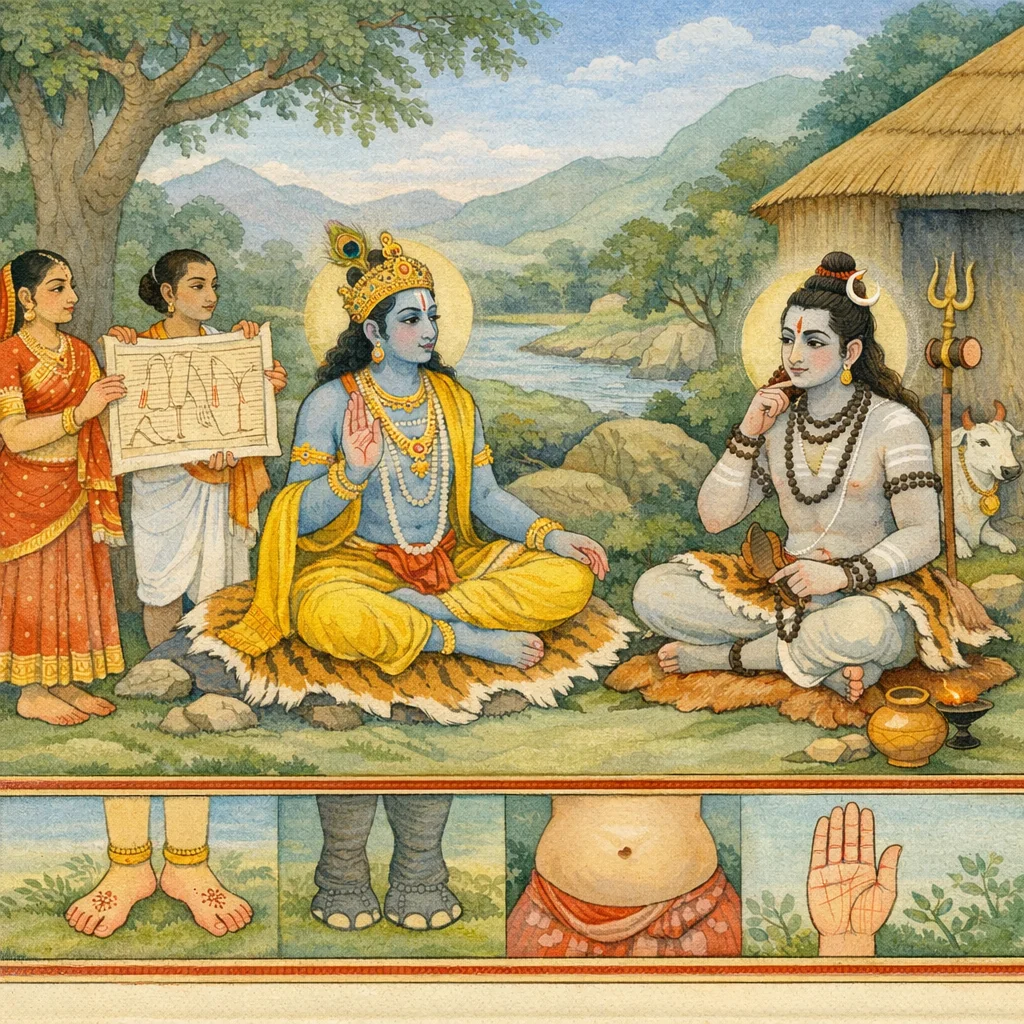
Continuing the Brahma Khanda’s Lakṣaṇa-śāstra, Hari teaches Śaṅkara/Rudra how bodily features are read as karmic signs of fortune or poverty, kingship, progeny, and lifespan. He begins with auspicious feet—soft, non-sweaty, lotus-like—and contrasts them with inauspicious deformities such as rough or pale nails, spaced toes, and contracted joints. Shanks are judged by hair and shape, with elephant-foreleg imagery marking excellence. He then links body-hair, knees, and reproductive traits to poverty, disease, children, and temperament, and notes gems as omens affecting vitality and wealth. Abdominal forms and signs in urination are next treated as indicators of prosperity or destitution. The chapter culminates in longevity diagnosis through forehead and palm lines—trident/axe marks, the number and clarity of lines, and the course and endpoints of the āyu-rekhā (life-line). It anchors the interpretive method for later chapters: external marks are read as indicators of karma, guiding worldly duty and dharmic self-correction.
Shlokas
Verse 1
शुभाशुभस्थानादिनिरूपणं नामैकपष्टितमो ऽध्यायः प्रमाणादिनिरूपणं नाम द्विषष्टितमो ऽध्यायः हरिरुवाच / नरस्त्रीलक्षणं वक्ष्ये संक्षपाच्छृणु शङ्कर / अस्वेदिनौ मृदुतलौ कमलोदरसन्निभौ
Hari said: “O Śaṅkara, listen in brief. I shall describe the marks of men and women. (Their soles) are not prone to sweating, are soft to the touch, and resemble the inner part of a lotus.”
Verse 2
श्लिष्टाङ्गुली ताम्रनखौ सुगुल्फौ शिरयोज्झितौ / कूर्मोन्नतौ च चरणौ स्यातां नृपवरस्य हि
A foremost king should have feet with close-set toes, copper-hued nails, well-formed ankles, prominent veins, and soles raised like a tortoise’s back.
Verse 3
विरूक्षपाण्डुरनखौ वक्रौ चैव शिरानतौ / सूर्पाकारौ च चरणौ संखुष्कौ विरलाङ्गुली
Their nails are rough and pale; their feet are crooked, as though bent downward. The feet are shaped like winnowing-baskets; the joints are dry and contracted, and the toes are sparse and far apart.
Verse 4
दुः खदारिद्यदौ स्याता नात्र कार्यां विचारणा / अल्परोमयुता श्रेष्ठा जङ्घा हस्तिकरोपमा
If (the shanks) bear the marks of sorrow and poverty, there is no need for further deliberation. The best shanks have scant hair and resemble the foreleg of an elephant.
Verse 5
रोमैकैकं कूपके स्याद्भूपानां तु महात्मनाम् / द्वेद्वे रोम्णी पण्डितानां श्रोत्रियाणां तथैव च
For great-souled kings, each single hair becomes a well of merit. For learned men and Veda-trained śrotriyas, each hair likewise becomes two such wells.
Verse 6
रोमत्रयं दरिद्राणां रोगी निर्मांसजानुकः / अल्पलिङ्गी च धनवान्स्याच्च पुत्रादिवर्जितः
One who has only three body-hairs is said to be poor; one whose knees are without flesh becomes diseased. One with a small generative organ may be wealthy, yet he will be deprived of sons and other offspring.
Verse 7
स्थूललिङ्गो दरिद्रः स्याद्दुख्येकवृष्णी भवेत् / विषमेस्त्रीचञ्चलो वै नृपः स्याद्वृषणे समे
One whose generative organ is large becomes poor and lives in suffering; one who has only a single testicle becomes unhappy. If the testicles are uneven, he becomes fickle toward women; but if they are even, he becomes a king.
Verse 8
प्रलम्बवृषणो ऽल्पायुर्निर्द्रव्यः कुमणिर्भवेत् / पाण्डुरैर्मलिनैश्चैव मणिभिश्च सुखी नरः
A man who wears inferior (inauspicious) gems becomes one with hanging testicles, a shortened lifespan, and loss of wealth. Yet, by wearing pale and blemished stones, a man may still live comfortably.
Verse 9
निः स्वाः सशब्दमूत्राः स्युर्नृपा निःशब्दधारया / भोगाढ्याः समजठरा निः स्वाः स्युर्घटसन्निभाः
Kings who become destitute pass urine with noise, whereas those with a silent stream are considered well-provided. Those rich in indulgence, with bellies grown uniformly large, become destitute too—appearing like pots.
Verse 10
सर्पोदरा दरिद्राः स्यू रेखाभिश्चायुरुच्यते / ललाटे यस्य दृश्यन्ते तिस्रो रेखाः समाहिताः
Those whose belly is like a serpent’s are said to be poor; and one’s lifespan is spoken of through the lines (marks). He on whose forehead three well-formed, orderly lines are seen is thereby shown to bear a notable sign of longevity.
Verse 11
सुखी पुत्रसमायुक्तः स षष्टिं जीवते नरः / चत्वारिंशच्च वर्षाणि द्विरेखादर्शनान्नरः
A man who is happy and blessed with sons is said to live for sixty years. But a man who bears the sign of a “double line” lives for forty years.
Verse 12
विंशत्यब्दं त्वेकरेखा आकर्णान्ताः शतायुषः
A single line indicates a lifespan of twenty years; those whose marks extend as far as the ears are said to live for a hundred years.
Verse 13
सप्तत्यायुर्द्विरेखा तु षष्ट्यायुस्तिसृभिर्भवेत् / व्यक्ताव्यक्ताभी रेखाभिर्विंशत्यायुर्भवेन्नरः
With two distinct lines, one is said to have a lifespan of seventy years; with three lines, sixty years. But when the lines are partly clear and partly unclear, a man is said to have a lifespan of twenty years.
Verse 14
चत्वारिंशच्च वर्षाणि हीनरेखस्तु जीवति / भिन्नाभिश्चैव रेखाभिरपमृत्युर्नरस्य हि
One who has deficient or faint lines is said to live for forty years; but when the lines are broken and irregular, an untimely death (apamṛtyu) befalls the man.
Verse 15
त्रिशूलं पट्टिशं वापि ललाटे यस्य दृश्यते / धनपुत्र समायुक्तः स जीवेच्छरदः शतम्
If a trident or a battle-axe is seen marked upon a person’s forehead, he is endowed with wealth and sons, and he lives for a hundred autumns (a full lifespan).
Verse 16
तर्जन्या मध्यमाङ्गुल्या आयूरेखा तु मध्यतः / संप्राप्ता या भवेद्रुद्र ! स जीवेच्छरदः शतम्
O Rudra! If the life-line running through the middle reaches the space between the index finger and the middle finger, that person lives for a hundred autumns (a full hundred years).
Verse 17
प्रथमा ज्ञानरेखा तु ह्यङ्गुष्ठादनुवर्तते / मध्यमामूलगा रेखा आयूरेखा अतः परम्
The first line is the ‘line of knowledge’; it runs beginning from the thumb. Thereafter, the middle line that descends to the root of the palm is known as the ‘life-line’.
Verse 18
कनिष्ठिकां समाश्रित्य आयूरेखा समाविशेत् / अच्छिन्ना वा विभक्ता वा स जीवेच्छरदः शतम्
If the life-line (āyū-rekhā) runs leaning toward the little finger, then—whether unbroken or even segmented—one lives for a hundred autumns (a full hundred years).
Verse 19
यस्य पाणितले रेखा आयुस्तस्य प्रकाशयेत् / शतवर्षाणि जीवेच्च भोगी रुद्र ! न संशयः
He in whose palm there is a line that reveals longevity will indeed live for a hundred years—enjoying worldly prosperities; O Rudra, there is no doubt.
Verse 20
कनिष्ठिकां समाश्रित्य मध्यमायामुपागता / षष्ठिवर्षायुषं कुर्यादायूरेखा तु मानवम्
If the life-line (āyu-rekhā), resting upon the little finger, reaches the middle phalanx, it is said that the human lifespan becomes sixty years.
Frequently Asked Questions
It describes royal auspiciousness through feet that are soft and not prone to sweating, with close-knit toes, coppery nails, well-formed ankles, prominent veins, and soles raised like a tortoise—signs associated with stability, authority, and prosperity.
Longevity is indicated through the number, clarity, and integrity of forehead lines: well-formed lines suggest longer life, while faint, mixed, broken, or irregular lines indicate reduced lifespan or untimely death. Specific auspicious symbols like a trident (triśūla) or battle-axe (paraśu) on the forehead are said to confer wealth, sons, and a full hundred years.
The āyu-rekhā is the palm’s ‘life-line’ described as the middle line running down toward the root of the palm. Its direction and endpoint are used to infer lifespan: reaching specific finger spaces or leaning toward the little finger is associated with living a hundred years, while shorter reach (e.g., to the middle phalanx near the little finger) is associated with a sixty-year lifespan.