Adhyaya 44
Brahma-dhyāna: From Purification to Samādhi (Meditation on Brahman and Viṣṇu)
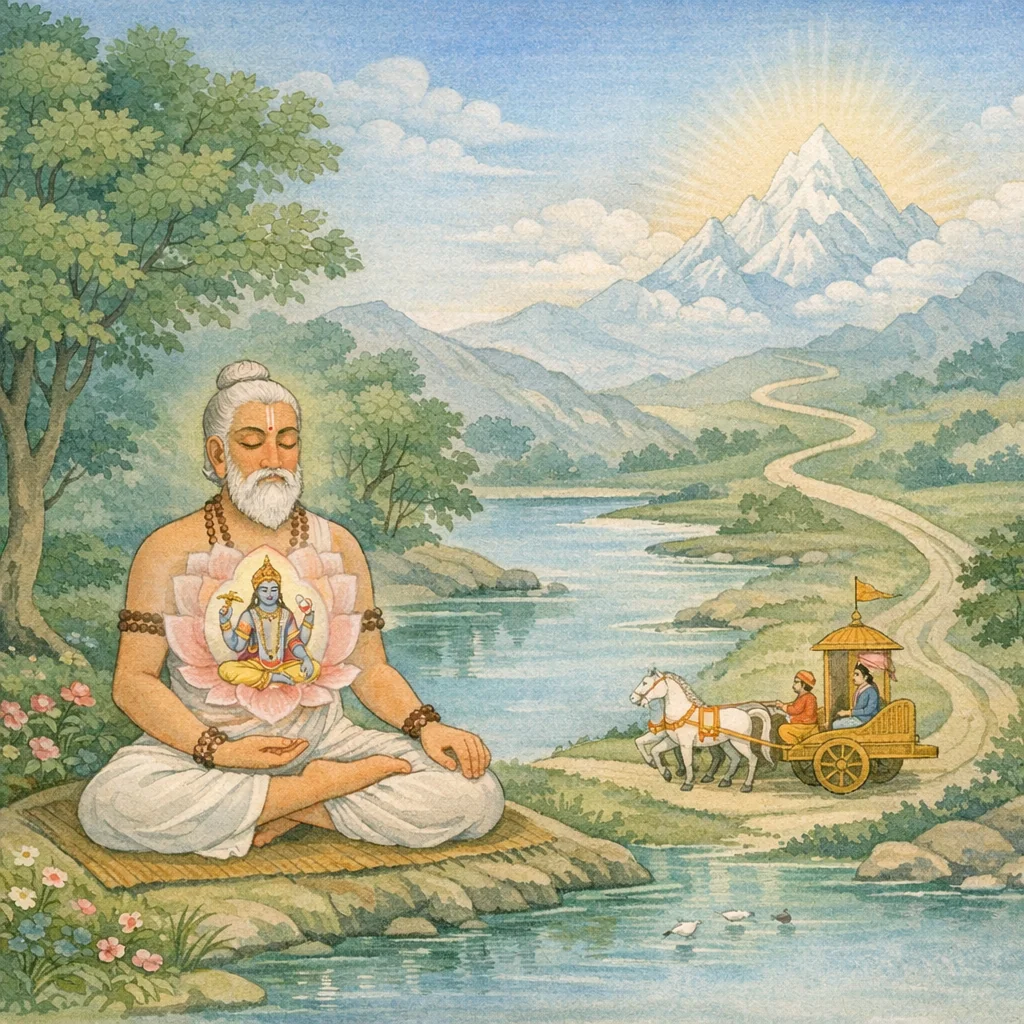
Continuing the Purāṇic mode of instruction, Hari (Viṣṇu) turns the seeker from outer sanctification (pavitra and related rites) to inner realization: meditation on Brahman that breaks the workings of Māyā. He defines the Self as beyond body, senses, mind, prāṇas, guṇas, and all conditioned states, and teaches that samādhi is abiding in the insight “I am Brahman” (turīya). To make this practical he gives the chariot model—Self as rider, intellect (buddhi) as charioteer, mind as reins—showing that a disciplined mind guided by discernment leads to the Supreme Abode and freedom from rebirth. He then outlines yogic disciplines (yama/niyama through samādhi) and compassionately adds that if steadiness is hard, one may contemplate Viṣṇu’s form within the heart-lotus. Bridging inner contemplation with temple-and-icon practice, the chapter affirms Viṣṇu’s presence in Śālagrāma and other sacred stones, and concludes by contrasting desire-based heavenly rewards with desireless liberation through meditation, praise, and nāma-japa, preparing for deeper instruction in practice, devotion, and knowledge.
Shlokas
Verse 1
नाम त्रिचत्वारिंशो ऽध्यायः हरिरुवाच / पूजयित्वा पवित्राद्यैर्ब्रह्म ध्यात्वा हरिर्भवेत् / ब्रह्मध्यानं प्रवक्ष्यामि मायायन्त्रप्रमर्दकम्
Chapter Forty-Four. Hari (Lord Vishnu) said: Having worshipped with sanctifying rites and sacred articles beginning with the pavitra, one should meditate upon Brahman and thus become established in Hari. Now I shall teach the meditation on Brahman, which crushes the mechanism of Māyā (delusion).
Verse 2
यच्छेद्वाङ्मनसं प्राज्ञस्तं यजेज्ज्ञानमात्मनि / ज्ञानं महति संयच्छेद्य इच्छेज्ज्ञानमात्मानि
The wise should restrain speech and mind, and worship that inner knowledge within the Self. Let him merge that knowledge into the Great (the Supreme Reality), and seek knowledge established in the Self.
Verse 3
देहेन्द्रियमनोबुद्धिप्राणाहङ्करावर्जितम् / वर्जितं भूततन्मात्रैर्गुणजन्माशनादिभिः
It is devoid of body, senses, mind, intellect, vital breaths (prāṇa), and ego (ahaṅkāra). It is also free from the elements and their subtle essences (tanmātras), from the guṇas, and from conditions such as birth, eating, and the like.
Verse 4
स्वप्रकाशं निराकारं सदानं दमनादि यत् / नित्यं शुद्धं बुद्धमृद्धं सत्यमानन्दमद्वयम्
That (Supreme Reality) is self-luminous and formless; ever-giving and the source of restraint and the like. It is eternal, pure, fully conscious and complete—truth itself, bliss (Ānanda), and non-dual.
Verse 5
तुरीयमक्षरं ब्रह्म अहमस्मि परं पदम् / अहं ब्रह्मेत्यवस्थानं समाधिरपि (रिति) गीयते
“I am the Fourth (turīya), the Imperishable Brahman; I am the supreme abode. Abiding in the realization ‘I am Brahman’—that state too is praised as samādhi.”
Verse 6
आत्मानं रथिनं विद्धि शरीरं रथमेव तु / बुद्धिं च सारथिं विद्धि मनः प्रग्रहमेव च / इन्द्रियाणि हयानाहुर्विषयास्तेषु गोचराः
Know the Self (Ātman) as the rider, and the body indeed as the chariot. Know the intellect (buddhi) as the charioteer, and the mind (manas) as the reins. The senses are said to be the horses, and the sense-objects their range of movement.
Verse 7
आत्मेन्द्रियमनोयुक्तो भोक्तेत्यार्मनीषिणः / यस्तु विज्ञान बाह्मेन युक्तेन मनसा सदा
The discerning declare: “When the Self, joined to the senses and the mind, becomes the experiencer (the enjoyer).” But one who is ever united—by the arm of discriminative knowledge (vijñāna)—with a disciplined mind is not bound as a mere enjoyer.
Verse 8
स तु तत्पदमाप्नोति स हि भूयो न जायते / विज्ञानसारथिर्यस्तु मनः प्रग्रहवान्नरः
But that person attains the Supreme Abode; indeed, he is not born again—he whose charioteer is discriminative knowledge (vijñāna), and who holds the mind firmly with the reins.
Verse 9
स्वर्धुन्याः पारमाप्नोति तद्विष्णोः परमं पदम् / अहिंसादिर्यमः प्रोक्तः शौचादिर्नियमः स्मृतः
One reaches the farther shore of the heavenly river—indeed, that is the supreme abode of Viṣṇu. Non-violence (ahiṃsā) and the like are declared to be the yamas (ethical restraints), while purity and the like are remembered as the niyamas (observances).
Verse 10
आसनं पद्मकाद्युक्तं प्राणायामो मरुज्जयः / प्रत्याहा रो जयः प्रोक्तो ध्यानमीश्वरचिन्तनम्
Posture (āsana) is said to be Padmaka and the like; breath-control (prāṇāyāma) is the conquest of the vital wind. Withdrawal (pratyāhāra) is declared to be victory (over the senses); and meditation (dhyāna) is contemplation of the Lord (Īśvara).
Verse 11
मनोधृतिर्धारणा स्थात्समाधिर्ब्रह्मणि स्थितिः / पूर्वं चेतः स्थिरं न स्यात्ततोमूर्तिं विचिन्तयेत्
Steadiness of mind is called dhāraṇā (concentration), and samādhi is the abiding of awareness in Brahman. If at first the mind is not steady, one should contemplate a sacred mūrti as a support.
Verse 12
हृत्पद्मकर्णिकामध्ये शङ्खचक्रगदाब्जवान् / श्रीवत्सकौस्तुभयुतो वनमालाश्रिया युतः
Within the pericarp of the lotus of the heart, one should contemplate the Lord bearing the conch, discus, mace, and lotus—adorned with the Śrīvatsa mark and the Kaustubha jewel, radiant with the splendor of a garland of forest flowers.
Verse 13
नित्यः शुद्धो भूतियुक्तः सत्यानन्दाह्वयः परः / आत्माहं परमं ब्रह्म परमं ज्योतिरेव तु
I am eternal and pure, endowed with divine power, the Supreme known as Truth-and-Bliss. I am the Self—indeed the highest Brahman, none other than the supreme Light.
Verse 14
चतुर्विशतिमूर्तिः स शालग्रामशिलास्थितः / द्वारकादिशिलासंस्थो ध्येयः पूज्यो ऽप्यहं च सः
He, the Lord of the twenty-four forms, abides in the Śālagrāma stone; and likewise, established in sacred stones such as those from Dvārakā, he is to be meditated upon and worshipped—for he is indeed Me.
Verse 15
मनसो ऽभीप्सितं प्राप्य देवो वैमानिको भवेत् / निष्कामो मुक्तिमाप्नोति मूर्तिं ध्याययंस्तुवञ्जपन्
By attaining what the mind longs for, one may become a vaimānika celestial being who travels in a divine aerial chariot; but the desireless person attains liberation—meditating on the Lord’s mūrti, praising Him, and repeating His sacred names in japa.
Frequently Asked Questions
Turīya is presented as the imperishable Brahman—beyond waking, dream, and deep sleep—where awareness rests in non-dual truth. The chapter praises samādhi as stabilization in the realization ‘I am Brahman,’ not as a new experience but as recognition of the ever-present Self.
They are the foundation for meditation: yamas (like ahiṃsā) and niyamas (like śauca) purify conduct and mind, enabling steadiness for dhāraṇā and dhyāna. The chapter treats them as integral limbs that support samādhi rather than optional moral add-ons.
Because the mind may initially lack steadiness, a sacred form serves as a stabilizing support (ālambana). Contemplation of Viṣṇu’s form in the heart-lotus trains attention and devotion, which then matures into absorption where awareness abides in Brahman.
They are affirmed as established abodes (adhiṣṭhāna) of the Lord—‘he is indeed Me’—legitimizing aniconic and iconic worship as valid supports for meditation. The mention of ‘twenty-four forms’ signals a theological mapping of Viṣṇu’s manifestations into worship practice.