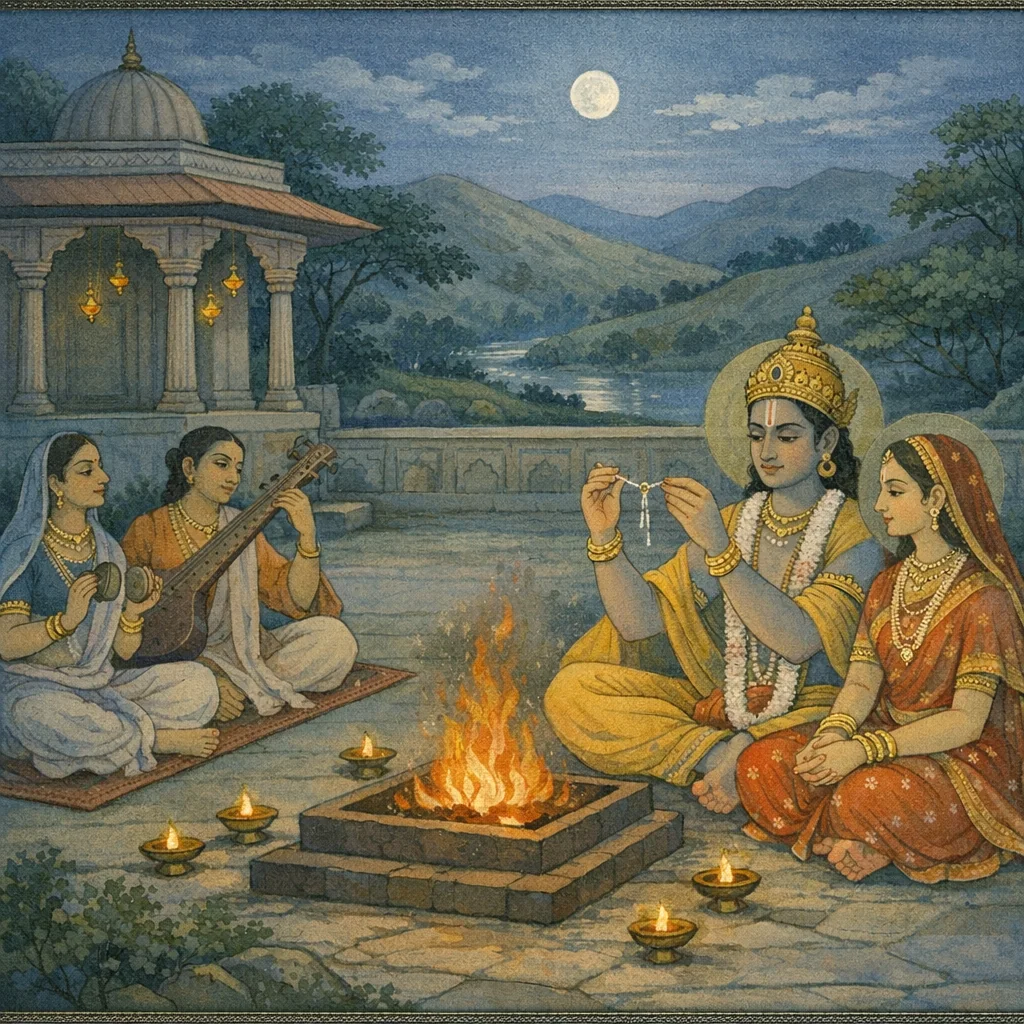
Adhyaya 42
Pavitrāropaṇa-vidhi (Rite of Investing/Offering the Pavitra Sacred Thread)
Continuing the ācāra-based teachings, Hari explains a Śaiva corrective and protective observance: how an ācārya/sādhaka (and qualified initiates such as putraka and samayī) should perform Pavitrāropaṇa so that worship is not obstructed. The chapter gives auspicious months and tithis, required materials (gold/silver/copper and cotton threads, ideally prepared by an unmarried maiden), and rules for making the pavitras—folding and tripling the strands, and purifying the knots with specific mantras. It names the presiding “tantu-devas” within the threads, prescribes recitation counts, knot spacing, and the series of named knots from Prakṛti to Sarvamukhī. The rite then expands into full liṅga worship: bathing and offerings, placing protective substances by direction, encircling the house with thread and using perforated protectors, performing homa and bhūta-bali, invoking the deity and keeping a night vigil, and finally installing the consecrated pavitras. It concludes with tattva-oriented mantra salutations (Śiva-tattva, Vidyā-tattva, Ātman), prayers to cleanse omissions, offerings into fire, dakṣiṇā to the guru, feeding brāhmaṇas, and formal dismissal—establishing a template for obstacle-removal and completion rites in the chapters that follow.
Shlokas
Verse 1
नामैकचत्वारिंशो ऽध्यायः हरिरुवाच / पवित्रारोपणं वक्ष्ये सिवस्याशिवनाशनम् / आचार्यः साधकः कुर्यात्पुत्रकः समयी हर
Chapter called “Eka-catvāriṃśa.” Hari said: “I shall explain the rite of investing the pavitra (sacred thread/amulet), which—being of Śiva—destroys inauspiciousness. The ācārya (preceptor) or the sādhaka (practitioner) should perform it; likewise the putraka (initiated disciple) and the samayī (one bound by observances), O Hara.”
Verse 2
संवत्सरकृतां पूजां विघ्नेशो हरते ऽन्यथा / आषाढे श्रावणे माघे कुर्याद्भाद्रपदे ऽपि वा
Otherwise, Vighneśa (the Lord of Obstacles) nullifies the worship performed over the course of a full year; therefore one should perform it in Āṣāḍha, Śrāvaṇa, Māgha, or even in Bhādrapada.
Verse 3
सौवर्णरौप्यताम्रं च सूत्रं कार्पासिकं क्रमात् / ज्ञेयं कुजादौ संग्राह्यं कन्यया कर्तितं च यत्
In due order, one should procure thread made of gold, silver, and copper, and also cotton thread; it should be understood that these are to be gathered beginning from Tuesday (the day of Kuja/Maṅgala), and that the thread twisted/prepared by an unmarried maiden is especially prescribed.
Verse 4
त्रिगुणं त्रिगुणीकृत्य ततः कुर्यात्पवित्रकम् / ग्रन्थयो वामदेवेन सत्येन क्षालयेच्छिव
Having made it threefold and then tripled again, one should prepare the sacred purifier, the pavitraka. With the Vāmadeva mantra and with the Satya (Truth) mantra, O Śiva, one should wash and cleanse the knots (bindings) of the thread/amulet.
Verse 5
अघोरेण तु संशोध्य बद्धस्तत्पुरुषाद्भवेत् / धूपयेदीशमन्त्रेण तन्तुदेवा इति (मे) स्मृताः
Having purified with the Aghora mantra, one should bind the sacred cord, doing so with the Tatpuruṣa mantra. Then one should offer incense with the Īśa mantra—these are remembered by me as the ‘Tantu-devas’, the deities presiding over the thread.
Verse 6
ॐ कारश्चन्द्रमा वह्निर्ब्रह्ना नागः शिखिध्वजः / रविर्विष्णुः शिवः प्रोक्तः क्रमात्तन्तुषु देवताः
In the threads (tantu) are declared, in proper order, the presiding deities: Oṃkāra, the Moon, Fire, Brahmā, the Nāga, the one bearing the peacock banner (Kārttikeya), the Sun, Viṣṇu, and Śiva.
Verse 7
अष्टोत्तरशतं कुर्यात्पञ्चाशत्पञ्चविंशतिम् / रुद्रो ऽत्तमादि विज्ञेयं मानं च ग्रन्थयो दश
One should perform the recitation/rite one hundred and eight times—or fifty, or twenty-five. The measure called ‘Rudra’ and the like should be understood as the standard; and the measure for a ‘grantha’ is ten (such units).
Verse 8
चतुरङ्गुलान्तराः स्युर्ग्रन्थिनामानि च क्रमात् / प्रकृतिः पौरुषी वीरा चतुर्थो चापराजिता
They are set at intervals of four aṅgulas (finger-breadths), and their knot-names are, in order: Prakṛti, Pauruṣī, Vīrā, and the fourth, Aparājitā.
Verse 9
जया च विजया रुद्रा अजिता च सदाशिवा / मनोन्मनी सर्वमुखी द्व्यङ्गुलाङ्गुलतो ऽथवा
Jaya and Vijaya; Rudrā; Ajitā and Sadāśivā; also Manonmanī and Sarvamukhī—these are to be invoked; and likewise that which is measured as two aṅgulas, or as one aṅgula.
Verse 10
रञ्जयेत्कुङ्कुमाद्यैस्तु कुर्याद्रन्धैः पवित्रकम् / सप्तम्यां वा त्रयोदश्यां शुक्लपक्षे तथेतरे
One should dye it with kuṅkuma (saffron) and the like, and fashion the pavitraka—sacred thread or amulet—with knots. This is to be done on the seventh or the thirteenth lunar day, in the bright fortnight, and likewise in the other fortnight.
Verse 11
क्षीरादिभिश्च संस्नाप्य लिङ्गं गन्धादिभिर्यजेत् / दद्याद्रन्धपवित्रं तु आत्मने ब्रह्मणे हर
After bathing the liṅga with milk and the like, one should worship it with fragrances and other offerings. One should also offer the randhra‑pavitra as an oblation to the Self (Ātman), to Brahman, and to Hara (Śiva).
Verse 12
पुष्पं गन्धयुतं दद्यान्मूलेनेशानगोचरे / पूर्वे च दण्डकाष्ठं तु उत्तरे चामलकीफलम्
One should place a fragrant flower at the base, in the north‑eastern quarter (Īśāna). In the east one should place a piece of daṇḍaka wood (sacred staff‑wood), and in the north an āmalakī fruit.
Verse 13
मृत्तिकां पश्चिमे दद्याद्दक्षिणे भस्म भूतयः / नैरृतेह्यगुरुं दद्याच्छिखामन्त्रेण मन्त्रवित्
A knower of mantras should place purifying earth (mṛttikā) to the west; to the south, sacred ash (bhasma) for the pacification of the bhūtas; and in the south‑west (Nairṛta) he should place aguru, fragrant wood, while reciting the Śikhā mantra.
Verse 14
वायव्यां सर्षपं दद्यात्कवचेन वृषध्वज / गृहं संवेष्ट्य सूत्रेण दद्याद्रन्धपवित्रकम्
O Vṛṣadhvaja (Śiva), in the north-west one should offer mustard seeds as a protective kavaca; and, having encircled the house with a thread, one should place a perforated pavitraka as an auspicious purifier for the openings.
Verse 15
होमं कृत्वा ग्नेय दत्त्वा दद्याद्भूतबलिं तथा / आमन्त्रितो ऽसि देवेश गणैः सार्धं महेश्वर
Having performed the homa (fire-offering) and given what is to be offered, one should also present the bhūta-bali, an oblation for the elemental beings. Then one prays: “You have been invited, O Lord of the gods—O Mahādeva, Mahēśvara—together with your hosts of gaṇas.”
Verse 16
प्रातस्त्वां पूजयिष्यामि अत्र सन्निहितो भव / निमन्त्र्यानेन तिष्ठेत्तु कुर्वन् गीतादिकं निशि
“In the morning I shall worship you; remain present here.” Having thus invoked, one should keep vigil through the night, performing devotional singing and the like.
Verse 17
मन्त्रितानि पवित्राणि स्थापयेद्देवपार्श्वतः / स्नात्वादित्यं चतुर्दश्यां प्राग्रुद्रं च प्रपूजयेत्
One should place the pavitra—sacred threads consecrated with mantras—beside the deity. Then, after bathing on the fourteenth lunar day, one should worship Āditya (the Sun) and also duly worship Rudra, facing east.
Verse 18
ललाटस्थं विश्वरूपं ध्यात्वात्मानं प्रपूजयेत् / अस्त्रेण प्रोक्षितान्येवं हृदयेनार्चितान्यथ
Meditating on the Viśvarūpa, the Universal Form present at the forehead, one should worship the Ātman, the Self. Thus, after sprinkling the offerings with the Astra (divine weapon) mantra, one should then honor them with the Hṛdaya (Heart) mantra.
Verse 19
संहितामन्त्रितान्येव धूपितानि समर्पयेत् / शिवतत्त्वात्मकं चादौ विद्यातत्त्वात्मकं ततः
One should offer the prescribed items only after consecrating them with the Saṃhitā-mantras and perfuming them with incense—first as embodying the Śiva-tattva, and thereafter as embodying the Vidyā-tattva, sacred knowledge.
Verse 20
आत्मतत्त्वात्मकं पश्चाद्देवकाख्यं ततोर्ऽचयेत् / ॐ हौं हौं शिवतत्त्वाय नमः / ॐ हीं(हीः) विद्यातत्त्वाय नमः
After worshipping the Ātma-tattva, the principle of the Self, one should then worship what is called Devaka, the divine principle. One should recite: “Oṃ hauṃ hauṃ—obeisance to the Śiva-tattva.” “Oṃ hīṃ (hīḥ)—obeisance to the Vidyā-tattva.”
Verse 21
ॐ हां (हौः) आत्मतत्त्वाय नमः / ॐ हां हीं हूं क्षैं सर्वतत्त्वाय नमः / कालात्मना त्वया देव यद्दृष्टं मामके विधौ
“Oṃ hāṃ (hauḥ)—obeisance to the Ātma-tattva.” “Oṃ hāṃ hīṃ hūṃ kṣaiṃ—obeisance to the Sarva-tattva, the principle of all realities.” O Lord, in Your form as Kāla, Time itself, whatever You have revealed according to my prescribed rite—I acknowledge it and bow to it.
Verse 22
कृतं क्लिष्टं समुत्सृष्टं हुतं गुप्त च यत्कृतम् / सर्वात्मनात्मना शम्भो पवित्रेण त्वदिच्छया
O Śambhu, whatever has been done—whether with strain, abandoned midway, offered into the fire, or done in secret—may it all, by Your will, be purified by the all-pervading Self (You), through the power of the Purifier.
Verse 23
पूरयपूरय मखव्रतं तन्नियमेश्वराय सर्वतत्त्वात्मकाय सर्वकारणपालिताय ॐ हां हीं हूं हैं हौं शिवाय नमः
“Fulfil, fulfil this sacrificial vow and its observances—offered to the Lord of disciplines, who is the very essence of all tattvas, the sustainer who upholds all causes. Oṃ: hāṃ hīṃ hūṃ haiṃ hauṃ—obeisance to Śiva.”
Verse 24
पूर्वैरनेन यो दद्यात्पवित्राणां चतुष्टयम् / दत्त्वा वह्नेः (वरे) पवित्रं च गुरवे दक्षिणां दिशेत्
Whoever, following the procedure taught earlier, offers the fourfold set of sacred pavitra; having then offered the pavitra into the fire (or in the prescribed manner), should present the dakṣiṇā, the priestly fee, to the guru.
Verse 25
बलिं दत्त्वा द्विजान् भोज्य चण्डं प्राच्यै विसर्जयेत्
Having offered the bali (ritual oblation) and fed the twice-born (brāhmaṇas), one should dismiss the caṇḍa, the ritual attendant, toward the east.
Frequently Asked Questions
The chapter places specific presiding deities ‘in the threads’ in a stated order—Oṃkāra, Moon, Fire, Brahmā, Nāga, Kārttikeya, Sun, Viṣṇu, and Śiva—so the pavitra becomes a sanctified support of worship. Invoking them sacralizes the cord as a carrier of cosmic and protective powers, aligning the offering with a deity-filled ritual body rather than a mere material thread.
Measured spacing and named knots function as a formal ritual grammar: the pavitra is structured into discrete sanctified nodes, each identified and invoked, so the rite is repeatable, auditable, and symbolically ordered. This also supports the chapter’s emphasis on removing defects—precision in measure and naming reduces ritual ambiguity and strengthens saṅkalpa (vow-intent).
It includes explicit prayers asking Śambhu to purify whatever was done with strain, abandoned midway, offered into fire, or performed in secret—requesting that the all-pervading Self, through the ‘power of the purifier’ (pavitra), rectify deficiencies. This is a built-in prāyaścitta-like closure to ensure ritual wholeness.