Adhyaya 164
Kuṣṭha-bheda-lakṣaṇa-nidāna and Śvitra (Kilāsa) Prognosis
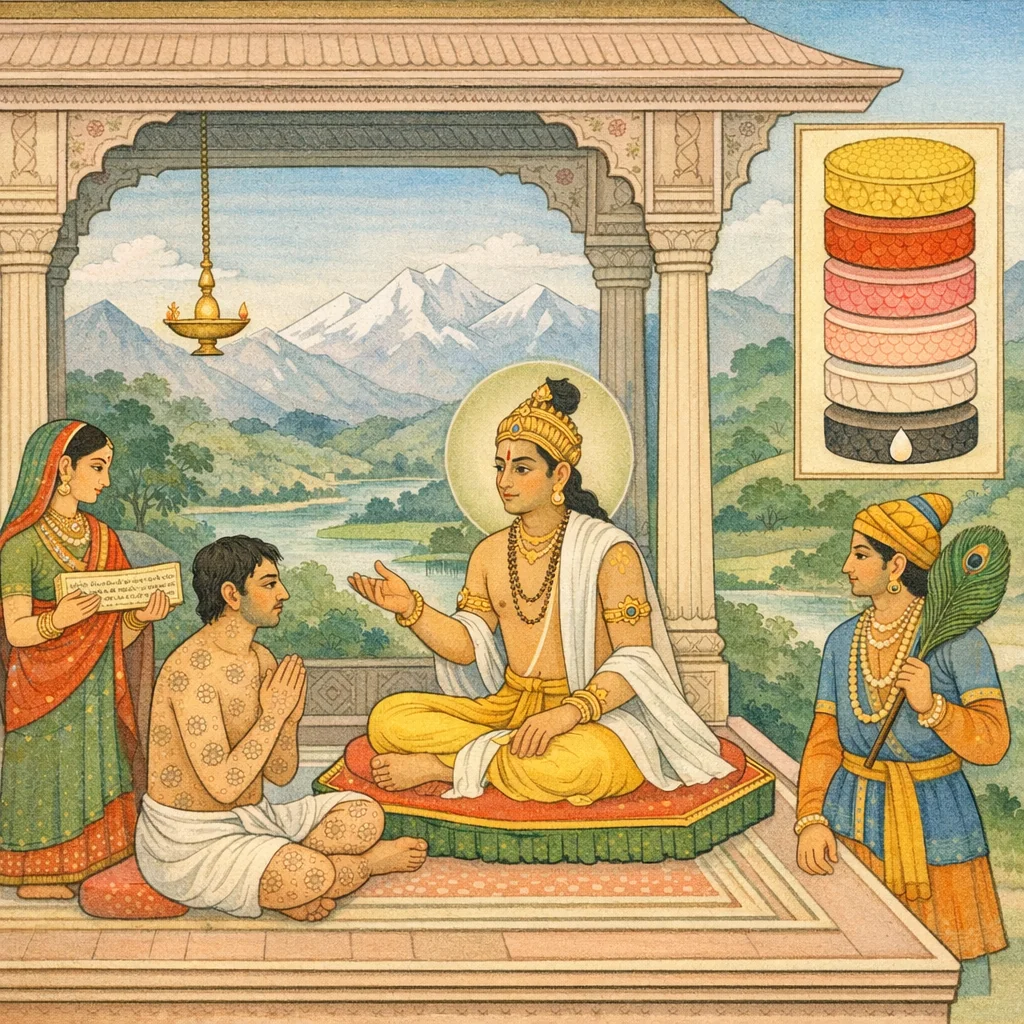
Continuing Dhanvantari’s medical teaching in the Brahma Khaṇḍa, this chapter turns from general causation to the specific nidāna of kuṣṭha: wrong diet and hostile, sinful conduct drive impurities into the srotas, vitiating skin, blood, flesh, and fat until outward lesions appear with discoloration, itching, burning, numbness, swelling, fissures, and parasite-like infestation. Kuṣṭha is then classified by the tridoṣa and their combinations, with major and minor types named and their forms described (skull-like dryness, udumbara-fruit-like swellings, ring-shaped dadru, blistered puṇḍarīka, fish-scale-like kiṭima). Diagnostic guidance explains how to infer doṣic dominance and gauge severity by depth of dhātu involvement (skin; blood/flesh/fat; or bone/marrow/semen), distinguishing curable, manageable, and difficult cases. Śvitra/kilāsa is introduced with doṣa-colored presentations and staged depth, followed by clear rules of prognosis and cautions about lesion sites. The chapter closes by noting spread through contact and shared objects, bridging toward the hygienic and therapeutic disciplines taught next.
Shlokas
Verse 1
त्रिपष्ट्यधिकशततमो ऽध्यायः धन्वन्तरिरुवाच / मिथ्याहारविहारेण विशेषेण विरोधिना / साधुनिन्दावधाद्युद्धहरणाद्यैश्च सेवितैः
Chapter 164. Dhanvantari said: Through false diet and improper conduct—especially by hostile, malicious opposition—and by resorting to deeds such as slandering the virtuous, killing, warfare, theft and robbery and the like, one becomes bound to the causes that bring grievous afflictions.
Verse 2
पाप्मभिः कर्मभिः सद्यः प्राक्तनैः प्रेरितामलाः / शिराः प्रपद्य तैर्युक्तास्त्वग्वसारक्तमामिषम्
Impurities, driven by sinful deeds—both those of the present and those from former times—at once enter the channels (veins, nāḍīs); and, joined with them, they afflict the skin, fat, blood, and flesh.
Verse 3
दूषयन्ति च संशोष्य निश्चरन्तस्ततो बहिः / त्वचः कुर्वान्ति वैवर्ण्यं शिष्टाः कुष्ठमुशन्तितम्
They vitiate and dry up the tissues; then, moving outward, they manifest. They cause discoloration of the skin—this the learned describe as kuṣṭha, a severe disease of the skin.
Verse 4
कालेनोपेक्षितं यत्स्यात्सर्वं कोष्ठानि तद्वपुः / प्रपद्य धातून्बाह्यान्तः सर्वान्संक्लेद्य चावहेत्
Whatever part of the body is neglected over time becomes a seat of ulcers and lesions; entering the tissues, without and within, it moistens and corrupts them all, and then bears them away into decay.
Verse 5
सस्वेदक्लेदसङ्कोचान्कृमीन् सूक्ष्मांश्चदारुणान् / लोमत्वक्स्नायुधमनीराक्रामति यथाक्रमम्
Along with sweat, dampness, and contraction, dreadful minute worms arise; and in due order they invade the hair, skin, sinews, and the body’s vessels and channels.
Verse 6
भस्माच्छादितवत्कुर्याद्बाह्यं कुष्ठमुदाहृतम् / कुष्ठानि सप्तधा दोषैः पृथग्द्वन्द्वैः समागतैः
It makes the outer surface appear as though covered with ash—this is called external kuṣṭha. Kuṣṭha is of seven kinds, arising from the doṣas (vāta, pitta, kapha), whether singly or in paired combinations.
Verse 7
सर्वेष्वपि त्रिदोषेषु व्यपदेशो ऽधिकस्ततः / वातेन कुष्ठं कापालं पित्तेनौदुम्बरं कफात्
Among all conditions arising from the three doṣas, their classification is set forth in greater detail. From vāta arises the kuṣṭha called kāpāla; from pitta arises audumbara; and from kapha arises yet another type.
Verse 8
मण्डलाख्यं विचर्चो च ऋष्याख्यं वातपित्तजम् / चर्मैककुष्ठं किटिमं सिध्मालसविपादिकाः
The varieties named maṇḍala and vicarcā, and the one called ṛṣya, are born of vāta and pitta together. Other forms are carma-kuṣṭha, eka-kuṣṭha, kiṭima, sidhmā, alasā, and vipādikā.
Verse 9
वातश्लेष्मोद्भवाः श्लेष्मपित्ताद्दद्रूशतारुषी / पुण्डरीकं सविस्फोटं पामा चर्मदलं तथा
Some arise from vāta and kapha together; from kapha and pitta arise dadrū and śatāruṣī. Also there are puṇḍarīka, savisphoṭa, pāmā, and likewise carmadala.
Verse 10
सर्वेभ्यः काकणं पूर्वत्रिकं दद्रु सकाकणम् / पुण्डरीकर्यजिह्वे च महाकुष्ठानि सप्त तु
Among them, the first three are Kākaṇa, Dadrū, and Sakākaṇa. Also counted among the great forms are Puṇḍarīka and Ṛjijihvā. Thus, in all, there are seven kinds of mahā-kuṣṭha (great kuṣṭhas).
Verse 11
अतिश्लक्ष्णखरस्पर्शस्वेदास्वेदविवर्णताः / दाहः कण्डूस्त्वचि स्वापस्तोदः कोचोन्नतिस्तमः
Excessive smoothness or harshness to the touch, abnormal sweating or absence of sweat, and discoloration—burning, itching, numbness of the skin, pricking pains, contraction and swelling, and darkening—these are the symptoms.
Verse 12
व्रणानामधिकं शूलं शीघ्रोत्पत्तिश्चिरस्थितिः / रूढानामपि रूक्षत्वं निमित्ते ऽल्पे ऽतिकोपनम्
In the wounds there is intense pain, swift arising and long persistence; even when healed, dryness and roughness remain; and from slight provocation it flares up excessively (or one becomes overly irritable).
Verse 13
रोमहर्षो ऽसृजः कार्ष्ण्यं कुष्ठलक्षणमग्रजम् / कृष्णारुणकपालाभं यद्रूक्षं परुषं तनु
Gooseflesh, lack of blood (or healthy coloration), and blackening are declared the foremost signs of leprosy. A body that looks like a black-and-reddish skull, dry and rough, is marked by this affliction.
Verse 14
विस्तृताकृतिपर्यस्तन्दूषितैर्लोमभिश्चितम् / कापालं तोदबहुलं तत्कुष्ठं विषमं स्मृतम्
That leprosy is remembered as ‘irregular’ (viṣama) when the form spreads and becomes distorted, is covered with tainted hairs, appears skull-like, and is filled with abundant pricking pains.
Verse 15
उदुम्बरफलाभासं कुष्ठमौदुम्बरं वदेत् / वर्तुलं बहुलकेत्युक्तं दाहरुजाधिकम्
That leprosy which resembles the fruit of the udumbara (cluster fig) is called ‘audumbara’. It is described as round and thick, and is marked by excessive burning and pain.
Verse 16
असंच्छन्नमदरणं कृमिवत्स्यादुदुम्बरम् / स्थिरं सत्यानं गुरु स्निग्धं श्वेतरक्तं मलान्वितम्
The condition called Udumbara is said to be exposed, lacking any protective covering, and worm-like in appearance; it is firm and enduring, heavy and unctuous, whitish-red in hue, and attended by impurity and discharge.
Verse 17
अन्योन्यसक्तपुच्छूनबहुकण्डूस्नुतिकृमि / श्लक्ष्णपीताभासंयुक्तं मण्डलं परिकीर्तितम्
That in which worms cling to one another, with fierce itching and oozing, and which is smooth with a yellowish sheen—this is declared to be the condition called Maṇḍala.
Verse 18
सकण्डूपिटिका श्यावा सक्लेदा च विचर्चिका / परुषन्तत्ररक्तान्तमन्तः श्यामं समुन्नतम्
Vicarcikā is described as having itchy eruptions, a dark (brownish) coloration, and moisture or oozing; it is rough, with reddened margins, dark within, and raised.
Verse 19
ऋष्यजिह्वाकृतिप्रोक्तं ऋष्यजिह्वं बहुक्रिमि / हस्तिचर्मखरस्पर्शं चर्माख्यं कुष्ठमुच्यते
A form of leprosy said to resemble the shape of a sage’s tongue is called Ṛṣyajihvā; it is infested with many worms. That leprosy which feels to the touch like an elephant’s hide—rough and harsh—is called Carmākhya (“skin-type”).
Verse 20
अस्वेदञ्चमत्स्यशल्कसन्निभं किटिमं पुनः / रूक्षाग्निवर्णं दुः स्पर्शं कण्डूमत्परुषासितम्
Another type is Kiṭima: it is without sweat and resembles the scales of a fish. It is dry, fire-colored (a burning red hue), painful to touch, itchy, harsh, and darkened.
Verse 21
अन्ता रूक्षं बहिः स्निग्धमन्तर्घृष्टं रजः किरेत् / श्लक्ष्णस्पर्शं तनु स्निग्धं स्वच्छमस्वेदपुष्पवत्
It is dry within yet oily without; when rubbed inside, it scatters dust-like particles. Its touch is smooth; it is thin, slightly unctuous, clear in appearance, like a flower without sweat.
Verse 22
प्रायेण चोर्ध्वकार्श्यञ्च कुण्डैः कण्डूपरैश्चितम् / रक्तैरलंशुका पाणिपादे कुर्याद्विपादिका
Generally it causes wasting of the upper body, and the skin becomes marked with raised eruptions attended by itching. With reddish lesions and fissuring, it produces ‘vipādikā’ on the hands and feet.
Verse 23
तीव्रार्तिं गाढकण्डूञ्च सरागपिडिकाचितम् / दीर्घप्रतानदूर्वावदतसीकुसुमच्छवि
It brings intense pain and severe itching, and is covered with inflamed, reddish pimples. Its appearance is like long-spreading dūrvā grass, with a hue resembling the flower of flax (atasī).
Verse 24
उच्छूनमण्डलो दद्रुः कण्डूमानिति कथ्यते / स्थूलमूलं सदाहार्ति रक्तस्त्रावं बहुव्रणम्
That ring-shaped eruption which is swollen and itchy is called dadru. It has a thick base, causes constant burning pain, oozes blood, and produces many sores.
Verse 25
सादहकक्लेदरुजं प्रायशः सर्वजन्म च / रक्ताक्तमण्डलं पाण्डु कण्डूदाहरुजान्वितम्
It is generally accompanied by burning, oozing, and pain, and is said to arise from many causes. The patch appears pale, with a ring smeared with blood, and is attended by itching, burning, and aching pain.
Verse 26
सोत्सेधमाचितं रक्तैः कञ्जपर्णमिवाम्बुभिः / पुण्डरीकं भवेत्तद्धि चितं स्फोटैः सितारुणैः
This condition rises up and is densely suffused with redness—like a lotus leaf speckled with drops of water. It is called Puṇḍarīka, for it is studded with blisters that are white and reddish.
Verse 27
विस्फोटपिटिका पामा कण्डूक्लेदरुजान्विताः / सूक्ष्मा श्यामारुणा रूक्षा प्रायः स्फिक्पाणिकूर्परे
Pāmā consists of eruptive pimples and blisters, accompanied by itching, oozing, and pain. They are minute, dark-reddish in color, dry, and are commonly found on the buttocks, hands, and elbows.
Verse 28
सस्फोटसंस्पर्शसहं कण्डूरक्तातिदाहवत् / रक्तदलं चर्मदलं काकणं तीव्रदाहरुक्
That skin disease which is accompanied by eruptive blisters, is painful to the touch, and is marked by itching, redness, and intense burning—splitting the skin into red patches and peeling layers—is called Kākaṇa, bringing severe burning pain.
Verse 29
पूर्वरक्तञ्च कृष्णञ्च काकणं त्रिफलोपमम् / कृष्णलिङ्गैर्युतैः सर्वैः स्वस्वकारणतो भवेत्
Kākaṇa first appears red and later turns black, resembling Triphalā in hue; it arises with all the black-mark signs, each manifesting according to its own particular cause.
Verse 30
दोषभेदाय विहितैरादिशेल्लिङ्गकर्मभिः / कुष्ठस्वदोषानुगतं सर्वदोषगतं त्यजेत्
To distinguish the doṣas, one should set forth the indicated signs and therapeutic measures. In kuṣṭha (skin disease), treat according to the particular doṣa it follows, and avoid (or set aside) what belongs to the all-doṣa type.
Verse 31
कुष्ठोक्तं यच्च यच्चास्थिमज्जाशुक्रसमाश्रयम् / कृच्छ्रं मेदोमतञ्चैव याप्यं स्नाप्वास्थिमांसगम्
Whatever is spoken of as kuṣṭha (a skin disease), and whatever abides in bone, marrow, and semen—this is called kṛcchra, a grievous affliction. That which is bound up with fat is likewise so; and that which pervades the sinews, bone, and flesh is deemed yāpya: chronic, yet still manageable by treatment.
Verse 32
अकृच्छ्रं कफवातोत्थं त्वग्गतं त्वमलञ्च यत् / तत्र त्वचि स्थिते कष्ठे काये वैवर्ण्यरूक्षाता
That which is not severe (akṛcchra), arising from kapha and vāta and confined to the skin—along with mere impurity of the skin—when kuṣṭha remains seated in the skin, it brings discoloration and dryness to the body.
Verse 33
स्वेदतापश्वयथवः शोणिते पिशिते पुनः / पाणिपादाश्रिताः स्फोटाः क्लेशात्सन्धिषु चाधिकम्
When it reaches the blood and then the flesh, there arise sweating, burning heat, and swelling; blisters appear especially upon the hands and feet, and the distress is greater in the joints.
Verse 34
दोषस्याभीक्ष्णयोगेन दलनं स्याच्च मेदसि / नातिसंज्ञास्ति मज्जास्थिनेत्रवेगस्वरक्ष्यः
By the doṣa’s repeated conjunction, there is a breaking down, especially in the fat-tissue. Consciousness is not greatly disturbed, yet marrow and bones waste away; the eyes grow weak, vigor is lost, and the voice declines.
Verse 35
क्षते च क्रिमिभिः शुक्रे स्वदारापत्यबाधनम् / यथापूर्वाणि सर्वाणि स्वलिङ्गानि मृगादिषु
And when the semen is injured by worms (parasites), one suffers affliction concerning one’s own wife and offspring. Then all bodily marks and characteristics return to their former, degraded state, as is seen among animals and the like.
Verse 36
कष्ठैकसम्भवं श्वित्रं किलासं दारुणं भवेत् / निर्दिष्टमपरिस्त्रावि त्रिधातूद्भवसंश्रयम्
Śvitra—also called kilāsa—arises from a single severe cause and becomes a dreadful condition. It is described as non-oozing and as taking root from the disturbance of the three doṣas.
Verse 37
वाताद्रूक्षारुणं पित्तात्ताम्रं कमलपत्रवत् / सदाहं रोमविध्वंसि कफाच्छ्वेतं घन गुरु
From vāta it becomes dry and reddish; from pitta it turns coppery like a lotus petal—burning constantly and destroying the hair. From kapha it becomes white, dense, and heavy.
Verse 38
सकण्डूरं क्रमाद्रक्तमांसमेदः सु चादिशेत् / वर्णेनैवेदृगुभयं कृच्छ्रं तच्चोत्तरोत्तरम्
With itching, one should understand it as progressively involving the blood, the flesh, and the fat-tissue. By the colour itself, both its type and depth are inferred; and in successive stages it becomes increasingly difficult to treat.
Verse 39
अशुक्लरोमबहुलमसंश्लिष्टं मिथो नवम् / अनग्निदग्धजं साध्यं श्वित्रं वर्ज्यमतो ऽन्यथा
That śvitra is curable which is new, has abundant hair that is not white, whose patches are not fused together, and which is not produced by burns from fire. Otherwise, it should be avoided as difficult or incurable.
Verse 40
गुह्यपाणितलौष्ठेषु जातमप्यचिरन्तरम् / वर्जनीयं विशेषेण किलासं सिद्धिमिच्छिता
Even if newly arisen, kilāsa—the white skin disorder—occurring on the genital region, the palms, or the lips should be especially avoided by one who seeks cure and success in treatment.
Verse 41
स्पर्शैकाहारसंगादिसेवनात्प्रायशो गदाः / एकशय्यासनाच्चैव वस्त्रमाल्यानुलेपनात्
Diseases commonly arise from touch, from sharing the same food and close association, and likewise from using the same bed and seat, as well as from sharing clothes, garlands, and unguents.
Frequently Asked Questions
It presents kuṣṭha as arising from vāta, pitta, kapha individually and in paired combinations, with named varieties mapped to doṣic causation; diagnosis is guided by observing characteristic color, texture (dry/oily), sweating changes, burning/itching, pain, and lesion morphology.
Severity is judged by depth: when seated in bone, marrow, or semen it is called severe (kṛcchra); involvement of fat is also difficult; pervasion of ligaments/sinews, bone, and flesh is described as chronic yet manageable (yāpya), while confinement to skin with kapha-vāta features is comparatively less severe.