Adhyaya 13
Vaiṣṇava Pañjara: Directional Kavacha of Viṣṇu, His Weapons, and Avatāras
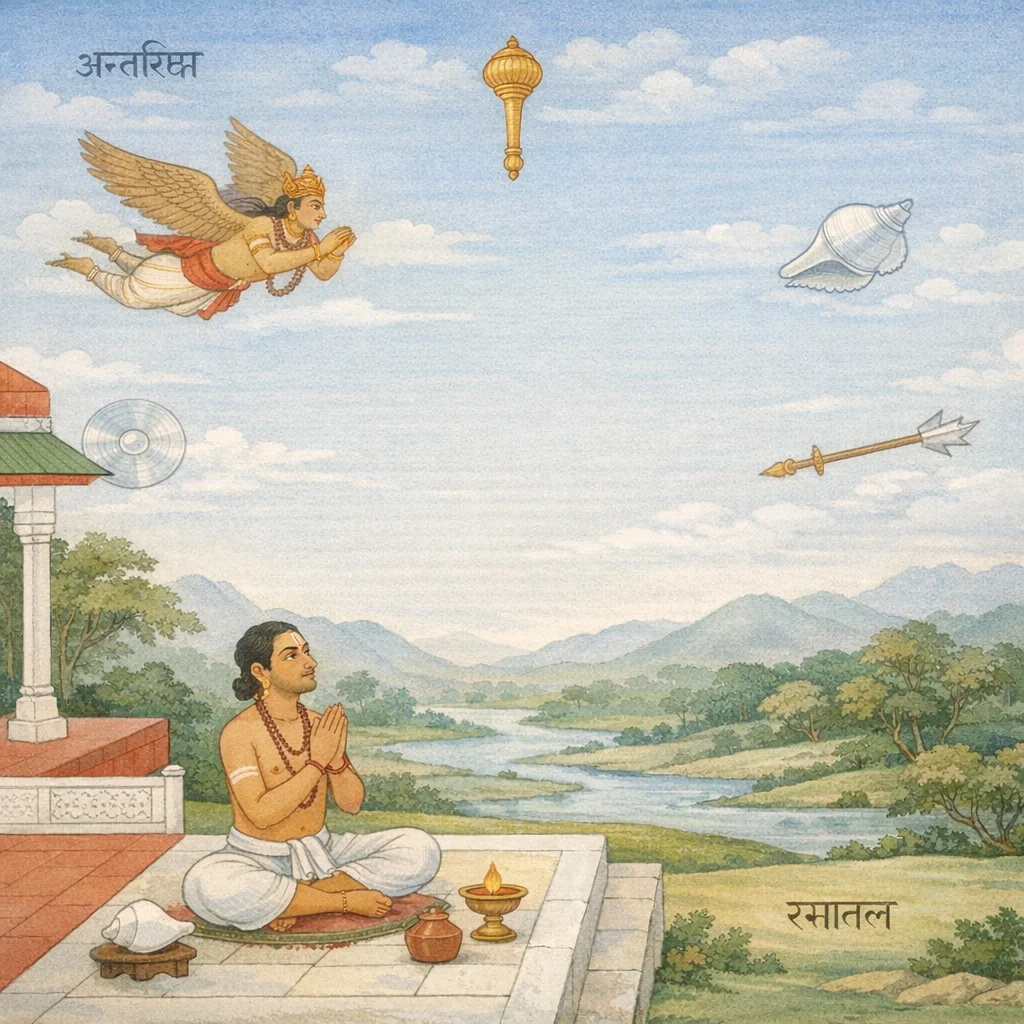
Continuing the Brahma/Ācāra-oriented instruction of the Garuḍa Purāṇa, Hari teaches a practical, recitable protection hymn (pañjara/kavacha) that consecrates the devotee’s surroundings as a field guarded by Viṣṇu. The chapter moves direction by direction: the east is sealed by taking refuge in Viṣṇu and placing the Sudarśana Cakra; other quarters are protected through Kaumodakī, plough-bearing Saunanda, a crushing mace, sword and shield, and the conch Pāñcajanya with the lotus. The protection expands beyond the horizontal plane to the interspace (antarikṣa) and the nether realms (rasātala), with Garuḍa as the divine vehicle of safeguarding. It culminates by including cosmic supports such as Akūpāra and the great fish within the protective framework, and anchors the practice in Purāṇic memory by recalling Śiva, Īśānī, and Kātyāyanī defending the devas. The closing promise—victory over enemies such as Raktabīja—prepares the transition to later chapters where stuti, vrata, and ritual bhakti function as spiritual technologies for protection, merit, and steadiness amid adversity.
Shlokas
Verse 1
नाम द्वादशो ऽध्यायः हरिरुवाच / प्रवक्ष्याम्यधुना ह्येतद्वैष्णवं पञ्जरं शुभम् / नमोनमस्ते मोविदं चक्रं गृह्य सुदर्शनम्
Hari said: “Now I shall proclaim this auspicious Vaiṣṇava Pañjara, the protective armor. Salutations, salutations to You—O all-knowing Sudarśana Cakra; take up Your place as the sacred discus.”
Verse 2
प्राच्यां रक्षस्व मां विष्णो ! त्वामहं शरणं गतः / गदां कौमोदकीं गृह्ण पद्मनाभ नमो ऽस्त ते
In the eastern direction, protect me, O Viṣṇu! To You I have come for refuge. O Padmanābha, take up the mace Kaumodakī; salutations unto You.
Verse 3
याम्यां रक्षस्व मां विष्णो ! त्वामहं शरणं गतः / हलमादाय सौनन्दे नमस्ते पुरुषोत्तम
O Viṣṇu, protect me from the southern (Yama-ruled) direction; I have taken refuge in You. O Saunanda, taking up the plough, I bow to You—O Puruṣottama, the Supreme Person.
Verse 4
प्रतीच्यां रक्ष मां विष्णो ! त्वामह शरणं गतः / मुसलं शातनं गृह्य पुण्डरीकाक्ष रक्ष माम्
In the west, protect me, O Viṣṇu! To You I have come for refuge. O lotus‑eyed Lord, taking up the crushing mace (musala), protect me.
Verse 5
उत्तरस्यां जगन्नाथ ! भवन्तं शरणं गतः / खड्गमादाय चर्ंमाथ अस्त्रशास्त्रादिकं हरे !
In the north, O Jagannātha, Lord of the universe, I take refuge in You. O Hari, take up sword and shield, and likewise weapons, the śāstras, and all such aids.
Verse 6
नमस्ते रक्ष रक्षोघ्न ! ऐशान्यां शरणं गतः / पाञ्चजन्यं महाशङ्खमनुघोष्यं च पङ्कजम्
Salutations to You—protect me, O slayer of demons! In the northeast I take refuge; You who bear the great conch Pāñcajanya, the resounding weapon, and the lotus.
Verse 7
प्रगृह्य रक्ष मां विष्णो आग्न्येय्यां रक्ष सूकर / चन्द्रसूर्यं समागृह्य खड्गं चान्द्रमसं तथा
Taking hold of me, protect me, O Viṣṇu; in the southeast let Varāha, the Boar Incarnation, protect. Holding the Moon and the Sun together, and likewise the moon‑like sword, may You guard me.
Verse 8
नैरृत्यां मां च रक्षस्व दिव्यमूर्ते नृकेसरिन् / वैजयन्तीं स्मप्रगृह्य श्रीवत्सं कण्ठभूषणम्
From the southwest protect me as well, O divine‑formed Narasiṁha. Holding the Vaijayantī garland, with the auspicious Śrīvatsa as the ornament upon Your neck.
Verse 9
वायव्यां रक्ष मां देव हयग्रीव नमो ऽस्तु ते / वैनतेयं समारुह्य त्वन्तरिक्षे जनार्दन !
In the northwest quarter, protect me, O Lord—O Hayagrīva, salutations unto You. O Janārdana, mounted upon Vainateya (Garuḍa), protect me in the mid-sky, the antarikṣa.
Verse 10
मां रक्षस्वाजित सदा नमस्ते ऽस्त्वपराजित / विशालाक्षं समारुह्य रक्ष मां त्वं रसातले
Protect me always, O Ajita, the Unconquered; salutations to You, O Aparājita, the Invincible. Mounted upon the wide‑eyed one (Garuḍa), protect me even in Rasātala, the nether realms.
Verse 11
अकूपार नमस्तुभ्यं महामीन नमो ऽस्तु प्ते / करशीर्षाद्यङ्गुलीषु सत्य त्वं बाहुपञ्जरम्
Salutations to You, Akūpāra; salutations to You, O Great Fish (Mahāmīna). Truly, You are the protective arm‑cage, from the wrist‑joints down to the fingers.
Verse 12
कृत्वा रक्षस्व मां विष्णो नमस्ते पुरुषोत्तम / एतदुक्तं शङ्कराय वैष्णवं पञ्जरं महत्
Having thus performed it, protect me, O Viṣṇu; salutations to You, O Puruṣottama, the Supreme Person. This great Vaiṣṇava “armor” (pañjara) was spoken to Śaṅkara (Śiva).
Verse 13
पुरा रक्षार्थमीशान्याः कात्यायन्या वृषध्वज / नाशायामास सा येन चामरान्महिषासुरम्
Formerly, for the protection of Īśānī (the Goddess), Vṛṣadhvaja—Śiva, whose banner bears the bull—brought forth Kātyāyanī; by her the buffalo‑demon Mahiṣāsura was destroyed, and thus the immortal devas were safeguarded.
Verse 14
दानवं रक्तबीजं च अन्यांश्च सुरकण्टकान् / एतज्जपन्नरो भक्त्या शत्रून्विजयते सदा
By chanting this with devotion, one always conquers enemies—such as the demon Raktabīja and other Dānavas who are thorns to the gods.
Frequently Asked Questions
Sudarśana is invoked with salutations and requested to “take up” its place as the discus, functioning as the opening seal of the kavacha—an emblem of Viṣṇu’s sovereignty and a ritualized boundary against harm.
It indicates totalizing protection across the vertical cosmos: not only the earthly directions but also the mid-sky (antarikṣa) and nether regions (rasātala) are placed under Viṣṇu’s guardianship, reflecting Purāṇic cosmology applied to devotional practice.