Adhyaya 33
श्रीनगर-त्रिपुरा-सप्तकक्षा-पालकदेवताप्रकाशनम् (Revelation of the Guardian Deities of Śrīnagara-Tripurā’s Seven Enclosures)
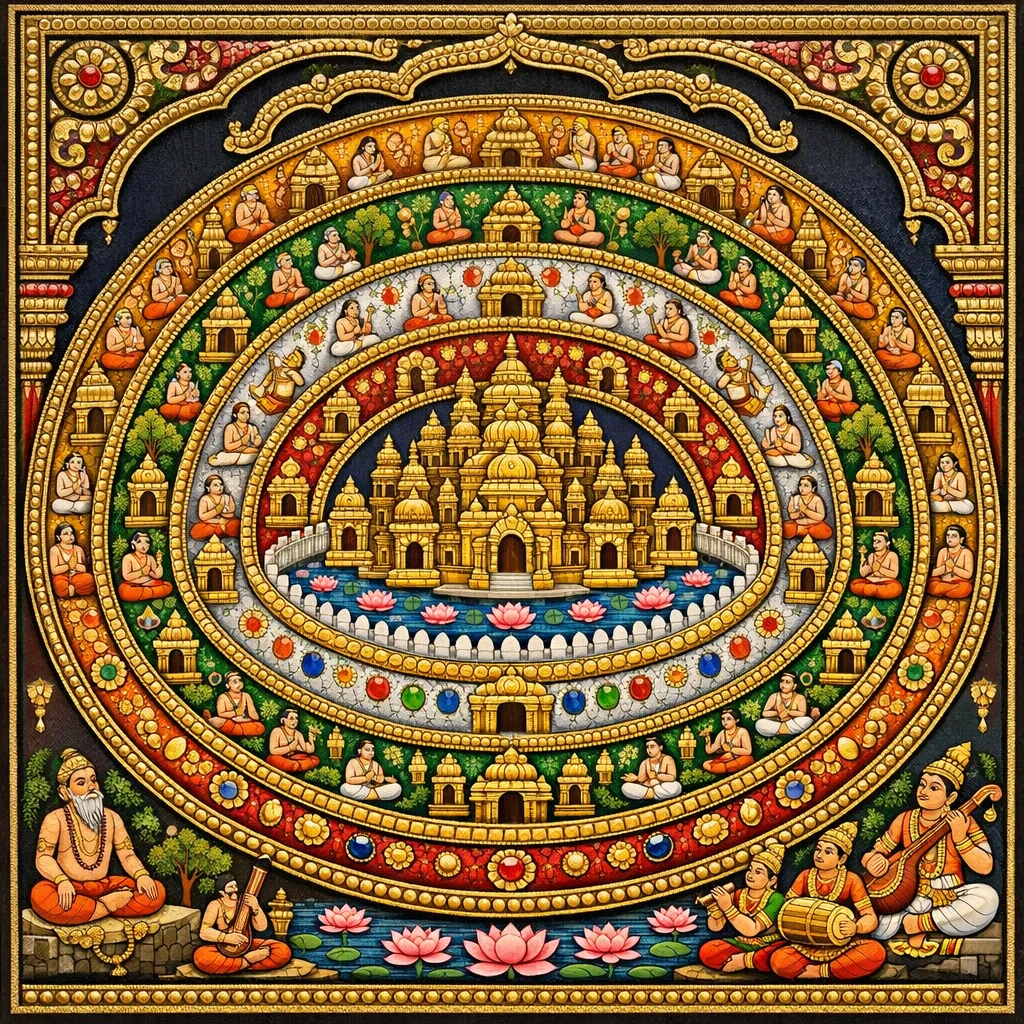
This chapter, in the Uttarabhāga of the Hayagrīva–Agastya dialogue within the Lalitopākhyāna, continues a technical portrayal of Śrīnagara/Tripurā as a tiered sacred city of jewels. After noting that artisans have already explained the features of the seven “śālās” (halls/enclosure-zones), Hayagrīva turns to the ratnamaya (gem-made) structures and their measurements, specifying spatial intervals (such as a seven-yojana interior span for certain jeweled halls). The text then inventories the realm’s fitting inhabitants—siddhas and siddha-women, cāraṇas, apsarases, gandharvas, and devotees engaged in Lalitā-mantra japa, kīrtana, and ritualized enjoyment. Architectural details (doors, bolts, gopuras) are said to be fashioned from particular gems (puṣparāga, padmarāga, gomedaka, hīra), while the ecology is color-matched: birds, lakes, rivers, and gem-trees correspond to each enclosure’s dominant hue/material. The chapter thus serves as cosmological “place metadata,” showing how devotion, perfected beings, and sacred architecture interlock within Lalitā’s mandalic city.
Shlokas
Verse 1
इति श्रीब्रह्माण्डमहापुराणे उत्तरभागे हयग्रीवागस्त्यसम्वादे ललितोपाख्याने श्रीनगरत्रिपुरासप्तकक्षापालकदेवताप्रकाशन कथनं नाम द्वात्रिंशो ऽध्यायः हयग्रीव उवाच कथितं सप्तशालानां लक्षणं शिल्पिभिः कृतम् / अथ रत्नमयाः शालाः प्रकीर्त्यन्ते ऽवधारय
Thus, in the Śrī Brahmāṇḍa Mahāpurāṇa, in the latter section, in the dialogue of Hayagrīva and Agastya, in the Lalitā narrative, is the thirty-second chapter called “The account revealing the deities who guard the seven precinct-chambers of Śrīnagara-Tripurā.” Hayagrīva said: The characteristics of the seven halls fashioned by the artisans have been told; now the jewel-made halls are proclaimed—listen and hold it well in mind.
Verse 2
सुवर्णमयशालस्य पुष्परागमयस्य च / सप्तयोजनमात्रं स्यान्मध्येन्तरमुदात्दृतम्
Between the hall of gold and the hall of puṣparāga (yellow gem) the inner central expanse extends to seven yojanas, exalted and splendid.
Verse 3
तत्र सिद्धाःसिद्धनार्यः खेलन्ति मदविह्वलाः / रसै रसायनैश्चापि खड्गैः पादाञ्जनैरपि
There the Siddhas and the Siddha-women sport, intoxicated with rapture; there are sacred essences (rasa) and rasāyana elixirs, and also swords, and even añjana unguent for the feet.
Verse 4
ललितायां भक्तियुक्तास्तर्पयन्तो महाजनान् / वसंति विविधास्तत्र पिबन्ति मदिरारसान्
Filled with bhakti toward Lalitā, they gratify the great assembly with tarpaṇa offerings; many kinds dwell there, and they drink the savor of madirā, the intoxicating liquor.
Verse 5
पुष्परागादिशालानां पूर्ववद्द्वारकॢप्तयः / पुष्परागादिशालेषु कवाटार्गलगोपुरम् / पुष्परागादिजं ज्ञेयमुच्चेन्द्वादित्यभास्वरम्
For the puṣparāga halls and the rest, the arrangement of the doorways is as before. In the puṣparāga and similar halls are door-leaves, bolts and bars, and gopuras, the towered gateways; know them to be made of puṣparāga and kindred gems, lofty and radiant like moon and sun.
Verse 6
हेमप्राकारचक्रस्य पुष्परागमयस्य च / अन्तरे या स्वली सापि पुष्परागमयी स्मृता
Within the golden ring of ramparts, fashioned also of the gem Puṣparāga, the graceful inner band is likewise remembered as made of Puṣparāga.
Verse 7
वक्ष्यमाणमहाशालाकक्षासु निखिलास्वपि / तद्वर्णाः पक्षिणस्तत्र तद्वर्णानि सरांसि च
In all the precincts of the great Mahāśālā that shall be described, the birds there bear that very hue, and the lakes as well are of that same color.
Verse 8
तद्वर्मसलिला नद्यस्तद्वर्णाश्च मणिद्रुमाः / सिद्धजातिषु ये देवीमुपास्य विविधैः क्रमै / त्यक्तवन्तो वपुः पूर्वं ते सिद्धास्तत्र सांगनाः
The rivers bear waters of that very hue, and the jewel-trees too are of that same color. Those Siddhas of various lineages who worshipped the Devī by diverse rites and formerly cast off the body—those perfected ones abide there, together with their consorts.
Verse 9
ललितामन्त्रजप्तारो ललिताक्रमतत्पराः / ते सर्वे ललितादेव्या नामकीर्तनकारिणः
They are chanters of the Lalitā-mantra, devoted to the Lalitā-krama; all of them perform nāma-kīrtana, the singing of the holy Names of Lalitā Devī.
Verse 10
पुष्परागमहाशालान्तरे मारुतयोजने / पद्मरागमयः शालश्चतुरस्रः समन्ततः
Within the great hall of Puṣparāga, at a distance of one yojana in the direction of the wind, stands a hall of Padmarāga, square on every side.
Verse 11
स्थली च पद्मरागढ्या गोपुराद्यं च तन्मयम् / तत्र चारणदेशस्थाः पूर्वदेहविनाशतः / सिद्धिं प्राप्ता महाराज्ञीचरमाम्भोजसेवकाः
There lay a terrace rich with padmarāga gems, and the gopuras and all else were suffused with that very radiance. There, the dwellers in the land of the Cāraṇas, upon the passing of their former bodies, attained siddhi and became the final attendants who serve the supreme lotus of the Mahārājñī, the Great Queen.
Verse 12
चारणीनां स्त्रियश्चापि चार्वङ्ग्यो मदलालसाः / गायन्ति ललितादेव्या गीतिबन्धान्मुहुर्मुहुः
The Cāraṇī women too—fair-limbed and longing for the intoxication of bliss—sing again and again the woven strains of song offered to the Goddess Lalitā.
Verse 13
तत्रैव कल्पवृक्षाणां मध्यस्थवेदिकास्थिताः / भर्तृभिः सहचारिण्यः पिबन्ति मधुरं मधु
There itself, amid the wish-fulfilling kalpavṛkṣa trees, seated upon the central dais, the consorts—together with their husbands—drink honey, sweet beyond measure.
Verse 14
पद्मरागमहाशालान्तरे मरुतयोजने / गोमेदकमहाशालः पूर्वशालासमाकृतिः / अतितुङ्गो हीरशालस्तयोर्मध्ये च हीरभूः
Between the great halls of padmarāga stretched a distance of one yojana, borne as if upon the wind. The great hall of gomedaka was fashioned like the former hall. Loftiest of all rose the hall of hīra—diamond—and between the two lay a ground of diamond.
Verse 15
तत्र देवीं समभ्यर्च्य पूर्वजन्मनि कुम्भज / वसन्त्यप्सरसां वृन्दैः साकं गन्धर्वपुङ्गवाः
O Kumbhaja, there the foremost of the Gandharvas—having duly worshipped the Goddess in a former birth—dwell together with companies of Apsarases.
Verse 16
महाराज्ञीगुणगणान्गायन्तो वल्लकीस्वनैः / कामभोजैकरसिकाः कामसन्निभविग्रहाः / सुकुमारप्रकृतयः श्रीदेवीभक्तिशालिनः
They sang the many virtues of the Great Queen to the sound of the vīṇā—delighting in the single savor of Kāma, their forms resembling Kāma; gentle by nature, adorned with bhakti for Śrī Devī.
Verse 17
गोमेदकस्य शालस्तुपूर्वशालसमाकृतिः / तदन्तरे योगिनीनां भैरवाणां च कोटयः / कालसङ्कर्षणीमंबां सेवन्ते तत्र भक्तितः
There stood a hall of gomedaka, shaped like the hall before it; within were koṭis of Yoginīs and Bhairavas, who there, in devotion, served the Mother Kāla-Saṅkarṣaṇī.
Verse 18
गोमेदकमहाशालान्तरे मारुतयोजने / उर्वशी मेनका चैव रम्भा चालंबुषा तथा
Within that great hall of gomedaka, at a distance of one yojana, swift as the wind, were Urvaśī, Menakā, Rambhā, and also Alambuṣā.
Verse 19
मञ्जुघोषा सुकेशी च पूर्वचित्तिर्घृताचिका / कृतस्थला च विश्वाची पुञ्जिकस्थलया सह
There were Mañjughoṣā and Sukeśī, and also Pūrvacitti and Ghṛtācikā; Kṛtasthalā and Viśvācī, together with Puñjikasthalā.
Verse 20
तिलोत्तमेति देवानां वेश्या एतादृशो ऽपराः / गन्धर्वैः सह नव्यानि कल्पवृक्षम धूनि च
There was Tilottamā, the devas’ celestial courtesan, and others like her; with the Gandharvas they delighted in ever-new splendors, in the wish-fulfilling Kalpavṛkṣa, and in the divine groves.
Verse 21
पिबन्त्यो ललितादेवीं ध्यायन्त्यश्च मुहुर्मुहुः / स्वसौभाग्यविवृद्ध्यर्थं गुणयन्त्यश्च तन्मनुम्
They drink in the Goddess Lalitā and meditate upon her again and again; to increase their own blessed fortune, they also chant and extol her mantra.
Verse 22
चतुर्दशसुचोत्पन्ना स्थानेष्वप्सरसो ऽखिलाः / तत्रैव देवीमर्चन्त्यो वसंति मुदिताशयाः
All the apsarases born in the fourteen places dwell there itself, their hearts filled with joy; there they worship and adore the Goddess.
Verse 23
अगस्त्य उवाच चतुर्दशापि जन्मानि तासामप्सरसां विभो / कीर्तय त्वं महाप्राज्ञ सर्वविद्यामहानिधे
Agastya said: “O Lord, recount the fourteen births of those apsarases. O greatly wise one, vast treasury of all knowledge, proclaim them and tell them in full.”
Verse 24
हयग्रीव उवाच ब्राह्मणो हृदयं कामो मृत्युरुर्वी च मारुतः / तपनस्य कराश्चन्द्रकरो वेदाश्च पावकः
Hayagrīva said: “The Brāhmaṇa, the heart, Kāma (desire), Mṛtyu (death), Urvī (earth) and Māruta (wind); the rays of the Sun, the rays of the Moon, the Vedas, and Pāvaka, the purifying fire.”
Verse 25
सौदामिनी च पीयूषं दक्षकन्या जलं तथा / जन्मनः कारणान्येतान्या मनन्ति मनीषिणः
And also Saudāminī, Pīyūṣa (amṛta, the nectar of immortality), the daughter of Dakṣa, and likewise water—these the sages deem to be the causes of birth.
Verse 26
गीर्वाणगण्यनारीणां स्फुरत्सौभाग्यसंपदाम् / एताः समस्ता गन्धर्वैः सार्धमर्चन्ति चक्रिणीम्
The celestial women, worthy of praise among the hosts of gods, radiant with the wealth of auspicious fortune—all of them together, along with the Gandharvas, worship and honor the Cakriṇī, the Bearer of the Disc.
Verse 27
किन्नराः सह नारीभिस्तथा किंपुरुषा मुने / स्त्रीभिः सह मदोन्मत्ता हीरकस्थलमाश्रिताः
O sage, the Kinnaras with their women, and likewise the Kiṃpuruṣas—together with the ladies, intoxicated with delight—have taken refuge in Hīraka-sthala, the diamond land.
Verse 28
महाराज्ञीमन्त्रजापैर्विधूताशेष कल्मषाः / नृत्यन्तश्चैव गायन्तो वर्तन्ते कुंभसंभव
O Kumbha-saṃbhava (Agastya), by the Great Queen’s mantra-recitation all remaining taints are wholly washed away; and they, dancing and singing, abide in sacred joy.
Verse 29
तत्रैव हीरकक्षोण्यां वज्रा नाम नदी मुने / वज्रकारैर्निबिडिता भासमाना तटद्रुमैः
There too, upon the diamond earth, O sage, is a river named Vajrā; closely thronged with vajra-craftsmen, it shines with the trees upon its banks.
Verse 30
वज्ररत्नैकसिकता वज्रद्रवमयोदका / सदा वहति सा सिंधुः परितस्तत्र पावनी
That purifying river has sand made solely of vajra-gems, and water as though of molten vajra; ever it flows, cleansing all the region round about.
Verse 31
ललितापरमेशान्यां भक्त ये मानवोत्तमाः / ते तस्या उदकं पीत्वा वज्ररूपकलेवराः / दीर्घायुषश्च नीरोगा भवन्ति कलशोद्भव
O Kalaśodbhava, the best of men who are devoted to Lalitā-Parameśānī—having drunk her sacred water—become firm-bodied like the vajra, long-lived and free from disease.
Verse 32
भण्डासुरेण गलिते मुक्ते वज्रे शतक्रतुः / तरयास्तीरे तपस्तेपे वज्रेशीं प्रति भक्तिमान्
When the vajra, melted by Bhaṇḍāsura, was set free, Śatakratu (Indra), filled with devotion to Vajreśī, performed tapas on the bank of the river Tārā.
Verse 33
तज्जलादुदिता देवी वज्रं दत्त्वा बलद्विषे / पुनरन्तर्दधेसो ऽपि कृतार्थःस्वर्गमेयिवान्
From that water the Goddess arose and, giving the vajra to Baladviṣ (Indra), vanished again. Indra, his purpose fulfilled, went to Svarga.
Verse 34
अथ वज्राख्यशालस्यान्तरे मारुतयोजने / वैदूर्यशाल उत्तुङ्गः पूर्ववद्गोपुरान्वितः / स्थाली च तत्र वैदृर्यनिर्मिता भास्वराकृतिः
Then, within the hall called Vajra, over a span of one maruta-yojana, there stood a lofty hall of vaidūrya, as before adorned with gopuras; and there too was a great dish fashioned of vaidūrya, radiant in form.
Verse 35
पातालवासिनो येये श्रीदेव्यर्चनसाधकाः / ते सिद्धमूर्तयस्तत्र वसन्ति सुखमेदुराः
Those who dwell in Pātāla and are devoted practitioners of the worship of Śrī Devī—there they abide in siddha-forms, living in ease and filled with bliss.
Verse 36
शेषकर्केटकमहापद्मवासुकिशङ्खकाः / तक्षकः शङ्खचूडश्च महादन्तो महाफणः
There are the great Nāgas—Śeṣa, Karkeṭaka, Mahāpadma, Vāsuki, and Śaṅkhaka; and also Takṣaka, Śaṅkhacūḍa, Mahādanta, and Mahāphaṇa.
Verse 37
इत्येवमादयस्तत्र नागा नागास्त्रयो ऽपि च / बलीन्द्रप्रमुखानां च दैत्यानां धर्मवर्तिनाम् / गणस्तत्र तथा नागैः सार्धं वसति सांगनाः
Thus, many Nāgas dwell there—indeed, three orders of Nāgas. There too abides a host of Daityas who walk in Dharma, led by Bali, living together with the Nāgas, accompanied by their wives.
Verse 38
ललितामन्त्र जप्तारो ललिताशास्त्रदीक्षिताः / ललितापूजका नित्यं वसन्त्यसुरभोगिनः
Those Asura-serpents are ever engaged in japa of Lalitā’s mantra, initiated into Lalitā’s sacred teachings, and daily worshippers of Goddess Lalitā; they dwell there continually.
Verse 39
तत्र वैदूर्यकक्षायां नद्यः शिशिरपाथसः / सरांसिविमलांभांसि सारसालङ्कृतानि च
In that Vaidūrya realm, rivers flow with cool waters; and lakes of spotless, crystal-clear water are adorned with sārasa birds.
Verse 40
भवनानि तु दिव्यानि वैदूर्यमणिमन्ति च / तेषु क्रीडन्ति ते नागा असुराश्च सहाङ्गनाः
There are divine palaces, studded with vaidūrya gems; within them the Nāgas and the Asuras sport and rejoice together with their wives.
Verse 41
वैदूर्याख्यमहाशालान्तरे मारुतयोजने / इन्द्रनीलमयः शालश्चक्रवाल इवापरः
Within the great hall called Vaidūrya, at a wind-measured distance of one yojana, stands a hall made of indranīla gems, like another Cakravāla.
Verse 42
तन्मध्यकक्षाभूमिश्च नीलरत्नमयी मुने / तत्र नद्यश्च मधुराः सरांसि शिशिराणि च / नानाविधानि भोग्यानि वस्तूनि सरसान्यपि
O sage, the ground of that central precinct is made of blue jewels; there are sweet rivers and cool lakes, and many kinds of enjoyable things—pleasant and full of savor.
Verse 43
ये भूलोकगता मर्त्या ललितामन्त्रसाधकाः / ते देहान्ते शक्रनीलकक्ष्यां प्राप्य वसंति वै
Those mortals on Bhūloka who accomplish the sādhana of Lalitā’s mantra, at the end of the body, attain Śakra’s Indranīla realm and truly dwell there.
Verse 44
तत्र दिव्यानि वस्तूनि भुञ्जाना वनितासखाः / पिबन्तो मधुरं मद्यं नृत्यन्तो भक्तिनिर्भराः
There they enjoy divine delights, with maidens as companions; they drink sweet wine and dance, their hearts overflowing with bhakti.
Verse 45
सरस्सु तेषु सिंधूनां कुलेषु कलशोद्भव / लतागृहेषु रम्येषु मन्दिरेषु महर्द्धिषु
O Kalaśodbhava, they dwell in those lakes, on the banks of the great rivers, in lovely vine-bowered homes, and in mandiras of vast splendor and wealth.
Verse 46
सदा जपन्तः श्रीदेवी पठन्तश्चापि तद्गुणान् / निवसंति महाभागा नारीभिः परिवेष्टिताः
The greatly blessed ever perform japa of Śrī Devī and recite Her virtues as well; they dwell there, surrounded by women.
Verse 47
कर्मक्षये पुनर्यान्ति भूलोके मानुषीं तनुम् / पूर्ववासनया युक्ताः पुनरर्चन्ति चक्रिणीम् / पुनर्यान्ति श्रीनगरे शक्रनीलमहास्थलीम्
When their karma is spent, they return again to the human world and take a human body. Bound by former vāsanās, they worship Cakrīṇī once more, and again go to Śrīnagara, the great Indranīla holy ground of Śakra.
Verse 48
तत्स्थलस्यैव संपर्काद्रागद्वेषसमुद्भवैः / नीलैर्भावैः सदा युक्ता वर्तन्ते मनुजा मुने
O sage, by contact with that very place, people ever remain joined to darkened moods born of rāga and dveṣa—attachment and aversion.
Verse 49
ये पुनर्ज्ञानिनो मर्त्या निर्द्वन्द्वा नियतेन्द्रियाः / ते मुने विस्मयाविष्टाः संविशन्ति महेश्वरीम्
But those mortals who are wise, free from dualities and with senses restrained—O sage—enter Maheśvarī, filled with wonder.
Verse 50
इन्द्रनीलाख्यशालस्यान्तरे मारुतयोजने / मुक्ताफलमयःशालः पूर्ववद्गोपुरान्वितः
Within the hall called Indranīla, at a distance of one yojana as measured by the wind, stands a hall made of pearls, as before, furnished with gopuras (gateway towers).
Verse 51
अत्यन्तभास्वरा स्वच्छा तयोर्मध्ये स्थली मुने / सर्वापि मुक्ताखचिताः शिशिरातिमनोहराः
Supremely radiant and crystal-pure; between the two lay a stretch of ground, O sage. All of it was inlaid with pearls, cool and exceedingly delightful to the heart.
Verse 52
ताम्रपर्णी महापर्णी सदा मुक्ताफलोदका / एवमाद्या महानद्यः प्रवरन्ति महास्थले
Tāmraparṇī and Mahāparṇī—mighty rivers—bear waters ever like pearl-fruits. Thus do other great rivers as well flow across that vast expanse.
Verse 53
तासां तीरेषु सर्वे ऽपि देवलोकनिवासिनः / वसंति पूर्वजनुषि श्रीदेवीमन्त्रसाधकाः
Upon the banks of those rivers dwell all the denizens of the Deva-world. They are those who, in former births, perfected the mantra-sādhana of Śrī Devī.
Verse 54
पूर्वाद्यष्टसु भागेषु लोकाः शक्रादिगोचराः / मुक्ताशालस्य परितः संयुज्य द्वारदेशकान्
In the eight divisions beginning with the East are worlds within the range of Śakra (Indra) and the rest. Those worlds gather about Muktāśāla, joined to the regions of its gates.
Verse 55
मुक्ताशालस्य नीलस्य द्वारयोर्मध्यदेशतः / पूर्वभागे शक्रलोकस्तत्कोणे वह्निलोकभूः
From the central region between the two gates of the blue Muktāśāla: to the East lies the world of Śakra (Indra), and at its corner is the realm of Vahni (Agni).
Verse 56
याम्यभागे यमपुरं तत्र दण्डधरः प्रभुः / सर्वत्र ललितामन्त्रजापी तीव्रस्वभाववान्
In the southern quarter lies Yamapura; there the Lord, bearer of the rod of punishment, fierce in nature, continually performs japa of the Lalitā-mantra everywhere.
Verse 57
आज्ञाधरो यमभटैश्चित्रगुप्तपुरोगमैः / सार्धं नियमयत्येव श्रीदेवीसमयं गुहः
Guha, bearer of the command, together with Yama’s attendants led by Citragupta, unfailingly enforces the samaya—the sacred ordinance of Śrī Devī.
Verse 58
गुहशप्तान्दुराचाराल्लंलिताद्वेषकारिणः / कूडभक्तिपरान्मूर्खांस्तब्धानत्यन्तदर्पितान्
Those cursed by Guha: the ill-conducted and wicked, the makers of hatred toward Lalitā; fools devoted to false bhakti, stubborn and exceedingly arrogant.
Verse 59
मन्त्रचोरान्कुमन्त्रांश्च कुविद्यानघसंश्रयान् / नास्तिकान्पापशीलांश्च वृथैव प्राणिहिंसकान्
Mantra-thieves, users of corrupt mantras and perverted vidyās that shelter in sin; nāstikas of sinful habit, and those who kill living beings for no cause at all.
Verse 60
स्त्रीद्विष्टांल्लोकविद्विष्टान्पाषण्डानां हि पालिनः / कालसूत्रे रौरवे च कुम्भीपाके च कुम्भज
Woman-haters, world-haters, and protectors of the pāṣaṇḍas (heretics)—O Kumbhaja—are cast into the hells called Kālasūtra, Raurava, and Kumbhīpāka.
Verse 61
असिपत्रवने घोरे कृमिभक्षे प्रतापने / लालाक्षेपे सूचिवेधे तथैवाङ्गारपातने
In the dreadful forest of sword-like leaves, in the hells where worms devour and scorching heat torments—there too are the casting of spittle, the piercing by needles, and the raining down of burning coals.
Verse 62
एवमादिषु कष्टेषु नरकेषु घटोद्भव / पातयत्याज्ञया तस्याः श्रीदेव्याः स महौजसः
O pot-born one! In these and other grievous hells, that mighty one casts beings down, by the command of the revered Śrī Devī.
Verse 63
तस्यैव पश्चिमे भागे निरृतिः खड्गधारकः / राक्षसं लोकमाश्रित्य वर्तते ललितार्चकः
On its western side stands Nirṛti, sword in hand; taking refuge in the realm of the Rākṣasas, he abides as a worshipper of the Goddess Lalitā.
Verse 64
तस्य चोत्तरभागे तु द्वारयोरन्तस्यले / वारुणं लोकमाश्रित्य वरुणे वर्तते सदा
On its northern side, in the inner space between the two gates, Varuṇa ever abides, taking refuge in the realm of Varuṇa.
Verse 65
वारुण्यास्वादनोन्मत्तः शुभ्राङ्गो झषवाहनः / सदा श्रीदेवतामं त्रजापी श्रीक्रमसाधकः
Intoxicated by the taste of Vāruṇī, white-limbed and radiant, with a fish as his mount—he ever performs japa and practices the Śrī-krama, ceaselessly worshipping the holy Śrī Devatā.
Verse 66
श्रीदेवतादर्शनस्य द्वेषिणः पाशबन्धनैः / बद्ध्वा नयत्यधोमार्गं भक्तानां बन्धमोचकः
Those who hate the vision of the glorious Deity are bound with the nooses of pāśa and led down the lower path; but the Liberator of the devotees’ bonds releases His bhaktas from bondage.
Verse 67
तस्य चोत्तरकोणेषु वायुलोको महाद्युतिः / तत्र वायुशरीराश्च सदानन्दमहोदयाः
In its northern quarters lies the radiant Vāyuloka, shining with great splendor; there dwell beings whose bodies are of wind, ever rising in the great dawning of eternal bliss (ānanda).
Verse 68
सिद्धा दिव्यर्षयश्चैव पवनाभ्यासिनो ऽपरे / गोरक्षप्रमुखाश्चान्ये योगिनो योगतत्पराः
There are Siddhas and divine seers, and others who practice pavanābhyāsa, the discipline of the vital wind. Other yogins too—foremost among them Gorakṣa—are wholly intent upon Yoga.
Verse 69
एतैः सह महासत्त्वक्तत्र श्रीमारुतेश्वरः / सर्वथा भिन्नमूर्तिश्च वर्तते कुम्भसम्भव
With them, there abides the glorious Māruteśvara, the great-souled one; and Kumbhasambhava, “born of the jar,” also dwells there, manifesting in wholly diverse forms.
Verse 70
इडा च पिङ्गला चैव सुषुम्णा तस्य शक्तयः / तिस्रो मारुतनाथस्य सदा मधुमदालसाः
Iḍā, Piṅgalā, and Suṣumṇā are his śaktis; these three powers of Mārutanātha, the Lord of the Wind, ever abide—honey-sweet, as though intoxicated with nectar.
Verse 71
ध्वजहस्तो मृगवरे वाहने महति स्थितः / ललितायजनध्यानक्रमपूजनतत्परः
With banner in hand, stationed upon the great mount—the noble beast—he is devoted to the ordered rites of sacrifice, meditation, and worship of Lalitā.
Verse 72
आनन्दपूरिताङ्गीभिरन्याभिः शक्तिभिर्वृतः / स मारुतेश्वरः श्रीमान्सदा जपति चक्रिणीम्
Surrounded by other Śaktis whose limbs are filled with bliss, that glorious Māruteśvara ever recites in japa the name of Cakriṇī.
Verse 73
तेन सत्त्वेन कल्पान्ते त्रैलोक्यं सचराचरम् / परागमयतां नीत्वा विनोदयति तत्क्षणात्
By that sattva-power, at the end of the kalpa, he turns the three worlds—moving and unmoving—into fine dust and dispels them in an instant.
Verse 74
तस्य सत्त्वस्य सिद्ध्यर्थं तामेव ललितेश्वरीम् / पूजयन्भावयन्नास्ते सर्वाभरणभूषितः
For the fulfillment of that sattva, he worships that very Laliteśvarī, offering and contemplating, abiding adorned with every ornament.
Verse 75
तल्लोकपूर्वभागस्थे यक्षलोके महाद्युतिः / यक्षेन्द्रो वसति श्रीमांस्तद्द्वारद्वन्द्वमध्यगः
In the eastern quarter of that realm, in the Yakṣa-world of great splendor, the glorious lord of the Yakṣas dwells, standing between its twin gates.
Verse 76
निधिभिश्च नवाकारैरृद्धिवृद्ध्यादिशक्तिभिः / सहितो ललिताभक्तान्पूरयन्धनसम्पदा
With the ninefold Nidhis and the powers of ṛddhi, vṛddhi and the like, he, accompanied by them, fulfills Lalitā’s devotees with wealth and prosperity.
Verse 77
यक्षीभिश्च मनोज्ञाभिरनुकूलप्रवृत्तिभिः / विविधैर्मधुभेदैश्च सम्पूजयति चक्रिणीम्
With charming Yakṣīs of favorable disposition, and with many kinds of honey, he offers complete worship to the Chakriṇī, the Bearer of the discus.
Verse 78
मणिभद्रः पूर्णभद्रो मणिमान्माणिकन्धरः / इत्येवमादयो यक्षसेनान्यस्तत्र संति वै
Maṇibhadra, Pūrṇabhadra, Maṇimān, Māṇikandhara, and others such—indeed, many hosts of Yakṣas are present there.
Verse 79
तल्लोकपूर्वभागे तु रुद्रलोको महोदयः / अनर्ध्यरत्नखचितस्तत्र रुद्रो ऽधिदेवता
In the eastern quarter of that realm lies Rudraloka, radiant with great splendor, inlaid with priceless jewels; there Rudra is the presiding deity.
Verse 80
सदैव मन्युना दीप्तः सदा बद्धमहेषुधिः / स्वसमानैर्महासत्त्वैलोङ्कनिर्वाहदक्षिणैः
Ever aflame with Manyu, the sacred wrath, ever bound with his great quiver, he stands with mighty beings his equals, skilled in sustaining and ordering the world.
Verse 81
अधिज्यकार्मुकैर्दक्षैः षोडशावरणस्थितैः / आवृतः सततं वक्त्रैर्जपञ्छीदेवतामनुम्
He is ever encompassed by skilled bowmen bearing strung bows, stationed within the sixteen āvaraṇas; and with many faces they ceaselessly chant the mantra of the goddess Chī.
Verse 82
श्रीदेवीध्यानसम्पन्नः श्रीदेवीपूजनोत्सुकः / अनेककोटिरुद्राणीगणमण्डितपार्श्वभूः
Abiding in meditation upon Śrī Devī and eager to worship Śrī Devī, his sides were adorned by hosts of Rudrāṇīs, countless in koṭis.
Verse 83
ताश्च सर्वाः प्रदीप्ताङ्ग्यो नवयौवनगर्विताः / ललिताध्याननिरनाः सदासवमदालसाः
All of them were radiant-limbed, proud of their fresh youth; unwavering in contemplation of Lalitā, they ever lingered in a gentle soma‑drunken languor.
Verse 84
ताभिश्च साकं स श्रीमान्महारुद्रस्त्रिशूलभृत् / हिरण्यबाहुप्रमुशै रुद्रैरन्यैर्निषेवितः
Along with them, the illustrious Mahārudra, bearer of the triśūla, was attended by other Rudras as well—Hiraṇyabāhu, Pramuśa, and the rest.
Verse 85
ललितादर्शनभ्रष्टानुद्धतान्गुरुधिक्कृतान् / शूलकोट्या विनिर्भिद्य नेत्रोत्थैः कटुपावकैः
Those who fell away from the vision of Lalitā—arrogant and scorning the guru—he pierced through with the triśūla’s point, as though with koṭis of spearheads, and scorched them with the biting fires that sprang from his eyes.
Verse 86
दहंस्तेषा वधूभृत्यान्प्रजाश्चैव विनाशयन् / आज्ञाधरो महावीरो ललिताज्ञाप्रपालकः
Burning their wives and servants, destroying their progeny, the great hero obeys the command, protecting the order of Goddess Lalita.
Verse 87
रुद्रलोके ऽतिरुचिरे वर्तते कुम्भसम्भव / महारुद्रस्य तस्यर्षे परिवाराः प्रमाथिनः
O Pot-born Sage, in the extremely beautiful Rudraloka exists the retinue of that Great Rudra, the tormentors of foes.
Verse 88
ये रुद्रास्तानसंख्यातान्को वा वक्तुं पटुर्भवेत् / ये रुद्रा अधिभूम्यां तु सहस्राणां सहस्रशः
Who indeed is capable of describing those innumerable Rudras? Those Rudras who are on the earth in thousands of thousands.
Verse 89
दिविये ऽपि च वर्तन्ते सहस्राणां सहस्रशः / येषामन्नमिषश्चव येषां वातास्तथेषवः
And those who exist in the heavens in thousands of thousands; whose arrows are food and whose arrows are the winds.
Verse 90
येषां च वर्षमिषवः प्रदीप्ताः पिङ्गलेक्षणाः / अर्णवे चान्तरिक्षे च वर्तमाना महौजसः
Whose arrows are the rain, the blazing ones with tawny eyes; existing in the ocean and in the intermediate space, possessing great energy.
Verse 91
जटावन्तो मधुष्मन्तो नीलग्रीवा विलोहिताः / ये भूतानामधिभुवो विशिखासः कपर्दिनः
They bear matted jata-locks, filled with honeyed splendor, blue-throated and ruddy-bright; lords over the hosts of bhūtas, without a topknot, kapardins with hair bound in sacred coils.
Verse 92
ये अन्नेषु विविध्यन्ति पात्रेषु पिबतो जनान् / ये पथां रथका रुद्रा ये च तीर्थनिवासिनः
There are Rudras who move within foods and within the vessels of those who drink; Rudras who drive chariots along the roads; and Rudras who dwell at tīrthas, the sacred fords.
Verse 93
सहस्रसंख्या ये चान्ये सृकावन्तो निषङ्गिणः / ललिताज्ञाप्रणेतारो दिशो रुद्रा वितस्थिरे
And others besides, numbering in thousands, with swords in hand and weapons at their side—bearers of gentle, graceful commands—those Rudras spread out through all the directions.
Verse 94
ते सर्वे सुमहात्मानः क्षणाद्विश्वत्रयीवहाः / श्रीदेव्या ध्याननिषणाताञ्छ्रीदेवीमन्त्रजापिनः
All of them are great-souled; in a moment they can bear the threefold world. Seated, steadfast in meditation on Śrī Devī, they ceaselessly repeat Śrī Devī’s mantra in japa.
Verse 95
श्रीदेवतायां भक्ताश्च पालयन्ति कृपालवः / षोडशावरणं चक्रं मुक्ताप्राकारमण्डले
Devoted to Śrī Devatā, they, compassionate, guard the sixteen-enclosure cakra within the maṇḍala ringed by walls of pearls.
Verse 96
आश्रित्य रुद्रास्ते सर्वे महारुद्रं महोदयम् / हिरण्यबाहुप्रमुखा ज्वलन्मन्युमुपासते
All the Rudras, taking refuge in Mahārudra of great majesty, with Hiraṇyabāhu and the rest at their head, worship Jvalanmanyu—the blazing Wrath.
Frequently Asked Questions
No royal or sage genealogy is foregrounded here; the chapter’s “catalog” is spatial and devotional—classifying perfected communities (siddhas, cāraṇas, apsarases, gandharvas) by enclosure and by their prior upāsanā of Lalitā.
The chapter gives enclosure-scale metrics such as an interior span measured in yojanas (e.g., a seven-yojana middle interval) and locates successive gem-built halls/enclosures at defined intervals, alongside detailed architectural parts like doors, bolts, and gopuras.
They encode a Śākta mandala in architectural form: each enclosure’s gem-material determines the realm’s visual ecology (birds, waters, trees), marking that space as a theologically “tuned” environment where mantra-japa, nāma-kīrtana, and siddhi-fruition are spatially organized around Lalitā.