Adhyaya 13
ललिताप्रादुर्भाव-स्तुति (Lalita’s Cosmic Praise and Body–Cosmos Correspondences)
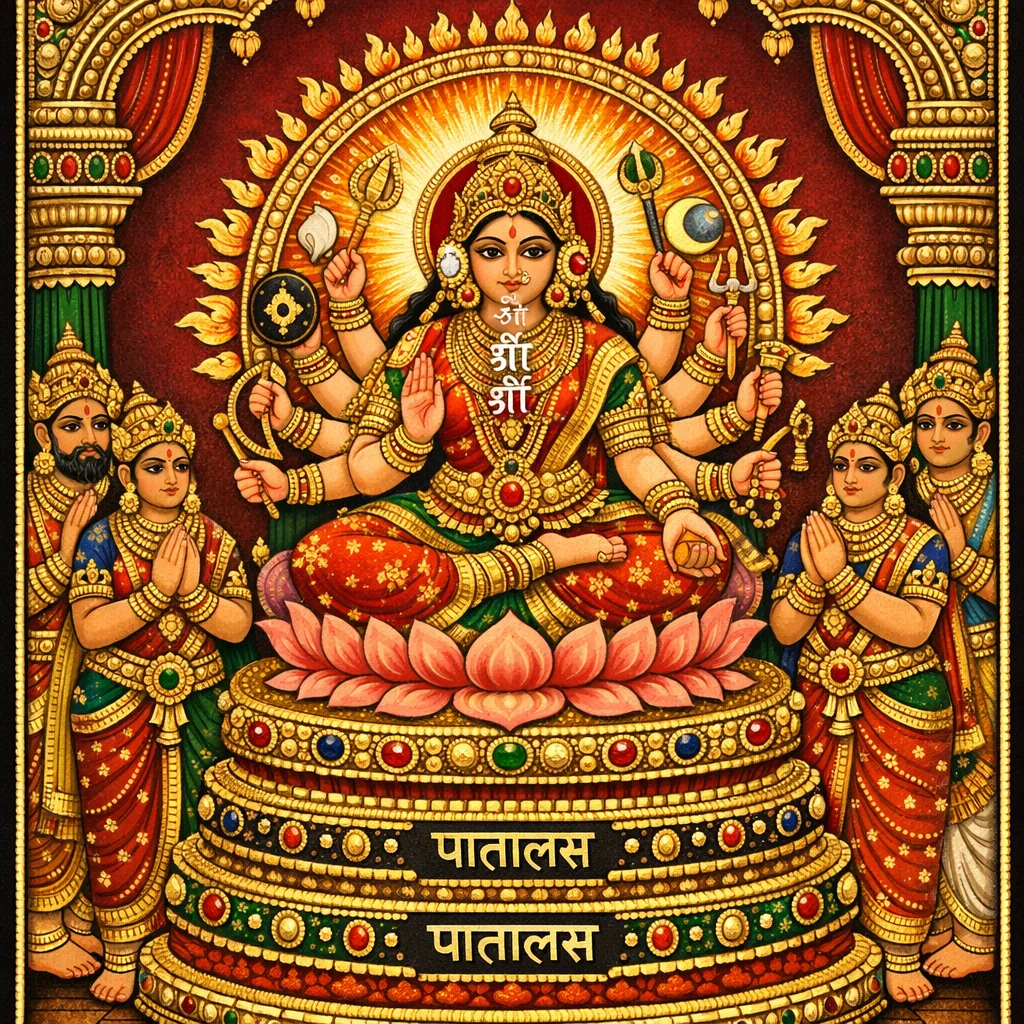
Within the Hayagriva–Agastya dialogue stream of the Lalitopakhyana, this chapter offers a stuti (hymn) voiced by the devas in praise of Lalita/Devi. The verses systematically list epithets in the form “jaya… namas…” and set out an explicit macrocosm–microcosm correspondence: netherworlds (Atala, Vitala, Rasatala), earth and the mid-region (Dharani, Bhuvarloka), luminaries and elements (moon, sun, fire), directions as arms, winds as breath, and the Vedas as speech—each identified with the Goddess’s body and faculties. The hymn also weaves in yogic-ritual terms (pranayama, pratyahara, dhyana, dharana, samadhi) as aspects of Devi, presenting Shakti not only as the object of devotion but as the cosmological and liberating ground.
Shlokas
Verse 1
इति श्रीब्रह्माण्डमहापुराणे उत्तरभागे हयग्रीवागस्त्यसंवादे ललितोपाख्याने ललिताप्रादुर्भावो नाम द्वादशो ऽध्यायः देवा ऊचुः जय देवि जगन्मातर्जय देवि परात्परे / जय कल्याणनिलये जय कामकलात्मिके
Thus, in the Śrī Brahmāṇḍa Mahāpurāṇa, in the latter section, in the dialogue of Hayagrīva and Agastya, within the Lalitā narrative, is the twelfth chapter called “The Manifestation of Lalitā.” The gods said: Victory to you, O Goddess, Mother of the world; victory to you, O Supreme beyond the supreme. Victory, abode of auspiciousness; victory, whose very essence is Kāmakalā.
Verse 2
जयकारि च वामाक्षि जय कामाक्षि सुन्दरि / जयाखिलसुराराध्ये जय कामेशि मानदे
Victory to Vāmākṣī, who brings forth triumph; victory to Kāmākṣī, the Beautiful. Victory to her whom all the gods adore; victory to Kāmeśī, bestower of honor.
Verse 3
जय ब्रह्ममये देवि ब्रह्मात्मकरसात्मिके / जय नारायणि परे नन्दिताशेषविष्टपे
Victory to you, O Goddess formed of Brahman, whose very nature is the blissful rasa of Brahman. Victory to you, O supreme Nārāyaṇī, who gladdens all the worlds.
Verse 4
जय श्रीकण्ठदयिते जय श्रीललितेंबिके / जय श्रीविजये देवि विजय श्रीसमृद्धिदे
Victory to the beloved of Śrīkaṇṭha (Śiva); victory to Śrī Lalitā Ambikā. Victory to the Goddess Śrīvijayā, giver of triumph, śrī, and abundance.
Verse 5
जातस्य जायमानस्य इष्टापूर्तस्य हेतवे / नमस्तस्यै त्रिजगतां पालयित्र्यै परात्परे
Salutations to the Goddess, the supreme beyond the supreme—cause of iṣṭa and pūrta for all who are born and being born, the protectress of the three worlds.
Verse 6
कलामुहूर्तकाष्ठाहर् मासर्तुशरदात्मने / नमः सहस्रशीर्षायै सहस्रमुखलोचने
Homage to Her who is the very essence of kalā, muhūrta, kāṣṭhā, day, month, season and autumn—unto the thousand-headed Goddess, of a thousand faces and a thousand eyes.
Verse 7
नमः सहस्रहस्ताब्जपादपङ्कजशोभिते / अणोरणुतरे देवि महतो ऽपि महीयसि
Salutations to the Goddess adorned with a thousand lotus-hands and lotus-feet—subtler than the subtlest, greater even than the great.
Verse 8
परात्परतरे मातस्तेजस्तेजीयसामपि / अतलं तु भवेत्पादौ वितलं जानुनी तव
O Mother, you are beyond the beyond, more radiant than the radiance of the radiant. Your feet are Atala, and your knees are said to be Vitala.
Verse 9
रसातलं कटीदेशः कुक्षिस्ते धरणी भवेत् / हृदयं तु भुवर्लोकः स्वस्ते मुखमुदाहृतम्
Your waist is Rasātala; your womb is the Earth (Dharanī). Your heart is Bhuvarloka, and your face is declared to be Svarloka.
Verse 10
दृशश्चन्द्रार्कदहना दिशस्ते बाहवोंबिके / मरुतस्तु तवोच्छ्वासा वाचस्ते श्रुतयो ऽखिलाः
O Ambikā! The moon, the sun, and fire are Your eyes; the directions are Your arms. The winds are Your breath, and all the Śrutis are Your sacred speech.
Verse 11
क्रीडा ते लोकरचना सखा ते चिन्मयः शिवः / आहारस्ते सदानन्दो वासस्ते हृदये सताम्
Your play is the fashioning of the worlds; Your companion is Śiva, pure consciousness. Your sustenance is everlasting bliss; Your dwelling is in the hearts of the virtuous.
Verse 12
दृश्यादृश्य स्वरूपाणि रूपाणि भुवनानि ते / शिरोरुहा घनास्ते तु तारकाः कुसुमानि ते
All worlds, seen and unseen, are Your forms; the clouds are Your tresses, and the stars are Your blossoms.
Verse 13
धर्माद्या बाहवस्ते स्युरधर्माद्यायुधानि ते / यमाश्च नियमाश्चैव करपादरुहास्तथा
Dharma and the like are Your arms; adharma and the like are Your weapons. The Yamas and Niyamas too are as sprouts upon Your hands and feet.
Verse 14
स्तनौ स्वाहास्वधाकरौ लोकोज्जीवनकारकौ / प्राणायामस्तु ते नासा रसना ते सरस्वती
Your breasts, bestowing Svāhā and Svadhā, sustain the life of the worlds. Prāṇāyāma is Your nose, and Sarasvatī is Your tongue.
Verse 15
प्रत्याहारस्त्विद्रिंयाणि ध्यानं ते धीस्तु सत्तमा / मनस्ते धारणाशक्तिर्हृदयं ते समाधिकः
O Goddess, the withdrawal of the senses is your pratyāhāra; meditation is your most excellent wisdom. The mind is your power of dhāraṇā, and the heart is your samādhi.
Verse 16
महीरुहास्तेङ्गरुहाः प्रभातं वसनं तव / भूतं भव्यं भविष्यच्च नित्यं च तव विग्रहः
O Goddess, the trees upon the mountains are the hairs upon your limbs; the dawn is your garment. Past, present, and future—together with eternity—are your very form.
Verse 17
यज्ञरूपा जगद्धात्री विश्वरूपा च पावनी / आदौ या तु दयाभूता ससर्ज निखिलाः प्रजाः
You are the very form of yajña, the Mother who upholds the world, the Universal Form, the Purifier. In the beginning, becoming compassion itself, you created all beings.
Verse 18
हृदयस्थापि लोकानामदृश्या मोहनात्मिका
Though abiding in the hearts of all beings, you remain unseen, and your very nature is enchantment.
Verse 19
नामरूपविभागं च या करोति स्वलीलया / तान्यधिष्ठाय तिष्ठन्ती तेष्वसक्तार्थकामदा / नमस्तस्यै महादेव्यै सर्वशक्त्यै नमोनमः
She who, by her own līlā, divides name and form, and abiding as their sovereign remains unattached—she grants artha and kāma. Salutations to that Mahādevī, the Sarvaśakti; salutations again and again.
Verse 20
यदाज्ञया प्रवर्तन्ते वह्निसूर्यैदुमारुताः / पृथिव्यादीनि भूतानि तस्यै देव्यै नमोनमः
By whose command fire, sun, moon, and winds proceed, and earth and all beings move—unto that Goddess, salutations again and again.
Verse 21
या ससर्जादिधातारं सर्गादावादिभूरिदम् / दधार स्वयमेवैका तस्यै देव्यै नमोनमः
She who, at the dawn of creation, brought forth the primal Ordainer (Brahmā) and manifested this primordial world; she alone upholds all by herself—unto that Goddess, salutations again and again.
Verse 22
यथा धृता तु धरिणी ययाकाशममेयया / यस्यामुदेति सविता तस्यै देव्यै नमोनमः
As by her immeasurable power the sky is upheld, so too is the earth sustained; within her Savitā, the Sun, arises—unto that Goddess, salutations again and again.
Verse 23
यत्रोदेति जगत्कृत्स्नं यत्र तिष्ठति निर्भरम् / यत्रान्तमेति काले तु तस्यै देव्यै नमोनमः
In her the entire universe arises, in her it stands supported, and in her, when time comes, it meets its end—unto that Goddess, salutations again and again.
Verse 24
नमोनमस्ते रजसे भवायै नमोनमः सात्त्विकसंस्थितायै / नमोनमस्ते तमसे हरायै नमोनमो निर्गुणतः शिवायै
Salutations again and again to You as Rajas, O Bhavānī; salutations to You established in Sattva. Salutations to You as Tamas, O beloved of Hara; salutations again and again to You as Śiva beyond all qualities, the Nirguṇa.
Verse 25
नमोनमस्ते जगदेकमात्रे नमोनमस्ते जगदेकपित्रे / नमोनमस्ते ऽखिलरूपतन्त्रे नमोनमस्ते ऽखिलयन्त्ररूपे
Salutations to You, the sole Mother of the universe; salutations again and again. Salutations to You, the sole Father of the world. Salutations to You, the Tantra-essence of all forms; salutations to You, who appear as every Yantra.
Verse 26
नमोनमो लोकगुरुप्रधाने नमोनमस्ते ऽखिलवाग्विभूत्यै / नमो ऽस्तु लक्ष्म्यै जगदेकतुष्ट्यै नमोनमः शांभवि सर्वशक्त्यै
Salutations again and again to You, foremost as the Guru of the worlds; salutations to You, the glory of all speech. Homage to Lakshmi, the universe’s single fulfillment; salutations to Shambhavi, the Power of all powers.
Verse 27
अनादिमध्यान्तमपाञ्चभौतिकं ह्यवाङ्मनोगम्यमतर्क्यवैभवम् / अरूपमद्वन्द्वमदृष्टगोचरं प्रभावमग्र्यं कथमंब वर्णये
O Mother, without beginning, middle, or end; beyond the five elements; unreachable by speech and mind, and of splendor beyond all reasoning—formless, non-dual, beyond the range of sight: how can I describe Your supreme majesty?
Verse 28
प्रसीद विश्वेश्वरि विश्ववन्दिते प्रसीद विद्येश्वरि वेदरूपिणि / प्रसीद मायामयि मन्त्राविग्रहे प्रसीद सर्वेश्वरि सर्वरूपिणि
Be gracious, O Sovereign of the universe, adored by all the worlds; be gracious, O Lady of sacred knowledge, whose form is the Vedas. Be gracious, O She who is woven of Maya, whose body is Mantra; be gracious, O Queen of all, who takes on every form.
Verse 29
इति स्तत्वा महादेवीं देवाः सर्वे सवासवाः / भूयोभूयो नमस्कृत्य शरणं जगमुरञ्जसा
Thus, having praised the Mahadevi, all the gods together with Indra bowed again and again, and with guileless hearts they went to Her for refuge.
Verse 30
ततः प्रसन्ना सा देवी प्रणतं वीक्ष्य वासवम् / वरेण च्छन्दयामास वरदाखिलदेहिनाम्
Then the Goddess, pleased, beheld Vāsava (Indra) bowed in reverence and, as the bestower of boons upon all embodied beings, invited him to choose a boon.
Verse 31
इन्द्र उवाच यदि तुष्टासि कर्याणि वरं दैत्येन्द्र पीडितः / दुर्धरं जीवितं देहि त्वां गताः शरणार्थिनः
Indra said: “O Auspicious Lady, if you are pleased, grant a boon: afflicted by the lord of the Daityas, we have come to you seeking refuge. Bestow upon us protection of this hard‑to-preserve life.”
Verse 32
श्रीदेव्युवाच अहमेव विनिर्जित्य भण्डं दैत्यकुलोद्भवम् / अचिरात्तव दास्यामि त्रैलोक्यं सचराचरम्
Śrī Devī said: “I myself shall conquer Bhaṇḍa, born of the Daitya race, and soon I will grant you the three worlds, with all that moves and all that is unmoving.”
Verse 33
निर्भया मुदिताः सन्तु सर्वे देवगणास्तथा / ये स्तोष्यन्ति च मां भक्त्या स्तवेनानेन मानवाः
May all the hosts of the gods be fearless and joyful; and may those humans who praise me with devotion through this hymn likewise become so.
Verse 34
भाजनं ते भविष्यन्ति धर्मश्रीयशसां सदा / विद्याविनयसंपन्ना नीरोगा दीर्घजीविनः
They shall ever be worthy vessels of dharma, of Śrī (prosperity), and of renown—endowed with learning and humility, free from illness, and long-lived.
Verse 35
पुत्रमित्रकल त्राढ्या भवन्तु मदनुग्रहात् / इति लब्धवरा देवा देवेन्द्रो ऽपि महाबलः
By my grace, may you be prosperous with sons, friends, and spouse—thus blessed with the boon, the gods, and even mighty Devendra, rejoiced.
Verse 36
आमोदं परमं जग्मुस्तां विलोक्य मुहुर्मुहुः
Beholding her again and again, they entered into supreme delight.
Frequently Asked Questions
No formal vamsha catalog appears in the sampled material; the chapter’s primary function is hymnic-theological and cosmographic, presenting Devī as the ground in which worlds and beings (including lineages) subsist rather than listing dynastic descent.
It provides qualitative cosmography rather than numeric measures: named nether regions (Atala, Vitala, Rasātala), loka-identifications (Dharaṇī, Bhuvarloka), and astronomical-elemental correspondences (moon/sun/fire as aspects of sight; directions as arms), functioning as a relational map instead of a metric one.
This chapter does not foreground a particular yantra diagram; its esoteric payload is the identificatory “vidyā” of correspondence—Devī is equated with cosmic layers and yogic limbs (prāṇāyāma through samādhi). The practical implication is that worship and inner discipline are read as participation in the Goddess’s own cosmological structure.