Adhyaya 29
Yuga-Vibhāga and Kāla-Pramāṇa (Measures of Time and the Four Yugas)
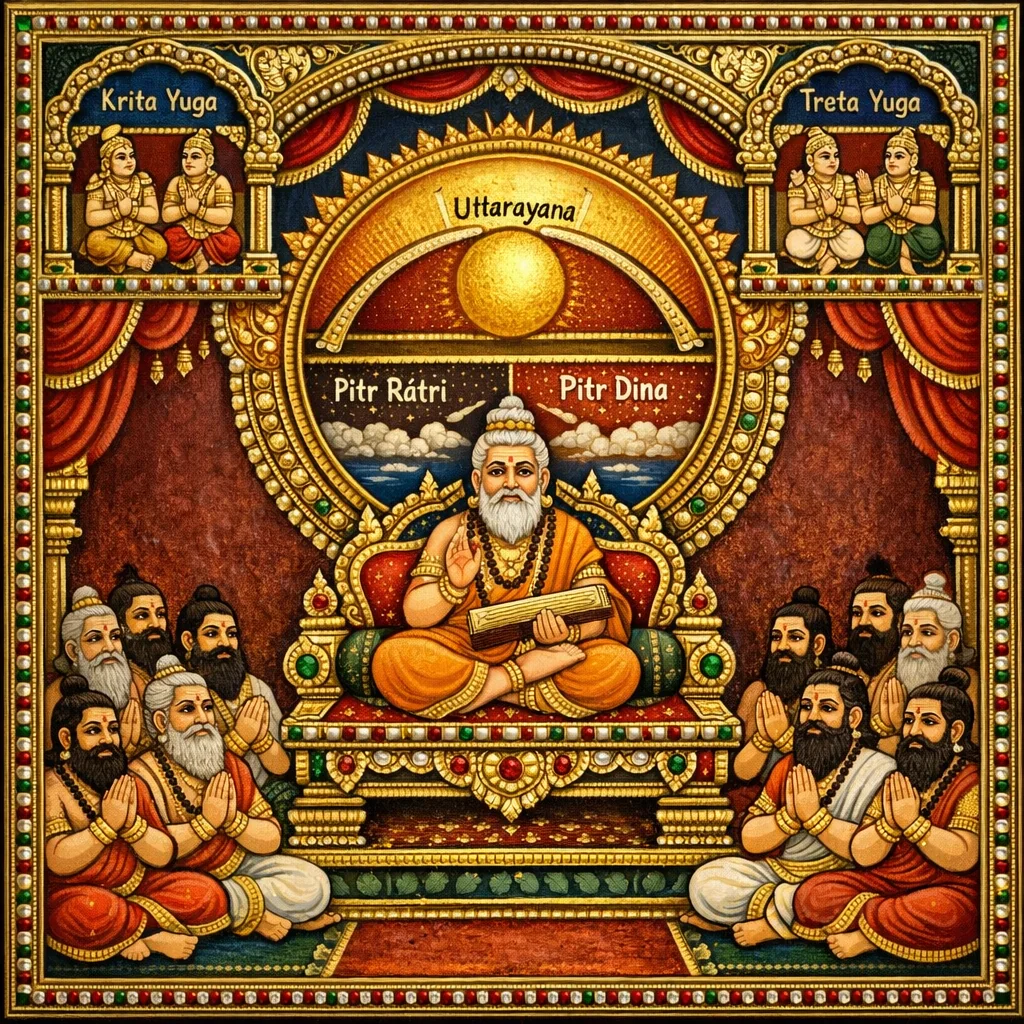
This adhyāya begins with a ṛṣi requesting a detailed account of the caturyuga cycles in the Svāyambhuva manvantara, focusing on their origin-pattern (nisarga) and underlying principle (tattva). Sūta links the subject to an earlier cosmological discussion and promises a systematic exposition. The chapter then enumerates measures of time from the smallest perceptible unit (nimeṣa, kāṣṭhā, kalā, muhūrta) up to the human (mānuṣa/laukika) day and night governed by the sun. It introduces scale-conversions: pitṛ-time, where a human month becomes a day-night unit (kṛṣṇapakṣa as “day,” śuklapakṣa as “night”), and divine time, where udagayana and dakṣiṇāyana form the devas’ day and night. On this basis it states yuga, yuga-bheda, yuga-dharma, and the junctions (yuga-sandhyā, sandhyāṃśa, sandhi) with numerical clarity, establishing a computable chronology for Purāṇic history.
Shlokas
Verse 1
इति श्रीब्रह्माण्डे महापुराणे वायुप्रोक्ते पूर्वभागे द्वितीये ऽनुषङ्गपादे अमावस्याश्राद्धे पितृविचयोनामाष्टाविंशति तमो ऽध्यायः ऋषिरुवाच चतुर्युगानि यान्यासन्पूर्वं स्वायंभुवे ऽन्तरे / तेषां निसर्गं तत्त्वं च श्रोतुमिच्छामि विस्तरात्
Thus in the Śrī Brahmāṇḍa Mahāpurāṇa, in the former section spoken by Vāyu, in the second Anuṣaṅga-pāda, in the account of the Amāvasyā śrāddha, the twenty-eighth chapter called “Pitṛvicaya”. The ṛṣi said: The four-yuga cycles that existed earlier in the Svāyambhuva Manvantara—their arising and their true principle I wish to hear in detail.
Verse 2
सूत उवाच पृथिव्यादिप्रसंगेन यन्मया प्रागुदीरितम् / तेषां चतुर्युगं ह्येतत्तद्वक्ष्यामि निबोधत
Sūta said: What I earlier mentioned in connection with the earth and related matters—this is their four-yuga cycle; now I shall explain it, listen attentively.
Verse 3
संख्ययेह प्रसंख्याय विस्तराच्चैव सर्वशः / युगं च युगभेदश्च युगधर्मस्तथैव च
Here I shall set forth, by the measure of numbers and in full detail, the yuga, the distinctions of the yugas, and likewise the dharma of each yuga.
Verse 4
युगसंध्यांशकश्चैव युगसंधानमेव च / षट्प्रकाशयुगाख्यैषा ता प्रवक्ष्यामि तत्त्वतः
I shall also speak of the portions of the yuga’s twilight (sandhyā) and of the yuga’s joining (sandhāna); these six divisions called “ṣaṭ-prakāśa” I will declare in truth.
Verse 5
लौकिकेन प्रमाणेन निष्पाद्याब्दं तु मानुषम् / तेनाब्देन प्रसंख्यायै वक्ष्यामीह वतुर्युगम् / निमेषकाल तुल्यं हि विद्याल्लघ्वक्षरं च यत्
By the common worldly measure the human year is established; using that year for reckoning, I shall describe here the fourfold yuga-cycle (caturyuga). And know that the “laghvakṣara” is equal to the duration of a nimeṣa (a blink).
Verse 6
काष्ठा निमेषा दश पञ्च चैव त्रिशच्च काष्ठा गणयेत्कलां तु / त्रिंशत्कलाश्चापि भवेन्मुहूर्त्तस्तै स्त्रिंशता रात्र्यहनी समे ते
Fifteen nimeṣas make one kāṣṭhā; thirty kāṣṭhās are reckoned as one kalā; thirty kalās make one muhūrta; and by thirty muhūrtas, night and day are formed in equal measure.
Verse 7
अहोरात्रौ विभजते सूर्यो मानुषलौकिकौ
The Sun divides, for humankind, the worldly day and the worldly night.
Verse 8
तत्राहः कर्मचेष्टायां रात्रिः स्वप्नाय कल्पते / पित्र्ये रात्र्यहनी मासः प्रविभागस्तयोः पुनः
There, the day is ordained for the striving of deeds, and the night is appointed for sleep and dream. In the realm of the Pitṛs, night and day together make a month; and again their division is set forth.
Verse 9
कृष्णपक्षस्त्वहस्तेषां शुक्लः स्वप्नाय शर्वरी / त्रिंशद्ये मानुषा मासाः पित्र्यो मासस्तु सः स्मृतः
For them, the dark fortnight is as the day, and the bright fortnight is the night of dreaming. Thirty human months are remembered as one month of the Pitṛs.
Verse 10
शतानि त्रीणि मासानां षष्ट्या चाप्यधिकानि वै / पित्र्यः संवत्सरो ह्येष मानुषेण विभाव्यते
Three hundred months, and sixty more—three hundred and sixty in all—are understood, by human reckoning, to be one year of the Pitṛs.
Verse 11
मानुषे णैव मानेन वर्षाणां यच्छतं भवेत् / पितॄणां त्रीणि वर्षाणि संख्यातानीह तानि वै
A hundred years by human measure are counted here as three years of the Pitṛs.
Verse 12
दश चैवाधिका मासाः पितृसंख्येह संज्ञिताः / लौकिकेनैव मानेन हृब्दो यो मानुषः स्मृतः
In the reckoning of the Pitṛs, ten months and additional months are spoken of; and the time known as ‘human’ is understood only by worldly measure.
Verse 13
एतद्दिव्यमहोरात्रं शास्त्रे स्यान्निश्चयो गतः / दिव्ये रात्र्यहनी वर्ष प्रविभागस्तयोः पुनः
In the śāstras this divine day-and-night is set forth with certainty. According to that divine night and day, the division of years is again determined.
Verse 14
अहस्तत्रोदगयनं रात्रिः स्याद्दक्षिणायनम् / ये ते रात्र्यहनी दिव्ये प्रसंख्यानं तयोः पुनः
There, the day is called Uttarāyaṇa and the night is Dakṣiṇāyaṇa. And the reckoning of those divine night and day is again set forth.
Verse 15
त्रिंशद्यानि तु वर्षाणि दिप्यो मासस्तु स स्मृतः / यन्मानुषं शतं विद्धि दिव्या मासास्त्रयस्तु ते
Thirty years are remembered as one divine month. Know that a hundred human years amount to three divine months.
Verse 16
दश चैव तथाहानि दिव्यो ह्येष विधिः स्मृतः / त्रीणि वर्षशतान्येव षष्टिवर्षाणि यानि तु / दिव्यः संवत्सरो ह्येष मानुषेण प्रकीर्त्तितः
Thus ten (divine) days are remembered as the divine ordinance. And three hundred and sixty human years are proclaimed to be one divine year (saṃvatsara).
Verse 17
त्रीणि वर्ष सहस्राणि मानुषाणि प्रमाणतः / त्रिंशदन्यानि वर्षाणि मतः सप्तर्षिवत्सरः
By the accepted measure, three thousand human years, with thirty more years besides, are regarded as the year of the Saptarṣis.
Verse 18
नव यानि सहस्राणि वर्षाणां मानुषाणि तु / अन्यानि नवतिश्चैव ध्रुवः संवत्सरः स्मृतः
Nine thousand human years, and a further ninety years besides—this is remembered as the fixed (Dhruva) saṃvatsara.
Verse 19
षड्विंशतिसहस्राणि वर्षाणि मानुषाणि तु / वर्षाणां तु शतं ज्ञेयं दिव्यो ह्येष विधिः स्मृतः
Twenty-six thousand human years; and a hundred years are to be known as the divine measure—such is the heavenly ordinance remembered.
Verse 20
त्रीण्येव नियुतान्याहुर्वर्षाणां मानुषाणि तु
In human years, they declare it to be three niyutas—three hundred thousand years.
Verse 21
षष्टिश्चैव सहस्राणि संख्यातानि तु संख्याया / दिव्यवर्षसहस्र तु प्राहुः संख्याविदो जनाः
By the reckoning of numbers it is counted as sixty thousand; the knowers of calculation declare it to be a thousand divine years.
Verse 22
इत्येवमृषिभिर्गीतं दिव्यया संख्याया त्विह / दिव्येनैव प्रमाणेन युगसंख्याप्रकल्पनम्
Thus have the ṛṣis sung here in divine enumeration; and by that very divine measure the reckoning of the yugas is set forth.
Verse 23
चत्वारि भारते वर्षे युगानि कवयो ऽबुवन् / कृतं त्रेता द्वापरं च कलिश्चेति चतुष्टयम्
In Bharata-varsha, the sages have declared four Yugas: Krita, Treta, Dvapara, and Kali—this is the fourfold cycle.
Verse 24
पूर्व कृतयुकं नाम ततस्त्रेती विधीयते / द्वापरं च कलिश्चैव युगान्येतानि कल्पयेत्
First is called the Krita Yuga; then Treta is ordained; thereafter come Dvapara and Kali—thus are these Yugas conceived.
Verse 25
चत्वार्याहुः सहस्राणि वर्षाणां च कृत युगम् / तस्य तावच्छती संध्या संध्यांशः संध्याया समः
Krita Yuga is said to be four thousand years; its twilight (saṃdhyā) is a hundred years, and its twilight-portion (saṃdhyāṃśa) is equal to that twilight.
Verse 26
इतरेषु ससंध्येषु ससंध्यांशेषु च त्रिषु / एकन्यायेन वर्तन्ते सहस्राणि शतानि च
In the other three Yugas as well, together with their saṃdhyā and saṃdhyāṃśa, the thousands and hundreds proceed by the same single rule.
Verse 27
त्रीणि द्वे च सहस्राणि त्रेताद्वापरयोः क्रमात् / त्रिशती द्विशती संध्ये संध्यांशौ चापि तत्समौ
In due order, Treta Yuga is three thousand years and Dvapara Yuga two thousand; their saṃdhyā are three hundred and two hundred years, and their saṃdhyāṃśa are equal to those.
Verse 28
कलिं वर्षसरस्रं तु युगमाहुर्द्विजोत्तमाः / तस्यैकशतिका संध्या संध्यांशः संध्यया समः
The foremost Brahmins declare that the Kali Yuga is a thousand years in length. Its twilight is one hundred years, and the twilight portion is equal to that twilight.
Verse 29
तेषां द्वादशसाहस्री युगसंख्या प्रकीर्त्तिता / कृतं त्रेता द्वापरं च कलिश्चैव चतुष्टयम्
Their yuga count is proclaimed as twelve thousand: Krita, Treta, Dvapara, and Kali—these four together form the set of ages.
Verse 30
अत्र संवत्सरा दृष्टा मानुषेण प्रमाणतः / कृतस्य तावद्वक्ष्यामि वर्षाणि च निबोधत
Here the years are reckoned by the human measure. Now I shall declare the years of the Krita Yuga; listen and understand.
Verse 31
सहस्राणां शतान्याहुश्चतुर्दश हि संख्याया / चत्वारिंशत्सहस्राणि तथान्यानि कृतं युगम्
In the count of hundreds of thousands, the number is said to be fourteen; and forty thousand, together with the remaining years, makes up the Krita Yuga.
Verse 32
तथा शतसहस्राणि वर्षाणि दशसंख्याया / अशीतिश्च सहस्राणि कालस्त्रेतायुगस्य सः
Likewise, ten hundred-thousands of years and eighty thousand years—such is the duration of the Treta Yuga.
Verse 33
सप्तैव नियुतान्याहुर्वर्षाणां मानुषेण तु / विंशतिश्च सहस्रामि कालः स द्वापरस्य च
By the reckoning of human years, the span of the Dvāpara Yuga is declared to be seven niyutas and twenty thousand years.
Verse 34
तथा शतसहस्राणि वर्षाणां त्रीणि संख्यया / षष्टिश्चैव सहस्राणि कालः कलियुगस्य तु
So too, the time of the Kali Yuga is remembered as three hundred thousand years and sixty thousand more—three hundred sixty thousand in all.
Verse 35
एवं चतुर्युगे काल ऋतैः संध्यांशकैः स्मृतः / नियुतान्येव षडिंशान्निरसानि युगानि वै
Thus the time of a Caturyuga is remembered together with the twilight periods (sandhyā) and their portions (sandhyāṃśa) of Kṛta and the other yugas; the measure of the yugas is sixteen niyutas, complete.
Verse 36
चत्वारिंशत्तथा त्रीणि नियुता नीह संख्यया / विंशतिश्च सहस्राणि स संध्यांशश्चतुर्युगः
Here, by count, there are forty-three niyutas and twenty thousand years; this is spoken of as the sandhyāṃśa, the twilight portion, of the Caturyuga.
Verse 37
एवं चतुर्युगाख्यानां साधिका ह्येकसप्ततिः / कृतत्रेतादियुक्तानां मनोरन्तरमुच्यते
Thus, a count exceeding seventy-one Caturyugas—comprising Kṛta, Tretā, and the rest—is spoken of as a Manvantara.
Verse 38
मन्वन्तरस्य संख्यां तु वर्षाग्रेण निबोधत / त्रिंशत्कोट्यस्तु वर्षाणां मानुषेण प्रकीर्त्तिताः
Know the measure of a Manvantara by the count of years: in human reckoning it is proclaimed as thirty crores of years.
Verse 39
सप्त षष्टिस्तथान्यानि नियुतान्यधिकानि तु / विशतिश्च सहस्राणि कालो ऽयं साधिकं विना
To this are added sixty-seven niyutas and twenty thousand; thus is this span of time, with no remainder beyond it.
Verse 40
मन्वन्तरस्य संख्यैषा संख्या विद्भिर्द्विजैः स्मृता / मन्वन्तरस्य कालो ऽयं युगैः सार्द्धं च कीर्त्तितः
This is the reckoning of a Manvantara, remembered by learned twice-born sages; this span of Manvantara is also declared together with the yugas.
Verse 41
चतुः साहस्रयुक्तं वै प्राकृतं तत्कृतं युगम् / त्रेताशिष्टं प्रवक्ष्यामि द्वापरं कलिमेव च
The primal Kṛta-yuga is indeed set with four thousand; now I shall declare as well what remains—Tretā, Dvāpara, and Kali.
Verse 42
युगपत्समयेनार्थो द्विधा वक्तुं न शक्यते / क्रमागतं मया ह्येतत्तुभ्यं नोक्त युग द्वयम्
The meaning cannot be spoken in two ways at the same time; therefore, what has come in due sequence I have not told you as two yugas at once.
Verse 43
ऋषिवंशप्रसंगेन व्याकुलत्वात्तथैव च / अत्र त्रेतायुगस्यादौ मनुः सप्तर्षयश्च ये
Stirred by the account of the lineage of the seers, here, at the dawn of the Tretā Yuga, Manu and the Seven Ṛṣis who were present are spoken of.
Verse 44
श्रौत स्मार्त्त च ते धर्म ब्रह्मणानुप्रचौदितम् / दाराग्निहोत्रसंबन्धमृग्यजुः सामसंहितम्
Their dharmas—both Śrauta and Smārta—were enjoined by Brahmā: the duties bound to household life and the Agnihotra, together with the Saṃhitās of Ṛg, Yajus, and Sāma.
Verse 45
इत्यादिलक्षणं श्रौतं धर्म सप्तर्षयो ऽब्रुवन् / परंपरागतं धर्म स्मार्त्तं चाचारलक्षणम्
Thus the Seven Ṛṣis declared the Śrauta dharma with such marks; and also the Smārta dharma, handed down through lineage, distinguished by ācāra—right conduct.
Verse 46
वर्णाश्रमाचारयुतं मनुः स्वायंभुवो ऽब्रवीत् / सत्येन ब्रह्मचर्येण श्रुतेन तपसा च वै
Manu Svāyambhuva spoke of the dharma joined to the conduct of varṇa and āśrama—through truth, brahmacarya, śruti (the Veda), and tapas, indeed.
Verse 47
तेषां तु तप्ततपसा आर्षेणोपक्रमेण तु / सप्तर्षीणां मनोश्चैव ह्याद्ये त्रेतायुगे तथा
In accord with their ardent tapas and the rishi-born mode of beginning, so too, at the very dawn of the Tretā Yuga, it was the same for the Seven Ṛṣis and for Manu.
Verse 48
अबुद्धिपूर्वकं तेषामक्रियापूर्वमेव च / अभिव्यक्तास्तु ते मन्त्रास्तारकाद्यैर्निदर्शनैः
Their mantras were not fashioned beforehand by intellect, nor preceded by any act; they became manifest through signs such as the stars and other indications.
Verse 49
आदिकल्पे तु देवानां प्रादुर्भूतास्तु याः स्वयम् / प्राणाशेष्वथ सिद्धीनामन्यासां च प्रवर्त्तनम्
In the primal kalpa, the gods’ siddhis arose of themselves; and when the life-breath waned, other siddhis too came into operation.
Verse 50
आसन्मन्त्रा व्यतीतेषु ये कल्पेषु सहस्रशः / ते मन्त्रा वै पुनस्तेषां प्रतिभायामुपस्थिताः
The mantras that had existed through thousands of bygone kalpas—those very mantras again arose within their inspired insight.
Verse 51
ऋचो यजूंषि सामानि मन्त्रश्चाथर्वणानि तु / सप्तर्षिभिस्तु ते प्रोक्ताः स्मार्त्तं धर्मं मनुर्जगौ
The Ṛc, the Yajus, the Sāman, and the Atharvan mantras were spoken by the Seven Ṛṣis; and Manu proclaimed the Smārta dharma.
Verse 52
त्रेतादौ संहिता वेदाः केवला धर्मसेतवः / संरोधादायुषश्चैव वर्त्स्यन्ते द्वापरेषु वै
At the dawn of Tretā, the Vedas were only Saṃhitās, nothing but bridges of dharma; as lifespan contracted, they would endure in Dvāpara (in divided form).
Verse 53
ऋषयस्तपसा वेदान्द्वापरादिष्वधीयते / अनादिनिधिना दिव्याः पूर्वं सृष्टाः स्वयंभुवा
The seers, by the power of austerity, study the Vedas in the Dvāpara and other ages. The Self-born, the divine Treasure without beginning, first created the celestial ṛṣis.
Verse 54
सधर्माः सव्रताः सांगा यथाधर्मं युगेयुगे / विक्रियन्ते समानार्था वेदवादा यथायुगम्
The Vedic teachings—together with dharma, vows, and the Vedāṅgas—proceed age after age in accord with righteousness. Their meaning is one, yet their expression shifts with each yuga.
Verse 55
आरंभयज्ञाः क्षत्राश्च हविर्यज्ञा विशस्तथा / परिचारयज्ञाः शूद्रास्तु जपयज्ञा द्विजोत्तमाः
The kṣatriyas perform the yajñas of undertaking, and the vaiśyas the yajñas of oblations. The śūdras are devoted to the yajña of service, while the foremost twice-born perform the yajña of sacred japa.
Verse 56
तदा प्रमुदिता वर्णास्त्रेतायां धर्मपालिताः / क्रियावन्तः प्रजावन्तः समृद्धाः सुखिनस्तथा
Then, in the Tretā age, the varṇas upheld by dharma were filled with joy—active in sacred rites, blessed with offspring, prosperous, and happy.
Verse 57
ब्राह्मणाननुर्त्तन्ते क्षत्रियाः क्षत्रियान्विशः / वैश्यानुवर्त्तिनः शुद्राः परस्परमनुव्रताः
The kṣatriyas follow the brāhmaṇas, and the vaiśyas follow the kṣatriyas. The śūdras follow the vaiśyas—each faithful to the other, observing their mutual vows and duties.
Verse 58
शुभाः प्रवृत्तयस्तेषां धर्मा वर्णाश्रमास्तथा / संकल्पितेन मनसा वाचोक्तेन स्वकर्मणा
Their ways were auspicious; so too were the dharmas of varṇa and āśrama—by resolve in the mind, by words spoken, and by each one’s own deeds.
Verse 59
त्रेतायुगे च विफलः कर्मारंभः प्रसिद्ध्यति / आयुर्मेधा बलं रूपमारोग्यं धर्मशीलता
In the Tretāyuga, even fruitless undertakings of action became well known; longevity, intellect, strength, beauty, health, and dharmic character increased.
Verse 60
सर्वसाधारणा ह्येते त्रेतायां वै भवं त्युत / वर्णाश्रमव्यवस्थानं तेषां ब्रह्मा तदाकरोत्
O Bhava, in the Tretāyuga all these were common to all; then Brahmā established for them the order of varṇa and āśrama.
Verse 61
पुनः प्रजास्तु ता मोहाद्धर्मा स्तानप्यपालयन् / परस्परविरोधेन मनुं ताः पुनरभ्ययुः
Then those beings, through delusion, failed to uphold those dharmas; by mutual conflict they again approached Manu.
Verse 62
पुनः स्वायंभुवो दृष्ट्वा याथातथ्यं प्रजापतिः / ध्यात्वा तु शतरूपायां पुत्रौ स उदपादयत्
Again Svāyaṃbhuva Prajāpati, seeing things as they truly were, meditated upon Śatarūpā and brought forth two sons.
Verse 63
प्रियव्रतो त्तानपादौ प्रथमौ तौ मोहीक्षितौ / ततः प्रभृति राजान उत्पन्ना दण्डधारिणः
Priyavrata and Uttanapada were regarded as the first two kings; from that time onward arose rulers who bore the daṇḍa, the rod of dharma.
Verse 64
प्रजानां रञ्जनाच्चैव राजानस्ते ऽभवन्नृपाः / प्रच्छन्न पापास्तैर्ये च न शक्यास्तु नराधिपैः
Because they delighted the people, those kings came to be called nṛpas; and they restrained even hidden sins that other rulers could not curb.
Verse 65
धर्मराजः स्मृतस्तेषां शास्ता वैवस्वतो यमः / वर्णानां प्रविभागाश्च त्रेतायां संप्रकीर्त्तिताः
For them, Vaivasvata Yama was remembered as Dharmaraja, the divine Judge; and in the Tretā age the divisions of the varṇas were also proclaimed.
Verse 66
संभृताच्च तदा मन्त्रा ऋषिभिर्ब्रह्मणः सुतैः / यज्ञाः प्रवर्त्तिताश्चैव तदा ह्येव तु दैवतैः
Then the sages, sons of Brahmā, gathered the mantras; and at that very time the gods set the yajñas, the sacred sacrifices, into motion.
Verse 67
यामशुक्रार्जितैश्चैव सर्वसाधन संभृतैः / सार्द्धं विश्वभुजा चैव देवेन्द्रेण महौजसा
With what Yama and Śukra had obtained, furnished with every requisite, together with Viśvabhuja and with mighty Devendra (they acted in concert).
Verse 68
स्वायंभुवेंऽतरे देवैर्यज्ञस्तैः प्राक्प्रवर्त्तितः / सत्यं जपस्तपो दानं त्रेताया धर्म उच्यते
In the Svāyambhuva Manvantara, the gods formerly set the yajña in motion; in the Tretā age, truth, sacred recitation, austerity, and giving are called dharma.
Verse 69
तदा धर्म्मसहस्रान्ते ऽहिंसाधर्मः प्रवर्त्तते / जायन्ते च तदा शूरा आयुष्मन्तो महाबलाः
Then, at the close of a thousand measures of dharma, the dharma of non‑violence comes forth; and in that time are born heroes—long‑lived and mighty.
Verse 70
व्यस्तदण्डा महाभागा धर्मिष्ठा ब्रह्मवादिनः / पद्मपत्रायताक्षाश्च पृथूरस्काः सुसंहताः
They set aside the rod of punishment—fortunate souls, steadfast in dharma, proclaimers of Brahman; with eyes long like lotus leaves, broad-chested and well-knit in form.
Verse 71
सिंहातङ्का महासत्त्वा मत्तमातङ्गगमिनः / महाधनुर्द्धराश्चैव त्रेतायां चक्रवर्त्तिनः
Lion-like in awe, great in spirit, moving with the gait of a rutting elephant; bearing mighty bows, they are, in the Tretā age, cakravartins—universal sovereigns.
Verse 72
सर्वलक्षणसम्पूर्मा न्यग्रोधपरिमण्डलाः / न्यग्रोधौ तु स्मृतौ बाहू व्यामो न्यग्रोध उच्यते
They are complete in every auspicious mark, of the measure called nyagrodha-parimaṇḍala (like the banyan’s full round). The two arms are remembered as “nyagrodha,” and a single vyāma is also called “nyagrodha.”
Verse 73
व्यामे नैवोछ्रयो यस्य सम ऊर्द्धं तु देहिनः / समोछ्रयपरीणाहो ज्ञेयो न्यग्रोधमण्डलः
That whose breadth and height above the body are equal, and whose height and girth are likewise equal—know that as the Nyagrodha-maṇḍala.
Verse 74
चक्रं रथो मणिर्भार्या निधिरश्वो गजस्तथा / सप्तैतानि च रत्नानि सर्वेषां चक्रवर्तिनाम
The Wheel, the Chariot, the Jewel, the Queen, the Treasure, the Horse, and the Elephant—these seven are the ratnas of all Cakravartins.
Verse 75
चक्रं रथो मणिः खड्गश्चर्मरत्नं च पञ्चमम् / केतुर्निधिश्च सप्तैव प्राणहीनानि चक्षते
The Wheel, the Chariot, the Jewel, the Sword, the Shield-ratna as the fifth, the Banner (Ketu), and the Treasure—these seven are said to be without life.
Verse 76
भार्या पुरोहितश्चैव सेनानी रथकृच्च यः / मन्त्र्यश्वः कलभश्चैव प्राणिनः सप्त कीर्त्तिताः
The Queen, the Purohita, the General, the Chariot-maker, the Minister, the Horse, and the young Elephant (Kalabha)—these seven are proclaimed as living.
Verse 77
रत्नान्येतानि दिव्यानि संसिद्धानि महात्मनाम् / चतुर्दश विधेयानि सर्वेषां चक्रवर्त्तिनाम्
These divine ratnas are perfected for the great-souled; for all Cakravartins they are declared to be fourteen ordained endowments.
Verse 78
विष्णोरंशेन जायन्ते पृथिव्यां चक्रवर्त्तिनः / मन्वन्तरेषु सर्वेषु अतीतानागतेष्विह
From a portion of Viṣṇu are born on earth the cakravartin sovereigns; in every manvantara—past and yet to come—so it is here.
Verse 79
भूतभव्यानि यानीह वर्त्तमानानि यानि च / त्रेतायुगे च तान्यत्र जायन्ते चक्रवर्त्तिनः
Whatever is of the past and the future, and whatever is present here—there, in the Tretā Yuga, all that is born as cakravartin rulers.
Verse 80
भद्राणीमानि तेषां वै भवन्तीह महीक्षिताम् / अत्यद्भुतानि चत्वारि बलं धर्मः सुखं धनम्
For those kings who guard the earth, these blessings arise here: four wondrous gifts—strength, dharma, happiness, and wealth.
Verse 81
अन्योन्यस्याविरोधेन प्राप्यन्ते तु नृपैः समम् / अर्थो धर्मश्च कामश्च यशो विजय एव च
Without clashing with one another, kings attain them all together: artha, dharma, kāma, fame, and victory as well.
Verse 82
ऐश्वर्येणाणिमाद्येन प्रभुशक्त्या तथैव च / श्रुतेन तपसा चैव मुनीनभिभवन्ति वै
By aiśvarya—siddhis such as aṇimā and the rest—and by sovereign power, and also by śruti-born wisdom and tapas, they truly surpass even the munis.
Verse 83
बलेन तपसा चैव देवदानवमानवान् / लक्षणैश्चैव जायन्ते शरीरस्थैरमानुषैः
By strength and by austerity, gods, dānavas, and humans are born, endowed with superhuman marks abiding in the body.
Verse 84
केशाःस्निग्धा ललाटोच्चा जिह्वा चास्य प्रमार्जिनी / ताम्रप्रभोष्टनेत्राश्च श्रीवत्साश्चैद्ध्वरोमशाः
His hair is sleek, his forehead high, and his tongue purifying; his lips and eyes shine with a coppery glow, he bears the Śrīvatsa mark, and his body is thickly haired.
Verse 85
आजानुबाहवस्छैव तदाम्रहस्ताः कटौ कृशाः / न्यग्रोधपरिणाहाश्च सिंहस्कन्धास्तु मेहनाः
His arms reach to his knees, his hands are copper-hued, and his waist is slender; his chest is broad like the nyagrodha tree, his shoulders leonine, and his strength is great.
Verse 86
गजेद्रगतयश्चैव महाहनव एव च / पादयोश्चक्रमत्स्योन्तु शङ्खपद्मौ तुहस्तयोः
His gait is like that of a lordly elephant, and his jaws are great; on his feet are the marks of the discus and the fish, and on his hands the conch and the lotus.
Verse 87
पञ्चाशीतिसहस्राणि ते राजन्त्यजरा नृपाः / असंगगतयस्तेषां चतस्रश्चक्रवर्त्तिनाम्
Those kings, free from decay, reign for eighty-five thousand years; and for the cakravartins, four unobstructed courses of movement are spoken of.
Verse 88
अन्तरिक्षे समुद्रि च पाताले पर्वतेषु च / इज्या दानं तपः सत्यं त्रेतायां धर्म उच्यते
In the sky, in the ocean, in Pātāla, and upon the mountains, the dharma of the Tretā Yuga is declared to be worship by sacrifice, giving, austerity, and truth.
Verse 89
तदा प्रवर्त्तते धर्मो वर्णाश्रमविभागशः / मर्यादास्थापनार्थं च दण्डनीतिः प्रवर्त्तते
Then dharma proceeds according to the divisions of varṇa and āśrama; and to establish due order, the polity of punishment (daṇḍanīti) also comes into force.
Verse 90
त्दृष्टपुष्टाः प्रजाः सर्वा अरोगाः पूर्णमानसाः / एको वेदश्चतुष्पादस्त्रेतायुगविधौस्मृतः
Then all people are well-nourished and thriving, free from disease and whole in mind; and in the order of the Tretā Yuga, the Veda is one, yet remembered as four-footed—of four parts.
Verse 91
त्रीणि वर्षसहस्राणि तदा जीवन्ति मानवाः / पुत्रपौत्रसमाकीर्णा म्रियन्ते च क्रमेण तु
In that age humans live for three thousand years; and surrounded by sons and grandsons, they pass away in due succession.
Verse 92
एष त्रेतायुगे धर्मस्त्रेतासंध्यां निबोधत / त्रेतायुगस्वभावानां संध्या पादेन वर्त्तते / संध्यापादः स्वभावस्तु सोंऽशपदेन तिष्ठति
This is the dharma of the Tretā Yuga; understand also the Tretā-saṃdhyā, its twilight transition. The transition of Tretā’s nature proceeds with one ‘foot’; and that twilight-foot endures as a partial share (aṃśa).
Frequently Asked Questions
It is a technical chapter on kāla-pramāṇa (time units) and yuga-vibhāga: defining measurable units from nimeṣa upward and using them to express caturyuga structure, yuga-dharma, and transitional junctions (sandhyā/sandhi).
It presents conversion models: for pitṛs, a human month functions as their day-night (kṛṣṇapakṣa as ‘day’ and śuklapakṣa as ‘night’); for devas, udagayana and dakṣiṇāyana function as day and night, enabling yuga-scale durations to be expressed across different ontological timelines.
No; the sampled verses indicate a cosmological-chronological focus rather than lineage cataloging. Its purpose is to establish the numerical and conceptual infrastructure needed before genealogies and dynastic histories can be chronologically situated.