Adhyaya 15
Pṛthivy-Āyāma-Vistara (Extent of the Earth) and Jambūdvīpa–Navavarṣa Description
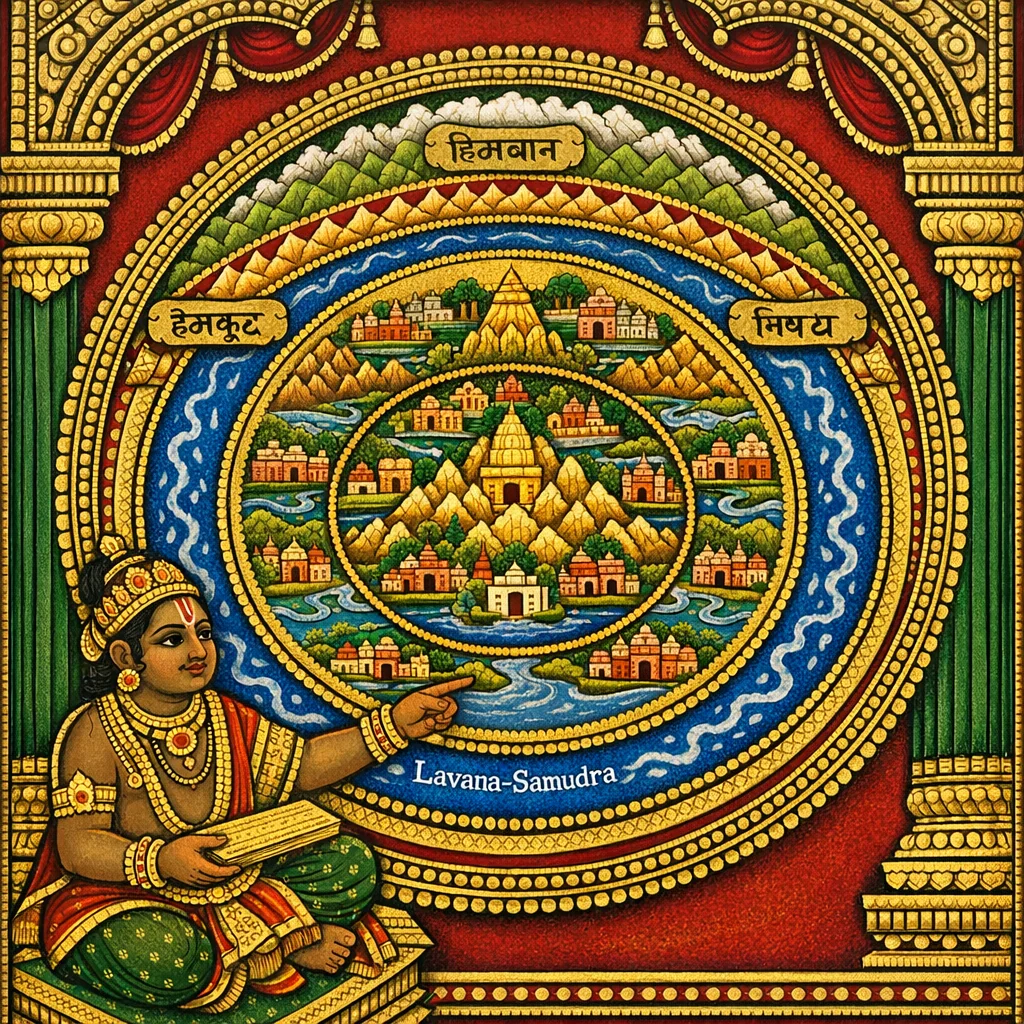
This chapter unfolds as a cosmographic briefing in question–response form. After hearing of the arrangement of peoples and settlements (prajā-sanniveśa), the inquirer asks for an ordered account of earth and cosmos: the number of dvīpas and oceans, the varṣas and their rivers, the scale of the mahābhūtas, the Lokāloka boundary, and the measures and motions of the sun and moon. Sūta replies with a programmatic promise to describe the earth’s extent and the logic for enumerating seas and islands, while admitting that the full complexity cannot be spoken exhaustively in sequence. The discourse then turns to the canonical sapta-dvīpa scheme and begins with Jambūdvīpa, a vast circular landmass encircled by the salt ocean (lavaṇa-samudra), divided into nine varṣas (navavarṣa), adorned with cities, peoples, siddhas/cāraṇas, mountains, and river systems rising from mountain sources. Key boundary and varṣa-mountains—such as Himavān, Hemakūṭa, and Niṣadha—are introduced as landmarks for the ninefold regional division.
Shlokas
Verse 1
इति श्रीब्रह्माण्डे महापुराणे वायुप्रोक्ते पूर्वभागे द्वितीये ऽनुषङ्गपादे प्रियव्रतवंशानुकीर्त्तनं नाम चतुदशो ऽध्यायः सूत उवाच एवं प्रजासन्निवेशं श्रुत्वा वै शांशपायनिः / पप्रच्छ नियतं सूतं पृथिव्युद धिविस्तरम्
Thus in the Śrī Brahmāṇḍa Mahāpurāṇa, in the former section spoken by Vāyu, in the second anuṣaṅga-pāda, the fourteenth chapter called “The Recital of Priyavrata’s Lineage.” Sūta said: Hearing this ordering of the peoples, Śāṃśapāyani asked the steadfast Sūta about the expanse of the earth and the oceans.
Verse 2
कति द्वीपा समुद्रा वा पवता वा कति स्मृताः / कियन्ति चैव वर्षाणि तेषु नद्यश्च काः स्मृताः
How many dvīpas, how many oceans, and how many mountains are remembered? And how many varṣas are there within them, and which rivers are spoken of there?
Verse 3
महा भूतप्रमाणं च लोकालोकं तथैव च / पर्यायं परिमाणं च गतिं चन्द्रार्कयोस्तथा / एतत्प्रबूहि नः सर्वं विस्तरेण यथार्थतः
Tell us the measure of the great elements, and of Lokāloka as well—its order and its extent—and likewise the courses of the moon and the sun. Declare all this to us in detail, in accordance with truth.
Verse 4
सूत उवाच हन्त वो ऽहं प्रवक्ष्यामि पृथिव्यायामविस्तरम्
Sūta said: Hear now; I shall declare to you the full expanse of the earth.
Verse 5
संख्यां चैव समुद्राणां द्वीपानां चैव विस्तरम् / द्वीपभेदसहस्राणि सप्तस्वन्तर्गतानि च
The number of the oceans and the expanse of the continents, and also the thousands of divisions of islands contained within those seven.
Verse 6
न शक्यन्ते क्रमेणेह वक्तुं यैः सततं जगत् / सप्त द्वीपान्प्रवक्ष्यामि चन्द्रादित्यग्रहैः सह
Those by which this world is ever sustained cannot be recounted here in due order; I shall declare the seven continents together with the Moon, the Sun, and the planets.
Verse 7
तेषां मनुष्या स्तर्क्केण प्रमाणानि प्रचक्षते / अचिन्त्याः खलु ये भावा न तांस्तर्केण साधयेत्
People speak of measures and proofs by reasoning; yet realities that are truly inconceivable should not be forced into proof by logic.
Verse 8
प्रकृतिभ्यः परं यच्च तदचिन्त्यं प्रचक्षते / नववर्षं प्रवक्ष्यामि जंबूद्वीपं यथातथम्
That which lies beyond the prakṛtis is called inconceivable; now I shall describe, as it truly is, the nine varṣas of Jambūdvīpa.
Verse 9
विस्तरान्मण्डलाच्चैव योजनैस्तन्निबोधत / शतमेकं सहस्राणां योजनाग्रात्समन्ततः
Know its breadth and its circular extent in yojanas: on every side it spreads to a measure of one hundred yojanas among those thousands.
Verse 10
नानाजनपदाकीर्णः पुरैश्च विविधैश्शुभैः / सिद्धचारणसंकीणः पर्वतैरुपशोभितः
It was filled with many realms and diverse auspicious cities, thronged with Siddhas and Cāraṇas, and beautified by mountains.
Verse 11
सर्वधातुनिबद्धैश्च शिलाजाल समुद्भवैः / पर्वतप्रभवाभिश्च नदीभिः सर्वतस्ततः
There, on every side, flowed rivers born of the mountains—arising from networks of rock and endowed with every mineral.
Verse 12
जंबूद्वीपः पृथुः श्रीमान् सर्वतः पृथुमण्डलः / नवभिश्चावृतः सर्वो भुवनैर्भूतभावनैः
Jambūdvīpa was vast and splendid, its circle spreading in all directions; it was wholly encompassed by nine bhuvanas, the nurturers of beings.
Verse 13
लवणेन समुद्रेण सर्वतः परिवारितः / जंबूद्वीपस्य विस्तारात् समेन तु समन्ततः
It was encircled on every side by the Salt Ocean; and that ocean spread evenly all around, equal in extent to Jambūdvīpa’s breadth.
Verse 14
प्रागायताः सूपर्वाणः षडिमे वर्षपर्वताः / अवगाढा ह्युभयतः मसुद्रौ पूर्वपश्चिमौ
These six Varṣa mountains stretched long toward the east, with well-knit ridges; and on both sides they plunged deep into the eastern and western seas.
Verse 15
हिमप्रायश्च हिमवान् हेमकूटश्च हेमवान् / सर्वर्त्तुषु सुखश्चापि निषधः पर्वतो महान्
Snow-clad are Himavān, Hemakūṭa and Hemavān of golden peaks; and the great Niṣadha mountain, pleasant in all seasons.
Verse 16
चतुर्वर्णश्च सौवर्णो मेरुश्चारुतमः स्मृतः / द्वात्रिंशच्च सहस्राणि विस्तीर्णः स च मूर्द्धनि
Meru is remembered as most beautiful—four-hued and golden in nature; upon its summit it spreads to thirty-two thousand yojanas.
Verse 17
वृत्ताकृतिप्रमाणश्च चतुरस्रः समुच्छ्रितः / नानावर्णास्तु पार्श्वेषु प्रजापतिगुणान्वितः
Its measure is like a circle, yet it rises in a four-sided form; on its flanks are many hues, endowed with the qualities of Prajāpati.
Verse 18
नाभिबन्धनसंभूतो ब्रह्मणो ऽव्यक्तजन्मनः / पूर्वतर्ः श्वेतवर्णश्च ब्राह्मणस्तस्य तेन तत्
Born from the navel-bond of Brahmā, whose birth is unmanifest; to the east it is white—the Brāhmaṇa—therefore it is spoken of thus.
Verse 19
पार्श्वमुत्तरतस्तस्य रक्तवर्मः स्वभावतः / तेनास्य क्षत्त्रभावस्तु मेरोर्नानार्थकारणात्
On its northern flank there is by nature a red mantle; hence, for various reasons, Meru is said to bear the Kṣatriya character.
Verse 20
पीतश्च दक्षिणेनासौ तेन वैश्यत्वमिष्यते / भृङ्गपत्रनिभश्चापि पश्चिमेन समाचितः
He who is yellow in the southern quarter is held to bear the nature of a Vaiśya; and he who is set in the west is said to be of a hue like the leaf of the bhṛṅga.
Verse 21
तेनास्य शूद्रभावः स्यादिति वर्णाः प्रकीर्त्तिताः / वृत्तः स्वभावतः प्रोक्तो वर्णतः परिमाणतः
Thus it is said that in him the state of a Śūdra arises—so have the varṇas been proclaimed. His form is spoken of by innate nature, and his measure is determined by color.
Verse 22
नीलश्च वैदुर्यमयः श्वेतः घुक्लो हिरण्मयः / मयुरबर्हवर्णस्तु शातकैंभश्च शृङ्गवान्
One is blue, as though formed of vaidūrya gem; one is white, radiant and golden; one bears the hue of peacock plumes; and one, like śātakumbha gold, is horned.
Verse 23
एते पर्वतराजानः सिद्धचारणसेविताः / तेषामन्तरविष्कंभो नवसाहस्र उच्यते
These are the kings of mountains, attended by Siddhas and Cāraṇas; the span between them is declared to be nine thousand.
Verse 24
मध्ये त्विलावृतं नाम महामेरोः समन्तमः / नवैवं तु सहस्राणि विस्तीर्णं सर्वतस्तु तत्
In the midst lies the land called Ilāvṛta, encircling Mahāmeru on every side; it is said to spread in all directions to the measure of nine thousand.
Verse 25
मध्ये तस्य महामेरुर्विधूम इव पावकः / वेद्यर्द्धं दक्षिणं मेरोरुत्तरार्द्धं तथोत्तरम्
In its midst stands Mahāmeru, radiant like fire without smoke. The southern half of Meru is as a vedi, a sacred altar, and the northern half likewise lies to the north.
Verse 26
वर्षाणि यानि षट् चैव तेषां ये वर्षपर्वताः / द्वे द्वे सहस्रे विस्तीर्णा योजनानां समुच्छ्रयात्
There are six varṣas, and the mountains that mark those regions spread two thousand yojanas in breadth each, in proportion to their height.
Verse 27
जंबूद्वीपस्य विस्तारात्तेषामायाम उच्यते / योजनानां सहस्राणि शतं द्वावायतौ गिरी
In keeping with the expanse of Jambūdvīpa, their length is stated: those mountains extend one hundred and two thousand yojanas.
Verse 28
नीलश्च निषधश्चैव ताभ्यां हीनास्तु ये परे / श्वेतश्च हेमकूटश्च हिमवाञ्छृङ्गवांस्तथा
There are Nīla and Niṣadha, and others lesser than those: Śveta, Hemakūṭa, and Himavān as well, adorned with many peaks.
Verse 29
नवती द्वे अशीती द्वे सहस्राण्यायतास्तु तेः / तेषां मध्ये जनपदास्तानि वर्णाणि सप्त वै
Their lengths are ninety-two thousand and eighty-two thousand yojanas, respectively. Between them lie the janapadas, which are indeed spoken of as seven varṇas.
Verse 30
प्रपातविषमैस्तैस्तु पर्वतैरावृतानि तु / संततानि नदीभेदैरगम्यानि परस्परम्
Those regions are enclosed by mountains made rugged by precipitous falls, and are continually divided by many branches of rivers; thus they are mutually inaccessible.
Verse 31
वसंति तेषु सत्त्वानि नानाजातीनि सर्वशः / इदं हैमवतं वर्षं भारतं नाम विश्रुतम्
In them dwell beings of many kinds in every quarter. This is the Himavat-linked varṣa, renowned by the name Bhārata.
Verse 32
हेमकूटं परं ह्यस्मा न्नान्ना किंषुरुपं स्मृतम् / नैषधं हेमकूटात्तु हरिवर्षं तदुच्यते
Beyond this lies Hemakūṭa, also remembered as Kiṃśurūpa. Past Hemakūṭa is Naiṣadha; that region is called Harivarṣa.
Verse 33
हरिवर्षात्परं चापि मेरोश्व तदिलावृतम् / इलावृतात्पिरं नीलं सम्यकं नाम विश्रुतम्
Beyond Harivarṣa, near Meru, lies Ilāvṛta. Beyond Ilāvṛta is Nīla, renowned by the name Samyaka.
Verse 34
रम्यकात्परतर्ः श्वेतं विश्रुतं तद्धिरण्मयम् / हिरण्मयात्परं चैव शृङ्गवत्तः कुरु स्मृतम्
Beyond Ramyaka lies Śveta, famed as Hiraṇmaya. Beyond Hiraṇmaya, toward Śṛṅgavat, is remembered the land of Kuru.
Verse 35
धनुःसंस्थे तु विज्ञेये द्वे वर्षे दक्षिणोत्तरे / दीर्घाणि तत्र चत्वारि मध्यमं तदिलावृतम्
In the region set under Dhanu, two varṣas (lands) are to be known, to the south and to the north; there are four long tracts there, and in the middle lies Ilāvṛta.
Verse 36
अर्वाक् च निषधस्याथ वेद्यर्द्धं दक्षिणं स्मृतम् / परं नीलवतो यच्च वेद्यर्द्धं तु तदुत्तरम्
What lies on this side of Mount Niṣadha is remembered as the southern half of the Vedi; and what lies beyond Nīlavata is the northern half of the Vedi.
Verse 37
वेद्यर्द्धे दक्षिणे त्रीणि त्रीणि वर्षाणि चोत्तरे / तयोर्मध्ये तु विज्ञेयो मेरुर्मध्य इलावृतम्
In the southern half of the Vedi are three varṣas, and in the northern half also three; between them, in the very middle, is Mount Meru to be known—the central heart of Ilāvṛta.
Verse 38
दक्षिणेन तु नीलस्य निषधस्योत्तरेम तु / उदगायेतो महाशैलो माल्यवान्नाम नामतः
South of Mount Nīla and north of Niṣadha, stretching northward, stands the great mountain known by the name Mālyavān.
Verse 39
योजनानां सहस्रं तु आनील निषधायतः / आयामतश्चतुस्त्रिंशत्सहस्राणि प्रकीर्तितः
Its breadth, from Nīla to Niṣadha, is a thousand yojanas; and its length is proclaimed to be thirty-two thousand yojanas.
Verse 40
तस्य प्रतीच्यां विज्ञेयः पर्वतो गन्धमादनः / आयामतो ऽथ विस्तारान्माल्यवा नितिविश्रुतः
To its west one should know the mountain Gandhamādana; and by its length and breadth it is also renowned as Mālyavān.
Verse 41
परिमण्डलयोर्मेरुर्मध्ये कनकपर्वतः / चतुर्वणः स सौवर्णः चतुरस्रः समुच्छ्रितः
Between the two encircling regions, in the midst of Meru, stands the golden mountain Kanaka—four-hued, wholly of gold, four-sided, and loftily raised.
Verse 42
सुमेरुः शुशुभेशुभ्रो राजव त्समधिष्ठितः / तरुणादित्यवर्णाभो विधूम इव पावकः
Sumeru shone forth, radiant and white, as though a king enthroned; it bore the hue of the young sun, blazing like fire without smoke.
Verse 43
योजनानां सहस्राणि चतुरशीतरुच्छ्रितः / प्रविष्टः षोडशाधस्ताद्विस्तृतः षोडशैव तु
Its height is eighty-four thousand yojanas; it is set sixteen (thousand yojanas) into the earth below, and its breadth is likewise sixteen (thousand yojanas).
Verse 44
शरावसंस्थितत्वात्तु द्वात्रिंशन्मूर्ध्निविस्तृतः / विस्तारात्रिगुणस्तस्य परिणाहः समन्ततः
Because it is set like a bowl (śarāva), its spread at the summit is thirty-two (thousand yojanas); and its girth on every side is three times that spread.
Verse 45
मण्डलेन प्रमाणेन त्र्यस्रे मानं तदिष्यते / चत्वारिंशत्सहस्राणि योजनानां समन्ततः
By the measure of the maṇḍala, the extent of the tri-angled form is declared; on every side it spans forty thousand yojanas.
Verse 46
अष्टाभिरधिकानि स्युस्त्र्यस्रे मानं प्रकीर्त्तितम् / चतुरस्रेण मानेन परिणाहः समन्ततः
The measure of the tri-angled form is proclaimed as eight more; and by the measure of the four-sided form, its circumference is set all around.
Verse 47
चतुः षष्टिसहस्राणि योजनानां विधीयते / स पर्वतो महादिव्यो दिव्यौषधिसमन्वितः
Its extent is ordained as sixty-four thousand yojanas; that mountain is supremely divine, endowed with celestial healing herbs.
Verse 48
भुवनैरावृतः सर्वो जातरूपमयैः शुभैः / तत्र देवगणाः सर्वे गन्धर्वोरगराक्षसाः
All of it is encompassed by auspicious worlds wrought of gold; there abide all the hosts of Devas, Gandharvas, Uragas, and Rākṣasas.
Verse 49
शैलराजे प्रदृश्यन्ते शुभाश्चाप्सरसां गणाः / स तु मेरुः परिवृतो भुवनैर्भूतभावनैः
Upon the king of mountains are seen the auspicious hosts of Apsarases; and that Meru is encircled by worlds that nurture all beings.
Verse 50
चत्वारो यस्य देशा वै चतुःपार्श्वेष्वधिष्ठिताः / भद्राश्वा भरताश्वैव केतुमालाश्च पश्चिमाः
On its four sides, in the four quarters, are established four realms: Bhadrāśva, Bharatāśva, and to the west, Ketumāla.
Verse 51
उत्तराः कुरवश्चैव कृतपुण्यप्रतिश्रयाः / गन्धमादनपर्श्वे तु परैषापरगण्डिका
To the north are the Uttara-Kurus, an abode sustained by earned merit; beside Mount Gandhamādana lie Paraiṣā and Aparagaṇḍikā.
Verse 52
सर्वर्त्तुरमणीया च नित्यं प्रमुदिता शिवा / द्वात्रिंशत्तु सहस्राणि योजनैः पूर्वपश्चिमात्
Lovely in every season, ever joyful and auspicious, it extends thirty-two thousand yojanas from east to west.
Verse 53
आयामतश्चतुस्त्रिंशत्सहस्राणि प्रमाणतः / तत्र ते शुभकर्माणः केतुमालाः प्रतिष्ठिताः
In length it measures thirty-four thousand yojanas; there dwell the Ketumālas, established in auspicious deeds.
Verse 54
तत्र काला नराः सर्वे महासत्त्वा महाबलाः / स्त्रियश्चोत्पल पत्राभाः सर्वास्ताः प्रियदर्शनाः
There all men are dark-hued, of great spirit and great strength; and the women, radiant like blue-lotus leaves, are all pleasing to behold.
Verse 55
तत्र दिव्यो महावृक्षः पनसः पड्रसाश्रयः / ईश्वरो ब्रह्मणः पुत्रः कामचारी मनोजवः
There stands a divine, mighty tree—the panasa—abode of the six tastes. There is Īśvara, son of Brahmā, roaming at will and swift as thought.
Verse 56
तस्य पीत्वा फलरसं जीवन्ति च समायुतम् / पार्श्वे माल्यवतश्चापि पूर्वे ऽपूर्वा तु गण्डिका
Drinking the juice of its fruits, they live for a very long time. Beside it is Mālyavat, and to the east lies the wondrous, unparalleled Gaṇḍikā.
Verse 57
आयामादथ विस्ताराद्यथैषापरगण्डिका / भद्राश्वास्तत्र विज्ञेया नित्यं मुदितमानसाः
In length and breadth, that farther Gaṇḍikā is just like this one. There dwell the Bhadrāśvas, ever joyful in heart.
Verse 58
भद्रशालवनं चात्र कालाम्रस्तु महाद्रुमः / तत्र ते पुरुषाः स्वेता महोत्साहा बलान्विताः
Here is the forest of Bhadrāśāla, and a great tree called Kālāmrā. There the men are fair, filled with mighty zeal, and endowed with strength.
Verse 59
स्त्रियः कुमुदवर्णाभाः सुन्दर्यः प्रियदर्शनाः / चन्द्रप्रभाश्चन्द्रवर्णाः पूर्णचन्द्र निभाननाः
The women shine with the hue of the kumuda lotus—beautiful and pleasing to behold. They glow with moonlight, are moon-hued, and have faces like the full moon.
Verse 60
चन्द्रशीतलगात्र्यस्ताः स्त्रिय उत्पलगन्धिकाः / दशवर्षसहस्राणि तेषामायुरनामयम्
The women there are cool-bodied like the moon and fragrant as the utpala lotus. Their lifespan is ten thousand years, and they are free from disease.
Verse 61
कालाम्रस्य रसं पीत्वा सर्वे च स्थिरयौवनाः / दक्षिणेन तु श्वेतस्य नीलस्यैवोत्तरेण च
By drinking the juice of the dark mango (kālāmra), all remain steadfast in youth—south of Mount Śveta and north of Mount Nīla.
Verse 62
वर्षं रमणकं नाम जायन्ते तत्र मानवाः / रतिप्रधाना विमला जरादौर्गन्ध्यवर्जिताः
In the land called Ramaṇaka, humans are born—delighting chiefly in love, pure, and free from old age and foul odor.
Verse 63
शुक्लाभिजनसंपन्नाः सर्वे च प्रियदर्शनाः / तत्रापि सुमहान्वृक्षो न्यग्रोधो रोहितो महान्
All are endowed with pure lineage and are pleasing to behold. There too stands a very great tree—the mighty nyagrodha called Rohita.
Verse 64
तस्यापि ते फलरसं पिबन्तो वर्त्तयन्ति वै / दशवर्षसहस्राणि शतानि दश पञ्च च
Drinking the juice of that tree’s fruits, they pass their lives—ten thousand years, and a further ten and five hundred (that is, fifteen hundred) years.
Verse 65
जीवन्ति ते महाभागाः सदा त्दृष्टा नरोत्तमाः / दक्षिणे वै शृङ्गवतः श्वेतस्याप्युत्तरेण च
Ever live those greatly blessed, best of men, who dwell to the south of Mount Śṛṅgavat and also to the north of Mount Śveta.
Verse 66
वर्षं हैरण्वतं नाम यत्र हैरण्वती नदी / महाबलाः सुतेजस्का जायन्ते तत्र मानवाः
There is a region called Hairaṇvata, where the river Hairaṇvatī flows; there men are born of great strength and radiant splendor.
Verse 67
यक्षा वीरा महासत्त्वा धनिनः प्रियदर्शनाः / एकादशसहस्राणि वर्षाणां ते महौजसः
Those Yakṣas are heroic, of mighty nature, wealthy and fair to behold; endowed with great vigor, they live for eleven thousand years.
Verse 68
आयुः प्रमाणं जीवन्ति शतानि दश पञ्च च / यस्मिन्वर्षे महावृक्षो लकुचः षड्रसाश्रयः
They live for the full measure of their span—fifteen hundred years; in that region stands the great Lakuca tree, the abode of the six tastes.
Verse 69
तस्य पीत्वा फलरसं ते जीवन्ति निरामयाः / त्रीणि शृङ्गवतः शृङ्गाण्युच्छ्रितानि महान्ति च
Drinking the juice of its fruits, they live free from illness; and Mount Śṛṅgavat has three peaks, lofty and vast.
Verse 70
एकं मणिमयं तेषामेकं चैव हिरण्मयम् / सर्वरत्नमयं चैकं भवनैरुपशोभितम्
Their dwellings were of three kinds: one made of gems, one of gold, and one fashioned of all precious jewels, splendidly adorned with palatial mansions.
Verse 71
उत्तरे वै शृङ्गावतः समुद्रस्य च दक्षिणे / कुरवस्तत्र तद्वर्षं पुण्यं सिद्धनिषेवितम्
North of Mount Śṛṅgāvata and south of the ocean lies the varṣa called Kuru—holy indeed, and resorted to by the Siddhas.
Verse 72
तत्र वृक्षा मधु फला नित्यपुष्पफलोपगाः / वस्त्राणि च प्रसूयन्ते फलेष्वाभरणानि च
There, trees bear honey-sweet fruits, ever laden with blossoms and produce; and within their fruits arise garments, and ornaments as well.
Verse 73
सर्वकामप्रदास्तत्र केचिद्वक्षा मनोरमाः / गन्धवर्णरसो पेतं प्रक्षरन्ति मधूत्तमम्
There are delightful trees that grant every desire; they pour forth the finest honey, rich with fragrance, hue, and taste.
Verse 74
अपरे क्षीरिणो नाम वृक्षास्तत्र मनोरमाः / ये क्षरन्ति सदा क्षीरं षड्रसं ह्यमृतोपमम्
There are also lovely trees called Kṣīriṇa, ever flowing with milk of sixfold taste, like unto amṛta.
Verse 75
सर्वा मणिमयी भूमिः सूक्ष्मकाञ्चनवालुका / सर्वर्तुसुखसंपन्ना न्निष्पङ्का नीरजा शुभा
There the whole earth is made of gems, with fine sand like particles of gold. It is rich in the joys of every season—mudless, pure, and auspicious.
Verse 76
देवलोकच्युतास्तत्र जायन्ते मानवाः शुभाः / शुक्लाभिजनसंपन्नाः सर्वे च स्थिरयौवनाः
There, auspicious humans are born, having fallen from the world of the gods. All are endowed with pure and noble lineage, and all possess steadfast, unfading youth.
Verse 77
मिथुनानि प्रसूयन्ते स्त्रियश्चाप्सरसः समाः / तेषां ते क्षीरिणां क्षीरं पिबन्ति ह्यमृतो पमम्
There, births occur as pairs, and the women are like apsarases. They drink the milk of the milk-bearing ones—milk that is like amṛta itself.
Verse 78
मिथुनं जायते सद्यः समं चैव विवर्द्धते / समं शीलं च रूपं च प्रियता चैव तत्समा
The pair is born at once and grows in perfect equality. Their nature and their beauty are alike, and so too is their mutual dear affection.
Verse 79
अन्योन्यमनुरक्ताश्च चक्रवाकसधर्मिणः / अनामया ह्यशोकाश्च नित्यं सुखनिषेविणः
They are devoted to one another, faithful like the cakravāka birds. Free from illness and sorrow, they ever abide in the enjoyment of bliss.
Verse 80
त्रयोदशसहस्राणि शतानि दश पञ्च च / जीवन्ति ते महावीर्या न चान्यस्त्रीनिषेविणः
Those mighty heroes live for thirteen thousand three hundred and fifteen years, and they do not consort with other women.
Frequently Asked Questions
A cosmographic outline of the earth’s extent (pṛthivy-āyāma-vistara), moving into the sapta-dvīpa scheme and a focused description of Jambūdvīpa as ninefold (navavarṣa) and surrounded by the salt ocean (lavaṇa-samudra).
Counts of dvīpas and oceans, the number of varṣas and their rivers, the scale (pramāṇa/parimāṇa) of the mahābhūtas, the Lokāloka boundary, and the measures and motions (gati) of the sun and moon.
Based on the provided verses, it is primarily a geography-and-cosmology briefing (Bhuvana-kośa), setting the spatial template in which genealogical catalogues can later be situated.