Adhyaya 9
पितृसर्ग-श्राद्धप्रश्नाः (Pitri-Origins and Shraddha Queries)
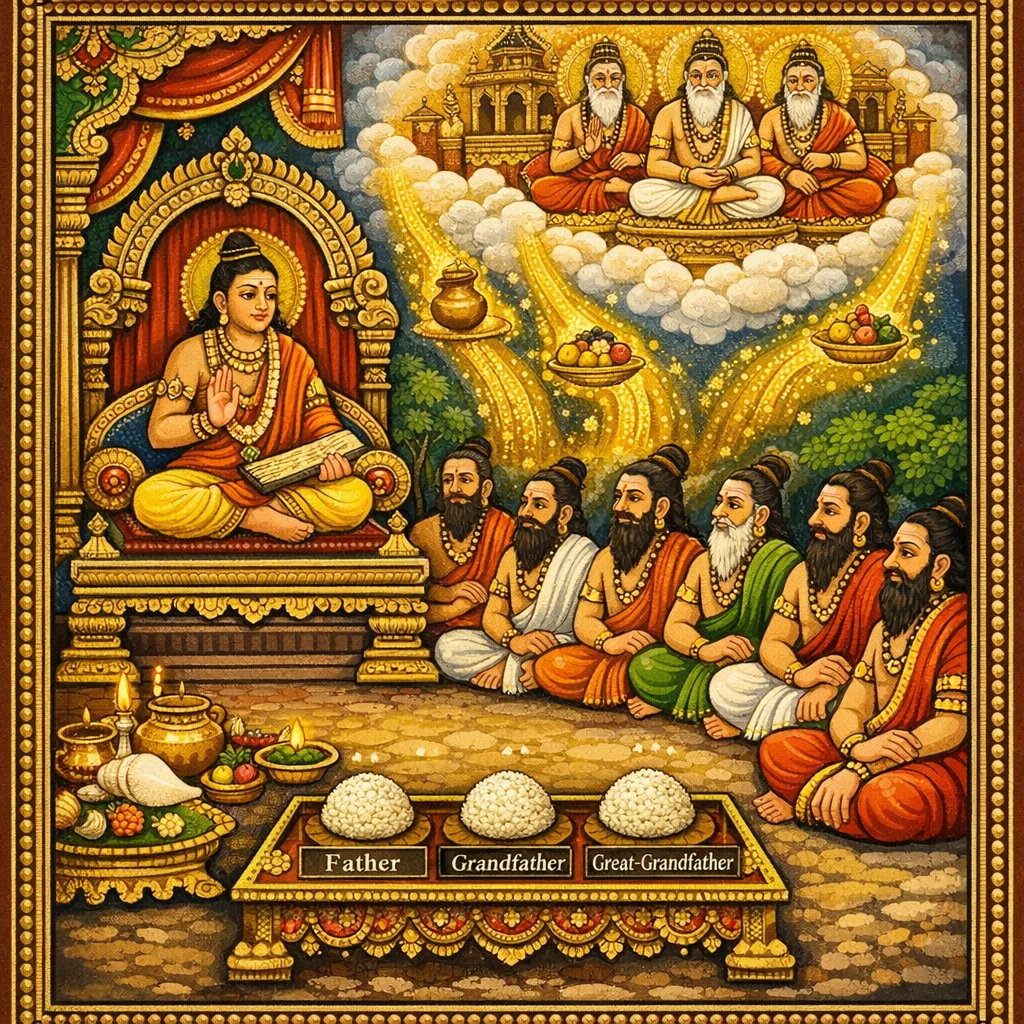
This Adhyaya opens with the Rishis’ formal inquiry and proceeds with Suta’s authoritative exposition. The questions probe the nature and origin of the Pitrs, their standing as celestial beings, why they are not ordinarily seen, which Pitrs abide in heaven or in hell, and how name-dedicated Shraddha offerings and the three pinda offerings (to father, grandfather, and great-grandfather) reach their proper recipients. Further clarification is sought on their classification and generation—how Pitrs arise, what their measure/constitution is, and how they can bestow results even when placed in adverse states. Suta then grounds the teaching in cosmic chronology, declaring the Pitrs to be “devasūnavaḥ” arising in the Manvantaras, arranged as earlier/later and senior/junior classes in ordered sequence, and linking Manu to the regulation and propagation of Shraddha procedure, thereby tying ritual practice to Manvantara governance within the Brahmanda Purana’s cyclic cosmology.
Shlokas
Verse 1
इति श्रीब्रह्माण्डे महापुराणे वायुप्रोक्ते मध्यभागे तृतीय उपोद्धातपादे ऋषिवंशवर्णनं नामाष्टमो ऽध्यायः // ८// ऋषय ऊचुः कथं द्विवारावुत्पन्ना भवानी प्राक्सती तु या / आसीद्दाक्षायणी पूर्वमुमा कथमजायत
Thus, in the Śrī Brahmāṇḍa Mahāpurāṇa, spoken by Vāyu, in the middle section, in the third Upoddhāta-pāda, is the eighth chapter called “The Description of the Lineages of the Rishis.” The rishis said: “How was Bhavānī—who formerly was Satī—born twice? She who was once Dākṣāyaṇī, how was Umā born?”
Verse 2
मेनायां पितृकन्यायां जनयञ्छैलराट् स्वयम् / के वै ते पितरो नाम येषां मेना तु मानसी
In Menā, the daughter of the Pitṛs, the king of mountains himself begot offspring. Who indeed are those Pitṛs, and what are their names, of whom Menā is said to be a mind-born daughter?
Verse 3
मैनाकश्चैव दोहित्रो दौहित्री च तथा ह्युमा / एकपर्णा तथा चैव तथा चैवैकपाटला
Maināka was the grandson, and the granddaughter was Umā; likewise Ekaparṇā, and likewise Ekapāṭalā.
Verse 4
गङ्गा चापि सरिच्छ्रेष्ठा सर्वासां पूर्वजा तथा / सर्वमेतत्वयोद्दिष्टं निर्देशं तस्य नो वद
And Gaṅgā too—the foremost of rivers—who is likewise the eldest of all. All this has been stated by you; now tell us clearly the precise account of it.
Verse 5
श्रोतुमिच्छामि भद्रं ते श्राद्धस्य च विधिं परम् / पुत्राश्च के स्मृतास्तेषां कथं च पितरस्तु ते
Auspiciousness to you; I wish to hear the supreme ordinance of Śrāddha. Who are remembered as their sons, and in what manner are they the Pitṛs?
Verse 6
कथं वा ते समुत्पन्नाः किंना मानः किमात्मकाः / स्वर्गे वै पितरो ह्येते देवानामपि देवताः
How did they arise, what is their honor, and what is their essential nature? In heaven these Pitṛs are indeed divinities even for the gods.
Verse 7
एवं वेदितुमिच्छामि पितॄणां सर्गमुत्तममा / यथा च दत्तमस्माभिः सार्द्धं प्रीणाति वै पितॄन्
I wish to know, in this manner, the supreme origin of the Pitṛs (ancestral Fathers), and how the offering we give with śraddhā truly gladdens and satisfies the Pitṛs.
Verse 8
यदर्थं ते न दृश्यन्ते तत्र किं कारणं स्मृतम् / स्वर्गे तु के च वर्त्तन्ते पितरो नरके व के
For what reason are they not seen—what cause is taught for this? And among the Pitṛs, who dwell in svarga, and who are in naraka?
Verse 9
अभिसंभाष्य पितरं पितुश्च पितरं तथा / प्रतितामहं तथा चैव त्रिषु पिण्डेषु नामतः
Addressing and invoking by name the father, the father’s father, and the great-grandfather, one offers the three piṇḍas, each with its proper name.
Verse 10
नाम्ना दत्तानि श्राद्धानि कथं गच्छन्ति वै पितॄन् / कथं च शक्तास्ते दातुं नरकस्थाः फलं पुनः
How do the śrāddhas offered with the utterance of names reach the Pitṛs? And how can those who abide in naraka still be able to bestow fruit in return?
Verse 11
के च ते पितरो नाम कान्यजामो वयं पुनः / देवा अपि पितॄन् स्वर्गे यजन्तीति हि नः श्रुतम्
Who, indeed, are those called the Pitṛs, and whom then should we worship? For we have heard that even the Devas in svarga perform worship to the Pitṛs.
Verse 12
एतदिच्छामि वै श्रोतुं विस्तरेण बहुश्रुतम् / स्पष्टाभिधान मपि वै तद्भवान्वक्तुमर्हसि
I wish to hear this in full detail, as it is widely heard; pray, speak it forth in clear words.
Verse 13
सूत उवाच अत्र वो कीर्तयिष्यामि यथाप्रज्ञं यथाश्रुतम् / मन्वन्तरेषु जायन्ते पितरो देवसूनवः
Sūta said: Here I shall recount to you, as best I know and as I have heard, how in the Manvantaras the Pitṛs are born as sons of the Devas.
Verse 14
अतीतानागताः श्रेष्ठाः कनिष्ठाः क्रमशस्तु वै / देवैः सार्द्धं पुरातीताः पितरो ऽन्येन्तरेषु वै
In times past and times to come, the Pitṛs appear as higher and lower in due succession; in other intervals they have, from of old, passed on together with the Devas.
Verse 15
वर्तन्ते सांप्रतं चे तु तान्वै पक्ष्यामि निश्चयात् / श्राद्धक्रियां मनुश्चैषां श्राद्धदेवः प्रवर्त्तयेत्
As for the Pitṛs who abide in the present, I shall describe them with certainty; and for them Manu, called Śrāddhadeva, shall set the rite of śrāddha in motion.
Verse 16
देवान्सृजत ब्रह्मा मां यक्ष्यन्तीति च प्रभुः / तमुत्सृज्य तदात्मानमयजंस्ते फलार्थिनः
Brahmā created the Devas, and the Lord thought, “They will worship Me through yajña.” Yet, seeking rewards, they forsook that Lord who is the very Self and offered worship elsewhere.
Verse 17
ते शप्ता ब्रह्मणा मूढा नष्टसंज्ञा भविष्यथ / तस्मात्किञ्चिन्न जानीत ततो लोकेषु मुह्यत
Cursed by Brahmā, you shall become deluded and bereft of awareness; therefore you will know nothing, and in the worlds you will wander in bewilderment.
Verse 18
ते भूयः प्रणताः सर्वे याचन्ति स्म पितामहम् / अनुग्रहाय लोकानां पुनस्तानब्रवीत्प्रभुः
Again they all bowed down and implored Pitāmaha Brahmā; and the Lord, to bestow grace upon the worlds, spoke to them once more.
Verse 19
प्रायश्चित्तं चरध्वं वै व्यभिचारो हि वः कृतः / पुत्रान्स्वान्परिपृच्छध्वं ततो ज्ञानमवाप्स्यथ
Perform prāyaścitta indeed, for a transgression has been committed by you. Question your own sons; then you shall attain true knowledge.
Verse 20
ततस्त स्वसुतांश्चैव प्रयश्चित्तजि घृक्षवः / अपृच्छन्संयतात्मानो विधिवच्च मिथो मिथः
Then, longing to undertake prāyaścitta and with disciplined minds, they questioned their own sons in due rite, and in turn questioned one another.
Verse 21
तेभ्यस्ते नियतात्मानः पुत्राः शंसुरनेकधा / प्रयश्चित्तानि धर्मज्ञावाङ्मनः कर्मजानि च
To them their sons—disciplined in spirit and knowing dharma—declared in many ways the prāyaścittas, for faults born of speech, mind, and deed.
Verse 22
ते पुत्रानब्रुवन्प्रीता लब्धसंज्ञा दिवौकसः / यूयं वै पितरो ऽस्माकं यैर्वयं प्रतिबोधिताः
The dwellers of heaven, regaining awareness and filled with joy, said to the sons: “You indeed are our Pitṛs, by whom we have been awakened.”
Verse 23
धर्मं ज्ञानं च वैराग्यं को वरो वः प्रदीयताम् / पुस्तानब्रवीद्ब्रह्मा यूयं वै सत्यवादिनः
“Dharma, knowledge, and dispassion—what boon shall be granted to you?” Thus asked, Brahmā said: “You are indeed speakers of truth.”
Verse 24
तस्माद्यदुक्तं युष्माभिस्तत्तथा न तदन्यथा / उक्तं च पितरो ऽस्माकं चेति वै तनयाः स्वकाः
Therefore, what you have spoken is exactly so, and not otherwise; and their own sons indeed said, “You are our Pitṛs.”
Verse 25
पितरस्ते भविष्यन्ति तेभ्यो ऽयं दीयतां वरः / तेनैव वचसा ते वै ब्रह्मणः परमेष्ठिनः
They shall become the Pitṛs; therefore let this boon be granted to them—so spoke Brahmā, the Parameṣṭhin, in those very words.
Verse 26
पुत्राः पितृत्वमाजग्मुः पुत्रत्वं पितरः पुनः / तस्मात्ते पितरः पुत्राः पितृत्वं तेषु तत्स्मृतम्
The sons attained fatherhood, and the Pitṛs again attained sonship; therefore they are both Pitṛs and sons—within them that fatherhood is remembered.
Verse 27
एवं स्मृत्वा पितॄन्पुत्राः पुत्रांश्चैव पितॄंस्तथा / व्याजहार पुनर्ब्रह्मा वितॄनात्मविवृद्धये
Thus remembering the Pitṛs and the sons alike, Brahmā again proclaimed the ordinance of the Ancestors for the increase of the Self.
Verse 28
यो ह्य निष्टान्पितॄञ्श्राद्धि क्रियां काञ्चितकरिष्यति / राक्षसा दानवाश्बैव फलं प्राप्स्यन्ति तस्य तत्
Whoever performs any śrāddha rite for the Pitṛs with impure intent—its fruit will be taken by rākṣasas and dānavas.
Verse 29
श्राद्धैराप्यायिताश्चैव पितरः सोममव्ययम् / आप्यायमाना युष्माभिर्वर्द्धयिष्यन्ति नित्यशः
The Pitṛs, nourished by śrāddha, partake of Soma that never wanes; sustained by you, they will ever increase your prosperity.
Verse 30
श्राद्धैराप्यायितः सोमो लोकानाप्याययिष्यति / कृत्स्नं सपर्वतवनं जङ्गमाजङ्गमैर्वृतम्
Soma, nourished by śrāddha, will nourish all the worlds—the whole cosmos with mountains and forests, filled with beings moving and unmoving.
Verse 31
श्राद्धानि पुष्टिकामाश्च ये करिष्यन्ति मानवाः / तेभ्यः पुष्टिं प्रजाश्चैव दास्यन्ति पितरः सदा
Those who perform śrāddhas seeking nourishment and well-being—the Pitṛs will ever grant them prosperity and offspring.
Verse 32
श्राद्धे येभ्यः प्रदास्यन्ति त्रीन्पिण्डान्नामगोत्रतः / सर्वत्र वर्तमानास्ते पितरः प्रपितामहाः
In the śrāddha rite, those to whom three piṇḍas are offered according to name and gotra are the Pitṛs and Prapitāmahas, present everywhere.
Verse 33
तेषामाप्याययिष्यन्ति श्राद्धदानेन वै प्रजाः / एवमाज्ञा कृता पूर्वं ब्रह्मणा परमेष्ठिना
By the offering of śrāddha, people indeed will nourish those Pitṛs; such was the command formerly ordained by Brahmā, the Parameṣṭhin.
Verse 34
तेनैतत्सर्वथा सिद्धं दानमध्ययनं तपः / ते तु ज्ञानप्रदातारः पितरो वो न संशयः
Therefore it is wholly established: giving, sacred study, and tapas; the Pitṛs are indeed the bestowers of knowledge—no doubt of it.
Verse 35
इत्येते पितरो देवा देवाश्च पितरः पुनः / अन्योन्यपितरो ह्येते देवाश्च पितरश्च ह
Thus the Pitṛs are gods, and the gods again are Pitṛs; they are truly one another’s ancestors—both gods and Pitṛs.
Verse 36
एतद्ब्रह्मवचः श्रुत्वा सूतस्य विदितात्मनः / पप्रच्छुर्मुनयो भूयः सूतं तस्माद्यदुत्तरम्
Having heard these words of Brahmā from Sūta, who knew the Self, the sages again questioned Sūta as to what the ensuing reply would be.
Verse 37
ऋषय ऊचुः कियन्तो वै मुनिगणाः कस्मिन्काले च ते गणाः / पूर्वे तु देवप्रवरा देवानां सोमवर्द्धनाः
The Rishis said: How many were those hosts of sages, and in what age did those companies abide? In ancient times they were foremost among the Devas, increasers of the gods’ Soma.
Verse 38
सूत उवाच एतद्वो ऽहं प्रवक्ष्यामि पितृसर्गमनुत्तमम् / शंयुः पप्रच्छ यत्पूर्वं पितरं वै बृहस्पतिम्
Suta said: I shall declare to you the unsurpassed account of the creation of the Pitris. Long ago, Śaṃyu asked this very question of his father, Bṛhaspati.
Verse 39
बृहस्पतिमुपासीनं सर्वज्ञानार्थकोविदम् / पुत्रः शंयुरिमं प्रश्नं पप्रच्छ विनयान्वितः
Bṛhaspati, seated and skilled in the meaning of all knowledge, was being attended upon. His son Śaṃyu, endowed with humility, asked this question.
Verse 40
क एते पितरो नाम कियन्तः के च नामतः / समुद्भूताः कथं चैते पितृत्वं समुपागताः
Who are these Pitris, how many are they, and who are they by name? How did they arise, and how did they attain the state of Pitrihood?
Verse 41
कस्माच्च पितरः पूर्वं यज्ञं पुष्णन्ति नित्यशः / क्रियाश्च सर्वा वर्त्तन्ते श्राद्धपूर्वा महात्मनाम्
And for what reason do the Pitris ever first sustain the yajña, day after day? All rites of the great-souled proceed with śrāddha set at the beginning.
Verse 42
कस्मै श्राद्धानि देयानि किं च दत्ते महाफलम् / केषु चाप्यक्षयं श्राद्धं तीर्थेषु च नदीषु च
To whom should śrāddha offerings be given, and what gift yields great fruit? In which places—at tīrthas and on riverbanks—does śrāddha become of imperishable merit?
Verse 43
केषु वै सर्वमाप्तोति श्राद्धं कृत्वा द्विजोत्तमः / कश्च कालो भवेच्छ्राद्धे विधिः कश्चानुवर्त्तते
For whom, by performing śrāddha, does the foremost dvija attain all? What is the proper time for śrāddha, and what prescribed rite (vidhi) is to be followed?
Verse 44
एतदिच्छामि भगवन्विस्तरेण यथा तथा / व्याख्यातमानुपूर्व्येण यत्र चोदाहृतं मया
O Bhagavan, I wish this to be explained as it truly is—fully and in due sequence—just as I have stated it here.
Verse 45
बृहस्पतिरिदं सम्यगेवं पृष्टो महामतिः / व्याजहारानुपूर्व्येण प्रश्नं प्रश्नविदां वरः
Thus questioned, Bṛhaspati, of great wisdom—the foremost among those skilled in inquiry—replied properly, answering the questions in due order.
Verse 46
बृहस्पतिरुवाच कथ यिष्यामि ते तात यन्मां त्वं परिपृच्छसि / विनयेन यथान्यायं गम्भीरं प्रश्नमुत्तमम्
Bṛhaspati said: My child, what you have asked me—this profound and excellent question, posed with humility and in accordance with dharma—I shall now explain to you.
Verse 47
द्यौरंरिक्षं पृथिवी नक्षत्राणि दिशस्त था / सूर्याचन्द्रमसौ चैव तथाहोरात्रमेव च
Then appeared the heaven, the mid‑space, the earth, the stars and the directions; likewise the Sun and the Moon, and also day and night.
Verse 48
न बभूवुस्तदा तात तमोभूतमभूज्जगत् / ब्रह्मैको दुश्चरं तत्र तताप परमं तपः
Then, dear child, nothing existed; the universe became sheer darkness. There Brahmā alone performed the supreme, arduous austerity.
Verse 49
शंयुस्तमब्रवीद्भूयः पितरं ब्रह्मवित्तमम् / सर्ववेदव्रतस्नातः सर्वज्ञानविदां वरः / कीदृशं सर्वभूतेशस्तपस्तेपे प्रजा पतिः
Then Śaṃyu again asked his father, the foremost knower of Brahman, purified by all Vedic vows and the best among the wise: “O Lord of all beings, what kind of austerity did Prajāpati perform?”
Verse 50
बृहस्पतिरुवाच सर्वेषां तपसां यत्तत्तपो योगमनुत्तमम् / ध्यायंस्तदा स भगवांस्तेन लोकानवासृजत्
Bṛhaspati said: “Among all austerities, that austerity is the unsurpassed Yoga. Meditating upon it, the Blessed One then brought forth the worlds.”
Verse 51
ज्ञानानि भूतभव्यानि लोका वेदाश्च सर्वशः / योगामृतास्तदा सृष्टा ब्रह्मणा लोकचक्षुषा
Knowledges of what was and what shall be, the worlds and the Vedas in every form; and the nectar of Yoga as well—these were then created by Brahmā, the Eye of the worlds.
Verse 53
लोकाः संतानका नाम यत्र तिष्ठन्ति भास्वराः / वैराजा इति विख्याता देवानां दिवि देवता/ // ५२// योगेन तपसा युक्तः पूर्वमेव तदा प्रभुः / देवानसृजत ब्रह्मा योगयुक्तान्सनातनान्
In the realm called Santānaka abide radiant beings; they are famed as the Vairājas, divinities in the heaven of the gods. Then the Lord Brahmā, united with yoga and austerity, had already created the eternal gods, established in yoga.
Verse 54
आदिदेवा इति ख्याता महासत्त्वा महौजसः / सर्वकामप्रदाः पूज्या देवादानवमानवैः
They are famed as the Ādidevas, great in being and mighty in splendor. Bestowers of every desire, they are worshipped by gods, dānavas, and humankind.
Verse 55
तेषां सप्त समाख्याता गणास्त्रैलोक्यपूजिताः / अमूर्त्तयस्त्रयस्तेषां चत्वारस्तु समूर्त्तयः
They are said to have seven gaṇas, revered throughout the three worlds. Of these, three are formless, while four are embodied in form.
Verse 56
उपरिष्टात् त्रयस्तेषां वर्त्तन्ते भावमूर्त्तयः / तेषामधस्ताद्वर्त्तन्ते चत्वारः सूक्ष्ममूर्त्तयः
Above, three of them abide as bhāva-mūrtis, forms of subtle state; below them, four abide as sūkṣma-mūrtis, forms most fine.
Verse 57
ततो देवास्ततो भूमिरेषा लोकपरंपरा / लोके वर्षन्ति ते ह्यस्मिंस्तेभ्यः पर्जन्यसंभवः
From them arose the gods, and then this earth—such is the succession of worlds. In this world they cause the rains to fall; and from them, too, is born Parjanya, the Rain-god.
Verse 58
अन्नं भवति वै वृष्ट्या लोकानां संभवस्ततः / आप्याययन्ति ते यस्मात्सोमं चान्नं च योगतः
From rain, indeed, food comes to be; from that the life of beings in the worlds arises. Those who, through yoga, nourish Soma and food, thereby sustain and satisfy all.
Verse 59
ऊचुस्तान्वै पितॄंस्त स्माल्लोकानां लोकसत्तमाः / मनोजवाः स्वधाभक्ष्यः सर्वकामपरिष्कृताः
Then the best among the worlds—swift as thought, nourished by the svadhā offering, and fulfilled in every desire—spoke to those Pitṛs (ancestral fathers).
Verse 60
लोभमोहभयोपेता निश्चिन्ताः शोक वर्जिताः / एते योगं परित्यज्य प्राप्ता लोकान्सुदर्शनान्
Though attended by greed, delusion, and fear, they were untroubled and free from sorrow. Abandoning yoga, they attained worlds fair to behold.
Verse 61
दिव्याः पुण्या विपाप्मानो महात्मानो भवन्त्युत / ततो युगसहस्रान्ते जायन्ते ब्रह्मवादिनः
They become divine, meritorious, free from sin, and great-souled. Then, at the end of a thousand yugas, they are born as brahmavādins—proclaimers of Brahman.
Verse 62
प्रतिलभ्य पुनर्योगं मोक्षं गच्छन्त्यमूर्त्तयः / व्यक्ताव्यक्तं परित्यज्य महायोगबलेन च
Regaining yoga once more, they—formless and subtle—go to liberation (mokṣa). By the power of great yoga, they abandon both the manifest and the unmanifest.
Verse 63
नश्यन्त्युल्केव गगने क्षणद्विद्युत्प्रभेव च / उत्सृज्य देहजालानि महायोगबलेन च
They vanish like a meteor in the sky, like the fleeting radiance of lightning; by the power of Mahāyoga they cast off the nets of bodily bonds.
Verse 64
निराख्योपास्यता यान्ति सरितं सागरं यथा / क्रियया गुरुपूजाभिर्यागं कुर्वन्ति यत्नतः
As rivers flow into the ocean, so they attain the nameless, worship-worthy Reality; through sacred rites and reverent service to the Guru, they diligently perform the yajña.
Verse 65
श्राद्धे प्रीतास्ततः सोमं पितरो योगमास्थिताः / आप्याययन्ति योगेन त्रैलोक्यं येन जीवति
Pleased by the śrāddha, the Pitṛs established in Yoga then receive Soma; by that Yoga they nourish the three worlds, through which the cosmos lives.
Verse 66
तस्माच्छ्राद्धानि देयानि योगानां यत्नतः सदा / पितॄणां हि बलं योगो योगात्सोमः प्रवर्त्तते
Therefore, for the yogins, śrāddha should always be offered with care; the strength of the Pitṛs is Yoga, and from Yoga the flow of Soma arises.
Verse 67
सहस्रशतविप्रान्वै भोजयेद्यावदागतान् / एकस्तानपि मन्त्रज्ञः सर्वानर्हति तच्छृणु
Even if one feeds the thousands and hundreds of brāhmaṇas who have come, a single knower of mantras is worthy as all of them together—hear this.
Verse 68
एतानेव च मन्त्रज्ञान्भोजयेद्यः समागतान् / एकस्तान्स्नातकः प्रितः सर्वानर्हति तच्छृणु
Whoever feeds these assembled knowers of mantras—hear this—though he be but one snātaka, if he is devoted and pleased, he is worthy of the merit due to them all.
Verse 69
मन्त्रज्ञानां सहस्रेण स्नातकानां शतेन च / योगाचार्येण यद्भुक्तं त्रायते महातो भयात्
Equal to a thousand mantra-knowers and a hundred snātakas: the food partaken of by a yogācārya delivers one from great fear.
Verse 70
गृहस्थानां सहस्रेण वानप्रस्थशतेन च / ब्रह्मचारिसहस्रेण योग एव विशिष्यते
Beyond a thousand householders, a hundred forest-dwellers, and a thousand brahmacārins, Yoga alone is declared pre-eminent.
Verse 71
नास्तिको वाप्यधर्मो वा संकीर्मस्तस्करो ऽपि वा / नान्यत्र तारणं दानं योगेष्वाह प्रजापतिः
Be he an unbeliever or unrighteous, of tainted ways or even a thief—Prajāpati has declared: there is no saving gift elsewhere; the gift to yogins is the deliverance.
Verse 72
पितरस्तस्य तुष्यन्ति सुवृष्टेनैव कर्षकाः / पुत्रो वाप्यथ वा पौत्रो ध्यानिनं भोजयिष्यति
As farmers are gladdened by timely, abundant rain, so are his ancestors satisfied; and his son or grandson will feed a meditator, a dhyānin.
Verse 73
अलाभे ध्याननिष्ठानां भोजयेद्ब्रह्मचारिणम् / तदलाभे उदसीनं गूहस्थमपि भोजयेत्
If a brahmacārin steadfast in meditation is not available, one should feed a brahmacārin; if even that is unavailable, one should feed even a detached householder (udāsīna).
Verse 74
यस्तिष्ठेदेकपादेन वायुभक्षः शतं समाः / ध्यानयोगी परस्तस्मादिति ब्रह्मानुशासनम्
Even one who stands on a single foot for a hundred years and lives on air is surpassed by the yogin of meditation—such is Brahmā’s ordinance.
Verse 75
आद्य एष गणः प्रोक्तः पितॄणाममितौजसाम् / भावयन्सर्वलोकान्वै स्थित एष गणः सदा
This is declared the first host among the Pitṛs of immeasurable might; ever established, this host continually sustains and quickens all the worlds.
Verse 76
अत ऊर्ध्वं प्रवक्ष्यामि सर्वानपि गणान्पुनः / संततिं संस्थितिं चैव भावनां च यथाक्रमम्
Henceforth I shall again describe all the hosts—their lineage, their abiding stations, and their sustaining power—in due order.
Frequently Asked Questions
Ritual doctrine is primary, with genealogy used as the addressing framework: the chapter emphasizes Pitri categories, their cosmic placement, and how Shraddha/pinda offerings are transmitted to specific ancestral generations.
Suta states that Pitrs arise in Manvantaras and exist in ordered classes (earlier/later, senior/junior), making ancestor-beings part of cyclical cosmology rather than a single historical lineage.
They encode a standardized three-generation ritual address—father, paternal grandfather, and great-grandfather—so that offerings are name-directed and genealogically precise, ensuring correct transmission of Shraddha to intended Pitrs.