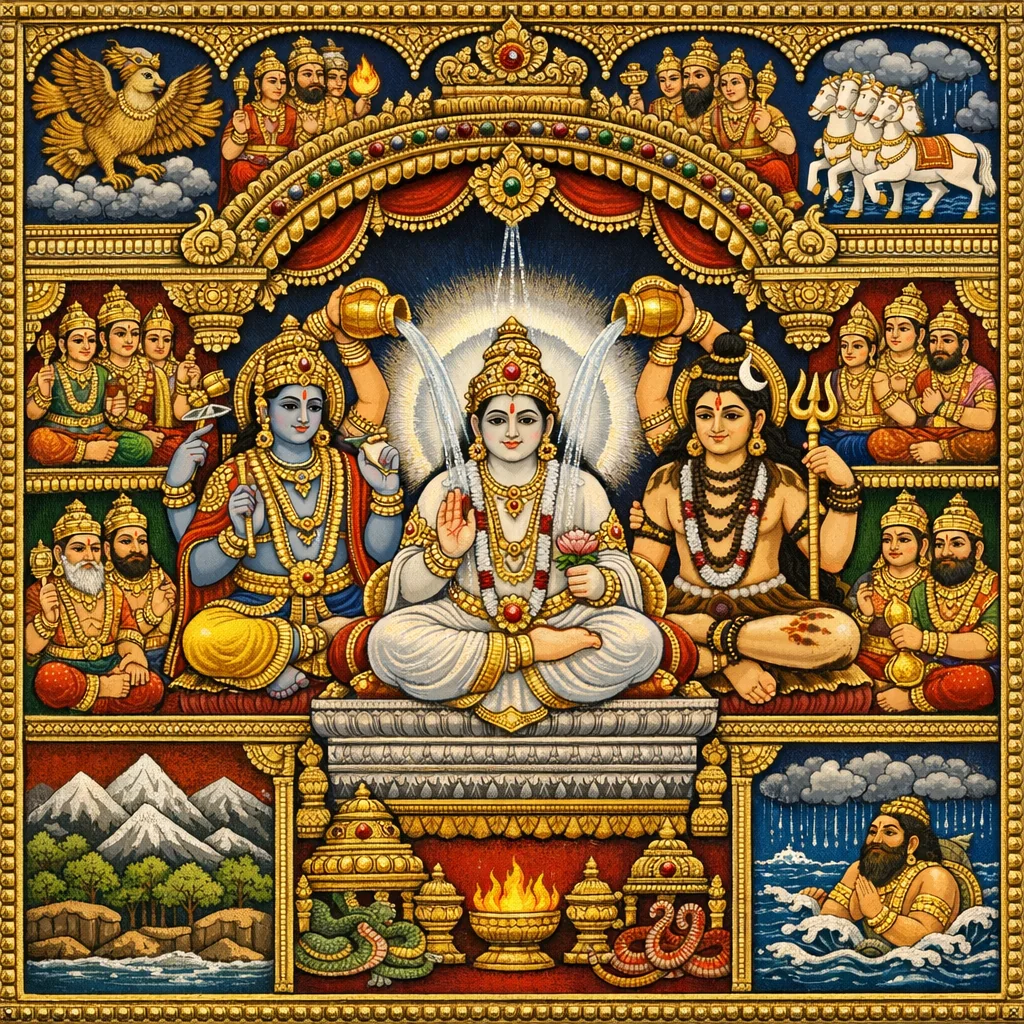
Adhyaya 8
राज्याभिषेक-विभागः (Distribution of Sovereignties / Appointments of Cosmic Lords)
This Adhyāya, narrated by Sūta, describes the orderly abhiṣeka (consecrated installation) of presiding powers after Kaśyapa’s creation has established moving and unmoving beings. It assigns domains to their lords: Soma over brāhmaṇas, plants, nakṣatras with grahas, and over yajña and tapas; Bṛhaspati as leader of the Viśve-devas/Angirasas; and Kāvya (Śukra) over the Bhṛgus. Further appointments follow: Viṣṇu over the Ādityas, Agni over the Vasus, Dakṣa over the Prajāpatis, Indra (Vāsava) over the Maruts; Prahlāda over the Daityas; Nārāyaṇa over the Sādhyas; Vṛṣadhvaja (Śiva) over the Rudras; Vipracitti over the Dānavas; Varuṇa over the waters; Vaiśravaṇa (Kubera) over kings and wealth; Yama (Vaivasvata) over the Pitṛs; Girīśa over bhūtas and piśācas; Himavān over mountains; Sāgara over rivers; Citraratha over Gandharvas; Uccaiḥśravas over horses; Garuḍa over birds; Vāyu over winds and strength; Śeṣa, Vāsuki, and Takṣaka over serpent classes; Parjanya over rain-bearing functions; and Kāmadeva over apsaras groups and erotic potency. The chapter thus serves as a cosmological registry of hierarchical sovereignties.
Shlokas
Verse 1
इति श्रीब्रह्माण्डे महापुराणे वायुप्रोक्ते मध्यभागे तृतीय उपोद्धातपादे काश्यपेयवर्णनं नाम सप्तमो ऽध्यायः सूत उवाच एवं प्रजासु सृष्टासु कश्यपेन महात्मना / प्रतिष्ठितासु सर्वासु चरासु स्थावरासु च
Thus, in the Śrī Brahmāṇḍa Mahāpurāṇa, in the middle section spoken by Vāyu, within the third introductory quarter, is the seventh chapter called “The Account of the Kāśyapeyas.” Sūta said: When the great-souled Kaśyapa had created the creatures, and when all—moving and unmoving—were duly established.
Verse 2
अभिषिच्याधिपत्येषु तेषां मुख्यान्प्रजापतिः / ततः क्रमेण राज्यानि आदेष्टुमुपचक्रमे
Prajāpati anointed the foremost among them into their respective lordships; then, in due order, he began to lay down the ordinances of the kingdoms.
Verse 3
द्विजानां वीरुधां चैव नक्षत्राणां ग्रहैः सह / यज्ञानां तपसां चैव सोमं राज्ये ऽभ्यषेचयत्
Over the twice-born, over plants and creepers, over the constellations together with the planets, and over sacrifices and austerities, Prajāpati anointed Soma to kingship.
Verse 4
बृहस्पतिं तु विश्वेषां ददावङ्गिरसां पतिम् / भृगूणामधिपं चैव काव्यं राज्ये ऽभ्यषेचयत्
He appointed Bṛhaspati, lord of the Aṅgiras, as the chief of the Viśvedevas; and he anointed Kāvya (Śukrācārya), ruler of the Bhṛgus, to kingship.
Verse 5
आदित्यानां पुनर्विष्णुं वसूनामथ पावकम् / प्रजापतीनां दक्षं च मरुतामथ वासवम्
He set Viṣṇu over the Ādityas, Pāvaka (Agni) over the Vasus, Dakṣa over the Prajāpatis, and Vāsava (Indra) over the Maruts.
Verse 6
दैत्यानामथ राजानं प्रह्रादं दितिनन्दनम् / नारायणं तु साध्यानां रुद्रणां च वृषध्वजम्
He appointed Prahlāda, son of Diti, as king of the Daityas; Nārāyaṇa as lord of the Sādhyas; and Vṛṣadhvaja (Śiva) as chief of the Rudras.
Verse 7
विप्रचित्तिं च राजानं दानवानामथादिशत् / अपां च वरुणं राज्ये राज्ञां वैश्रवणं तथा
He appointed Vipracitti as king of the Dānavas; set Varuṇa to rule the realm of waters; and likewise made Vaiśravaṇa (Kubera) lord over kings.
Verse 8
यक्षाणां राक्षसानां च पार्थिवानां धनस्य च / वैवस्वतं पितॄणां च यमं राज्ये ऽभ्यषेचयत्
He appointed a lord over the Yakṣas and Rākṣasas, and also over earthly kings and wealth; and he anointed Vaivasvata Yama to rule over the Pitṛs (ancestral spirits).
Verse 9
सर्वभूतपिशाचाना गिरिशं शूलपाणिनम् / शैलानां हिमवन्तं च नदीनामथ सागरम्
For all bhūtas and piśācas he appointed Girīśa, the trident-bearer; among mountains, Himavān, and among rivers, the Ocean as supreme.
Verse 10
गन्धर्वाणामधिपतिं चक्रे चित्ररथं तथा / उच्चैःश्रवसमश्वानां राजानं चाभ्यषेचयत्
He made Citraratha the lord of the gandharvas; and among horses he anointed Uccaiḥśravas as king.
Verse 11
मृगाणामथ शार्दूलं गोवृषं च ककुद्मिनाम् / पक्षिणामथ सर्वेषां गरुडं पततां वरम्
Among beasts he appointed the Śārdūla (tiger); among horned creatures, the bull; and among all birds, Garuḍa, the best of those who fly.
Verse 12
गन्धानां मरुतां चैव भूतानामशरीरिणाम् / समकालबलानां च वायुं बलवतां वरम्
Among fragrances, the Maruts, and bodiless beings, and even among those equal in timely strength, he appointed Vāyu as the foremost of the mighty.
Verse 13
सर्वेषां दंष्ट्रिणां शेषं नागानामथ वासुकिम् / सरीसृपाणां सर्पाणां पन्नगानां च तक्षकम्
Among all fanged beings he appointed Śeṣa; among the nāgas, Vāsuki; and among reptiles, serpents, and pannagas, Takṣaka.
Verse 14
सागराणां नदीनां च मेघानां वर्षितस्य च / आदित्यानामन्यतमं पर्जन्यमभिषिक्तवान्
He anointed Parjanya—one among the Ādityas—as lord over the oceans, the rivers, and the rain poured forth by the clouds.
Verse 15
सर्वाप्सरोगणानां च कामदेवं तथा प्रभुम् / ऋतूनामथ मासानामार्त्तवानां तथैव च
He appointed Kāmadeva as lord of all the hosts of Apsarases, and likewise set rulers over the seasons, the months, and the cycle of seasons (ārtavān).
Verse 16
यक्षाणां च विपक्षाणां मुहूर्त्तानां च पर्वणाम् / कलाकाष्ठाप्रमाणानां गतेरयनयोस्तथा
He set in order the Yakṣas and their opposing hosts, the muhūrtas and sacred observance-days (parva), the measures of time such as kalā and kāṣṭhā, and also motion and the two ayanas.
Verse 17
गणितस्याथ योगस्य चक्रे संवत्सरं प्रभुम् / प्रजापतेर्विरजसः पूर्वस्यां दिशि विश्रुतम्
Then he established the Lord of Saṃvatsara as sovereign over calculation and yoga—renowned in the eastern quarter and belonging to Prajāpati Virajas.
Verse 18
पुत्रं नाम्ना सुधन्वानं राजानं सो ऽभ्यषेचयत् / दक्षिणास्यां दिशि तथा कर्दमस्य प्रजापतेः
He anointed as king Sudhanvā, the son of Prajāpati Kardama, and established him in the southern quarter.
Verse 19
पुत्रां शङ्खपदं नाम राजानं सोभ्यषेचयत् / पस्चिमस्यां दिशि तथा रजसः पुत्रमच्युतम्
Then he anointed his son named Śaṅkhapada as king; and in the western quarter he likewise स्थापित Acyuta, the son of Rajasa.
Verse 20
केतुमन्तं महात्मानं राजानं चाभ्यषेचयत् / तथा हिरण्यरोमाणं पर्जन्यस्य प्रजापतेः
He also anointed the great-souled Ketumant as king; and likewise Hiraṇyaromā, the son of Prajāpati Parjanya.
Verse 21
उदीच्यां दिशि दुर्द्धर्षपुत्रं राज्ये ऽभ्यषेचयत् / मनुष्याणामधिपतिं चक्रे वैवस्वतं मनुम्
In the northern quarter he anointed the son of Durdharṣa to kingship; and he made Vaivasvata Manu the lord of humankind.
Verse 22
तैरियं पृथिवी सर्वा सप्तद्वीपा सपत्तना / यथाप्रदेशमद्यापि धर्मेण परिपाल्यते
By them this entire earth—together with the seven dvīpas and its cities—has even today been protected in each region according to dharma.
Verse 23
स्वायंभुवेन्तरे पूर्वं ब्रह्मणा ते ऽभिषेचिताः / नृपाश्चैते ऽभिषिच्यन्ते मनवो ये भवन्ति वै
Formerly, in the Svāyambhuva Manvantara, Brahmā had anointed them; and these kings are anointed by those who indeed become Manus.
Verse 24
मन्वन्तरेष्वतीतेषु गता ह्येतेषु पार्थिवाः / एवमन्ये ऽभिषिच्यन्ते प्राप्ते मन्वन्तरे पुनः
In the manvantaras that have passed, these earthly kings have departed; so too, when a manvantara arrives, other rulers are again anointed.
Verse 25
अतीतानागताः सर्वे स्मृता मन्वन्तरेश्वराः / राजसूये ऽभिषिक्तश्च पृथु रेभिर्नरोत्तमः
All the lords of the manvantaras, past and yet to come, are remembered; and in the Rājasūya, Prithu—the best of men—was anointed by the Rebhi seers.
Verse 26
वेददृष्टेन विधिना ह्यधिराजः प्रतापवान् / एतानुत्पाद्य पुत्रांस्तु प्रजासन्तानकारणात्
By the rite beheld in the Vedas, the mighty overlord begot those sons, so that the line of the people might continue.
Verse 27
पुनरेव महा भागः प्रजानां पतिरीश्वरः / कश्यपो गोत्रकामस्तु चचार परमं तपः
Once more, Kashyapa—the greatly blessed lord of beings, like Īśvara—desiring a gotra, undertook the highest austerity.
Verse 28
पुत्रौ गोत्रकरौ मह्यं भवेतामिति चिन्तयन् / तस्यप्रध्यायमानस्य कश्यपस्य महात्मनः
Thinking, “May two sons be born to me who shall found a gotra,” the great-souled Kashyapa remained absorbed in contemplation.
Verse 29
ब्रह्मणोंऽशौ सुतौ पश्चात्प्रादुर्भूतौ महौजसौ / वत्सारश्चासितश्चैव तावुभौ ब्रह्म वादना
Later, from a portion of Brahmā arose two sons of great splendor—Vatsāra and Asita; both were proclaimers of Brahmanic wisdom.
Verse 30
वत्सारान्निध्रुवो जज्ञे रेभ्यश्च सुहमायशाः / रेभ्यस्य रैभ्यो विज्ञेयो निध्रुवस्य निबोधत
From Vatsāra was born Nidhruva, and from Rebhya the renowned Suhamā-yaśas; Rebhya’s son is known as Raibhya—understand the lineage of Nidhruva.
Verse 31
च्यवनस्य सुकन्याया सुमेधाः समपद्यत / निध्रुवस्य तु या पत्नी माता वै कुण्डपायिराम्
From Sukanyā, the wife of Cyavana, was born Sumedhā; and Nidhruva’s wife was indeed the mother of Kuṇḍapāyirām.
Verse 32
असितस्यैकपर्णायां ब्रह्मिष्ठः समपद्यत / शाण्डिल्यानां वरः श्रीमान् देवलः सुमहायशाः
From Ekaparṇā, Asita’s wife, was born Brahmiṣṭha; and Devala—radiant and greatly renowned—was the foremost among the Śāṇḍilyas.
Verse 33
निध्रुवाः शाण्डिला रैभ्यास्त्रयः पक्षास्तु काश्यपाः / वज्रिप्रभृतयो देवा देवास्तस्य प्रजा स्विमाः
Nidhruva, Śāṇḍilya, and Raibhya—these are three branches of the Kaśyapa line; and the gods, beginning with Vajrī, are remembered as his progeny.
Verse 34
चतुर्युगे त्वतिक्रान्ते मनोर्ह्येकादशे प्रभोः / अथावशिष्टे तस्मिंस्तु द्वापरे संप्रर्त्तिते
When the four yugas had passed and the eleventh era of Manu, O Lord, had come, then in that remaining Dvāpara this succession was set in motion.
Verse 35
मरुत्तस्य नरिष्यं तस्तस्य पुत्रो दमः किल / राज्यवर्द्धनकस्तस्य सुधृतिस्तत्सुतो नरः
Marutta’s son was Nariṣyanta; his son, it is said, was Dama. Dama’s son was Rājyavardhanaka, and his son, the man-king, was Sudhṛti.
Verse 36
केवलश्च ततस्तस्य बन्धुमान्वेगवांस्ततः / बुधस्तस्या भवद्यस्या तृणबिन्दुर्महीपतिः
Then his son was Kevala; after him came Bandhumān, and then Vegavān. His son was Budha, whose son was Tṛṇabindu, lord of the earth.
Verse 37
त्रेतायुगमुखे राजा तृतीये स बभूव ह / तस्य चेलविला कन्यालंबुषागर्भसंभवा
At the dawn of the Tretā-yuga, in the third manvantara, he became king. His daughter was Celavilā, born from the womb of the apsarā Lambuṣā.
Verse 38
तस्यां जातो विश्रवास्तु वौलस्त्यकुलवर्द्धनः / बृहस्पतिबृर्हत्कीर्तिर्देवाचार्यस्तु कीर्त्तितः
From her was born Viśravā, who increased the Vaulastya line. And Bṛhaspati is praised as of vast renown, the preceptor of the gods (Devācārya).
Verse 39
कन्यां तस्योपयेमे स नाम्ना वै देववर्णिनीम् / पुष्पोत्कटां च वाकां च सुते माल्यवतस्तथा
He took to wife the maiden named Devavarṇinī; and Mālyavat’s daughters were Puṣpotkaṭā and Vākā as well.
Verse 40
कैकसीं मालिनः कन्यां तासां तु शृणुत प्रजाः / ज्येष्ठं वैश्रवणं तस्य सुषुवे देववर्णिनी
O people, hear: Mālin’s daughter was Kaikasī; Devavarṇinī bore to him his eldest son, Vaiśravaṇa.
Verse 41
दिव्येन विधिना युक्तमार्षेण च श्रुतेन च / राक्षसेन च रूपेण आसुरेण बलेन च
It was aligned with the divine ordinance and with the ṛṣis’ sacred śruti; possessing a rākṣasa form and an āsura strength.
Verse 42
त्रिपादं सुमहा कायं स्थूलशीर्षं महाहनुम् / अष्टदंष्ट्रं हरिछ्मश्रुं शङ्कुकर्णं विलोहितम्
Three-footed was he, of vast body, with a heavy head and mighty jaw; eight-fanged, with greenish beard, cone-like ears, and a ruddy hue.
Verse 43
ह्रस्वबाहुं प्रबाहुं च पिगलं सुद्विभीषणम् / वैवर्त्तज्ञानसंपन्नं संबुद्धं चैव संभवात्
His arms were both short and long; tawny-hued and exceedingly fearsome; endowed with vaivartta-knowledge, awakened from the very moment of birth.
Verse 44
पिता दृष्ट्वाब्रवीत्तं तु कुबेरो ऽयमिति स्वयम् / कुत्सायां क्विति शब्दो ऽयं शरीरं बेरमुच्यते
The father, seeing him, spoke of his own accord: “This is Kubera.” In a sense of reproach there is the word ‘kvi’, and the body is called ‘bera’.
Verse 45
कुबेरः कुशरीरत्वान्नाम्ना वै तेन सोंऽकितः / यस्माद्विश्रवसो ऽपत्यं सादृश्याद्विश्रवा इव
Because he bore a ‘ku-śarīra’ (an uncomely body), he was marked by that very name as “Kubera.” For he was the offspring of Viśravas; by likeness, as though Viśrava himself.
Verse 46
तस्माद्वैश्रवणो नाम नाम्ना तेन भविष्यति / ऋद्रयां कुबेरो ऽजनयद्विश्रुतं नलकूबरम्
Therefore he will also be known by the name “Vaiśravaṇa.” From Ṛdrā, Kubera begot the renowned Nalakūbara.
Verse 47
रावणं कुम्भकर्णं च कन्यां शूर्पणखीं तथा / विभीषणचतुर्थांस्तु कैकस्यजनयत्सुतान्
Kaikasī bore Rāvaṇa, Kumbhakarṇa, the maiden Śūrpaṇakhā, and as the fourth, Vibhīṣaṇa.
Verse 48
शङ्कुकर्णो दशग्रीवः पिङ्गलो रक्तमूर्द्धजः / चतुष्पाद्विंशतिभुजो महाकायो महाबलः
He was Śaṅkukarṇa, the ten-necked Daśagrīva, tawny-hued with red hair; four-footed, twenty-armed, vast of body and mighty in strength.
Verse 49
जात्यञ्ज ननिभो दंष्ट्री लोहितग्रीव एव च / राक्षसेनौजसा युक्तो रूपेण च बलेन च
He was like Jātyañja and Nanibha—tusked, with a crimson neck—endowed with the might of a rākṣasa host, mighty in form and in strength.
Verse 50
सत्त्वबुद्धिजितैर्चङ्क्षरा असैरेव रावणः / विसर्गदारुणः क्रूरो रावणो द्रावणस्तु सः
That was Rāvaṇa himself, in league with the asuras called Caṅkṣara who conquer virtue and discernment; dreadful in his deeds and cruel in nature—Rāvaṇa, truly Drāvaṇa, the one who makes beings tremble.
Verse 51
हिरण्यकशिपुर्ह्यासीद्रावणः पूर्वजन्मनि / चतुर्युगानि राजाभूत् त्रयोदश स राक्षसः
In a former birth, Rāvaṇa was Hiraṇyakaśipu; that rākṣasa reigned as king for thirteen caturyugas.
Verse 52
ताः पञ्चकोट्यो वर्षाणां संख्याताः संख्यया द्विजाः / नियुतान्येकषष्टिं च शरदां गणितानि वै
O dvijas, the count of those years is reckoned as five koṭis; and the śarad seasons are computed as sixty-one niyutas.
Verse 53
षष्टिं चैव सहस्राणि वर्षाणां वै स रावणः / देवतानामृषीणां च घोरं कृत्वा प्रजागरम्
That Rāvaṇa, for sixty thousand years, wrought a dreadful prajāgara upon the gods and the ṛṣis—unceasing disturbance and terror.
Verse 54
त्रेतायुगे चतुर्विंशे रावणस्तपसः क्षयात् / रामं दाशरथिं प्राप्य सगणः क्षयमीयिवान्
In the twenty-fourth age of the Tretā Yuga, when the power of his austerities was spent, Rāvaṇa, meeting Rāma the son of Daśaratha, went to destruction along with all his hosts.
Verse 55
महोदरः प्रहस्तश्च महापार्श्वः खरस्तथा / पुष्पोत्कटायाः पुत्रास्ते कन्या कुम्भीनसी तथा
Mahodara, Prahasta, Mahāpārśva, and Khara—these were the sons of Puṣpotkaṭā; and she also had a daughter named Kumbhīnasī.
Verse 56
त्रिशिरा दूषणश्चैव विद्युज्जिह्वः सराक्षसः / कन्यानुपालिका चैव वाकायाः प्रसवः स्मृतः
Triśirā, Dūṣaṇa, and the rākṣasa Vidyujjihva were also born; and Kanyānupālikā is remembered as the offspring of Vākā.
Verse 57
इत्येते क्रूर कर्माणः पौलस्त्या राक्षसा दश / दारुणाभिजनाः सर्वे देवैरपि दुरासदाः
Thus were these ten rākṣasas of the line of Paulastya—cruel in their deeds, all of dreadful birth, hard to assail even for the gods.
Verse 58
सर्वे लब्धवराः शूराः पुत्रपौत्रैः समन्विताः / यक्षाणां चैव सर्वेषां पौलस्त्या चे च राक्षसाः
All of them were valiant heroes, blessed with boons, attended by sons and grandsons; and they were counted among all the yakṣas and the rākṣasas of Paulastya’s line (of renown).
Verse 59
आगस्त्यवैश्वामित्राणां क्रूराणां ब्रह्मरक्षसाम् / वेदाध्ययनशीलानां तपोव्रतनिषेविणाम्
The fierce Brahmarākṣasas of the lines of Agastya and Vaiśvāmitra—steadfast in Vedic study and devoted to austerity and sacred vows.
Verse 60
तेषामैडविडो राजा पौलस्त्यः सव्यपिङ्गलः / इतरे ये यज्ञजुषस्ते वै रक्षोगणास्त्रयः
Among them was the king of the Aiḍaviḍa line—Paulastya, known as Savyapiṅgala; the others who partook of the sacrificial share are said to be three hosts of rākṣasas.
Verse 61
यातुधाना ब्रह्मधाना वार्त्ताश्चैव दिवाचराः / निशाचरगणास्तेषां चत्वारः कविभिः स्मृताः
Yātudhānas, Brahmadhānas, Vārttās, and Divācaras—these are remembered by the poets as four companies among their night-roaming hosts.
Verse 62
पौलस्त्या नैरृताश्चैव आगस्त्याः कौशिकास्तथा / इत्येताः सप्त तेषां वै जातयो राक्षसाः स्मृताः
Paulastyas, Nairṛtas, Āgastyas, and Kauśikas—thus are their seven lineages remembered as the jātis of the rākṣasas.
Verse 63
तेषां रुपं प्रवक्ष्यामि स्वाभाव्येन व्यवस्थितम् / वृत्ताक्षाः पिङ्गलाश्चैव महाकाया महोदराः
Now I shall describe their form as set by their very nature: round-eyed, tawny-hued, of vast bodies and mighty bellies.
Verse 64
अष्टदंष्ट्राः शङ्कुकार्णा ऊर्द्ध्वरोमाण एव च / आकर्णा हारितस्याश्च मुञ्जधूम्रोर्ध्वमूर्धजाः
They possess eight fangs, ears shaped like spikes, and body hair standing erect. Their mouths gape wide to their ears, and their head-hair is smoky like Munja grass and stands upwards.
Verse 65
स्थूलशीर्षाः सिताभाश्च ह्रस्वसक्थिप्रबाहवः / ताम्रास्या लंबजिह्वोष्ठा लंबभ्रूस्थूलनासिकाः
They have massive heads, a white complexion, and short thighs and forearms. Their faces are coppery, with hanging tongues and lips, long eyebrows, and thick noses.
Verse 66
नीलाङ्गा लोहितग्रीवा गंभीराक्षा विभीषणाः / महाघोरस्वराश्चैव विकटोद्बद्धपिण्डिकाः
Their limbs are blue, necks red, eyes deep-set, and they are terrifying. Their voices are exceedingly horrible, and their calves are hideous and knotted.
Verse 67
स्थूलाश्च तुङ्गनासाश्च शिलासंहनना दृढाः / दारुणाभिजनाः क्रूराः प्रायशः क्लिष्टकर्मिणः
They are stout, have prominent noses, bodies hard as stone, and are firm. They come from a harsh lineage, are cruel, and mostly perform difficult deeds.
Verse 68
सकुण्डलाङ्गदापीडा मुकुटोष्णीषधारिणः / विचित्राभरणाश्चित्रमाल्यगन्धानुलेपनाः
They wear earrings, armlets, crowns, and turbans. They are decked with wonderful ornaments and smeared with variegated garlands and fragrant pastes.
Verse 69
अन्नादाः पिशितादाश्च पुरुषादाश्च ते स्मृताः / इत्येतद्रूपसाधर्म्यं राक्षसानां स्मृतं बुधैः
They are remembered as eaters of food, eaters of flesh, and eaters of men; thus the wise have taught the likeness of form that marks the Rākṣasas.
Verse 70
न समास्ते बले बुद्धौ युद्धे माया कृते तदा / पुलहस्य मृगाः पुत्राः सर्वे व्यालाश्च दंष्ट्रिणः
Then, in strength, in wit, and in battle—even when māyā was employed—none could match them; Pulaha’s sons, the beasts, and all the fierce creatures were armed with fangs.
Verse 71
भूताः सर्प्पाः पिशाचाश्च सृमरा हस्तिनस्तथा / वानराः किन्नराश्चेव मायुः किंपुरुषास्तथा
There arose bhūtas, serpents, and piśācas; sṛmaras and elephants as well; and also vānaras, kinnaras, māyu, and kiṃpuruṣas.
Verse 72
प्रागप्येते परिक्रान्ता मया क्रोधवशान्वयाः / अनपत्यः क्रतुर्ह्यस्मिन्स्मृतो वैवस्वतेंऽतरे
Earlier, borne along by the lineage of wrath, I had already passed beyond these; in this Vaivasvata Manvantara, Kratu is remembered as without offspring.
Verse 73
न तस्य पत्न्यः पुत्रा वा तेजः संक्षिव्य च स्थितः / अत्रेर्वशं प्रवक्ष्यामि तृतीयस्य प्रजापतेः
He had neither wives nor sons; drawing his radiance inward, he remained. Now I shall proclaim the lineage of Atri, the third of the Prajāpatis.
Verse 74
तस्य पत्न्यस्तु सुन्दर्यों दशैवासन्पतिव्रताः / बद्राश्वस्य घृताच्यां वै दशाप्सरसि सूनवः
He had ten lovely wives, all steadfast in the vow of wifely fidelity. By the apsaras Ghṛtācī, Badrāśva begot ten sons.
Verse 75
भद्रा शूद्रा च मद्रा च शालभा मलदा तथा / बला हला च सप्तैता या च गोचपलाः स्मृताः
Bhadrā, Śūdrā, Madrā, Śālabhā, Maladā, Balā, and Halā—these are the seven; and one more is remembered as Gocapalā.
Verse 76
तथा तामरसा चैव रत्नकूटा च तादृशः / तत्र यो वंशकृच्चासौ तस्य नाम प्रभाकरः
So too were Tāmarasā and Ratnakūṭā, of like kind. There, the one who founded the lineage was named Prabhākara.
Verse 77
मद्रायां जनयामास सोमं पुत्रं यशस्विनम् / स्वर्भानुना हते सूर्ये पतमाने दिवो महीम्
In Madrā he begot Soma, a son of shining renown. When Svarbhānu struck the Sun and it seemed to fall from heaven toward the earth,
Verse 78
तमो ऽभिभूते लोके ऽस्मिन्प्रभा येन प्रवर्त्तिता / स्वस्ति तेस्त्विति चौक्तो वै पतन्निह दिवाकरः
When this world was overcome by darkness, it was he who set the radiance in motion. Then Divākara, falling here, spoke to him: “May auspiciousness be yours.”
Verse 79
ब्रह्मर्षेर्वचनात्तस्य न पपात दिवो महीम् / अत्रिश्रेष्ठानि गोत्राणि यश्चकार महातपाः
By the word of that Brahmarṣi, the earth did not fall from heaven. The great ascetic established the foremost gotras of Atri.
Verse 80
यज्ञेष्वनिधनं चैव सुरैर्यस्य प्रवर्तितम् / स तासु जनयामास पुत्रानात्मसमानकान्
In the sacrifices, the Devas set in motion for him the ‘anidhana’ rite, imperishable. And among them he begot sons equal to his own self.
Verse 81
दश तान्वै सुमहता तपसा भावितः प्रभुः / स्वस्त्यात्रेया इति ख्याता ऋषयो वेदपारगाः
The Lord ripened those ten through exceedingly great austerity. They were famed as the Svastyātreyas, seers who had mastered the Vedas.
Verse 82
तेषां द्वौ ख्यातयशसौ ब्रह्मिष्ठौ सुमहौजसौ / दत्तो ह्यनुमतो ज्येष्ठो दुर्वासास्तस्य चानुजः
Among them, two were renowned and glorious, most steadfast in Brahman and of immense power: Datta, the eldest (Anumata), and his younger brother Durvāsā.
Verse 83
यवीयसी सुता तेषामबला ब्रह्मवादिनी / अत्राप्युदाहरन्तीमं श्लोकं पौराणिकाः पुरा
Their youngest daughter was Abalā, a brahmavādinī who spoke of Brahman. Here too, the ancient Paurāṇikas cite this śloka as a testimony.
Verse 84
अत्रेः पुत्रं महात्मानं शान्तात्मानमकल्मषम् / दत्तात्रेयं तनुं विषणोः पुराणज्ञाः प्रजक्षते
Dattatreya, the son of Atri—great-souled, tranquil, and stainless—is declared by the knowers of the Puranas to be a bodily manifestation (tanu) of Vishnu.
Verse 85
तस्य गोत्रान्वयज्जाताश्चत्वारः प्रथिता भुवि / श्यावाश्वा मुद्गलाश्चैव वाग्भूतकगवि स्थिराः
From his gotra-lineage arose four lines renowned upon the earth: Śyāvāśva, Mudgala, Vāgbhūtaka, and Gavistira.
Verse 86
एते ऽत्रीणां तु चत्वारः स्मृताः पक्षा महौजसः / काश्यपो नारदश्चैव पर्वतो ऽरुन्धती तथा
These are remembered as the four mighty ‘wings’ (pakṣa) of Atri’s line: Kāśyapa, Nārada, Parvata, and Arundhatī.
Verse 87
जज्ञिरे मानसा ह्येते ऽरुधत्यास्तन्निबोधत / नारदस्तु वसिष्ठायारुन्धती प्रत्यपादयत्
All these were born from Arundhatī by the mind (mānasa)—know this. And Nārada bestowed Arundhatī upon Vasiṣṭha.
Verse 88
ऊर्द्ध्वरेता महातेजा दक्षशापात्तु नारदः / पुरा देवासुरे तस्मिन्संग्रामे तारकामये
By Dakṣa’s curse, Nārada became ūrdhvareta (steadfast in celibacy) and of great radiance; long ago, in that deva–asura war, the Tārakāmaya battle.
Verse 89
अनावृष्ट्या हते लोके व्यग्रे शस्ते सुरैः सह / वसिष्ठस्तपसा धीमाञ्जीवयामास वै प्रजाः
When the world was struck down by drought and all, together with the gods, were distressed, the wise Vasiṣṭha by the power of his austerity restored the beings to life.
Verse 90
अनेकफलमूलिन्य औषधीश्च प्रवर्तयन् / तास्तेन जीवयामास कारुण्यादौषधेन सः
He caused many medicinal herbs, rich in fruits and roots, to flourish; moved by compassion, by that healing power he sustained all life.
Verse 91
अरुन्धत्यां वसिष्टस्तु शक्तिमुत्पादय त्सुतम् / स्वाङ्गज जनयच्छक्तिरदृश्यन्त्यां पराशरम्
From Arundhatī, Vasiṣṭha begot the son Śakti; and Śakti, from Adṛśyantī, begot his own offspring, Parāśara.
Verse 92
काल्यां पराशराज्जज्ञे कृष्णद्वैपायनः प्रभुः / द्वैपायनादरण्यां वै शुको जज्ञे गुणान्वितः
From Kālī and Parāśara was born the Lord Kṛṣṇa-Dvaipāyana (Vyāsa); and from Dvaipāyana and Araṇyā was born Śuka, endowed with virtues.
Verse 93
उदपद्यन्त षडिमे पीवर्यां शुकसूनवः / भूरिश्रवाः प्रभुः शंभुः कृष्णो गौरश्च पञ्चमः
In Pīvarī were born these six sons of Śuka—Bhūriśravā, Prabhu, Śaṃbhu, Kṛṣṇa, and the fifth, Gaura; (and one more).
Verse 94
कन्या कीर्तिमती चैव योगमाता धृतव्रता / जननी ब्रह्मदत्तस्य पत्नी सा त्वणुहस्य च
The maiden Kīrtimatī was Yogamātā, steadfast in her vows; she was the mother of Brahmadatta and also the wife of Anuha.
Verse 95
श्वेताः कृष्णाश्च पौराश्च श्यामधूम्राश्च चण्डिनः / ऊष्मादा दारिकाश्चैव नीलाश्चैव पराशराः
Among the Parāśaras are spoken of the Śvetas, the Kṛṣṇas, the Pauras, the Śyāma-dhūmras, and the Caṇḍins; likewise the Ūṣmādas, the Dārikas, and the Nīlas.
Verse 96
पराशराणामष्टौ ते पक्षाः प्रोक्ता महात्मनाम् / अत ऊर्द्ध्व निबोध त्वमिन्द्रप्रमति संभवम्
Thus have been declared the eight branches of the great-souled Parāśaras. Now, hear further of the birth of Indrapramati.
Verse 97
वसिष्ठस्य कपिञ्जल्यां घृताच्यामुदपद्यत / कुणीति यः समाख्यात इन्द्रप्रमतिरुच्यते
From Vasiṣṭha, in Kapiñjalā, Ghṛtācī gave birth to one famed as Kuṇi; he is spoken of as Indrapramati.
Verse 98
पृथोः सुतायां संभूतः पुत्रस्तस्याभवद्वसुः / उपमन्युः सुतस्तस्य यस्येमे ह्यौपमन्यवः
From the daughter of Pṛthu was born his son Vasu. His son was Upamanyu, from whom these descendants are called the Aupamanyavas.
Verse 99
मित्रावरुणयोश्चैव कुण्डिनेयाः परिश्रुताः / एकार्षेयास्तथा चान्ये वसिष्ठा नाम विश्रुताः
In the line of Mitra and Varuṇa, the Kuṇḍineyas are well renowned; and others too, of a single rishi lineage, are famed by the name “Vasiṣṭha”.
Verse 100
एते पक्षा वसिष्ठानां स्मृता ह्येकादशैव तु / इत्येते ब्रह्मणः पुत्रा मानसा अष्ट विश्रुताः
These branches of the Vasiṣṭhas are remembered as eleven; thus are famed the eight mind-born sons of Brahmā.
Verse 101
भ्रातरः सुमहाभागा येषां वंशाः प्रतिष्ठिताः / त्रींल्लोकान्धारयन्तीमान्देवर्षिगणसंकुलान्
They are most fortunate brothers, whose lineages stand firmly established; they uphold these three worlds, thronged with hosts of deva-rishis.
Verse 102
तेषां पुत्राश्च पौत्राश्च शतशो ऽथ सहस्रशः / व्याप्ता येस्तु त्रयो लोकाः सूर्यस्येव गभस्तिभिः
Their sons and grandsons are in hundreds and in thousands; by them the three worlds are pervaded, like the Sun’s own rays.
Frequently Asked Questions
A domain-to-sovereign registry: it assigns presiding rulers to categories such as nakṣatras/grahas, rivers, mountains, bhūtas, pitṛs, gandharvas, serpent-classes, and major deva groups—forming a governance map of the created cosmos.
Soma (over brāhmaṇas, plants, nakṣatras/grahas, yajña, tapas), Bṛhaspati, Kāvya (Śukra), Viṣṇu, Agni (Pāvaka), Dakṣa, Indra (Vāsava), Prahlāda, Nārāyaṇa, Vṛṣadhvaja (Śiva), Vipracitti, Varuṇa, Vaiśravaṇa (Kubera), Yama, Girīśa, Himavān, Sāgara, Citraratha, Uccaiḥśravas, Garuḍa, Vāyu, Śeṣa, Vāsuki, Takṣaka, Parjanya, and Kāmadeva.
No. The content here is administrative-cosmological (appointments and jurisdictions) rather than Śākta esotericism; Lalitopākhyāna themes like specific vidyās/yantras and Bhaṇḍāsura appear in the Upasaṃhāra-oriented portion, not in this appointment catalogue.