Adhyaya 25
Rāma’s Stuti of Śiva (Śarva) and the Theophany of the Three‑Eyed Lord
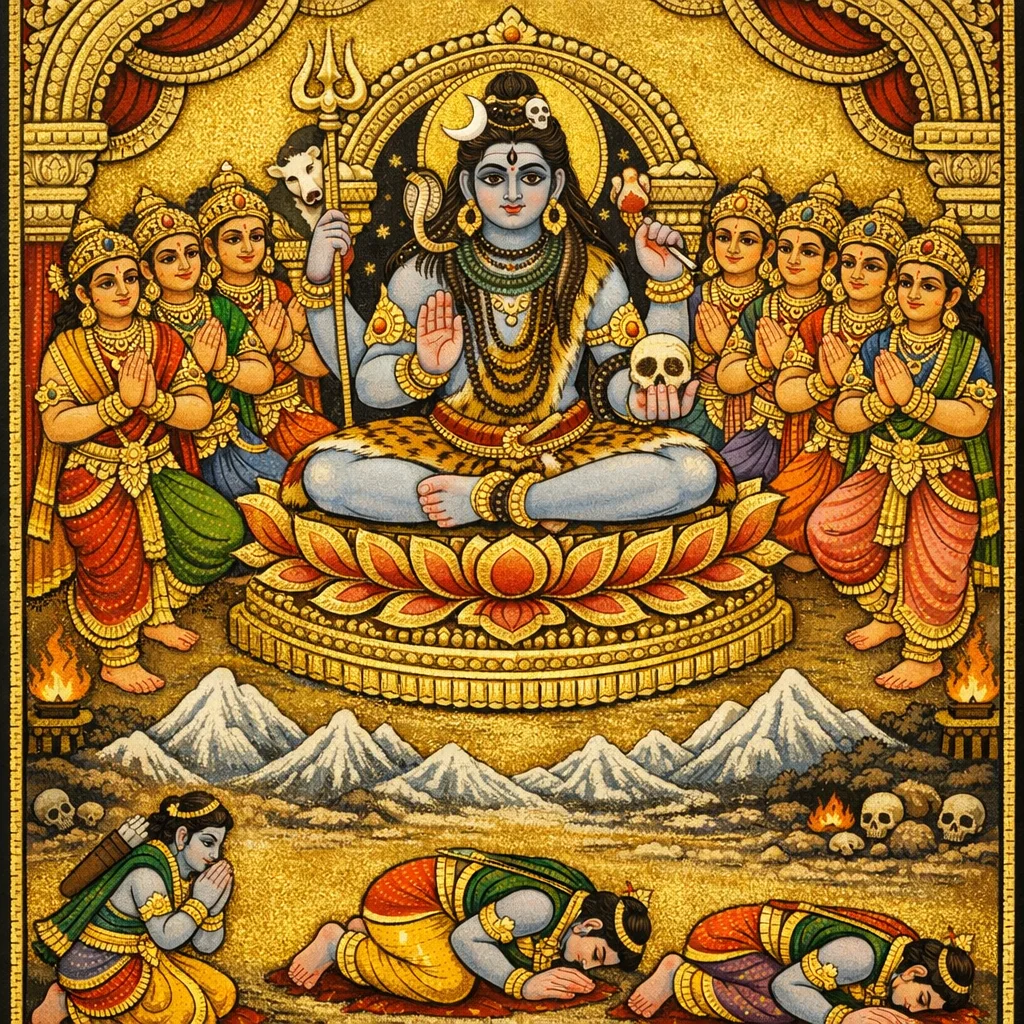
This adhyāya is cast as a sage-to-sage narration (with Vasiṣṭha speaking in the sample) and turns on a direct theophany: Jagatpati, the Lord of the world, manifests, attended by the hosts of the Maruts. Beholding Śiva—hailed through many epithets such as Trinetra, Candraśekhara, Vṛṣendravāhana, Śambhu, and Śarva—Rāma repeatedly rises, prostrates in devotion, and offers an extended stuti. The hymn serves as a compact theological catalogue, listing Śiva’s cosmic offices (witness of all acts; lord of beings and worlds), iconic marks (bull-banner, skull-bearing, ash-smeared body), abodes (Kailāsa and the cremation-ground), and famed deeds (the destruction of Tripura, the disruption of Dakṣa’s yajña, the slaying of Andhaka, and the Kālakūṭa poison episode). The chapter thus functions as a high-density index of Śaiva identifiers, linking them to cosmology, time-cycle narratives, and legitimacy through divine sanction.
Shlokas
Verse 1
इति श्रीब्रह्माण्डे महापुराणे वायुप्रोक्ते मध्यभागे तृतीय उपोद्धातपादेर्ऽजुनोपाख्याने चतुर्विंशतितमो ऽध्यायः // २४// वसिष्ठ उवाच ततस्त द्रक्तियोगेन स प्रीतात्मा जगत्पतिः / प्रत्यक्षमगमत्तस्य सर्वैः सह मरुद्गणैः
Thus, in the Śrī Brahmāṇḍa Mahāpurāṇa, in the middle section spoken by Vāyu, in the third introductory division, within the Arjuna narrative, ends the twenty-fourth chapter. Vasiṣṭha said: then, by the yoga of divine vision, the Lord of the worlds (Śiva), joyful at heart, appeared before him together with all the hosts of the Maruts.
Verse 2
तं दृष्ट्वा देवदेवेशं त्रिनेत्रं चन्द्रशेखरम् / वृषेन्द्रवाहनं शंभुं भूतकोटिसमन्वितम्
Beholding Him—the Lord of gods, the Three‑eyed One, Candraśekhara; Śambhu riding the noble bull, attended by myriads of bhūtas.
Verse 3
ससंभ्रमं समुत्थाय हर्षेणाकुललोचनः / प्रणाममकरोद्भक्त्या शर्वाय भुवि भार्गवः
Rising in reverent haste, his eyes trembling with joy, Bhārgava bowed down on the earth in devotion to Śarva.
Verse 4
उत्थायोत्थाय देवेशं प्रणम्य शिरसासकृत् / कृताञ्जलिपुटो रामस्तुष्टाव च जगत्पतिम्
Again and again rising, he bowed with his head to the Lord of gods; with palms joined, Rāma praised the Lord of the world.
Verse 5
राम उवाच नमस्ते देवदेवेश नमस्ते परमेश्वर / नमस्ते जगतो नाथ नमस्ते त्रिपुरान्तक
Rāma said: Salutations to You, Lord of gods; salutations to You, Supreme Lord. Salutations to You, Lord of the world; salutations to You, Destroyer of Tripurā.
Verse 6
नमस्ते सकलाध्यक्ष नमस्ते भक्तवत्सल / नमस्ते सर्वभूतेश नमस्ते वृषभध्वज
Salutations to You, Overseer of all; salutations to You, tender to devotees. Salutations to You, Lord of all beings; salutations to You, whose banner bears the bull.
Verse 7
नमस्ते सकलाधीश नमस्ते करुणाकर / नमस्ते सकलावास नमस्ते नीललोहित
Salutations to You, Lord of all; salutations to You, ocean of compassion. Salutations to You, abode of all; salutations to You, Nīlalohita, the Blue‑throated One.
Verse 8
नमः सकलदेवारिगणनाशाय शूलिने / कपालिने नमस्तुभ्यं सर्वलोकैकपालिने
Homage to the Trident‑bearer who destroys the hosts of the gods’ foes. O Skull‑bearer, sole Guardian of all the worlds, salutations to You.
Verse 9
श्मशानवासिने नित्यं नमः कैलासवासिने / नमो ऽस्तु पाशिने तुभ्यं कालकूटविषाशिने
Homage, ever, to the Dweller in the cremation‑ground; homage to the One who abides on Kailāsa. Salutations to You, bearer of the noose; homage to the Devourer of the Kālakūṭa poison.
Verse 10
विभवे ऽमरवन्द्याय प्रभवे ते स्वयंभुवे / नमो ऽखिलजगत्कर्मसाक्षिभूताय शंभवे
Homage to You, embodiment of majesty, adored by the Immortals; to You, the primal Source, the Self‑born. Salutations to Śambhu, Witness of the deeds of the entire universe.
Verse 11
नमस्त्रिपथ गाफेनभासिगार्द्धन्दुमौलिने / महाभोगीन्द्रहाराय शिवाय परमात्मने
Salutations to Him whose crown is the crescent moon, radiant with the foam of Tripathagā, the Gaṅgā. Salutations to Śiva, the Paramātman, adorned with the garland of Mahābhogīndra, the mighty serpent.
Verse 12
भस्मसंच्छन्नदेहाय नमोर्ऽकाग्नीन्दुचक्षुषे / कपर्दिने नमस्तुभ्यमन्धकासुरमर्द्दिने
Salutations to Him whose body is covered with sacred ash, whose eyes are the Sun, Fire, and Moon. O Kapardin, bearer of matted locks, slayer of the asura Andhaka—unto You, my reverence.
Verse 13
त्रिपुरध्वंसिने दक्षयज्ञविध्वंसिने नमः / गिरिजाकुचकाश्मीरविरञ्जितमहोरसे
Homage to the destroyer of Tripura, to the one who shattered Daksha’s sacrifice. Homage to Him of vast chest, adorned with the kumkuma from Girijā’s bosom.
Verse 14
महादेवाय मह ते नमस्ते कृत्तिवाससे / योगिध्येयस्वरूपाय शिवायाचिन्त्यतेजसे
O Mahādeva, to You my profound salutation; O Kṛttivāsa, wearer of the hide, I bow. To Śiva, the form contemplated by yogis, of inconceivable radiance—my reverence.
Verse 15
स्वभक्तहृदयांभोजकर्णिकामध्यवर्त्तिने / सकलागमसिद्धान्तसाररूपाय ते नमः
Salutations to Him who abides in the very center of the lotus-heart of His devotees. To You, the very essence of all Āgamas and Siddhāntas, I bow.
Verse 16
नमो निखिलयोगेन्द्रबोधनायामृतात्मने / शङ्करायाखिलव्याप्तमहिम्ने परमात्मने
Salutations to Him who awakens all the lords of yoga, the deathless Ātman, nectar-like. Salutations to Śaṅkara, whose all-pervading glory is the Supreme Self, the Paramātman.
Verse 17
नमः शर्वाय शान्ताय ब्रह्मणे विश्वरुपिणे / आदिमध्यान्तहीनाय नित्यायाव्यक्तमूर्त्तये
Salutations to Śarva, the Peaceful One, to Brahman of the universal form; to the Eternal, whose being is without beginning, middle, or end, whose form is unmanifest.
Verse 18
व्यक्ताव्यक्तस्वरूपाय स्थूलसूक्ष्मात्मने नमः / नमो वेदान्तवेद्याय विश्वविज्ञानरूपिणे
Salutations to the One whose nature is both manifest and unmanifest, the Self as gross and subtle; salutations to the One known through Vedānta, whose form is universal knowledge.
Verse 19
नमः सुरासुरश्रेणिमौलिपुष्पार्चिताङ्घ्रये / श्रीकण्ठाय जगद्धात्रे लोककर्त्रे नमोनमः
Again and again salutations to Śrīkaṇṭha, whose feet are worshipped with flowers from the crowns of hosts of devas and asuras; to the Sustainer of the world, the Maker of the realms—salutations.
Verse 20
रजोगुणात्मने तुभ्यं विश्वसृष्टिविधायिने / हिरण्यगर्भरूपाय हराय जगदादये
Salutations to You whose essence is rajas, who ordain the creation of the universe; to Hara, the primal source of the world, who assumes the form of Hiraṇyagarbha.
Verse 21
नमो विश्वात्मने लोकस्थितिव्या पारकारिणे / सत्त्वविज्ञानरुपाय पराय प्रत्यगात्मने
Salutations to the Universal Self who carries out the work of sustaining the order of the worlds; to the Supreme, the inward Self, whose form is sattvic wisdom.
Verse 22
तमोगुणविकाराय जगत्संहारकारिणे / क्ल्पान्ते रुद्ररूपाय परापर विदे नमः
Salutations to the Knower of the higher and the lower, who manifests as the transformations of tamas, the destroyer of the world, who at the end of the kalpa appears in the form of Rudra.
Verse 23
अविकाराय नित्याय नमः सदसदात्मने / बुद्धिबुद्धिप्रबोधाय बुद्धीन्द्रियविकारिणे
Salutations to the Unchanging and Eternal, whose very nature is being and non-being; to the awakener of intelligence, the lord of the mind’s and senses’ transformations.
Verse 24
वस्वादित्यमरुद्भिश्च साध्यरुद्राश्विभेदतः / यन्मायाभिन्नमतयो देवास्तस्मै नमोनमः
The Vasus, Ādityas, Maruts, Sādhyas, Rudras, and Aśvins—gods distinguished in many ways—hold differing views through His māyā; to Him, salutations again and again.
Verse 25
अविकारमजं नित्यं सूक्ष्मरूपमनौपमम् / तव यत्तन्न जानन्ति योगिनो ऽपि सदामलाः
That nature of Yours is unchanging, unborn, eternal, subtle, and without compare—yet even yogins, ever pure, do not truly know it.
Verse 26
त्वामविज्ञाय दुर्ज्ञेयं सम्यग्ब्रह्मादयो ऽपि हि / संसरन्ति भवे नूनं न तत्कर्मात्मकाश्चिरम्
O Hard-to-know Lord! Not realizing You rightly, even Brahmā and the others surely wander in the cycle of worldly becoming; being bound to karma’s nature, they do not endure for long.
Verse 27
यावन्नोपैति चरणौ तवाज्ञानविघातिनः / तावद्भ्रमति संसारे पण्डितो ऽचेतनो ऽपि वा
So long as one does not reach Your feet that shatter ignorance, one wanders in saṃsāra—be one a scholar or even a senseless fool.
Verse 28
स एव दक्षः स कृती स मुनिः स च पण्डितः / भवतश्चरणांभोजे येन बुद्धिः स्थिरीकृता
He alone is capable, fulfilled, a muni, and a true scholar—by whom the mind is made steady in the lotus of Your feet.
Verse 29
सुसूक्ष्मत्वेन गहनः सद्भावस्ते त्रयीमयः / विदुषामपि मूढेन स मया ज्ञायते कथम्
Your true being, formed of the Triple Veda, is profound through utmost subtlety; even the wise find it hard to grasp—how could I, deluded, know it?
Verse 30
अशब्दगोजरत्वेन महिम्नस्तव सांप्रतम् / स्तोतुमप्यनलं सम्यक्त्वा महं जडधीर्यतः
Your glory is beyond the reach of words; therefore I, dull of mind, am not able even to praise You rightly.
Verse 31
तस्मादज्ञानतो वापि मया भक्त्यैव संस्तुतः / प्रीतश्च भव देवेश ननु त्वं भक्तवत्सलः
Therefore, even if through ignorance, I have praised You only with devotion; O Lord of the gods, be pleased—for You are ever tender to Your devotees.
Verse 32
वसिष्ठ उवाच इति स्तुतस्तदा तेन भक्त्या रामेण शङ्करः / मेघगंभीरया वाचा तमुवाच हसन्निव
Vasiṣṭha said: Thus praised by devoted Rāma, Śaṅkara spoke to him in a voice deep as thunderclouds, as though smiling.
Verse 33
भगवानुवाच रामाहं सुप्रसन्नो ऽस्मि शोर्ंयशालितया तव / तपसा मयि भक्त्या च स्तोत्रेण च विशेषतः
The Blessed Lord said: O Rāma, I am greatly pleased by your valor, your austerity, your devotion to me, and especially by this hymn.
Verse 34
वरं वरय तस्मात्त्वं यद्यदिच्छसि चेतसा / तुभ्यं तत्तदशेषेण दास्याम्यहमशेषतः
Therefore, choose a boon—whatever your heart desires; I shall grant it to you wholly, without remainder.
Verse 35
वसिष्ठ उवाच इत्युक्तो देवदेवेन तं प्रणम्य भृगूद्वहः / कृताञ्जलिपुटो भूत्वा राजन्निदमुवाच ह
Vasiṣṭha said: Thus addressed by the God of gods, the foremost of Bhṛgu’s line bowed to him; with palms joined, O king, he spoke these words.
Verse 36
यदि देव प्रसन्नस्त्वं वारर्हे ऽस्मि च यद्यहम् / भवतस्तदभीप्सामि हेतुमस्त्राण्यशेषतः
O Deva, if you are pleased and if I am worthy of a boon, then I seek from you all the divine astras in full, together with their causes and sacred secrets.
Verse 37
अस्त्रे शस्त्रे च शास्त्रे च न मत्तो ऽभ्यधिको भवेत् / लोकेषु मांरणेजेता न भवेत्त्वत्प्रसादतः
In astra, śastra, and śāstra, let none be superior to me; and by your prasāda, let none in the worlds become a conqueror of death.
Verse 38
वसिष्ठ उवाच तथेत्युक्त्वा ततः शंभुरस्त्रशस्त्राण्यशेषतः / ददौ रामाय सुप्रीतः समन्त्राणि क्रमान्नृप
Vasiṣṭha said, “So be it.” Then Śambhu, greatly pleased, bestowed upon Rāma all the astras and śastras in full, together with their mantras, in due order, O king.
Verse 39
सप्रयोगं ससंहारमस्त्रग्रामं चतुर्विधम् / प्रसादाभिमुखो रामं ग्राहयामास शङ्करः
With their methods of discharge and withdrawal, the fourfold host of astras—Śaṅkara, facing Rāma with prasāda—caused him to receive.
Verse 40
असंगवेगं शुभ्राश्वं सुध्वजं च रथोत्तमम् / इषुधी चाक्षयशरौ ददौ रामाय शङ्करः
Śaṅkara gave Rāma a white horse of unhindered speed, the finest chariot with a noble banner, and a quiver filled with inexhaustible arrows.
Verse 41
अभेद्यमजरं दिव्यं दृढज्यं विजयं धनुः / सर्वशस्त्रसहं चित्रं कवचं च महाधनम्
The ‘Vijaya’ bow—unbreakable, ageless, divine, with a firm string—and a splendid, priceless cuirass that can endure every weapon.
Verse 42
अजेयत्वं च युद्धेषु शौर्यं चाप्रतिमं भुवि / स्वेच्छया धारणे शाक्तिं प्राणानां च नराधिप
O king of men, he bestowed on you invincibility in battles, unrivaled valor upon the earth, and the power to sustain the prāṇas at your own will.
Verse 43
ख्यातिं च बीजमेत्रेण तन्नाम्ना सर्वलौकिकीम् / तपः प्रभावं च महत्प्रददौ भार्गवाय सः
By the mere seed of that Name he granted fame throughout all the worlds, and to Bhārgava he gave the great potency of austerity.
Verse 44
भक्ति चात्मनि रामाय दत्त्वा राजन्यथोचिताम् / सहितः सकलैर्भूतैश्चामरैश्चन्द्रशेखरः
Chandrasekhara bestowed upon Rama a kingly devotion toward Himself, and stood there accompanied by all the bhūtas and the bearers of cāmara fans.
Verse 45
तेनैव वपुषा शंभुः क्षिप्रमन्तरधाद्धरः / कृतकृत्यस्ततो रामो लब्ध्वा सर्वमभीप्सितम्
In that very form Śambhu, the Upholder of the earth, swiftly vanished from sight. Then Rama, having gained all he desired, became one whose purpose was fulfilled.
Verse 46
अदृश्यतां गते शर्वे महोदरमुवाच ह / महोदर मदर्थे त्वमिदं सर्वमशेषतः
When Śarva had passed into invisibility, (Rama) said to Mahodara: “O Mahodara, for my sake carry out all this entirely, leaving nothing undone.”
Verse 47
रथचापादिकं तावत्परिरक्षितुमर्हसि / यदा कृत्यं ममैतेन तदानीं त्वं मया स्मृतः / रथचापादिकं सर्वं प्रहिणु त्वं मदन्तिकम्
For now, you must safeguard the chariot, the bow, and the rest. When I have some duty to be done with these, then I shall remember you. At that time, send the chariot, the bow, and all the equipment to my side.
Verse 48
वसिष्ठ उवाच तथेत्युक्त्वा गते तस्मिन्भृगुवर्यो महोदरे / कृतकृत्यो गुरुजनं द्रष्टुं गन्तुमियेष सः
Vasiṣṭha said, “So be it.” When he had departed, the foremost sage of Bhṛgu’s line in Mahodara, his duty fulfilled, desired to go and behold the venerable elders and teachers.
Verse 49
गच्छन्नथ तदासौ तु हिमाद्रिवनगह्वरे / विवेश कन्दरं रामो भाविकर्मप्रचोदितः
As he went on, Rāma came to a forested gorge of Himādri; urged on by the karma that was yet to unfold, he entered a cavern.
Verse 50
स तत्र ददृशे बालं धृतप्राणमनुद्रुतम् / व्याघ्रेण विप्रतनयं रुदन्तं भीतभीतवत्
There he saw a child—breath held fast, unable to flee—a brāhmaṇa’s son, weeping and trembling in terror because of a tiger.
Verse 51
दृष्ट्वानुकंपहृदयस्तत्परित्राणकातरः / तिष्ठतिष्ठेति तं व्याघ्रं वदन्नुच्चैरथान्वयात्
Seeing him, his heart overflowed with compassion; eager to rescue the boy, he rushed toward the tiger, crying aloud, “Stop, stop!”
Verse 52
तमनुद्रुत्य वेगेन चिरादिव भृगूद्वहः / आससाद वने घोरं शार्दूलमतिभीषणम्
Chasing him at full speed, the foremost of Bhṛgu’s line, as though after a long while, came upon a dreadful, most terrifying tiger in the forest.
Verse 53
व्याघ्रेणानुद्रुतः सो ऽपि पलायन्वनगह्वरे / निपपात द्विजसुतस्त्रस्तः प्राणभयातुरः
Pursued by the tiger, the brahmin’s son fled into the forest ravines; trembling and distressed with fear for his life, he fell down.
Verse 54
रामो ऽपि क्रोधरक्ताक्षो विप्रपुत्रपरीप्सया / तृणमूलं समादाय कुशास्त्रेणाभ्यमन्त्रयत्
Seeking to protect the brahmin’s son, Rāma, his eyes reddened with wrath, took a root of grass and empowered it with the Kuśāstra mantra.
Verse 55
तावत्तरक्षुर्बलवानाद्रवत्पतितं द्विजम् / दृष्ट्वा ननादसुभृशं रोदसी कम्पयन्निव
Just then a powerful bear, seeing the fallen dvija, rushed in and roared mightily, as if shaking heaven and earth.
Verse 56
दग्ध्वा त्वस्त्राग्निना व्याघ्रं प्रहरन्तं नखाङ्कुरैः / अकृतव्रणमेवाशु मोक्षयामास तं द्विजम्
Burning with the weapon’s fire the tiger that struck with its claws, he swiftly freed the dvija, leaving him wholly uninjured.
Verse 57
सो ऽपि ब्रह्माग्निनिर्दग्धदेहः पाप्मा नभस्तले / गान्धर्वं वपुरास्थाय राममाहेति सादरम्
He too, his body scorched by Brahmā’s fire, in the vault of heaven assumed a Gandharva form and spoke to Rāma with reverence.
Verse 58
विप्रशापेन भोपूर्वमहं प्राप्तस्तरक्षुताम् / गच्छामि मोचितः शापात्त्वयाहमधुना दिवम्
O noble one! Formerly, by a brahmin’s curse, I fell into the state of a Rākṣasa; now, freed from that curse by you, I depart for heaven.
Verse 59
इत्युक्त्वा तु गते तस्मिन्रामो वेगेन विस्मितः / पतितं द्विजपुत्रं तं कृपया व्यवपद्यत
When he had spoken thus and departed, Rāma, astonished, hastened forward and, out of compassion, approached that fallen son of a brahmin.
Verse 60
माभैरेवं वदन्वाणीमारादेव द्विजात्मजम् / परमृशत्तदङ्गानि शनैरुज्जीवयन्नृप
Saying, “Fear not,” King Rāma, standing close by, touched the brahmin’s son upon his limbs and slowly restored him to life.
Verse 61
रामेणोत्थापितश्चैवं स तदोन्मील्य लोचने / विलोकयन्ददर्शाग्रे भृगुश्रेष्ठमवस्थितम्
Raised up by Rāma, he then opened his eyes; looking about, he beheld before him the foremost of the Bhṛgus standing there.
Verse 62
भस्मीकृतं च शार्दूलं दृष्टवा विस्मयमागतः / गतभीराह कस्त्वं भोः कथं वेह समागतः
Seeing the tiger reduced to ashes, he was struck with wonder. Fear gone, he said, “O noble one, who are you, and how have you come here?”
Verse 63
केन वायं निहन्तुं मामुद्यतो भस्मसात्कृतः / तरक्षुर्भीषणाकारः साक्षान्मृत्युरिवापरः
By whom was this one—poised to slay me—reduced to ashes? This tarakṣu, dreadful in form, seems like Death itself, appearing as another.
Verse 64
भयसंमूढमनमो ममाद्यापि महामते / हते ऽपि तस्मिन्नखिला भान्ति वै तन्मया दिशः
O great-minded one, my mind is still bewildered by fear. Though he has been slain, all directions seem to me as if filled with him.
Verse 65
त्वामेव मन्ये सकलं पिता माता सुत्दृद्गुरू / परमापदमापन्नं त्वं मां समुपजीवयन्
I deem you to be my all—father, mother, son, and steadfast guru. When I fell into the direst peril, you sustained me and kept me alive.
Verse 66
आसीन्मुनिवरः कश्चिच्छान्तो नाम महातपाः / पुत्रस्तस्यास्मि तीर्थार्थी शालग्राममयासिषम्
There was once a foremost sage, a great ascetic named Śānta. I am his son, a pilgrim seeking sacred tīrthas, and I bear a sword fashioned of Śālagrāma.
Verse 67
तस्मात्संप्रस्थितश्शैलं दिदृक्षुर्गन्धमादनम् / नानामुनिगणैर्जुष्टं पुण्यं बदरिकाश्रमम्
Therefore I set out, longing to behold Mount Gandhamādana, and went toward the holy Badarikāśrama, graced by many companies of sages.
Verse 68
गन्तुकामो ऽपहायाहं पन्थानं तु हिमाचले / प्रविशन्गहनं रम्यं प्रदेशालोकनाकुलम्
Wishing to reach Himācala, I left the path and entered a dense yet lovely region; beholding the sights all around, my mind grew unsettled.
Verse 69
दिशंप्राचीं समुद्दिश्य क्रोशमात्रमयासिषम् / ततो दिष्टवशेनाहं प्राद्रवं भयपीडितः
Heading east, I had gone only about a krośa; then, by the compulsion of fate, oppressed by fear, I broke into a run.
Verse 70
पतितश्च त्वया भूयोभूमेरुत्थापितो ऽधुना / पित्रेव नितरां पुत्रः प्रेम्णात्यर्थं दयालुना / इत्येष मम वृत्तान्तः साकल्येनोदितस्तव
I had fallen, yet now you have lifted me up again from the ground—like a most compassionate father who, out of love, raises his son. Thus have I told you my whole account in full.
Verse 71
वसिष्ठ उवाच इति पृष्टस्तदा तेन स्ववृत्तान्तमशेषतः / कथयामास राजेन्द्र रामस्तस्मै यथाक्रमम्
Vasiṣṭha said: O best of kings, thus questioned, Rāma related to him his entire story, in due order.
Verse 72
ततस्तौ प्रीतिसंयुक्तौ कथयन्तौ परस्परम् / स्थित्वा नातिचिरं कालमथ गन्तुमियेष सः
Then the two, joined in affection, spoke with one another; after staying only a short while, he resolved to depart.
Verse 73
अन्वीयमानस्तेनाथ रामस्तस्माद्गुहामुखात् / निष्क्रम्यावसथं पित्रोः संप्रतस्थे मुदान्वितः
Accompanied by him, Rama came out from the mouth of that cave and, filled with joy, set forth toward his parents’ dwelling.
Verse 74
अकृतव्रण एवासौ व्याघ्रेण भुवि पातितः / रामेण रक्षितश्चाभुद्यस्माद्ध्याघ्रं विनिघ्नता
Though unhurt, he was thrown to the ground by a tiger; yet Rama protected him by slaying the beast, and thus he was saved.
Verse 75
तस्मात्तदेव नामास्य बभूव प्रथितं भुवि / विप्रपुत्रस्य राजेन्द्र तदेतत्सो ऽकृतव्रणः
Therefore, O king of kings, that very name became renowned upon the earth for the brahmin’s son: he was called Akṛtavraṇa, “the Unwounded”.
Verse 76
तदा प्रभृति रामस्य च्छायेवातपगा भुवि / बभूव मित्रमत्यर्थं सर्वावस्थासु पार्थिव
From that time on, O king, he became for Rama upon the earth like shade beneath the burning sun; in every circumstance he was a most devoted friend.
Verse 77
स तेनानुगतो राजन्भृगोरासाद्य सन्निधिम् / दृष्ट्वा ख्यातिं च सो ऽभ्येत्य विनयेनाभ्यवादयत्
O King, following him he came into the presence of Sage Bhṛgu. Seeing Khyāti, he stepped forward and, with humility, offered reverent salutations.
Verse 78
स ताभ्यां प्रियमाणाभ्यामाशीर्भिरभिनन्दितः / दिनानि कतिचित्तत्र न्यवसत्तत्प्रियेप्सया
Pleased by him, the two blessed and praised him with benedictions. Seeking their favor, he stayed there for some days.
Verse 79
ततस्तयोरनुमते च्यवनस्य महामुनेः / आश्रमं प्रतिचक्राम शिष्यसंघैः समावृतम्
Then, with the consent of them both, he returned toward the hermitage of the great sage Cyavana, who was surrounded by companies of disciples.
Verse 80
नियन्त्रितान्तः करणं तं च संशान्तमानसम् / सुकन्याचापि तद्भार्यामवन्दत महामनाः
With his inner faculties restrained and his mind serene, the noble one bowed to that sage, and also paid reverence to Sukanyā, his wife.
Verse 81
ताभ्यां च प्रीतियुक्ताभ्यां रामः समभिनन्दितः / और्वाश्रमं समापेदे द्रष्टुकामस्तपोनिधिम्
Honored by the loving welcome of them both, Rāma reached Aurva’s hermitage, desiring to behold that treasure-house of austerity.
Verse 82
तं चाभिवाद्य मेधावी तेन च प्रतिनन्दितः / उवास तत्र तत्प्रीत्या दिनानि कतिचिन्नृप
The wise one bowed to him in reverence, and was warmly welcomed in return. O king, to please him he dwelt there for several days.
Verse 83
विसृष्टस्तेन शनकैरृचीकभवनं मुदा / प्रतस्थे भार्गवः श्रीमानकृतव्रणसंयुतः
Granted leave at last, the illustrious Bhārgava set out with joy for Ṛcīka’s hermitage, his wounds already healed.
Verse 84
अवन्दत पितुः पित्रोर्नत्वा पादौ पृथक् पृथक् / तौ च तं नृप संहर्षाच्चाशिषा प्रत्यनन्दताम्
He bowed separately at the feet of his father and mother. O king, both, filled with delight, blessed him in return.
Verse 85
पृष्टश्च ताभ्यामखिलं निजवृत्तमुदारधीः / कथयामास राजेन्द्र यथावृत्तमनुक्रमात्
Questioned by them both, the noble-minded one, O lord of kings, recounted his entire story exactly as it had occurred, in due order.
Verse 86
स्थित्वा दिनानि कतिचित्तत्रापि तदनुज्ञया / जगामावसथं पित्रोर्मुदा परमया युतः
After staying there for a few more days, with their permission he went to his parents’ dwelling, filled with the highest joy.
Verse 87
अभ्येत्य पितरौ राजन्नासी नावाश्रमोत्तमे / अवन्दत तयोः पादौ यथावद्भृगुनन्दन
O king, the son of Bhṛgu approached his parents, sat in the most excellent nāvāśrama, and duly bowed at their feet.
Verse 88
पादप्रणामावनतं समुत्थाप्य च सादरम् / आश्लिष्य नेत्रसलिलैर्नन्दन्तौ पर्यषिञ्चताम्
As he lay bowed in obeisance at their feet, they lifted him up with affection, embraced him, and in joy bathed him with tears from their eyes.
Verse 89
आशीर्भिरभिनन्द्याङ्के समारोप्य सुहुर्मुखम् / विक्षन्तौ तस्य चाङ्गानि परिस्पृश्यापतुर्मुदम्
Blessing him with auspicious words, they set the fair-faced son upon their lap; gazing on his limbs and gently touching them, the two were filled with joy.
Verse 90
अपृच्छताञ्च तौ रामं कलेनैतावता त्वया / किं कृतं पुत्र को वायं कुत्र वा त्वमुपस्थितः
Then the two asked Rāma, “My son, in all this time what have you done? Who is this? And from where have you come here?”
Verse 91
कथं सह सकाशे त्वमास्थितो वात्र वागतः / त्वयेतदखिलं वत्स कथ्यतां तथ्यमावयोः
“How did you remain in his company, or how did you come here? Dear child, tell us everything—truthfully.”
Frequently Asked Questions
In the provided sample, the chapter’s emphasis is not a formal vamśa list but a legitimizing devotional frame: Rāma’s encounter with Śiva and the stuti supply divine identifiers and sanctioning context that can be attached to royal/epic line narratives elsewhere in the Purāṇa.
Rather than measurements, the chapter encodes cosmological governance through titles like ‘sarvalokaikapālin’ (protector of all worlds) and locational anchors such as Kailāsa and the cremation-ground (śmaśāna), which function as realm/abode nodes in a cosmological graph.
Based on the sample, the content is a Śaiva theophany and stuti centered on Rāma and Śiva, not an explicit Lalitopākhyāna segment and not a Vidyā/Yantra exposition; its primary utility is epithet-based entity mapping and mythic cross-references (Tripura, Dakṣa-yajña, Andhaka, Kālakūṭa).