Adhyaya 14
Manvantara Administration: Appointment of Manus, Indras, and the Restoration of Dharma
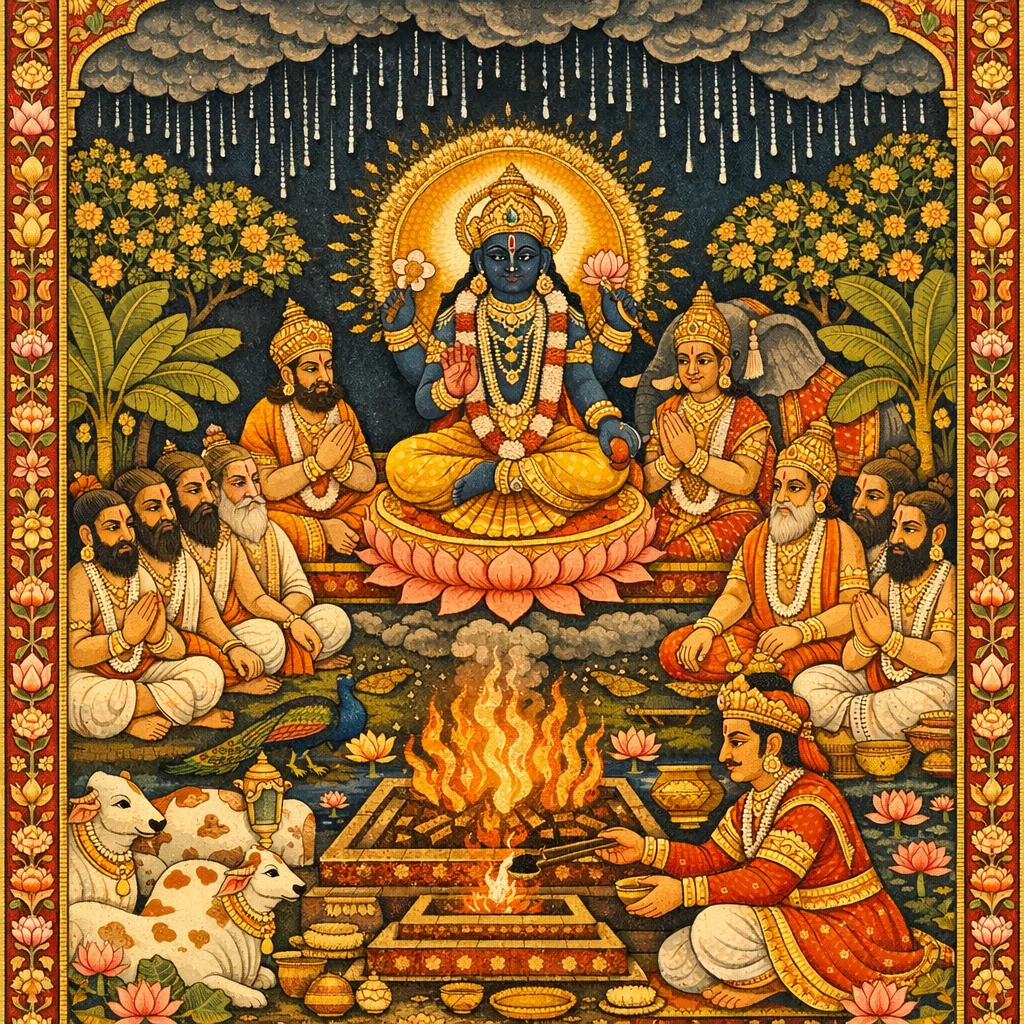
After earlier accounts of avatāras and manvantara arrangements, Parīkṣit asks how Manu and other cosmic administrators carry out their duties and under whose command they act. Śukadeva explains that the Supreme Personality of Godhead, Hari/Kṛṣṇa, through specific incarnations such as Yajña, appoints the Manus, their sons, the great ṛṣis, Indra, and the devas to manage universal affairs. When dharma is distorted at yuga junctions, saintly authorities reestablish religious principles; then the Manus, acting under the Lord’s direct instruction, restore the full fourfold varṇāśrama duties. Kings descended from Manu perform yajñas, share the results with the devas, and maintain order by the Lord’s mandate, while Indra—empowered by divine benediction—sustains the three worlds with timely rains. The chapter expands into a theology of divine functions: siddhas who teach knowledge, instructors of karma, yoga teachers, prajāpatis, kingship, and even time itself as manifestations of Hari. It concludes that speculative seekers, bewildered by māyā, fail to see the Lord, and it anchors the topic in cosmic time: fourteen Manus appear in one day of Brahmā, preparing for further manvantara narratives.
Shlokas
Verse 1
श्रीराजोवाच मन्वन्तरेषु भगवन्यथा मन्वादयस्त्विमे । यस्मिन्कर्मणि ये येन नियुक्तास्तद्वदस्व मे ॥ १ ॥
Mahārāja Parīkṣit inquired: O most opulent Śukadeva Gosvāmī, please tell me how, in each manvantara, Manu and the others are engaged in their respective duties, and by whose order they are appointed.
Verse 2
श्रीऋषिरुवाच मनवो मनुपुत्राश्च मुनयश्च महीपते । इन्द्रा: सुरगणाश्चैव सर्वे पुरुषशासना: ॥ २ ॥
Śukadeva Gosvāmī said: O King, the Manus, the sons of Manu, the great sages, the Indras and all the demigods are appointed under the rule of Bhagavān, the Supreme Personality of Godhead, through His incarnations such as Yajña.
Verse 3
यज्ञादयो या: कथिता: पौरुष्यस्तनवो नृप । मन्वादयो जगद्यात्रां नयन्त्याभि: प्रचोदिता: ॥ ३ ॥
O King, I have already described to you various incarnations of the Lord, such as Yajña. Inspired and directed by these incarnations, Manu and the others are chosen, and they conduct the affairs of the universe.
Verse 4
चतुर्युगान्ते कालेन ग्रस्ताञ्छ्रुतिगणान्यथा । तपसा ऋषयोऽपश्यन्यतो धर्म: सनातन: ॥ ४ ॥
At the end of every cycle of four yugas, when the great saints see that, under the devouring power of time, the śruti tradition and the eternal duties of mankind have been misused, they reestablish the principles of dharma through austerity.
Verse 5
ततो धर्मं चतुष्पादं मनवो हरिणोदिता: । युक्ता: सञ्चारयन्त्यद्धा स्वे स्वे काले महीं नृप ॥ ५ ॥
Thereafter, O King, the Manus, inspired by the instructions of Śrī Hari, in their respective times fully engaged, directly reestablish dharma in its complete form with all four parts.
Verse 6
पालयन्ति प्रजापाला यावदन्तं विभागश: । यज्ञभागभुजो देवा ये च तत्रान्विताश्च तै: ॥ ६ ॥
To partake of the fruits of yajñas, the rulers who protect the people—the sons and grandsons of Manu—carry out the Bhagavān’s commands, each according to his allotted duty, until the end of Manu’s reign. The devas, who enjoy their share of the sacrifice, likewise partake of those results.
Verse 7
इन्द्रो भगवता दत्तां त्रैलोक्यश्रियमूर्जिताम् । भुञ्जान: पाति लोकांस्त्रीन् कामं लोके प्रवर्षति ॥ ७ ॥
Indra, the king of heaven, having received the Bhagavān’s benediction and thus enjoying the mighty prosperity of the three worlds, sustains the beings in all three realms by sending sufficient rain upon every world.
Verse 8
ज्ञानं चानुयुगं ब्रूते हरि: सिद्धस्वरूपधृक् । ऋषिरूपधर: कर्म योगं योगेशरूपधृक् ॥ ८ ॥
In every yuga, the Supreme Lord Hari assumes the form of Siddhas (such as Sanaka) to teach transcendental knowledge; He assumes the form of great ṛṣis (such as Yājñavalkya) to instruct the path of karma; and He assumes the form of great yogīs (such as Dattātreya) to reveal the discipline of mystic yoga.
Verse 9
सर्गं प्रजेशरूपेण दस्यून्हन्यात् स्वराड्वपु: । कालरूपेण सर्वेषामभावाय पृथग्गुण: ॥ ९ ॥
In the form of Prajāpati Marīci, the Bhagavān brings forth progeny; as the sovereign king, He slays thieves and rogues; and as Time, He dissolves all things. The many qualities seen in material existence should be understood as qualities of the Bhagavān Himself.
Verse 10
स्तूयमानो जनैरेभिर्मायया नामरूपया । विमोहितात्मभिर्नानादर्शनैर्न च दृश्यते ॥ १० ॥
Bewildered by māyā, which manifests as name and form, people praise and seek the Absolute through many doctrines and speculations; yet they remain unable to behold the Bhagavān, the Supreme Lord.
Verse 11
एतत् कल्पविकल्पस्य प्रमाणं परिकीर्तितम् । यत्र मन्वन्तराण्याहुश्चतुर्दश पुराविद: ॥ ११ ॥
O King, in one kalpa—one day of Brahmā—there occur many transformations called vikalpas; their authority I have already described. The sages learned in the Purāṇas have ascertained that within Brahmā’s one day there are fourteen manvantaras.
Frequently Asked Questions
Śukadeva states that the Supreme Personality of Godhead appoints them through His incarnations (such as Yajña). Under the Lord’s direction, Manus, Indras, sages, and devas administer universal affairs, making cosmic governance ultimately a delegated function of Hari.
At yuga transitions, saintly authorities reestablish religious principles; then the Manus, acting fully under the Lord’s instructions, restore occupational duty in its complete fourfold form. This presents dharma not as a merely social convention but as a divinely supervised system meant to guide human life toward purification and devotion.
Indra’s rains represent a key administrative service: empowered by the Lord’s benedictions, Indra maintains living beings across the three worlds by providing sufficient rainfall. The text links ecological stability and prosperity to divine order mediated through appointed devas.
It attributes their institutional teaching to the Lord’s functional manifestations: Hari appears as siddhas (e.g., Sanaka) to teach transcendental knowledge, as sages (e.g., Yājñavalkya) to teach karma, and as great yogīs (e.g., Dattātreya) to teach mystic yoga—integrating diverse disciplines under one supreme source.
The chapter states that the Lord, as time, annihilates everything; similarly, as king He punishes rogues, and as prajāpati He generates progeny. This frames creation, governance, and destruction as coordinated divine functions rather than independent material forces.
Because people are bewildered by māyā (illusory energy). The verse implies that purely speculative or empirical approaches, lacking divine grace and proper devotional orientation, fail to reveal the personal Absolute Truth who stands behind cosmic functions and administrators.
There are fourteen Manus in one kalpa (one day of Brahmā). This anchors manvantara history within Purāṇic cosmology, explaining how repeated administrative cycles occur within a larger temporal framework and preparing the reader for subsequent manvantara-specific accounts.