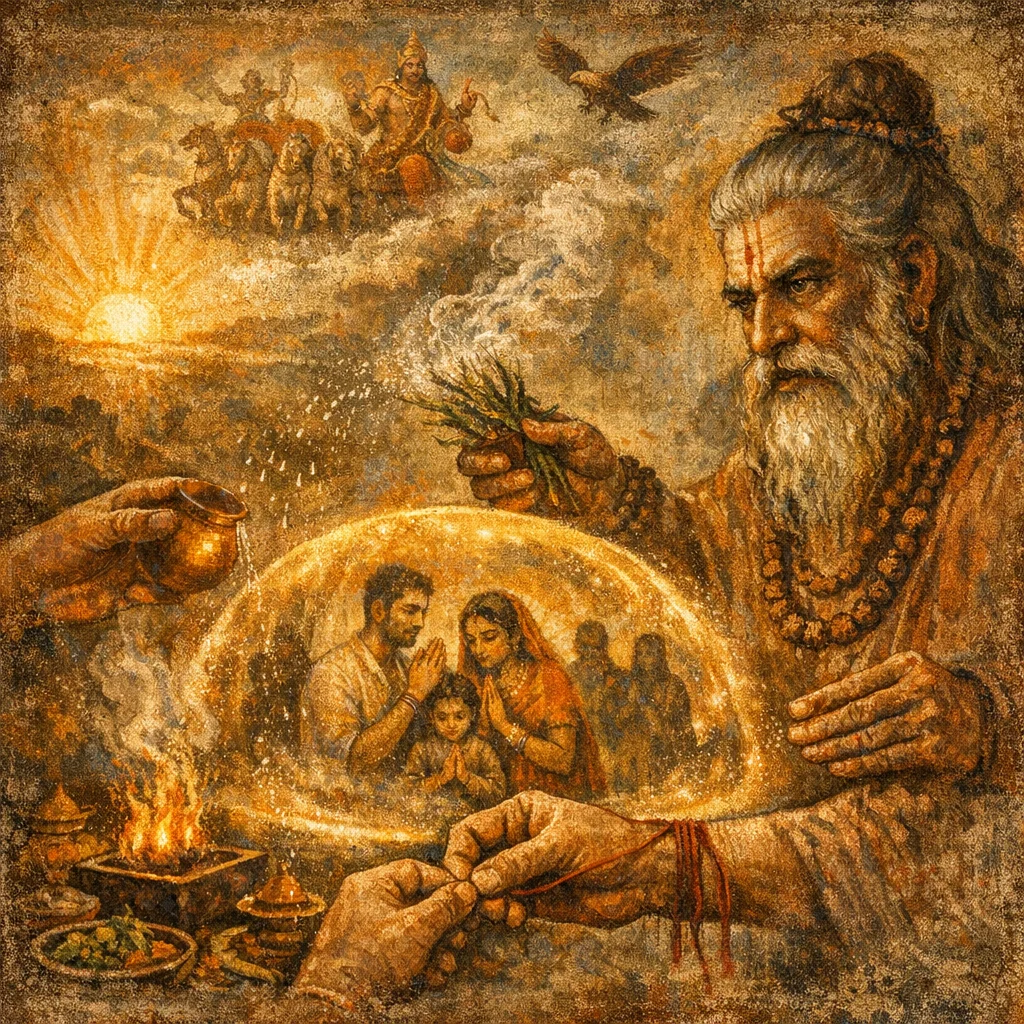
Sukta 4
Rishi: Atharvanic tradition (specific r̥ṣi attribution varies by anukramaṇī for this section; commonly treated as anonymous/collective in late books)
Devata: Composite sovereignty: Agni–Sūrya–Yama–Mahendra (Indra) as a single power
Chandas: Anuṣṭubh (with refrain-like cadence in pāda 2)
Mantras
Mantra 1
अध्यात्मम्। स एति सविता स्वऽर्दिवस्पृष्ठेऽवचाकशत्
Inwardly (in the self) he moveth on: Savitar goeth; on the back of heaven’s light he hath shone forth.
Mantra 2
रश्मिभिर्नभ आभृतं महेन्द्र एत्यावृतः
With rays the firmament is borne and filled: great Indra goeth on, encompassed round about.
Mantra 3
स धाता स विधर्ता स वायुर्नभ उच्छ्रितम्। रश्मिभिर्नभ आभृतं महेन्द्र एत्यावृतः
He is the Ordainer, he the Upholder; he is Vāyu—aloft is the firmament upraised. With rays the firmament is borne and filled: great Indra goeth on, encompassed round about.
Mantra 4
सोऽर्यमा स वरुणः स रुद्रः स महादेवः। रश्मिभिर्नभ आभृतं महेन्द्र एत्यावृतः
He is Aryaman, he Varuṇa; he Rudra, he the Great God. With rays the firmament is borne and filled: great Indra goeth on, encompassed round about.
Mantra 5
सो अग्निः स उ सूर्यः स उ एव महायमः। रश्मिभिर्नभ आभृतं महेन्द्र एत्यावृतः
He is Agni; he, verily, is Sūrya; he indeed is great Yama. With rays the firmament is borne and filled: great Indra comes, encompassed round about.
Mantra 6
तं वत्सा उप तिष्ठन्त्येकशीर्षाणो युता दश । रश्मिभिर्नभ आभृतं महेन्द्र एत्यावृतः
To him the calves draw near and stand—ten, in harness, one-headed. With rays the firmament is borne and filled: great Indra comes, encompassed round about.
Mantra 7
पश्चात् प्राञ्च आ तन्वन्ति यदुदेति वि भासति । रश्मिभिर्नभ आभृतं महेन्द्र एत्यावृतः
From the rear to the fore they stretch abroad, when he arises and shines out widely. With rays the firmament is borne and filled: great Indra comes, encompassed round about.
Mantra 8
तस्यैष मारुतो गणः स एति शिक्याकृतः
Of him this Marut-host is here: it comes, wrought as a hanging net.
Mantra 9
रश्मिभिर्नभ आभृतं महेन्द्र एत्यावृतः
With rays the firmament is borne and filled: great Indra comes, encompassed round about.
Mantra 10
तस्येमे नव कोशा विष्टम्भा नवधा हिताः
His are these nine sheaths; ninefold are the props set firmly in their places.
Mantra 11
स प्रजाभ्यो वि पश्यति यच्च प्राणति यच्च न
For all his creatures he looks abroad, discerning what breathes and what breathes not.
Mantra 12
तमिदं निगतं सहः स एष एक एकवृदेक एव
This might hath entered into this (all); he—this very one—is One, the Single-Vowed, One alone indeed.
Mantra 13
एते अस्मिन् देवा एकवृतो भवन्ति
In him these Gods become of one observance, gathered under a single rule.
Frequently Asked Questions
It proclaims that one sovereign divine power appears as many gods (Agni, Sūrya, Yama, Indra and others) and uses the image of sun-rays filling the sky to create an all-round protective enclosure for prosperity and order.
Rays function like binding, protective ‘bands’ that leave no opening for harm, while the firmament is the total ritual-cosmic field being ‘filled’—a way of saying protection and authority pervade everything.
Traditionally it suits prosperity-and-protection rites for a community or ruler: recited at dawn/midday, with purification, optional fire, and an encircling action or protective cord to mirror the hymn’s theme of being ‘encompassed round about.’