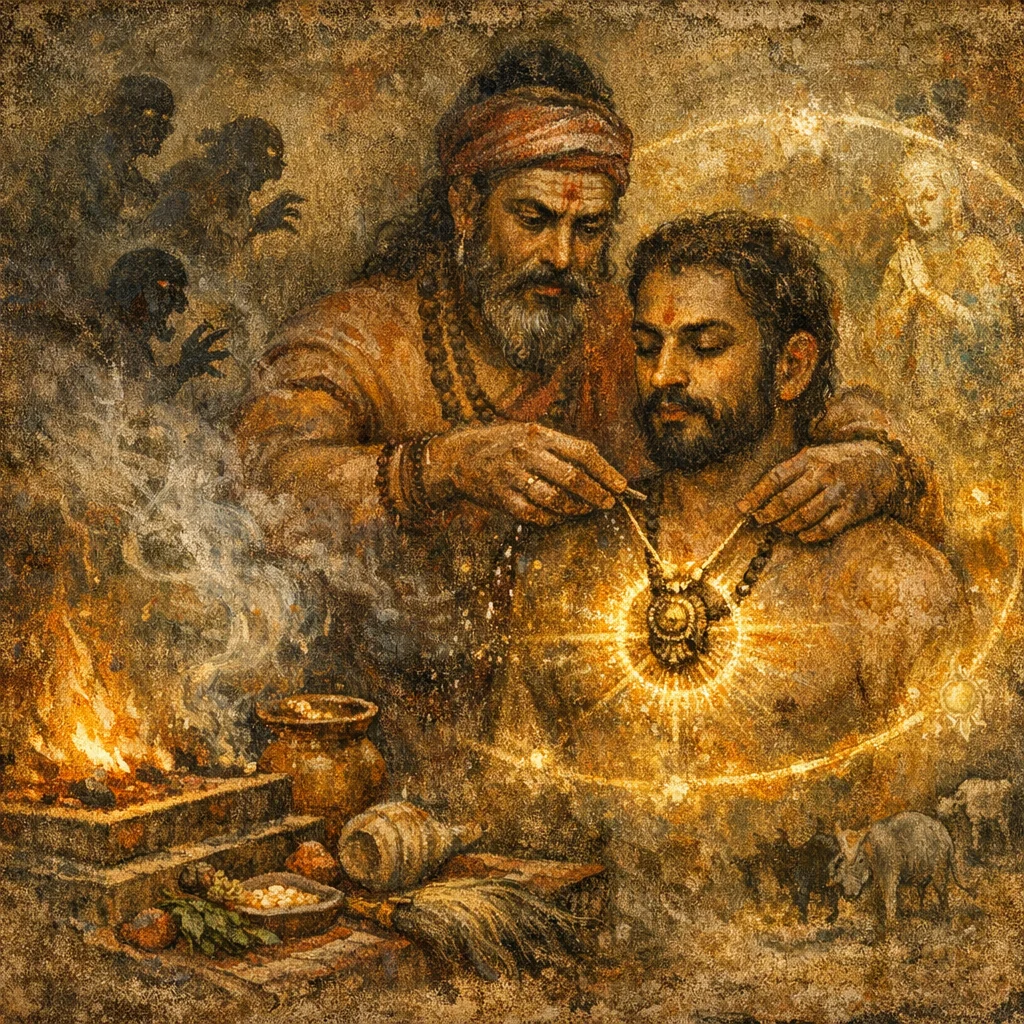
Sukta 3
Rishi: Atharvanic tradition (amulet hymn complex; r̥ṣi attribution varies in indices).
Devata: Maṇi (amulet) empowered by Varana; functional ‘deity’ is the charm-power itself.
Chandas: Anuṣṭubh (with an initial label-like pāda)
Mantras
Mantra 1
सपत्नत्क्षयणो वरणमणिः। अयं मे वरणो मणिः सपत्नक्षयणो वृषा । तेना रभस्व त्वं शत्रून् प्र मृणीहि दुरस्यतः
A rival-waster is the Varana-amulet. This Varana jewel is mine, a bull that wastes my rivals: with it do thou seize the foes; crush them forth, away from evil purpose.
Mantra 2
प्रैणान्छृणीहि प्र मृणा रभस्व मणिस्ते अस्तु पुरएता पुरस्तात्। अवारयन्त वरणेन देवा अभ्याचारमसुराणां श्वःश्वः
Smite these forth; crush them forth; seize with onset: let thine amulet be a vanguard before thee. With Varana the Gods warded off the Asuras’ witchcraft, day by day.
Mantra 3
अयं मणिर्वरणो विश्वभेषजः सहस्राक्षो हरितो हिरण्ययः । स ते शत्रूनधरान् पादयाति पूर्वस्तान् दभ्नुहि ये त्वा द्विषन्ति
This amulet is Varuṇa, a medicine for all; thousand-eyed, green-hued, golden. It makes thine enemies low beneath thee; going before, smite those who hate thee.
Mantra 4
अयं ते कृत्यां विततां पौरुषेयादयं भयात्। अयं त्वा सर्वस्मात् पापाद् वरणो वारयिष्यते
This shall ward for thee the sorcery spread abroad, wrought by a man; this, from fear. This Varuṇa shall keep thee back from every evil.
Mantra 5
वरणो वारयाता अयं देवो वनस्पतिः । यक्ष्मो यो अस्मिन्नाविष्टस्तमु देवा अवीवरन्
Let Varuṇa ward it off—this divine lord of the forest. The wasting sickness which hath entered into this man, that verily the Gods have driven away.
Mantra 6
स्वप्नं सुप्त्वा यदि पश्यासि पापं मृगः सृतिं यति धावादजुष्टाम्। परिक्षवाच्छकुनेः पापवादादयं मणिर्वरणो वारयिष्यते
If, having slept, thou see in dream an evil—beast that goes upon a track, unwelcome, in sudden rush; from the ominous cry of the bird, from evil-speaking, this Varuṇa-amulet shall ward thee off.
Mantra 7
अरात्यास्त्वा निरृत्या अभिचारादथो भयात्। मृत्योरोजीयसो वधाद् वरणो वारयिष्यते
From hostility, from Nirṛti, from sorcery, and also from fear; from Death’s mightier stroke of slaughter—Varuṇa shall ward thee off.
Mantra 8
यन्मे माता यन्मे पिता भ्रातरो यच्च मे स्वा यदेनश्चकृमा वयम्। ततो नो वारयिष्यतेऽयं देवो वनस्पतिः
What sin my mother wrought, what sin my father, what my brothers, and what my own folk—what guilt we have committed: from that shall this divine Lord of the Forest ward us off.
Mantra 9
वरणेन प्रव्यथिता भ्रातृव्या मे सबन्धवः । असूर्तं रजो अप्यगुस्ते यन्त्वधमं तमः
By the Varana are my rival kinsmen, with all their allies, sorely disquieted: into the sunless murk they have gone—let them pass to the nethermost darkness.
Mantra 10
अरिष्टोऽहमरिष्टगुरायुष्मान्त्सर्वपूरुषः । तं मायं वरणो मणिः परि पातु दिशोदिशः
Unharmed am I, unharmed in my going; life-possessed, complete in all my person. The Varana-amulet—against that witchcraft—shall guard me round about, from quarter after quarter.
Mantra 11
अयं मे वरण उरसि राजा देवो वनस्पतिः । स मे शत्रून् वि बाधतामिन्द्रो दस्यूनिवासुरान्
This Varana upon my breast is king, the divine Lord of the Forest. Let it scatter my foes, as Indra the Dasyus—yea, as the Asuras.
Mantra 12
इमं बिभर्मि वरणमायुष्मान्छतशारदः । स मे राष्ट्रं च क्षत्रं च पशूनोजश्च मे दधत्
This Varana I bear, life-giving, for a hundred autumns. May it bestow on me realm and ruling power, and cattle, and strength besides.
Mantra 13
यथा वातो वनस्पतीन् वृक्षान् भनक्त्योजसा । एवा सपत्नान् मे भङ्ग्धि पूर्वान् जातां उतापरान् वरणस्त्वाभि रक्षतु
As the Wind with might shatters the forest-lords, the trees,—even so do thou shatter for me my rivals, those born before and those that shall be born hereafter. May Varuṇa guard thee round about.
Mantra 14
यथा वातश्चाग्निश्च वृक्षान् प्सातो वनस्पतीन्। एवा सपत्नान् मे प्साहि पूर्वान् जातां उतापरान् वरणस्त्वाभि रक्षतु
As Wind and Fire together waste the trees, the forest-lords,—even so waste thou for me my rivals, those born before and those that shall be born hereafter. May Varuṇa guard thee round about.
Mantra 15
यथा वातेन प्रक्षीणा वृक्षाः शेरे न्यऽर्पिताः । एवा सपत्नांस्त्वं मम प्र क्षिणीहि न्यऽर्पय पूर्वान्जातां उतापरान् वरणस्त्वाभि रक्षतु
As, wasted by the Wind, the trees lie there, cast down,—even so do thou waste away my rivals and lay them low, those born before and those that shall be born hereafter. May Varuṇa guard thee round about.
Mantra 16
तांस्त्वं प्र च्छिन्द्धि वरण पुरा दिष्टात् पुरायुषः । य एनं पशुषु दिप्सन्ति ये चास्य राष्ट्रदिप्सवः
Them do thou cut off, O Varuṇa, beforehand—from their aimed design, beforehand from their full term of life: who seek to injure him in his cattle, and who are fain to injure his realm.
Mantra 17
यथा सूर्यो अतिभाति यथास्मिन् तेज आहितम्। एवा मे वरणो मणिः कीर्तिं भूतिं नि यच्छतु तेजसा मा समुक्षतु यशसा समनक्तु मा
As the Sun shines forth surpassingly, as splendour is deposited in this,—even so may for me Varuṇa’s amulet establish fame and thriving; with brilliance may it thoroughly bathe me, with glory may it wholly anoint me.
Mantra 18
यथा यशश्चन्द्रमस्यादित्ये च नृचक्षसि । एवा मे वरणो मणिः कीर्तिं भूतिं नि यच्छतु तेजसा मा समुक्षतु यशसा समनक्तु मा
As glory is in the Moon, and in the Sun, in the man-beholding (sphere), so may the Varuṇa-amulet for me fasten firm fame and thriving; with splendour may it bedew me, with glory may it anoint me.
Mantra 19
यथा यशः पृथिव्यां यथास्मिन् जातवेदसि । एवा मे वरणो मणिः कीर्तिं भूतिं नि यच्छतु तेजसा मा समुक्षतु यशसा समनक्तु मा
As glory is upon the Earth, as (it is) in this Jātavedas, so may the Varuṇa-amulet for me fasten firm fame and thriving; with splendour may it bedew me, with glory may it anoint me.
Mantra 20
यथा यशः कन्याऽयां यथास्मिन्त्संभृते रथे । एवा मे वरणो मणिः कीर्तिं भूतिं नि यच्छतु तेजसा मा समुक्षतु यशसा समनक्तु मा
As glory is in a maiden, as (it is) in this well-appointed chariot, so may the Varuṇa-amulet for me fasten firm fame and thriving; with splendour may it bedew me, with glory may it anoint me.
Mantra 21
यथा यशः सोमपीथे मधुपर्के यथा यशः । एवा मे वरणो मणिः कीर्तिं भूतिं नि यच्छतु तेजसा मा समुक्षतु यशसा समनक्तु मा
As glory is at the Soma-drinking, as at the madhuparka (honour-feast) is glory, so may the Varuṇa-amulet for me fasten firm fame and thriving; with splendour may it bedew me, with glory may it anoint me.
Mantra 22
यथा यशोऽग्निहोत्रे वषट्कारे यथा यशः । एवा मे वरणो मणिः कीर्तिं भूतिं नि यच्छतु तेजसा मा समुक्षतु यशसा समनक्तु मा
As glory is in the Agnihotra, as in the Vaṣaṭ-cry is glory, so may the Varuṇa-amulet for me fasten firm fame and thriving; with splendour may it bedew me, with glory may it anoint me.
Mantra 23
यथा यशो यजमाने यथास्मिन् यज्ञ आहितम्। एवा मे वरणो मणिः कीर्तिं भूतिं नि यच्छतु तेजसा मा समुक्षतु यशसा समनक्तु मा
As glory is set in the Sacrificer, as in this sacrifice it is established,—so may the Varuṇa-amulet for me hold fast fame and thriving; with splendour may it bedew me, with glory may it anoint me.
Mantra 24
यथा यशः प्रजापतौ यथास्मिन् परमेष्ठिनि । एवा मे वरणो मणिः कीर्तिं भूतिं नि यच्छतु तेजसा मा समुक्षतु यशसा समनक्तु मा
As glory is in Prajāpati, as in this Most-Exalted One it is,—so may the Varuṇa-amulet for me hold fast fame and thriving; with splendour may it bedew me, with glory may it anoint me.
Mantra 25
यथा देवेष्वमृतं यथैषु सत्यमाहितम्। एवा मे वरणो मणिः कीर्तिं भूतिं नि यच्छतु तेजसा मा समुक्षतु यशसा समनक्तु मा
As among the gods immortality is, as in these truth is established,—so may the Varuṇa-amulet for me hold fast fame and thriving; with splendour may it bedew me, with glory may it anoint me.
Frequently Asked Questions
It is a physically worn amulet made from varaṇa material, treated as a container of mantra-power. The hymn ‘installs’ Varuṇa’s warding and binding force into it so it acts as protection.
Its primary mode is rival-subduing and defense against hostile intent, including sorcery. But it also aims to stabilize positive outcomes—fame (kīrti/yaśas), splendor (tejas), and thriving (bhūti)—so protection and success go together.
The verses are recited over the amulet to consecrate it, and then it is tied or worn on the body. It is especially used before contests, during periods of hostility, or when one fears occult attack or misfortune.