Adhyaya 2: Daksha’s Sacrifice and the Origin of Kapalin Rudra (Pulastya–Narada Dialogue)
दक्षयज्ञ-प्रसङ्गः कपाली-रुद्रोत्पत्तिकथा (Dakṣayajña-prasaṅgaḥ Kapālī-Rudrotpatti-kathā)
Origin of Kapalin Rudra
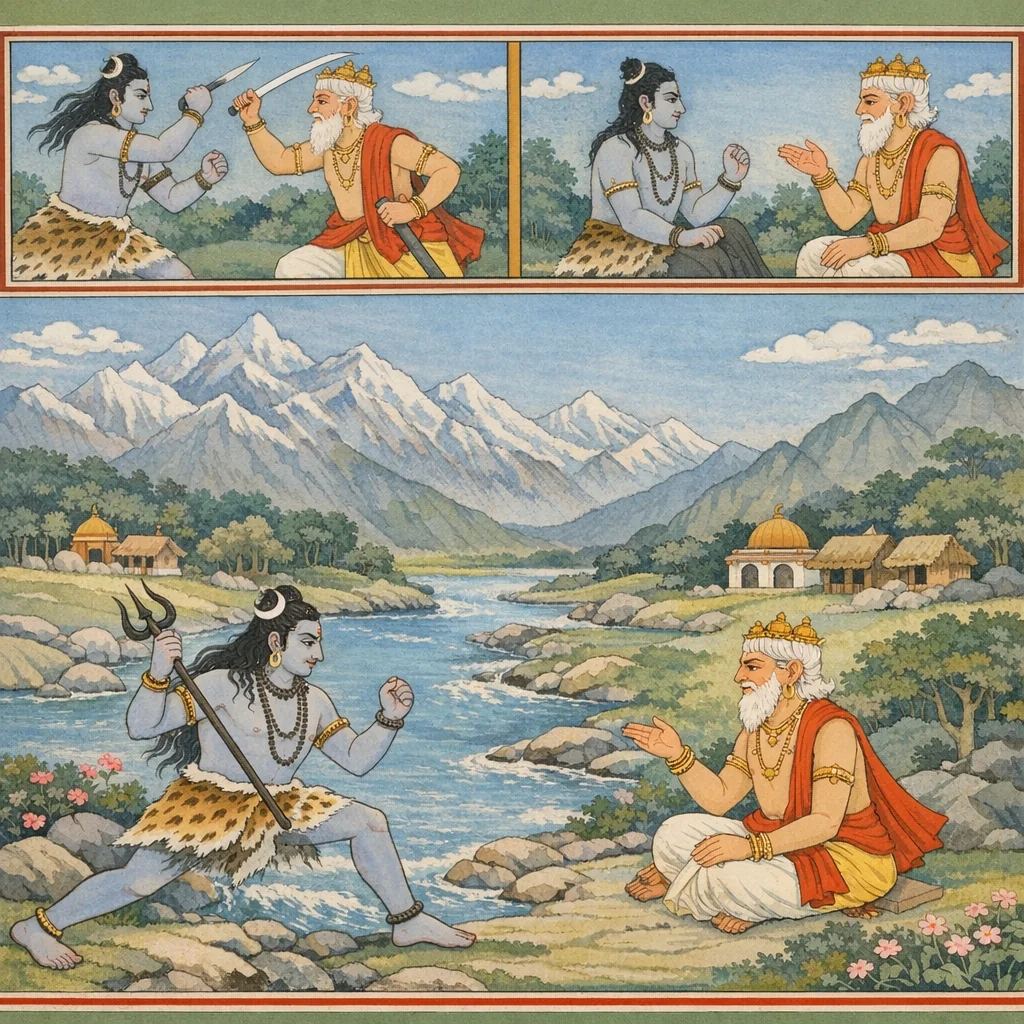
Within the Pulastya–Nārada dialogue-frame, this adhyāya moves from a poetic seasonal prelude (the clearing of the rains into śarad) to a pivotal sectarian crisis: Dakṣa Prajāpati inaugurates a grand kratu while deliberately excluding Mahādeva. Nārada’s questions prompt Pulastya to narrate an older cosmogonic episode that explains Śiva’s epithet “Kapālī” and his liminal iconography. In a syncretic theological register, Brahmā (rājasa creator) and Rudra (tāmasa, trilocana, śūlapāṇi) arise in primordial conditions and are seized by a fierce ahaṅkāra, leading to rivalry, the manifestation of Rudra’s five faces, and the severing of Brahmā’s head—whose skull adheres to Śiva’s hand, grounding the kapāla motif. The narrative then relocates to the Himalayan Badarikāśrama/Nara–Nārāyaṇa sphere, where a ritualized confrontation yields emanations (including Atri and Durvāsas) and culminates in a cosmic arbitration between Brahmā and Hara, underscoring Purāṇic reconciliation through controlled conflict rather than doctrinal separation.
Divine Beings
Sacred Geography
Mortal & Asura Figures
Key Content Points
- Pulastya narrates a śarad-season setting and Dakṣa’s organization of a kratu, including the formal invitation of Ādityas, Indra and other devas, and major ṛṣis—while pointedly omitting Śiva and Satī.
- Nārada interrogates the omission and Śiva’s ‘Kapālī’ status; Pulastya answers by recounting a primordial cosmogony where ahaṅkāra drives Brahmā–Rudra rivalry, Rudra’s pañcavaktra manifestation, and the beheading of Brahmā’s head that becomes the inerasable kapāla in Śiva’s hand.
- Topographical sanctification shifts the action to Badarikāśrama in the Himalaya (Nara–Nārāyaṇa-sthāna, Sarasvatī context), where a triśūla-strike produces three streams/emanations (including Atri and Durvāsas) and a prolonged divine combat resolved by Brahmā–Hara negotiation—modeling Shaiva–Vaishnava synthesis through shared sacred space and mythic causality.
Shlokas in Adhyaya 2
Verse 1
इति श्रीवामनपुराणे प्रथमो ऽध्यायः पुलस्त्य उवाच ततस्त्रिनेत्रस्य गतः प्रावृट्कालो घनोपरि लोकान्न्दकरी रम्या शरत् समभवन्मुने
Thus ends the first chapter in the sacred Vāmana Purāṇa. Pulastya said: Thereafter, for the Three-eyed One, the season of rains passed; upon the clouds (or: with clouds above), the lovely autumn arose, O sage, dispelling darkness from the worlds.
Verse 2
त्यजन्ति नीलाम्बुधरा नभस्तलं वृक्षांश्च कङ्काः सरितस्तटानि पद्माः सुगन्धं निलयानि वायसा रुरुर्विषाणं कलुषं जलाशयः
The dark rain-clouds leave the expanse of the sky; herons abandon the trees and settle on river-banks. Lotuses yield fragrance; crows take to their resting-places. The deer’s horn (is seen clearly), and the reservoirs of water become turbid.
Verse 3
विकासमायन्ति त पङ्काजानि चन्द्रांशवो भान्ति लताः सुपुष्पाः नन्दन्ति हृष्टान्यपि गोकुलानि सन्तश्च संतोषमनुव्रजन्ति
Lotuses come into full bloom; the moon’s rays shine forth; creepers are filled with fine blossoms. Even the cowherd settlements rejoice in delight, and good people too are accompanied by contentment.
Verse 5
सरस्सु पद्म गगने च तारका जलाशयेष्वेव तथा पयांसि सतां च चित्तं हि दिशां मुखैः समं वैमल्यमायान्ति शशङ्ककान्तयः // वम्प्_2.4 ए तादृशे हरः काले मघपृष्ठाधिवासिनीम् सतीमादाय शैलेन्द्रं मन्दरं समुपाययौ
In the lakes, the lotuses (brighten); in the sky, the stars (shine); in the reservoirs, even the waters (appear clear). Likewise, the moon’s radiance brings purity—equally in all directions—to the minds of the virtuous. At such a time, Hara, taking Satī who dwelt upon the back of Magha, went to the lordly mountain Mandara.
Verse 6
ततो मन्दरपृष्ठे ऽसौ स्थितः समशिलातले रराम शंभुर्भगवान् सत्या सह महाद्युतिः
Then, upon the back of Mandara, standing on an even rocky surface, the blessed, greatly radiant Śambhu sported together with Satī.
Verse 7
ततो व्यतीते शरदि प्रतिबुद्धे च केशवे दक्षः प्रजापतिश्रेष्ठो यष्टुमारभत क्रतुम्
Then, when the autumn had passed and Keśava had awakened, Dakṣa—the foremost of the Prajāpatis—began to undertake a sacrificial rite (kratu) in order to perform worship through yajña.
Verse 8
द्वादशेव स चादित्याञ् शक्रादींश् च सुरोत्तमान् सकश्यपान् समामन्त्र्य सदस्यान् समचीकरत्
He invited the twelve Ādityas, and also Śakra and other excellent gods; together with the Kaśyapas, having duly summoned them, he appointed them as members of the sacrificial assembly (sadasyas).
Verse 9
अरुन्धत्य च सहितं वसिष्ठं शंसितव्रतम् सहानसूययात्रिं च सह धृत्या च कौशिकम्
He also (invited) Vasiṣṭha—accompanied by Arundhatī—whose vows were renowned; and Atri accompanied by Anasūyā; and the Kauśika (Viśvāmitra) accompanied by Dhṛti.
Verse 10
अहल्यया गौतमं च भरद्वाजममायया चन्द्रया सहितं ब्रह्मन्नृषिमङ्गीरसं तथा
O Brāhmaṇa, he (Dakṣa) also summoned Gautama together with Ahalyā, Bharadvāja with Amāyā, and likewise the sage Aṅgiras accompanied by Candrā.
Verse 11
आमन्त्र्य कृतावान्दक्षः सदस्यान् यज्ञसंसदि विद्वान् गुणसंपन्नान् वेदवेदाड्गपारगान्
Dakṣa, having duly invited them, appointed as members in the sacrificial assembly those who were learned, endowed with virtues, and well-versed in the Vedas and Vedāṅgas.
Verse 12
धर्मं च स समाहूय भार्ययाहिंसया सह निमन्त्र्य यज्ञवाटस्य द्वारपालत्वमादिशत्
He also called Dharma and, together with his wife Ahiṃsā, invited him and assigned them the duty of guarding the gate of the sacrificial enclosure.
Verse 13
अरिष्टनेमिनं चक्रे इध्माहरणकारिणम् भृगुं च मन्त्रसंस्कारे सम्यग् दक्षं प्रयुक्तवान्
He appointed Ariṣṭanemi to be the one who brings the fuel-sticks (for the sacrifice). And he duly engaged Bhṛgu in the consecration/conditioning of the mantras; Dakṣa was properly employed (in the rite).
Verse 14
तथा चन्द्रमसं देवं रोहिण्या सहितं शुचिम् धनानामाधिपत्ये च युक्तवान् हि प्रजापतिः
Likewise, Prajāpati appointed the god Candramas (the Moon), pure and accompanied by Rohiṇī, to the lordship over riches (wealth).
Verse 15
जामातृदुहितृश्वैव दौहित्रांश्च प्रजापतिः सशङ्करां सतीं मुक्त्वा मखे सर्वान् न्यमन्त्रयत्
Prajāpati invited (to the sacrifice) the sons-in-law, the daughters, and the grandsons as well; but leaving aside Satī together with Śaṅkara, he invited everyone to the sacrificial rite.
Verse 16
नारद उवाच किमर्थं लोकपतिना धनाध्यक्षो महेश्वरः ज्येष्ठः श्रेष्ठो वरिष्ठो ऽपि आद्यो ऽपि न निमन्त्रितः
Nārada said: For what reason did the lord of the worlds not invite Maheśvara—overseer of wealth—though he is the eldest, the best, the most excellent, indeed the primeval one?
Verse 17
पुलस्त्य उवाच ज्येष्ठः श्रेष्ठो वरिष्ठो ऽपि आद्यो ऽपि भगवाञ्शिवः कपालीलि विदित्वेशो दक्षेण न निमन्त्रितः
Pulastya said: Bhagavān Śiva—though the eldest, the best, the most excellent, and the primordial—was not invited by Dakṣa, (he) the Kapālī, the lord known as Īśa.
Verse 18
नारद उवाच किमर्थं देवताश्रेष्ठः शूलपाणिस्त्रिलोचनः कपाली भगवाञ्जातः कर्मणा केन शङ्करः
Nārada said: For what reason did Śaṅkara—the best among the gods, the trident-bearer, the three-eyed Lord—become the Kapālī? By what deed (karma) did this come about?
Verse 19
शृणुष्वावहितो भूत्वा कथामेतां पुरातनीम् प्रोक्तमादिपुराणे च ब्रह्मणाव्यक्तमूर्त्तिना
Listen attentively to this ancient narrative, which was also spoken in the primordial Purāṇa by Brahmā, whose form was unmanifest.
Verse 20
पुरा त्वेकार्णवं सर्वं जगत्स्थावरजङ्गमम् नष्टटन्द्रार्कनक्षत्रं प्रणष्टपवनानलम्
Formerly, the entire world—both the immobile and the mobile—became a single ocean; the sun and the stars were gone, and wind and fire had ceased.
Verse 21
अप्रतर्क्यमविज्ञेयं भावाभावविवर्जितम् निमग्नुपर्वततरु तमोभूतं सुदुर्दसम्
It was beyond reasoning and unknowable, devoid of both being and non-being; mountains and trees were submerged, everything had become darkness, and the condition was exceedingly dire.
Verse 22
तस्मिन् स शेते भगवान् निद्रां वर्षसहस्रिकीम् रात्र्यन्ते सृजते लोकान् राजसं रूपास्थितः
Therein the Blessed Lord lies in sleep for thousands of years; at the end of the cosmic night, abiding in a rājasa (creation-impelling) form, he brings forth the worlds.
Verse 23
राजसः पञ्चवदनो वेदवेदाङ्गपारगः स्रष्टा चराचरस्यास्य जगतो ऽद्भुतदर्शनः
The rājasa one is five-faced, a master of the Vedas and Vedāṅgas; he is the creator of this entire moving and unmoving world, wondrous in appearance.
Verse 24
तमोमयस्तथैवान्यः समुद्भूतस्त्रिलोचनः शूलपाणिः कपर्द्दी च अक्षमालां च दर्शयन्
Likewise another arose, constituted of tamas: three-eyed, holding a trident, with matted hair, and displaying a rosary.
Verse 25
ततो महात्मा ह्यसृजदहङ्कारं सुदारुणम् येनाक्रान्ताव् उभौ देवौ तावेव ब्रह्मशङ्करौ
Then the great one created a most terrible Ahaṅkāra (ego-principle), by which both those gods—Brahmā and Śaṅkara—were overpowered.
Verse 26
अहङ्कारावृतो रुद्रः प्रत्युवाच पितामहम् को भवानिह संप्राप्तः केन सृष्टो ऽसि मां वद
Rudra, enveloped by Ahaṅkāra, replied to Pitāmaha (Brahmā): 'Who are you that have come here? By whom were you created? Tell me.'
Verse 27
पितामहो ऽप्यहङ्कारात् प्रत्युवाचाथ को भवान् भवतो जनकः को ऽत्र जननी वा तदुच्यताम्
Pitāmaha (Brahmā) too, due to Ahaṅkāra, replied: 'And who are you? Here, who is your father, or your mother? Let that be stated.'
Verse 28
इत्यन्योन्यं पुरा ताभ्यां ब्रह्मेशाभ्यां कलिप्रिय परिवादो ऽभवत् तत्र उत्पत्तिर्भवतो ऽभवत्
Thus, long ago, between those two—Brahmā and Īśa (Śiva)—there arose mutual disparagement; and there, O dear one of Kali, there came about your very origin (birth).
Verse 29
भवान्प्यन्तरिक्षं हि जातमात्रस्तदोत्पतत् धारयन्नतुलां वीणां कुर्वन् किलकिलाध्वनिम्
And you, indeed—no sooner born—then leapt up into the mid-air, holding an incomparable vīṇā, making a shrill, chattering sound.
Verse 30
ततो विनिर्जितः शंभुर्मानिना पद्मयोनिना तस्थावधोमुखो दीनो ग्रहाक्रान्तो यथा शशी
Then Śambhu (Śiva) was overcome by the proud Lotus-born (Brahmā). He stood with face cast downward, dejected—like the moon when seized by an eclipse (a graha).
Verse 31
पराजिते लोकपतौ देवेन परमेष्षिना क्रोधान्धकारितं रुद्रं पञ्चमो ऽथ मुखो ऽब्रोवीत्
When the lord of the worlds had been overcome by the supreme god, then the fifth face addressed Rudra, who had been darkened (blinded) by anger.
Verse 32
अहं ते प्रतिजानामि तमोमूर्तो त्रिलोचन दिग्वासा वृषभारूढो लोकक्षयकरो भवान्
I promise you, O three-eyed one: you are the embodiment of darkness, clothed with the quarters (naked), mounted upon the bull, and a maker of the dissolution of the worlds.
Verse 33
इत्युक्ताः शङ्करः क्रुद्धो वदनं घोरचक्षुषा निर्दग्धुकामस्त्वनिशं ददर्श भगवानजः
Thus addressed, Śaṅkara became enraged; with dreadful eyes (he turned his) face, desiring to burn (all). Meanwhile, the Blessed Unborn (Aja) kept watching continually.
Verse 34
ततस्त्रिनेत्रस्य समुद्भवन्ति वक्त्राणि पञ्चाथ सुदर्शनानि श्वेतं च रक्तं कनकावदातं नीलं तथा पिङ्गजटं च शुभ्रम्
Then, from the Three-eyed one (Śiva) there arose five splendid, beautiful faces—white, red, golden-bright, blue, and one with tawny matted locks, radiant and pure.
Verse 35
वक्त्राणि दृष्ट्वार्ऽकसमानि सद्यः पैतामहं वक्त्रमुवाच वाक्यम् समाहतस्याथ जलस्य बुद्बुदा भवन्ति किं तेषु पराक्रमो ऽस्ति
Seeing those faces, radiant like the sun, immediately the Grandfather (Brahmā) spoke words from his own mouth: ‘When water is struck, bubbles arise—what prowess is there in them?’
Verse 36
तच्छ्रुत्वा क्रोधयुक्तेन शङ्करेण महात्मना नखाग्रेण शिरश्छिन्नं ब्राह्मं परुषवादिनम्
Hearing that, the great-souled Śaṅkara, filled with wrath, cut off (one) head of Brahmā—who had spoken harshly—using the tip of his nail.
Verse 37
तच्छिन्नं शङ्करस्यैव सव्ये करतले ऽपतत् पतते न कदाचिच्च तच्छङ्करकराच्छिरः
That severed (head) of Śaṅkara fell into his own left palm; and that head never fell down from Śaṅkara’s hand.
Verse 38
अथ क्रोधावृतेनापि ब्रह्मणाद्भुवतकर्मणा सृष्टस्तु पुरुषो धीमान् कवची कुण्डली शरी
Then, by Brahmā—though enveloped in wrath, and of wondrous deeds—there was created a wise Puruṣa, armored, wearing earrings, and bearing arrows.
Verse 39
धनुष्पाणिर्महाबाहुर्बाणशक्तिधरो ऽव्ययः चतुर्भुजो महातूणी आदित्यसमदर्शनः
With bow in hand, great-armed, bearing arrows and a spear, unfailing; four-armed, possessing a great quiver, and having an appearance like the Sun.
Verse 40
स प्राह गच्छ दुर्बुद्धे मा त्वां शूलिन् निपातये भवान् पापसमायुक्तः पापिष्ठं को जिघांसति
He said: “Go, you ill-minded one. I shall not strike you down, O wielder of the trident. You are laden with sin—who would wish to kill one who is most sinful?”
Verse 41
इत्युक्ताः शेकरस्तेन पुरुषेण महात्मना त्रपायुक्तो जगामाथ रुद्रो बदरिकाश्रमम्
Thus addressed by that great-souled Person, Rudra—(the Lord) ‘Śekhara’—filled with shame, then went to Badarikāśrama.
Verse 42
नरनारायणस्थानं पर्वते हि हिमाश्रये सरस्वती यत्र पुण्या स्तन्दने सरितां वरा
There is the abode of Nara and Nārāyaṇa on the mountain that rests upon the Himālaya. There, the holy Sarasvatī (is present)—best among rivers—at (a place called) Standana.
Verse 43
तत्र गत्वा च तं दृष्ट्वा नारायणमुवाच ह भिक्षां प्रयच्छ भगवन् महाकापालिको ऽस्मि भोः
Having gone there and seeing him, he addressed Nārāyaṇa: “Grant me alms, O Blessed Lord; I am a great Kāpālika (skull-bearing ascetic), O sir.”
Verse 44
इत्युक्तो धर्मपुत्रस्तु रुद्रं वचनमब्रवीत् सव्यं भुजं ताडयस्व त्रिशूलेन महेश्वर
Thus addressed, Dharmaputra spoke these words to Rudra: “Strike my left arm with your trident, O Maheśvara.”
Verse 45
नारायणवचः श्रुत्वा त्रिशूलेन त्रिलोचनः सव्यं नारायणभुजं ताडयामास वेगवान्
Hearing Nārāyaṇa’s words, the three-eyed one (Śiva), swift in action, struck Nārāyaṇa’s left arm with the trident.
Verse 46
त्रिशूलाभिहतान्मार्गात् तिस्रो धारा विनिर्ययुः एका गगनमाक्रम्य स्थिता ताराभिमम्डिता
From the track (or channel) struck by the trident, three streams issued forth. One rose up into the sky and remained there, adorned with stars.
Verse 47
द्वितीया न्यपतद् भूमौ तां जग्राह तपोधनः अत्रिस्तस्मात् समुद्भूतो दुर्वासाः शङ्करांशतः
The second stream fell upon the earth; the rich-in-austerity (ascetic) seized it. From that, Atri arose; and from a portion of Śaṅkara, Durvāsā (came forth).
Verse 48
तृतीया न्यपतद् धारा कपाले रौद्रदर्शने तस्माच्छिशुः समभवत् संनद्धकवचो युवा
The third stream fell into a skull of terrifying, Rudra-like appearance. From that, a child came into being—(yet) a youth, clad in fastened armor.
Verse 49
श्यामावदातः शरचापपाणिर् गर्जन्यथा प्रावृषि तोयदो ऽसौ इत्थं ब्रुवन् कस्य विशातयामि स्कन्धाच्छिरस् तालफलं यथैव
Dark yet radiant in hue, holding a bow with arrows, he roared like a rain-cloud in the monsoon. Speaking thus, he boasted: “Whose head shall I sever from his shoulders—like a palmyra fruit (struck down from its stalk)?”
Verse 50
तं शकरो ऽभ्येत्य वचो वभाषे नरं हि नारायणबाहुजातम् निपातयैनं नर दुष्टवाक्यं ब्रह्मात्मजं सूर्यशतप्रकाशम्
Approaching him, Śaṅkara spoke these words: “This is Nara, born from Nārāyaṇa’s arm. Strike down this wicked-tongued one, O Nara—(you who are) Brahmā’s son, radiant like a hundred suns.”
Verse 51
इत्येवमुक्तः स तु शङ्करेण आद्यं धनुस्त्वाजगवं प्रसिद्धम् जग्राह तूणानि तथाक्षयाणि युद्धाय वीरः स मतिं चकार
Thus addressed by Śaṅkara, the hero took up the famed primeval bow called Ājagava, and also inexhaustible quivers; the valiant one then resolved upon battle.
Verse 52
ततः प्रयुद्धौ सुभृशं महाबलौ1 ब्रह्मात्मजो बाहुभवश्च शार्वः दिव्यं सहस्रं परिवत्सराणां ततो हरो ऽभ्येत्य विरञ्चिमूचे
Then the two mighty ones fought with great intensity—Brahmā’s son and Śārva (Śiva), born from (Brahmā’s) arm. For a divine thousand years they continued; then Hara approached and spoke to Virañci (Brahmā).
Verse 53
जितस्त्वदीयः पुरुषः पितामह नरेण दिव्यद्भुतकर्मणा बली महापृषत्कैरभिपत्य ताडितस्तदद्भुतं चेह दिशो दशैव
O Grandfather (Brahmā), your own Puruṣa has been conquered by a man—powerful, whose deeds are divinely wondrous. Rushing upon him, he was struck with great arrows; and this marvel has indeed (astonished) the ten directions.
Verse 54
ब्रह्म तमीशं वचनं बभाषे नेहास्य जन्मान्यजितस्य शंभो पराजितश्चेष्यते ऽसौ त्वदीयो नरो मदीयः पुरुषो महात्मा
Brahmā spoke these words to the Lord (Śiva): ‘O Śambhu, there are no (ordinary) births here for that Unconquered One (Ajita). That one—your man—will act as though defeated; (yet) he is my Puruṣa, a great-souled being.’
Verse 55
इत्येवमुक्तो वचनं त्रिनेत्रश्चिक्षेप सूर्ये पुरुषं विरिञ्चेः नरं नरस्यैव तदा स विग्रहे चिक्षेप धर्मप्रभवस्य देवः
Thus addressed, the three-eyed Lord (Rudra), having spoken, cast the person (the embodied affliction) of Viriñci (Brahmā) into the Sun. Then, in that very embodied form, the god cast a man into the man born of Dharma.
Frequently Asked Questions
The chapter stages conflict (Dakṣa’s exclusion; Brahmā–Rudra rivalry) but resolves it through shared cosmology and shared sacred space: Śiva’s Kapālī identity is explained as a consequence of primordial ahaṅkāra and cosmic function (tāmasa dissolution), while the narrative relocates to Nara–Nārāyaṇa territory where Śiva engages Nārāyaṇa in a controlled, dharma-governed encounter. This frames Shaiva and Vaishnava powers as complementary agencies within one Purāṇic order rather than competing absolutes.
The adhyāya explicitly sanctifies a Himalayan pilgrimage complex: Badarikāśrama and the Nara–Nārāyaṇa-sthāna, with Sarasvatī invoked as a sacred river presence in that region. The movement from Mandara (a divine mountain setting) to Badarikāśrama functions as topographical theology—locating sectarian synthesis and ascetic authority in a recognized tīrtha landscape associated with Nara–Nārāyaṇa.
This passage does not advance the Bali–Vāmana cycle directly. Instead, it establishes a foundational syncretic frame—through the Pulastya–Nārada discourse and the Kapālī-Rudra origin—preparing the Purāṇa’s broader project of integrating Shaiva and Vaishnava theologies before later avatāra-centered narratives.