Sarga 75
अयोध्याकाण्डे पञ्चसप्ततितमः सर्गः (Sarga 75: Bharata and Kausalya—Reproach, Oaths, and Reconciliation)
अयोध्याकाण्ड
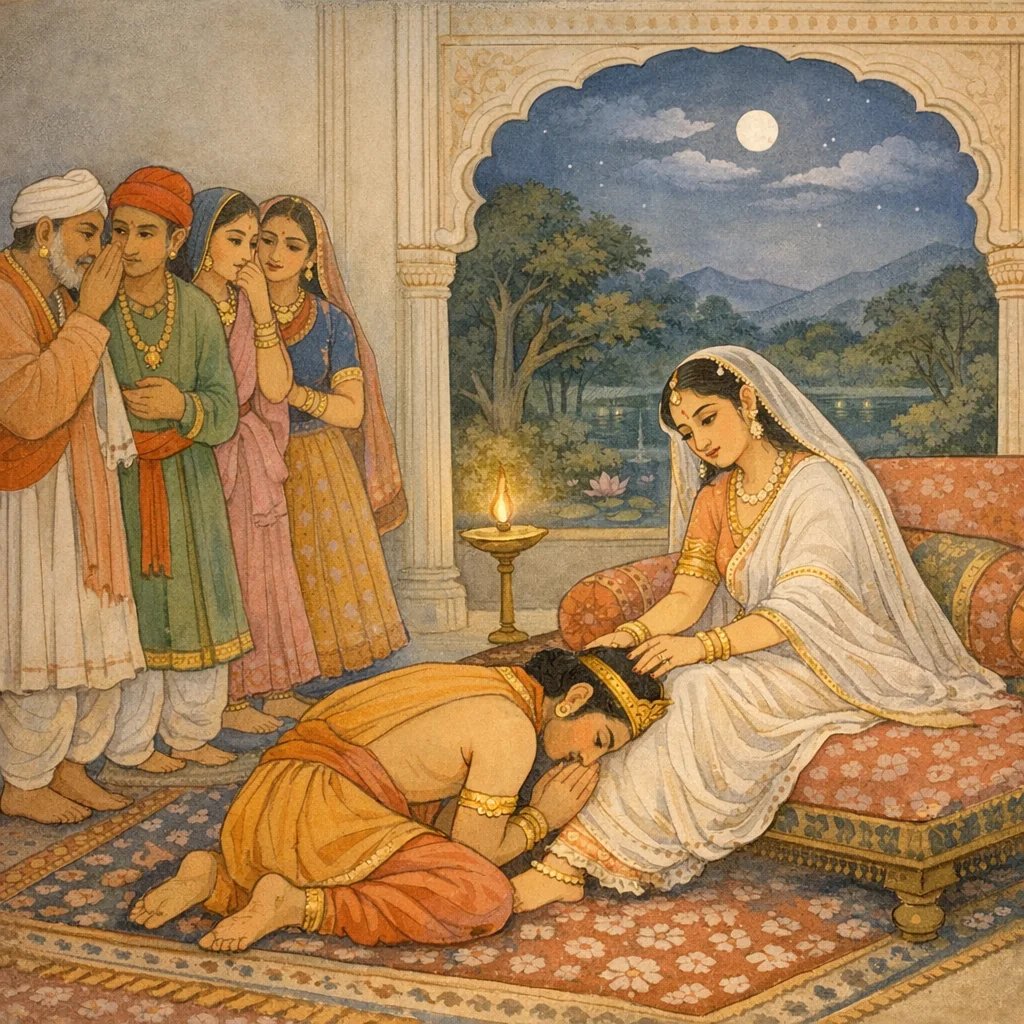
Sarga 75 stages a courtroom-like moral confrontation within the domestic sphere. Bharata regains consciousness, looks upon his grieving mother, and publicly condemns Kaikeyī’s role amid the counsellors, signalling that succession is inseparable from ethical legitimacy (2.75.1). Kauśalyā, overwhelmed by bereavement and suspicion, addresses Bharata with bitter irony, accusing him of desiring a kingdom obtained ‘without obstacle’ through Kaikeyī’s crooked act (2.75.10–16). Bharata replies with a formal denial: he neither sought the kingdom nor knew of the planned consecration, having been away with Śatrughna (2.75.2–4). He then intensifies his self-vindication through a long sequence of conditional imprecations: may the curse-like sins fall upon whoever consented to Rāma’s exile (2.75.21–58), transforming private defense into a ritualized oath-performance. The emotional arc culminates in collapse and supplication—Bharata falls at Kauśalyā’s feet, laments, loses consciousness, and is consoled (2.75.18–19, 59–63). Kauśalyā finally recognizes his steadfastness in dharma and truth, embraces him, and the night passes in grief and exhaustion (2.75.60–65).
Shlokas
Verse 1
दीर्घकालात्समुत्थाय संज्ञां लब्ध्वा च वीर्यवान्।नेत्राभ्यामश्रुपूर्णाभ्यां दीनामुद्वीक्ष्य मातरम्।।।।सोऽमात्यमध्ये भरतो जननीमभ्यकुत्सयत्।
After a long while, the valiant Bharata rose up and regained consciousness; looking upon his wretched mother with tear-filled eyes, he reproached her in the midst of the ministers.
Verse 2
राज्यं न कामये जातु मन्त्रये नापि मातरम्।।।।अभिषेकं न जानामि योऽभूद्राज्ञा समीक्षितः।विप्रकृष्टेह्यहं देशे शत्रुघ्नसहितोऽवसम्।।।।
I never desired the kingdom, nor did I ever consult even my mother about it. I do not know of the consecration that was overseen by the king, for I was staying far away in another land together with Śatrughna.
Verse 3
राज्यं न कामये जातु मन्त्रये नापि मातरम्।।2.75.2।।अभिषेकं न जानामि योऽभूद्राज्ञा समीक्षितः।विप्रकृष्टेह्यहं देशे शत्रुघ्नसहितोऽवसम्।।2.75.3।।
I knew nothing of the consecration that the king had arranged, for I was staying far away in another region together with Śatrughna.
Verse 4
वनवासं न जानामि रामस्याहं महात्मनः।विवासनं वा सौमित्रे स्सीतायाश्च यथाऽभवत्।।।।
I did not know at all about the forest-exile of great-souled Rāma, nor how the banishment of Saumitrī (Lakṣmaṇa) and of Sītā came to pass.
Verse 5
तथैव क्रोशतस्तस्य भरतस्य महात्मनः।कौसल्या शब्दमाज्ञाय सुमित्रामिदमब्रवीत्।।।।
As that great-souled Bharata continued to wail, Kausalya recognized his voice and spoke these words to Sumitra.
Verse 6
आगतः क्रूरकार्यायाः कैकेय्या भरतस्सुतः।तमहं द्रष्टुमिच्छामि भरतं दीर्घदर्शिनम्।।।।
Bharata—the far-sighted son of Kaikeyī, whose deeds are cruel—has arrived. I wish to see that Bharata.
Verse 7
एवमुक्त्वा सुमित्रां सा विवर्णा मलिना कृशा।प्रतस्थे भरतो यत्र वेपमाना विचेतना।।।।
Having spoken thus to Sumitrā, Kausalyā—pale, sullied, and emaciated—set out trembling, almost bereft of sense, to the place where Bharata was.
Verse 8
स तु रामानुजश्चापि शत्रुघ्नसहितस्तदा।प्रतस्थे भरतो यत्र कौसल्याया निवेशनम्।।।।
Then Bharata, the younger brother of Rāma, accompanied by Śatrughna, proceeded to where Kausalyā’s residence was.
Verse 9
तत श्शत्रुघ्नभरतौ कौसल्यां प्रेक्ष्य दुःखितौ।पर्यष्वजेतां दुःखार्तां पतितां नष्टचेतसाम्।।।।रुदन्तौ रुदतीं दुःखात्समेत्यार्यां मनस्स्विनीम्।
Then Śatrughna and Bharata, stricken with sorrow on seeing Kausalyā—grief-tormented, fallen down, and almost senseless—approached that venerable, noble-hearted lady; weeping as she wept in pain, they embraced her.
Verse 10
भरतं प्रत्युवाचेदं कौसल्या भृशदुःखिता।।।।इदं ते राज्यकामस्य राज्यं प्राप्तमकण्टकम्।संप्राप्तं बत कैकेय्या शशीघ्रं क्रूरेण कर्मणा।।।।
Deeply afflicted, Kauśalyā said to Bharata: “Here is the kingdom you desired—won without obstacle. Alas, Kaikeyī has quickly secured it for you by a cruel deed.”
Verse 11
भरतं प्रत्युवाचेदं कौसल्या भृशदुःखिता।।2.75.10।।इदं ते राज्यकामस्य राज्यं प्राप्तमकण्टकम्।संप्राप्तं बत कैकेय्या शशीघ्रं क्रूरेण कर्मणा।।2.75.11।।
Deeply afflicted, Kauśalyā said to Bharata: “Here is the kingdom you desired—won without obstacle. Alas, Kaikeyī has quickly secured it for you by a cruel deed.”
Verse 12
प्रस्थाप्य चीरवसनं पुत्रं मे वनवासिनम्।कैकेयी कं गुणं तत्र पश्यति क्रूरदर्शिनी।।।।
Having sent my son—clad in bark garments—to live in the forest, what ‘benefit’ did Kaikeyī, cruel in outlook, imagine there?
Verse 13
क्षिप्रं मामपि कैकेयी प्रस्थापयितुमर्हति।हिरण्यनाभो यत्रास्ते सुतो मे सुमहायशाः।।।।
Kaikeyī should send even me away at once—to wherever my son, the greatly renowned Rāma of golden navel, now dwells.
Verse 14
अथवा स्वयमेवाहं सुमित्रानुचरा सुखम्।अग्निहोत्रं पुरस्कृत्य प्रस्थास्ये यत्र राघवः।।।।
Or else I myself will set out gladly, with Sumitrā accompanying me, carrying the sacred household fire before me, to wherever Rāghava (Rāma) is.
Verse 15
कामं वा स्वयमेवाद्य तत्र मां नेतुमर्हसि।यत्रासौ पुरुषव्याघ्रः पुत्रो मे तप्यते तपः।।।।
Or indeed, you yourself should take me today to that place where that tiger among men—my son—undertakes his austerities.
Verse 16
इदं हि तव विस्तीर्णं धनधान्यसमाचितम्।हस्त्वश्वरथसम्पूर्णं राज्यं निर्यातितं तया।।।।
For this vast kingdom—rich in wealth and grain, and well supplied with elephants, horses, and chariots—has been handed over to you by her.
Verse 17
इत्यादिबहुभिर्वाक्यैः क्रूरैः सम्भर्त्सितोऽनघः।विव्यथे भरतस्तीव्रं व्रणे तुद्येव सूचिना।।।।
Reproached with many such harsh words, the sinless Bharata was pierced with acute pain—like a wound being pricked by a needle.
Verse 18
पपात चरणौ तस्यास्तदा सम्भ्रान्तचेतनः।विलप्य बहुधाऽसंज्ञो लब्धसंज्ञस्ततः स्थितः।।।।
Then, his mind reeling, he fell at her feet; lamenting again and again, he lost consciousness—then, regaining awareness, he stood there.
Verse 19
एवं विलपमानां तां भरतः प्राञ्जलिस्तदा।कौसल्यां प्रत्युवाचेदं शोकैर्बहुभिरावृताम्।।।।
As she lamented thus, overwhelmed by many griefs, Bharata then—hands joined in reverence—replied to Kausalyā with these words.
Verse 20
आर्ये कस्मादजानन्तं गर्हसे मामकिल्बिषम्।विपुलां च मम प्रीतिं स्थिरां जानासि राघवे।।।।
O noble lady, why do you condemn me—though I was unaware and am guiltless? You know my deep and steadfast affection for Rāghava (Rāma).
Verse 21
कृता शास्त्रानुगा बुद्धिर्माभूत्तस्य कदाचन।सत्यसन्ध स्सतां श्रेष्ठो यस्याऽर्योऽनुमते गतः।।।।
May such a thought never arise in one whose mind is formed to follow the śāstras—that my noble brother, steadfast in truth and best among the virtuous, went into exile with that person’s approval.
Verse 22
प्रेष्यं पापीयसां यातु सूर्यञ्च प्रतिमेहतु।हन्तु पादेन गां सुप्तां यस्याऽर्योऽनुमते गतः।।।।
May the one by whose sanction my noble brother went into exile incur these sins: servitude under the most wicked, urinating facing the sun, and kicking a sleeping cow.
Verse 23
कारयित्वा महत्कर्म भर्ता भृत्यमनर्थकम्।अधर्मो योऽस्य सोऽस्यास्तु यस्याऽर्योऽनुमतेगतः।।।।
May the blame of unrighteousness fall upon the one by whose counsel my noble brother was sent away—like a master who makes a servant do heavy work without any due recompense.
Verse 24
परिपालयमानस्य राज्ञो भूतानि पुयत्रवत्।ततस्नु दुह्यतां पापं यस्याऽर्योऽनुमते गतः।।।।
May sin come upon the one by whose counsel my noble brother was exiled—like the sin incurred by a man who betrays a king who protects his subjects as a father guards his own children.
Verse 25
बलिषड्भागमुद्धृत्य नृपस्यारक्षतः प्रजाः।अधर्मो योऽस्य सोऽस्यास्तु यस्यार्थोऽनुमते गतः।।।।
May the same unrighteousness fall upon the one by whose sanction my noble brother was exiled—as upon a king who takes the lawful sixth share of revenue yet fails to protect his people.
Verse 26
संश्रुत्य च तपस्विभ्यस्सत्रे वै यज्ञदक्षिणाम्।तां विप्रलपतां पापं यस्यार्योऽनुमते गतः।।।।
May sin come upon the one by whose counsel my noble brother was exiled—like the sin of one who promises sacrificial gifts to ascetics at a rite and then deceitfully withholds them.
Verse 27
हस्त्यश्वरथसम्बाधे युद्धे शस्त्रसमाकुले।मा स्म कार्षीत्सतां धर्मं यस्यार्योऽनुमते गतः।।।।
May the one by whose counsel my noble brother was exiled fail in the righteous duty upheld by the good—like a warrior who enters a battle crowded with elephants, horses, chariots, and weapons, yet does not perform his proper duty.
Verse 28
उपदिष्टं सुसूक्ष्मार्थं शास्त्रं यत्नेन धीमता।स नाशयतु दुष्टात्मा यस्याऽर्योऽनुमते गतः।।।।
May the evil-minded man by whose counsel my noble brother was exiled come to ruin the subtle meaning of the scriptures—carefully taught by a wise teacher—thus earning the stain of wrongdoing.
Verse 29
मा च तं व्यूढबाह्वंसं चन्द्रार्कसमतेजसम्।द्राक्षीद्राज्यस्थमासीनं यस्यार्योऽनुमतेगतः।।।।
And may the one by whose counsel my noble brother was exiled never behold him—broad-armed and broad-shouldered, radiant like the sun and moon—seated upon the throne of kingship.
Verse 30
पायसं कृसरं छागं वृथा सोऽश्नातु निर्घृणः।गुरूंश्चाप्यवजानातु यस्याऽर्योऽनुमते गतः।।।।
May the pitiless man by whose counsel my noble brother was exiled eat milk-rice, rice mixed with sesame, and goat-meat in vain—without sacred purpose—and may he also show contempt for his teachers.
Verse 31
गाश्च स्पृशतु पादेन गुरून्परिवदेत्स्वयम्।मित्रे द्रुह्येत सोऽत्यन्तं यस्याऽर्योऽनुमते गतः।।।।
May the one by whose counsel my noble brother was exiled commit the worst offenses: may he kick cows with his foot, revile his elders himself, and betray his friends utterly.
Verse 32
विश्वासात्कथितं किञ्चित्परिवादं मिथः क्वचित्।विवृणोतु स दुष्टात्मा यस्याऽर्योऽमते गतः।।।।
May that wicked-minded man, by whose consent my noble brother was sent away, incur the guilt of one who betrays a confidence—revealing, somewhere and to someone, a little slander that had been spoken privately in trust.
Verse 33
अकर्ता ह्यकृतज्ञश्च त्यक्ताचाऽत्मा निरपत्रपः।लोके भवतु विद्विष्टो यस्यार्योऽनुमते गतः।।।।
May the man by whose consent my noble brother was exiled be hated in the world—as one who never helps, who is ungrateful, who has abandoned right conduct, and who is shameless.
Verse 34
पुत्रैर्दारैश्च भृत्यैश्च स्वगृहे परिवारितः।स एको मृष्टमश्नातु यस्यार्योऽनुमते गतः।।।।
May the man by whose consent my noble brother was exiled incur the blame of one who, though surrounded at home by children, wife, and servants, eats fine food all alone.
Verse 35
अप्राप्य सदृशान् दाराननपत्यः प्रमीयताम्।अनवाप्य क्रियां धर्म्यां यस्याऽर्योऽनुमते गतः।।।।
May the man by whose consent my noble brother was exiled die without obtaining a worthy wife, without children, and without ever accomplishing the religious duties that uphold dharma.
Verse 36
माऽत्मनस्सन्ततिं द्राक्षीत्स्वेषु दारेषु दुःखितः।आयुस्समग्रमप्राप्य यऽस्यार्योऽनुमते गतः।।।।
May the man by whose consent my noble brother was exiled live in misery and, even without reaching a full and happy span of life, never behold his own descendants through his wife.
Verse 37
राजस्त्रीबालवृद्धानां वधे यत्पापमुच्यते।भृत्यत्यागे च यत्पापं तत्पापं प्रतिपद्यताम्।।।।
May the man by whose consent my noble brother was exiled incur whatever sin the scriptures declare for killing a king, a woman, children, and the aged—and whatever sin there is in abandoning dependents.
Verse 38
लाक्षया मधुमांसेन लोहेन च विषेण च।सदैव बिभृयाद्भृत्यान्यस्यार्योऽनुमते गतः।।।।
May the man by whose consent my noble brother was exiled incur the guilt of one who supports his dependents by dealing forever in lac, liquor, meat, metal, and even poison.
Verse 39
सङ्ग्रमे समुपोढे स्म शत्रुपक्षभयङ्करे।पलायामानो वध्येत यस्यार्योऽनुमते गतः।।।।
May the man by whose consent my noble brother was exiled meet the fate of a warrior who, though terrifying to the enemy, is slain while fleeing when the battle reaches its height.
Verse 40
कपालपाणिः पृथिवीमटतां चीरसंवृतः।भिक्षमाणो यथोन्मत्तो यस्यार्योऽनुमते गतः।।।।
May the man by whose consent my noble brother was exiled wander the earth clad in rags, begging for alms like a madman, with a skull in his hand.
Verse 41
मद्ये प्रसक्तो भवतु स्त्रीष्वक्षेषु च नित्यशः।कामक्रोधाभिभूतस्तु यस्यार्योऽनुमते गतः।।।।
May the man by whose consent my noble brother was sent into exile become ever addicted to drink, women, and gambling—and be overpowered by desire and anger.
Verse 42
मास्म धर्मे मनो भूयादधर्मं स निषेवताम्।अपात्रवर्षी भवतु यस्यार्योऽनुमते गतः।।।।
May the mind of the man by whose consent my noble brother went into exile never rest in dharma; may he practice unrighteousness and squander gifts upon the unworthy.
Verse 43
सञ्चितान्यस्य वित्तनि विविधानि सहस्रशः।दस्युभिर्विप्रलुप्यन्तां यस्यार्योऽनुमते गतः।।।।
May the man by whose consent my noble brother went into exile have his many and varied hoarded riches plundered by thieves in countless ways.
Verse 44
उभे सन्ध्ये शयानस्य यत्पापं परिकल्प्यते।तच्चपापं भवेत्तस्य यस्यार्योऽनुमते गतः।।।।
May the man by whose consent my noble brother went into exile incur that very sin which is assigned to one who sleeps through both twilight junctions (dawn and dusk).
Verse 45
यदग्निदायके पापं यत्पापं गुरतल्पगे।मित्रद्रोहे च यत्पापं तत्पापं प्रतिपद्यताम्।।।।
May the man (responsible by consent for my noble brother’s exile) incur the same sin as one who commits arson, violates the teacher’s bed, or betrays a friend.
Verse 46
देवतानां पित्रूणां च मातापित्रोस्तथैव च।मा स्म कार्षीत्स शुश्रूषां यस्यार्योऽनुमते गतः।।।।
May the man by whose consent my noble brother went into exile never render proper service to the gods, the ancestors, or his mother and father.
Verse 47
सतां लोकात्सतां कीर्त्या स्सञ्जुष्टात्कर्मणस्तथा।भ्रश्यतु क्षिप्रमद्यैव यस्यार्योऽनुमते गतः।।।।
May the man by whose consent my noble brother went into exile fall away—this very day, at once—from the world of the virtuous, from their renown, and from deeds approved by the good.
Verse 48
अपास्य मातृशुश्रूषामनर्थे सोऽवतिष्ठताम्।दीर्घबाहुर्महावक्षा: यस्यार्योऽनुमते गतः।।।।
May the man by whose consent my noble brother—long-armed and broad-chested—went into exile abandon service to his mother and remain fixed in futile, purposeless pursuits.
Verse 49
बहुपुत्रो दरिद्रश्च ज्वररोगसमन्वितः।स भूयात्सतत क्लेशी यस्यार्योऽनुमते गतः।।।।
May the man by whose consent my noble brother went into exile live in constant misery—burdened with many sons, poverty, and afflictions of fever and disease.
Verse 50
आशामाशंसमानानां दीनानामूर्ध्वचक्षुषाम्।अर्थिनां वितथां कुर्याद्यस्यार्योऽनुमते गतः।।।।
May that man—by whose sanction my noble brother was sent into exile—incur the guilt of one who makes the hopes of wretched beggars, looking up in expectation, turn out to be futile.
Verse 51
मायया रमतां नित्यं परुषः पिशुनोऽशुचिः।राज्ञो भीतस्त्वधर्मात्मा यस्यार्योऽनुमते गतः।।।।
May he—by whose sanction my noble brother was exiled—bear the guilt of one who lives ever by deceit: harsh in speech, malicious, impure, unrighteous at heart, and always fearful of the king’s punishment.
Verse 52
ऋतुस्नातां सतीं भार्यामृतुकालानुरोधिनीम्।अतिवर्तेत दुष्टात्मा यस्यार्योऽनुमते गतः।।।।
May he—by whose sanction my noble brother was exiled—incur the guilt of a wicked man who neglects his chaste wife, though she has bathed after her season and is attentive to the proper time.
Verse 53
सधर्मदारान्परित्यज्य परदारान्निषेवताम्।त्यक्तधर्मरतिर्मूढो यस्यार्योऽनुमते गतः।।।।
May he—by whose sanction my noble brother was exiled—incur the guilt of a deluded man who abandons the wife who is his rightful partner in dharma and seeks the wives of others, having forsaken righteousness.
Verse 54
विप्रलुप्तप्रजातस्य दुष्कृतं ब्राह्मणस्य यत्।तदेव प्रतिपद्येत यस्यार्योऽनुमते गतः।।।।
May he—by whose sanction my noble brother was exiled—meet with that very demerit which belongs to a brahmin who, having lost his lineage, commits grievous wrongdoing.
Verse 55
पानीयदूषके पापं तथैव विषदायके।यत्तदेकस्स लभतां यस्यार्योऽनुमते गतः।।।।
May he—by whose sanction my noble brother was exiled—alone receive that sin which belongs to one who pollutes drinking water and likewise to one who gives poison.
Verse 56
ब्राह्मणायोद्यतां पूजां विहन्तु कलुषेन्द्रियः।बालवत्सां च गां दोग्धु यस्यार्यो ऽनुमते गतः।।।।
May he—by whose sanction my noble brother was exiled—incur the guilt of a defiled-sensed man who disrupts offerings prepared for a brahmin and who milks a cow that has a young calf.
Verse 57
तुर्ष्णार्तं सति पानीये विप्रलम्भेन योजयेत्।लभेत तस्य यत्पापं यस्यार्योऽनुमते गतः।।।।
May he—by whose sanction my noble brother was exiled—incur the sin of one who, though water is available, cruelly deceives a thirst-tormented person and contrives to deny relief.
Verse 58
भक्त्या विवदमानेषु मार्गमाश्रित्य पश्यतः।तस्य पापेन युज्येत यस्यार्योऽनुमते गतः।।।।
May he—by whose sanction my noble brother was exiled—be burdened with the sin of one who, when disputants contend, looks on and takes shelter in a partisan line out of loyalty, delivering a one-sided course.
Verse 59
विहीनां पतिपुत्राभ्यां कौसल्यां पार्थिवात्मजः।एवमाश्वासयन्नेव दुःखार्तो निपपात ह।।।।
Thus consoling Kausalya, bereft of husband and son, the prince Bharata—overwhelmed by sorrow—fell down (in anguish) at her feet.
Verse 60
तथा तु शपथैः कष्टै श्शपमानमचेतनम्।भरतं शोकसन्तप्तं कौसल्या वाक्यमब्रवीत्।।।।
As Bharata, scorched by grief, lay senseless and kept swearing dreadful oaths, Kausalyā spoke these words to him.
Verse 61
मम दुःखमिदं पुत्र भूयस्समुपजायते।शपथै श्शपमानो हि प्राणानुपरुणत्सि मे।।।।
My son, this sorrow of mine only increases; for by swearing such oaths you are, as it were, choking the very life-breath within me.
Verse 62
दिष्ट्या न चलितो धर्मादात्मा ते सहलक्ष्मणः।वत्स सत्यप्रतिज्ञो ते सतां लोकमवाप्स्यसि।।।।
Dear child, happily your resolve has not swerved from dharma—(as has) Lakṣmaṇa’s as well. Since you are true to your pledge, you shall attain the world of the virtuous.
Verse 63
इत्युक्त्वा चाङ्कमानीय भरतं भ्रातृवत्सलम्।परिष्वज्य महाबाहुं रुरोद भृशदुःखिता।।।।
Having said this, she drew Bharata—so devoted to his brother—onto her lap; embracing the mighty-armed one, she wept, overwhelmed by sorrow.
Verse 64
एवं विलपमानस्य दुःखार्तस्य महात्मनः।मोहाच्च शोकसम्रोधाद्बभूव लुलितं मनः।।।।
Thus, as that noble Bharata lamented in anguish, his mind became unsteady—through faintness and from being hemmed in by grief.
Verse 65
लालप्यमानस्य विचेतनस्य प्रणष्टबुद्धे: पतितस्य भूमौ।मुहुर्मुहुर्निश्श्वसतश्च घर्मं सा तस्य शोकेन जगाम रात्रिः।।।।
That night passed in grief over him—Bharata—who had fallen to the ground, senseless and with his understanding clouded, repeatedly lamenting and again and again breathing out deep, warm sighs.
Frequently Asked Questions
Bharata faces a dharma-sankat of legitimacy: he must refute the charge that he desired or colluded in the usurpation and exile, while honoring his mother and addressing the ministers—balancing filial respect with public moral accountability.
The sarga teaches that righteous intent must be demonstrable in public life: truth is asserted not only by speech but by willingness to accept moral consequences (oath-forms), and reconciliation becomes possible when grief yields to verified integrity.
The setting is the Ayodhya palace/residential quarters (Kauśalyā’s nivēśana) with the ministerial assembly as audience; culturally, the agnihotra (sacred domestic fire) and exile markers like bark-robes (cīra) function as ritual and social signifiers.