Sarga 52
गङ्गातरणम्, सुमन्त्र-प्रतिनिवर्तनम्, जटाधारणम् (Crossing the Gaṅgā; Sumantra’s Return; Adoption of Ascetic Signs)
अयोध्याकाण्ड
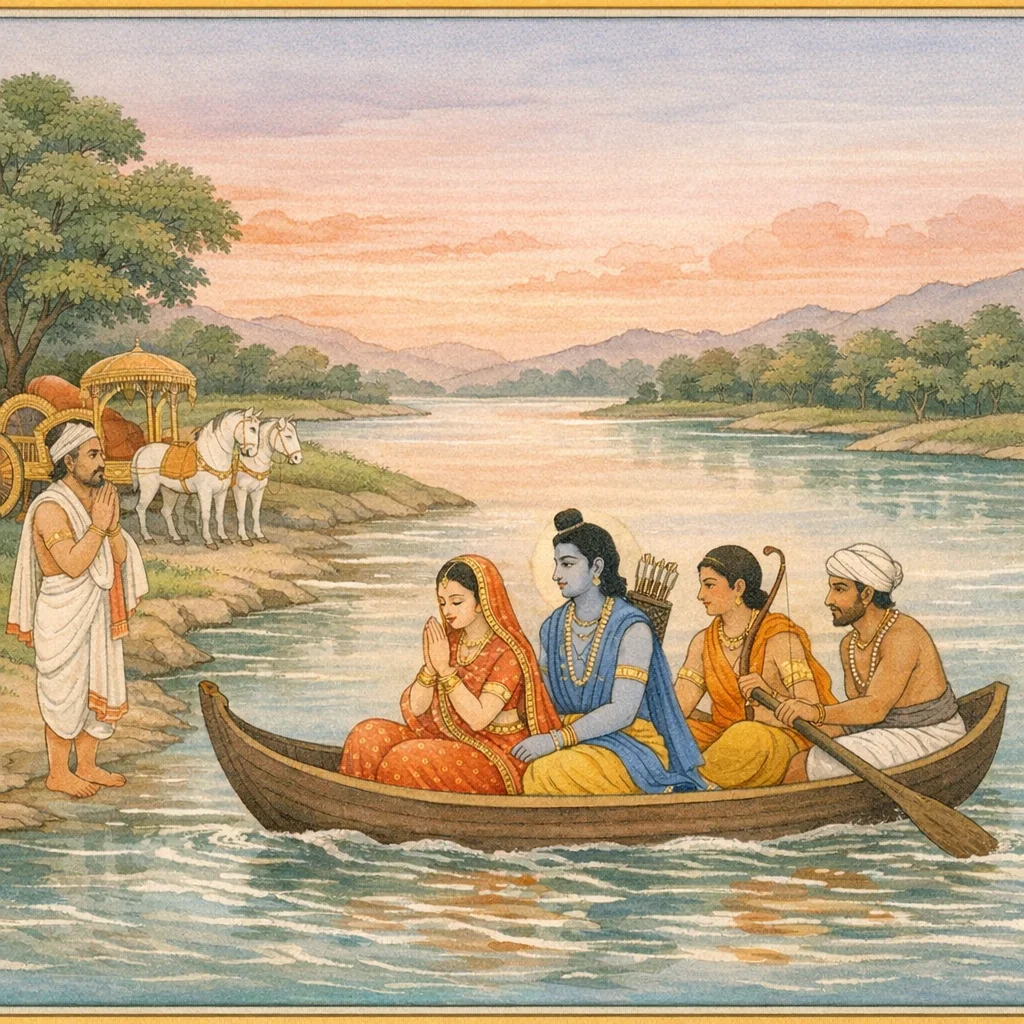
Sarga 52 stages the logistical and ethical threshold between Ayodhyā’s civic order and the forest regime of vrata. At dawn, Rāma initiates movement toward the Gaṅgā and directs Lakṣmaṇa, Sītā, and attendants with procedural clarity. He dismisses Sumantra with compassionate firmness, instructing him to serve Daśaratha without negligence and to stabilize court succession by summoning Bharata and ensuring equitable conduct toward all queens—especially reverence toward Kauśalyā. Sumantra’s grief becomes a civic symptom: he anticipates the city’s anguish at the empty chariot and requests permission to accompany the exiles, even threatening self-immolation, which Rāma counters with reasoned statecraft (Kaikeyī must be convinced the exile is real). Guha provides a boat; Rāma requests a hermitage-oriented life and adopts ascetic markers by matting hair (jaṭā) with banyan latex, with Lakṣmaṇa similarly transformed. The party crosses the swiftly flowing Gaṅgā; Sītā offers a formal vow-prayer to the river, promising future worship upon safe return. Reaching the southern bank, Rāma institutes a protection protocol—Lakṣmaṇa ahead, Sītā in the middle, Rāma behind—signaling the disciplined ethics of wilderness travel and mutual guardianship.
Shlokas
Verse 1
प्रभातायां तु शर्वर्यां पृथुवक्षा महायशाः।उवाच रामः सौमित्रिं लक्ष्मणं शुभलक्षणम्।।2.52.1।।
When the night had turned to dawn, broad-chested Rāma, famed for his glory, spoke to Lakṣmaṇa—the son of Sumitrā—who bore auspicious marks.
Verse 2
भास्करोदयकालोऽयं गता भगवती निशा।असौ सुकृष्णो विहगः कोकिलस्तात कूजति।।2.52.2।।
Dear Lakṣmaṇa, the venerable night has passed; it is now the time of sunrise. That dark-feathered bird—the cuckoo—sings there.
Verse 3
बर्हिणानां च निर्घोषः श्रूयते नदतां वने।तराम जाह्नवीं सौम्य शीघ्रगां सागरङ्गमाम्।।2.52.3।।
The calls of peacocks are heard in the forest; dear friend, let us cross the Jāhnavī (Gaṅgā), swift-flowing and bound for the sea.
Verse 4
विज्ञाय रामस्य वचः सौमित्रिर्मित्रनन्दनः।गुहमामन्त्र्य सूतं च सोऽतिष्ठद्भ्रातुरग्रतः।।2.52.4।।
Understanding Rama’s instruction, Saumitri Lakṣmaṇa—gladdener of friends—summoned Guha and the charioteer, and then stood before his brother.
Verse 5
स तु रामस्य वचनं निशम्य प्रतिगृह्य च।स्थपतिस्तूर्णमाहूय सचिवानिदमब्रवीत्।।2.52.5।।
Having heard Rāma’s words and accepted his request, the Niṣāda chief promptly summoned his ministers and spoke as follows.
Verse 6
अस्य वाहनसंयुक्तां कर्णग्राहवतीं शुभाम्।सुप्रतारां दृढां तीर्थे शीघ्रं नावमुपाहर।।2.52.6।।
Quickly procure at the sacred ford a strong, auspicious boat—equipped with fittings and helmsmen—so that the crossing may be done safely and with ease.
Verse 7
तं निशम्य समादेशं गुहामात्यगणो महान्।उपोह्य रुचिरां नावं गुहाय प्रत्यवेदयत्।।2.52.7।।
On hearing that directive, Guha’s eminent band of ministers brought forth a fine boat and reported back to Guha that the order had been carried out.
Verse 8
ततः स प्राञ्जलिर्भूत्वा गुहो राघवमब्रवीत्।उपस्थितेयं नौर्देव भूयः किं करवाणि ते।।2.52.8।।
Then Guha, joining his palms, said to Rāghava: “O lord, the boat is ready. What more shall I do for you?”
Verse 9
तवामरसुतप्रख्य तर्तुं सागरगां नदीम्।नौरियं पुरुषव्याघ्र तां त्वमारोह सुव्रत।।2.52.9।।
O tiger among men—radiant like a divine son and steadfast in vows—here is the boat for you to cross the river that flows to the sea; board it.
Verse 10
अथोवाच महातेजा रामो गुहमिदं वचः।कृतकामोऽस्मि भवता शीघ्रमारोप्यतामिति।।2.52.10।।
Then the radiant Rāma said these words to Guha: “Through your help my purpose is fulfilled; let us quickly embark.”
Verse 11
ततः कलापान् सन्नह्य खड्गौ बध्वा च धन्विनौ।जग्मतुर्येन तौ गङ्गां सीतया सह राघवौ।।2.52.11।।
Then the two Rāghavas, bearing bows, fastened their quivers and strapped on their swords; with Sītā they set out toward the Gaṅgā.
Verse 12
राममेव तु धर्मज्ञमुपगम्य विनीतवत्।किमहं करवाणीति सूतः प्राञ्जलिरब्रवीत्।।2.52.12।।
Approaching Rāma, the knower of dharma, the charioteer spoke humbly with folded hands: “What shall I do?”
Verse 13
ततोऽब्रवीद्दाशरथिः सुमन्त्रं स्पृशन् करेणोत्तमदक्षिणेन।सुमन्त्र शीघ्रं पुनरेव याहिराज्ञः सकाशे भव चाप्रमत्तः।।2.52.13।।
Then Rāma, son of Daśaratha, gently touched Sumantra with his excellent right hand and said: “Sumantra, return at once; be near the king, and be ever attentive in your service.”
Verse 14
निवर्तस्वेत्युवाचैव ह्येतावद्धि कृतं मम।रथं विहाय पद्भ्यां तु गमिष्यामि महावनम्।।2.52.14।।
“Return,” he said; “you have done enough for me up to this point. Leaving the chariot behind, I shall go on foot into the great forest.”
Verse 15
आत्मानं त्वभ्यनुज्ञातमवेक्ष्यार्तः स सारथिः।सुमन्त्रः पुरुषव्याघ्रमैक्ष्वाकमिदमब्रवीत्।।2.52.15।।
Seeing that he had been granted leave to depart, Sumantra—the charioteer, stricken with sorrow—spoke these words to Rama, the tiger among men, scion of the Ikṣvāku line.
Verse 16
नातिक्रान्तमिदं लोके पुरुषेणेह केनचित्।तव सभ्रातृभार्यस्य वासः प्राकृतवद्वने।।2.52.16।।
No one in this world could surpass what you have undertaken: to dwell in the forest like an ordinary man, together with your brother and your wife.
Verse 17
न मन्ये ब्रह्मचर्येऽस्ति स्वधीते वा फलोदयः।मार्दवार्जवयोर्वापि त्वां चेद्व्यसनमागतम्।।2.52.17।।
If, despite your celibate discipline, your sacred learning, your gentleness and straightforwardness, calamity has still come upon you—then I do not think these virtues yield any fruit.
Verse 18
सह राघव वैदेह्या भ्रात्रा चैव वने वसन्।त्वं गतिं प्राप्स्यसे वीर त्रीन् लोकांस्तु जयन्निव।।2.52.18।।
O Rāghava, heroic one—dwelling in the forest with Vaidehī and your brother, you will attain a blessed end, as though you had conquered the three worlds.
Verse 19
वयं खलु हता राम ये त्वयाप्युपवञ्चिताः।कैकेय्या वशमेष्यामः पापाया दुःखभागिनः।।2.52.19।।
Truly we are ruined, O Rama—bereft even of you; we shall fall under the sway of that sinful Kaikeyī, becoming heirs to sorrow.
Verse 20
इति ब्रुवन्नात्मसमं सुमन्त्रः सारथिस्तदा।दृष्ट्वा दूरगतं रामं दुःखार्तो रुरुदे चिरम्।।2.52.20।।
Speaking thus, Sumantra the charioteer—who regarded Rama as his own self—seeing Rama go far away, wept for a long time, tormented by grief.
Verse 21
ततस्तु विगते बाष्पे सूतं स्पृष्टोदकं शुचिम्।रामस्तु मधुरं वाक्यं पुनः पुनरुवाच तम्।।2.52.21।।
Then, when his tears had subsided and the charioteer had sipped water and become composed and purified, Rama spoke to him again and again in gentle, sweet words.
Verse 22
इक्ष्वाकूणां त्वया तुल्यं सुहृदं नोपलक्षये।यथा दशरथो राजा मां न शोचेत्तथा कुरु।।2.52.22।।
Among the Ikṣvākus I see no friend equal to you. Therefore act in such a way that King Daśaratha does not grieve for me.
Verse 23
शोकोपहतचेताश्च वृद्धश्च जगतीपतिः।कामभावावसन्नश्च तस्मादेतद्ब्रवीमि ते।।2.52.23।।
For the lord of the earth is overwhelmed in mind by grief, and he is old; and he is also weighed down by the impulses of passion—therefore I say this to you.
Verse 24
यद्यदाज्ञापयेत्किञ्चित्स महात्मा महीपतिः।कैकेय्याः प्रियकामार्थं कार्यं तदविकाङ्क्षया।।2.52.24।।
To please Kaikeyī, you should carry out—without hesitation—whatever little that great king commands.
Verse 25
एतदर्थं हि राज्यानि प्रशासति नरेश्वराः।यदेषां सर्वकृत्येषु मनो न प्रतिहन्यते।।2.52.25।।
Indeed, for this very reason kings rule kingdoms: their resolve is not checked by obstacles in the execution of their affairs.
Verse 26
यद्यथा स महाराजो नालीकमधिगच्छति।न च ताम्यति दुःखेन सुमन्त्र कुरु तत्तथा।।2.52.26।।
Sumantra, act in just such a way that the great king does not fall into despair and does not wither in grief.
Verse 27
अदृष्टदुःखं राजानं वृद्धमार्यं जितेन्द्रियम्।ब्रूयास्त्वमभिवाद्यैव मम हेतोरिदं वचः।।2.52.27।।
After first offering him reverence, speak these words on my behalf to the king—aged, noble, self-controlled, and unaccustomed to sorrow.
Verse 28
नैवाहमनुशोचामि लक्ष्मणो न च मैथिली।अयोध्यायाश्च्युताश्चेति वने वत्स्यामहेति च।।2.52.28।।
I do not grieve—not Lakṣmaṇa, nor Maithilī—either at our removal from Ayodhyā or at the thought that we must dwell in the forest.
Verse 29
चतुर्दशसु वर्षेषु निवृत्तेषु पुनः पुनः।लक्ष्मणं मां च सीतां च द्रक्ष्यसे क्षिप्रमागतान्।।2.52.29।।
When the fourteen years have run their course, you will soon see Lakṣmaṇa, Sītā, and me returned—again and again (thereafter).
Verse 30
एवमुक्त्वा तु राजानं मातरं च सुमन्त्र मे।अन्याश्च देवीस्सहिताः कैकेयीं च पुनः पुनः।।2.52.30।।आरोग्यं ब्रूहि कौशल्यामथ पादाभिवन्दनम्।सीताया मम चाऽऽर्यस्य वचनाल्लक्ष्मणस्य च।।2.52.31।।
After speaking thus to the king, Sumantra, convey again and again (my message) also to my mother, to the other queens together, and to Kaikeyī as well.
Verse 31
एवमुक्त्वा तु राजानं मातरं च सुमन्त्र मे।अन्याश्च देवीस्सहिताः कैकेयीं च पुनः पुनः।।2.52.30।।आरोग्यं ब्रूहि कौशल्यामथ पादाभिवन्दनम्।सीताया मम चाऽऽर्यस्य वचनाल्लक्ष्मणस्य च।।2.52.31।।
Tell Kauśalyā of our well-being; and, at the word of Sītā, of me, and of noble Lakṣmaṇa, convey our salutations at her feet.
Verse 32
ब्रूयाश्च हि महाराजं भरतं क्षिप्रमानय।आगतश्चापि भरतः स्थाप्यो नृपमते पदे।।2.52.32।।
And tell the great king to summon Bharata quickly; and once Bharata arrives, he should be installed in the royal position according to the king’s decision.
Verse 33
भरतं च परिष्वज्य यौवराज्येऽभिषिच्य च।अस्मत्सन्तापजं दुःखं न त्वामभिभविष्यति।।2.52.33।।
Embrace Bharata and install him as crown-prince; then the sorrow born of our separation will not overpower you.
Verse 34
भरतश्चापि वक्तव्यो यथा राजनि वर्तसे।तथा मातृषु वर्तेथाः सर्वास्वेवाविशेषतः।।2.52.34।।
And Bharata too should be told: just as he conducts himself toward the king, so should he conduct himself toward all the mothers, without distinction.
Verse 35
यथा च तव कैकेयी सुमित्रा च विशेषतः।तथैव देवी कौशल्या मम माता विशेषतः।।2.2.35।।
And just as Kaikeyī and Sumitrā are especially dear to you, so too should Devī Kauśalyā—my mother—be treated with special regard.
Verse 35
यथा च तव कैकेयी सुमित्रा च विशेषतः।तथैव देवी कौशल्या मम माता विशेषतः।।2.2.35।।
And just as Kaikeyī and Sumitrā are especially dear to you, so too should Devī Kauśalyā—my mother—be treated with special regard.
Verse 36
तातस्य प्रियकामेन यौवराज्यमपेक्षता।लोकयोरुभयोः शक्यं त्वया यत्सुखमेधितुम्।।2.52.36।।
The crown-princeship awaits him through our father’s loving wish; see that, by your conduct, our father can attain well-being in both worlds.
Verse 37
निवर्त्यमानो रामेण सुमन्त्रः शोककर्शितः।तत्सर्वं वचनं श्रुत्वा स्नेहात्काकुत्स्थमब्रवीत्।।2.52.37।।
Sent back by Rama, Sumantra—worn down by grief—heard all those words and, out of affection, spoke to the Kakutstha prince.
Verse 38
यदहं नोपचारेण ब्रूयां स्नेहादविक्लबः।भक्तिमानिति तत्तावद्वाक्यं त्वं क्षन्तुमर्हसि।।2.52.38।।
If, out of affection and without hesitation, I speak to you informally, please forgive these words, taking them as those of a devoted servant.
Verse 39
कथं हि त्वद्विहीनोऽहं प्रतियास्यामि तां पुरीम्।तव तावद्वियोगेन पुत्रशोकाकुलामिव।।2.52.39।।
How can I return to that city without you—Ayodhyā, which in this separation from you will be like a mother distraught with grief for her son?
Verse 40
सराममपि तावन्मे रथं दृष्ट्वा तदा जनः।विना रामं रथं दृष्ट्वा विदीर्येतापि सा पुरी।।2.52.40।।
The people, having seen my chariot then with Rama in it, will be shattered when they see the chariot returning without Rama; the city itself would as it were split with grief.
Verse 41
दैन्यं हि नगरी गच्छेद्दृष्ट्वा शून्यमिमं रथम्।सूतावशेषं स्वं सैन्यं हतवीरमिवाऽहवे।।2.52.41।।
Seeing this chariot empty, the city will fall into a pitiable state—like an army on the battlefield left with only its charioteer after its hero has been slain.
Verse 42
दूरेऽपि निवसन्तं त्वां मानसेनाग्रतः स्थितम्।चिन्तयन्तोऽद्य नूनं त्वां निराहाराः कृताः प्रजाः।।2.52.42।।
Even though you are living far away, the people hold you in their minds as though you stood right before them. Today, surely, they will go without food, absorbed only in thoughts of you.
Verse 43
दृष्टं तद्धि त्वया राम यादृशं त्वत्प्रवासने।प्रजानां सङ्कुलं वृत्तं त्वच्छोकक्लान्तचेतसाम्।।2.52.43।।
For you saw it yourself, O Rāma—at the time of your departure—how the people’s condition became confused and anguished, their minds exhausted by sorrow for you.
Verse 44
आर्तनादो हि यः पौरैर्मुक्तस्त्वद्विप्रवासने।सरथं मां निशाम्यैव कुर्युः शतगुणं ततः।।2.52.44।।
The cry of anguish the citizens raised at the time of your banishment—when they now see me returning with the chariot, they will raise it a hundred times more.
Verse 45
अहं किं चापि वक्ष्यामि देवीं तव सुतो मया।नीतोऽसौ मातुलकुलं सन्तापं मा कृथा इति।।2.52.45।।
What could I possibly say to Queen Kauśalyā—‘Your son has been taken by me to his maternal uncle’s house; do not grieve’—as though that were the truth?
Verse 46
असत्यमपि नैवाहं ब्रूयां वचनमीदृशम्।कथमप्रियमेवाहं ब्रूयां सत्यमिदं वचः।।2.52.46।।
I cannot speak such words that are untrue; yet how can I speak this true statement, when it is so painful to hear?
Verse 47
मम तावन्नियोगस्थास्त्वद्बन्धुजनवाहिनः।कथं रथं त्वया हीनं प्रवक्ष्यन्ति हयोत्तमाः।।2.52.47।।
These excellent horses—though they stand under my command and were used to carrying you and your companions—how will they draw this chariot now, emptied of you?
Verse 48
तन्न शक्ष्याम्यहं गन्तुमयोध्यां त्वदृतेऽनघ।वनवासानुयानाय मामनुज्ञातुमर्हसि।।2.52.48।।
Therefore, O sinless one, I cannot go to Ayodhyā without you. You ought to grant me permission to follow you into forest-exile.
Verse 49
यदि मे याचमानस्य त्यागमेव करिष्यसि।सरथोऽग्निं प्रवेक्ष्यामि त्यक्तमात्र इह त्वया।।2.52.49।।
If, even as I beg you, you choose only to cast me off, then the moment I am abandoned by you here, I will enter the fire together with my chariot.
Verse 50
भविष्यन्ति वने यानि तपोविघ्नकराणि ते।रथेन प्रतिबाधिष्ये तानि सत्त्वानि राघव।।2.52.50।।
O Rāghava, whatever creatures may be in the forest that would hinder your austerities—I will drive them back and restrain them with my chariot.
Verse 51
त्वत्कृते न मयाऽवाप्तं रथचर्याकृतं सुखम्।आशंसे त्वत्कृते नाहं वनवासकृतं सुखम्।।2.52.51।।
Through your favor I once enjoyed the happiness of driving your chariot; and through that same favor I now hope to find happiness even in forest-dwelling during your exile.
Verse 52
प्रसीदेच्छामि तेऽरण्ये भवितुं प्रत्यनन्तरः।प्रीत्याऽभिहितमिच्छामि भव मे प्रत्यनन्तरः।।2.52.52।।
Be gracious to me; I wish to remain close beside you in the forest. In affection, I long to hear you say, ‘Stay close to me.’
Verse 53
इमे चापि हया वीर यदि ते वनवासिनः।परिचर्यां करिष्यन्ति प्राप्स्यन्ति परमां गतिम्।।2.52.53।।
O heroic one, if these horses too could serve you while you live in the forest, they would attain the highest destiny.
Verse 54
तव शुश्रूषणं मूर्ध्ना करिष्यामि वने वसन्।अयोध्यां देवलोकं वा सर्वथा प्रजहाम्यहम्।।2.52.54।।
Dwelling in the forest, I will serve you with my head bowed; for that purpose I would abandon everything—Ayodhya itself, even heaven.
Verse 55
न हि शक्या प्रवेष्टुं सा मयाऽयोध्या त्वया विना।राजधानी महेन्द्रस्य यथा दुष्कृतकर्मणा।।2.52.55।।
Without you I cannot enter Ayodhya—just as one who has done evil deeds cannot enter the city of great Indra.
Verse 56
वनवासे क्षयं प्राप्ते ममैष हि मनोरथः।यदनेन रथेनैव त्वां वहेयं पुरीं पुनः।।2.52.56।।
This is my cherished wish: when your forest-exile is complete, may I carry you back again to the city in this very chariot.
Verse 57
चतुर्दश हि वर्षाणि सहितस्य त्वया वने।क्षणभूतानि यास्यन्ति शतसङ्ख्यान्यतोऽन्यथा।।2.52.57।।
If I am with you in the forest, those fourteen years will pass like a moment; otherwise, they will feel like a hundred years.
Verse 58
भृत्यवत्सल तिष्ठन्तं भर्तृपुत्रगते पथि।भक्तं भृत्यं स्थितं स्थित्यां त्वं न मां हातुमर्हसि।।2.52.58।।
O one who is tender toward servants, I stand on the path taken by you, the son of my lord. I am your devoted servant, fixed in my duty—do not abandon me.
Verse 59
एवं बहुविधं दीनं याचमानं पुनः पुनः।रामो भृत्यानुकम्पी तु सुमन्त्रमिदमब्रवीत्।।2.52.59।।
Thus, as Sumantra pleaded again and again in many pitiable ways, Rama—compassionate toward his servants—spoke these words to him.
Verse 60
जानामि परमां भक्तिं मयि ते भर्तृवत्सल।शृणु चापि यदर्थं त्वां प्रेषयामि पुरीमितः।।2.52.60।।
I know your supreme devotion to me, O loyal servant of your master. Now listen to the purpose for which I am sending you from here back to the city.
Verse 61
नगरीं त्वां गतं दृष्ट्वा जननी मे यवीयसी।कैकेयी प्रत्ययं गच्छेदिति रामो वनं गतः।।2.52.61।।
When my younger mother Kaikeyī sees you returned to Ayodhyā, she will be convinced: ‘Rāma has indeed gone to the forest.’
Verse 62
परितुष्टा हि सा देवी वनवासं गते मयि।राजानं नातिशङ्केत 'मिथ्यावादी'ति धार्मिकम्।।2.52.62।।
For when that queen is fully satisfied that I have gone to forest-dwelling, she will no longer suspect the righteous king, thinking, ‘He is a liar.’
Verse 63
एष मे प्रथमः कल्पो यदम्बा मे यवीयसी।भरतारक्षितं स्फीतं पुत्रराज्यमवाप्नुयात्।।2.52.63।।
This is my first resolve: that my younger mother should attain her son’s flourishing kingdom, protected and administered by Bharata.
Verse 64
मम प्रियार्थं राज्ञश्च सरथस्त्वं पुरीं व्रज।सन्दिष्टश्चासि यानर्थांस्तां स्तान् ब्रूयास्तथा तथा।।2.52.64।।
For my sake—and for the king’s—go back to the city with the chariot; and as you have been instructed, convey to each person the messages exactly in the manner given.
Verse 65
इत्युक्त्वा वचनं सूतं सान्त्वयित्वा पुनः पुनः।गुहं वचनमक्लीबो रामो हेतुमदब्रवीत्।।2.52.65।।
Having thus addressed the charioteer and consoled him again and again, the indefatigable Rama then spoke to Guha with words grounded in reason.
Verse 66
नेदानीं गुह योग्योऽयं वासो मे सजने वने।आवश्यं ह्याश्रमे वासः कर्तव्यस्तद्गतो विधिः।।2.52.66।।
“Guha, this forest frequented by people is not suitable for my dwelling now. I must live in a hermitage, where the prescribed discipline of that life can be properly observed.”
Verse 67
सोऽहं गृहीत्वा नियमं तपस्वि जनभूषणम्।हितकामः पितुर्भूयः सीताया लक्ष्मणस्य च।।2.52.67।।जटाः कृत्वा गमिष्यामि न्यग्रोधक्षीरमानय।
“Having accepted the ascetic discipline—an ornament to those who practise austerities—seeking the welfare of my father, and also of Sita and Lakshmana, I shall depart with matted hair. Bring the latex of the banyan tree.”
Verse 68
तत् क्षीरं राजपुत्राय गुहः क्षिप्रमुपाहरत्।।2.52.68।।लक्ष्मणस्यात्मनश्चैव रामस्तेनाकरोज्जटाः।
Guha swiftly brought that banyan latex for the prince, and with it Rama made matted locks for himself as well as for Lakshmana.
Verse 69
दीर्घबाहुर्नरव्याघ्रो जटिलत्वमधारयत्।।2.52.69।।तौ तदा चीरवसनौ जटामण्डलधारिणौ।आशोभेतामृषिसमौ भ्रातरौ रामलक्ष्मणौ।।2.52.70।।
The long-armed Rama, tiger among men, assumed the state of matted hair. Then the two brothers—Rama and Lakshmana—clad in bark garments and wearing crowns of matted locks, shone like a pair of sages.
Verse 70
दीर्घबाहुर्नरव्याघ्रो जटिलत्वमधारयत्।।2.52.69।।तौ तदा चीरवसनौ जटामण्डलधारिणौ।आशोभेतामृषिसमौ भ्रातरौ रामलक्ष्मणौ।।2.52.70।।
Then the two brothers, Rāma and Lakṣmaṇa—clad in bark garments and wearing crowns of matted locks—shone like sages.
Verse 71
ततो वैखानसं मार्गमास्थितः सह लक्ष्मणः।व्रतमादिष्टवान् रामः सखायं गुहमब्रवीत्।।2.52.71।।
Thereafter, having taken up the Vaikhānasa path of ascetic discipline along with Lakṣmaṇa, Rāma—having undertaken the vowed observance—spoke to his friend Guha.
Verse 72
अप्रमत्तो बले कोशे दुर्गे जनपदे तथा।भवेथा गुह राज्यं हि दुरारक्षतमं मतम्।।2.52.72।।
“Guha, remain vigilant regarding the army, the treasury, the forts, and the provinces as well; for a kingdom—so it is held—is among the hardest things to guard.”
Verse 73
ततस्तं समनुज्ञाय गुहमिक्ष्वाकुनन्दनः।जगाम तूर्णमव्यग्रः सभार्यः सह लक्ष्मणः।।2.52.73।।
Then the delight of the Ikṣvāku line, having courteously taken leave of Guha, departed swiftly—calm in mind—together with his wife and with Lakṣmaṇa.
Verse 74
स तु दृष्ट्वा नदीतीरे नावमिक्ष्वाकुनन्दनः।तितीर्षुः शीघ्रगां गङ्गामिदं लक्ष्मणमब्रवीत्।।2.52.74।।
But when the Ikṣvāku prince saw the boat on the riverbank, intending to cross the swift-flowing Gaṅgā, he spoke these words to Lakṣmaṇa.
Verse 75
आरोह त्वं नरव्याघ्र स्थितां नावमिमां शनैः।सीतां चारोपयान्वक्षं परिगृह्य मनस्विनीम्।।2.52.75।।
“O tiger among men, board this ready boat slowly; and help Sītā, the high-minded lady, to embark—holding her securely by the support/beam.”
Verse 76
स भ्रातुः शासनं श्रुत्वा सर्वमप्रतिकूलयन्।आरोप्य मैथिलीं पूर्वमारुरोहाऽऽत्मवां स्ततः।।2.52.76।।
Hearing his brother’s command and opposing it in no way, self-controlled Lakṣmaṇa first helped Maithilī (Sītā) into the boat, and then boarded himself.
Verse 77
अथारुरोह तेजस्वी स्वयं लक्ष्मणपूर्वजः।ततो निषादाधिपतिर्गुहो ज्ञातीनचोदयत्।।2.52.77।।
Then the radiant Rāma himself—Lakṣmaṇa’s elder brother—boarded the boat. After that, Guha, lord of the Niṣādas, urged his kinsmen to set to work (and row).
Verse 78
राघवोऽपि महातेजा नावमारुह्य तां ततः।ब्रह्मवत् क्षत्रवच्चैव जजाप हितमात्मनः।।2.52.78।।
Even Rāghava, of great splendor, having boarded that boat, then softly recited for his own protection auspicious formulas—befitting both a brāhmaṇa and a kṣatriya.
Verse 79
आचम्य च यथाशास्त्रं नदीं तां सह सीतया।प्राणमत्प्रीतिसंहृष्टो लक्ष्मणश्चामितप्रभः।।2.52.79।।
Having sipped the water in accordance with scriptural rule, he—together with Sītā—bowed to that river; and Lakṣmaṇa too, radiant and delighted, paid reverent obeisance.
Verse 80
अनुज्ञाय सुमन्त्रं च सबलं चैव तं गुहम्।आस्थाय नावं रामस्तु चोदयामास नाविकान्।।2.52.80।।
After granting leave to Sumantra and to Guha along with his men, Rāma boarded the boat and urged the boatmen onward.
Verse 81
ततस्तैश्चोदिता सा नौः कर्णधारसमाहिता।शुभस्फ्यवेगाभिहता शीघ्रं सलिलमत्यगात्।।2.52.81
Then that boat—well steadied by skilled helmsmen and driven by the swift force of strong oars—quickly passed over the waters.
Verse 82
मध्यं तु समनुप्राप्य भागीरथ्यास्त्वनिन्दिता।वैदेही प्राञ्जलिर्भूत्वा तां नदीमिदमब्रवीत्।।2.52.82।।
When they reached the midstream of the Bhāgīrathī, Vaidehī—blameless Sītā—joined her palms and addressed the river in these words.
Verse 83
पुत्रो दशरथस्यायं महाराजस्य धीमतः।निदेशं पारयित्वेमं गङ्गे त्वदभिरक्षितः।।2.52.83।।चतुर्दश हि वर्षाणि समग्राण्युष्य कानने।भ्रात्रा सह मया चैव पुनः प्रत्यागमिष्यति।।2.52.84।।ततस्त्वां देवि सुभगे क्षेमेण पुनरागता।यक्ष्ये प्रमुदिता गङ्गे सर्वकामसमृद्धिनी।।2.52.85।।
“O Gaṅgā, protected by you, this son of the wise Mahārāja Daśaratha will fulfill that command. After dwelling in the forest for the full fourteen years, he will return again—together with his brother and with me. Then, O blessed goddess Gaṅgā, when I have come back safely, I shall worship you with joy, O fulfiller of all desires.”
Verse 84
पुत्रो दशरथस्यायं महाराजस्य धीमतः।निदेशं पारयित्वेमं गङ्गे त्वदभिरक्षितः।।2.52.83।।चतुर्दश हि वर्षाणि समग्राण्युष्य कानने।भ्रात्रा सह मया चैव पुनः प्रत्यागमिष्यति।।2.52.84।।ततस्त्वां देवि सुभगे क्षेमेण पुनरागता।यक्ष्ये प्रमुदिता गङ्गे सर्वकामसमृद्धिनी।।2.52.85।।
“O Gaṅgā, protected by you, this son of the wise Mahārāja Daśaratha will fulfill that command. After dwelling in the forest for the full fourteen years, he will return again—together with his brother and with me. Then, O blessed goddess Gaṅgā, when I have come back safely, I shall worship you with joy, O fulfiller of all desires.”
Verse 85
पुत्रो दशरथस्यायं महाराजस्य धीमतः।निदेशं पारयित्वेमं गङ्गे त्वदभिरक्षितः।।2.52.83।।चतुर्दश हि वर्षाणि समग्राण्युष्य कानने।भ्रात्रा सह मया चैव पुनः प्रत्यागमिष्यति।।2.52.84।।ततस्त्वां देवि सुभगे क्षेमेण पुनरागता।यक्ष्ये प्रमुदिता गङ्गे सर्वकामसमृद्धिनी।।2.52.85।।
“O Gaṅgā, protected by you, this son of the wise Mahārāja Daśaratha will fulfill that command. After dwelling in the forest for the full fourteen years, he will return again—together with his brother and with me. Then, O blessed goddess Gaṅgā, when I have come back safely, I shall worship you with joy, O fulfiller of all desires.”
Verse 86
त्वं हि त्रिपथगा देवि ब्रह्मलोकं समीक्षसे।भार्या चोदधिराजस्य लोकेऽस्मिन् सम्प्रदृश्यसे।।2.52.86।।
“For you, O Goddess, are Tripathagā, flowing in the three realms; you look upon Brahmā’s world, and in this mortal world you are seen as the consort of the Ocean-king.”
Verse 87
सा त्वां देवि नमस्यामि प्रशंसामि च शोभने।प्राप्तराज्ये नरव्याघ्रे शिवेन पुनरागते।।2.52.87।।गवां शतसहस्राणि वस्त्राण्यन्नं च पेशलम्।ब्राह्मणेभ्यः प्रदास्यामि तव प्रियचिकीर्षया।।2.52.88।।
“O Goddess, O beautiful one, I bow to you and praise you. When the tiger among men returns safely and regains his kingdom, I shall give to brāhmaṇas a hundred thousand cows, garments, and fine food—intending to do what is pleasing to you.”
Verse 88
सा त्वां देवि नमस्यामि प्रशंसामि च शोभने।प्राप्तराज्ये नरव्याघ्रे शिवेन पुनरागते।।2.52.87।।गवां शतसहस्राणि वस्त्राण्यन्नं च पेशलम्।ब्राह्मणेभ्यः प्रदास्यामि तव प्रियचिकीर्षया।।2.52.88।।
“O Goddess, O beautiful one, I bow to you and praise you. When the tiger among men returns safely and regains his kingdom, I shall give to brāhmaṇas a hundred thousand cows, garments, and fine food—intending to do what is pleasing to you.”
Verse 89
सुराघटसहस्रेण मांसभूतौदनेन च।यक्ष्ये त्वां प्रयता देवि पुरीं पुनरुपागता।।2.52.89।।
O Goddess, once I return again to the city (Ayodhyā), purified and disciplined, I shall worship you with a thousand pots of surā and with offerings of cooked food prepared with meat.
Verse 90
यानि त्वत्तीरवासीनि दैवतानि च सन्ति हि।तानि सर्वाणि यक्ष्यामि तीर्थान्यायतनानि च।।2.52.90।।
I shall worship all the deities who dwell upon your banks, and also the sacred fords and the shrines (connected with you).
Verse 91
पुनरेव महाबाहुर्मया भ्रात्रा च सङ्गतः।अयोध्यां वनवासात्तु प्रविशत्वनघोऽनघे।।2.52.91।।
O sinless one, may the mighty-armed, blameless Rāma—reunited with me and with his brother—enter Ayodhyā again after the forest-dwelling.
Verse 92
तथा सम्भाषमाणा सा सीता गङ्गामनिन्दिता।दक्षिणा दक्षिणं तीरं क्षिप्रमेवाभ्युपागमत्।।2.52.92।।
As that blameless Sītā thus spoke to Gaṅgā, the boat quickly reached the southern bank—an auspicious landing.
Verse 93
तीरं तु समनुप्राप्य नावं हित्वा नरर्षभः।प्रातिष्ठत सह भ्रात्रा वैदेह्या च परन्तपः।।2.52.93।।
Having reached the bank and leaving the boat behind, Rāma—the best of men, the subduer of foes—set out onward together with his brother and with Vaidehī (Sītā).
Verse 94
अथाब्रवीन्महाबाहुः सुमित्रानन्दवर्धनम्।भव संरक्षणार्थाय सजने विजनेऽपि वा।।2.52.94।।
Then the mighty-armed Rāma said to Lakṣmaṇa—who increases Sumitrā’s joy: “Be alert for protection, whether among people or even in lonely places.”
Verse 95
अवश्यं रक्षणं कार्यमदृष्टे विजने वने।अग्रतो गच्छ सौमित्रे सीता त्वामनुगच्छतु।।.2.52.95।।
Protection must certainly be maintained in this lonely forest, unseen and unfamiliar. Go in front, O son of Sumitrā; let Sītā follow behind you.
Verse 96
पृष्ठतोऽहं गमिष्यामि त्वां च सीतां च पालयन्।अन्योन्यस्येह नो रक्षा कर्तव्या पुरुषर्षभ।।2.52.96।।
I shall walk behind, guarding both you and Sītā. Here we must ensure one another’s protection, O best of men.
Verse 97
न हि तावदतिक्रान्ता सुकरा काचन क्रिया।अद्य दुःखं तु वैदेही वनवासस्य वेत्स्यति।।2.52.97।।
No truly difficult task has yet been left behind; from today onward Vaidehī (Sītā) will come to know the hardships of life in the forest.
Verse 98
प्रणष्टजनसम्बाधं क्षेत्रारामविवर्जितम्।विषमं च प्रपातं च वनमद्य प्रवेक्ष्यति।।2.52.98।।
Today she will enter a forest empty of crowds, bereft of fields and gardens—uneven, difficult to traverse, and broken by ravines and steep drops.
Verse 99
श्रुत्वा रामस्य वचनं प्रतस्थे लक्ष्मणोऽग्रतः।अनन्तरं च सीताया राघवो रघुनन्दनः।।2.52.99।।
Hearing Rāma’s words, Lakṣmaṇa set out in front; and Rāghava, the delight of the Raghu line, walked behind Sītā.
Verse 100
गतं तु गङ्गापरपारमाशुरामं सुमन्त्रः प्रततं निरीक्ष्य।अध्वप्रकर्षाद्विनिवृत्तदृष्टिर्मुमोच बाष्पं व्यथित स्तपस्वी।।2.52.100।।
Sumantra kept watching Rāma as he swiftly reached the far bank of the Gaṅgā; and only when the great distance forced his gaze to turn back, the afflicted man—wretched with grief—broke into tears.
Verse 101
स लोकपालप्रतिमप्रभाववांस्तीर्त्वा महात्मा वरदो महानदीम्।ततः समृद्धान् शुभसस्यमालिनःक्रमेण वत्सान् मुदितानुपागमत्।।2.52.101।।
Having crossed that mighty river, he—great-souled, a giver of boons, resplendent like a guardian of the world—then gradually came to the land of the Vatsas, prosperous and garlanded with fine crops, its people joyful.
Verse 102
तौ तत्र हत्वा चतुरो महामृगान्वराहमृश्यं पृषतं महारुरुम्।आदाय मेध्यं त्वरितं बुभुक्षितौवासाय काले ययतुर्वनस्पतिम्।।2.52.102।।
There, being hungry, the two killed four great beasts—a boar, an ṛśya-antelope, a spotted deer, and a great ruru deer. Taking the pure meat quickly, they went by evening to a tree for their night’s lodging.
Frequently Asked Questions
The pivotal dilemma is whether compassion should override duty: Sumantra begs to accompany Rāma, but Rāma insists he return to serve Daśaratha and preserve political stability, showing that dharma may require denying emotionally persuasive requests.
The chapter teaches that ethical leadership combines empathy with governance: Rāma consoles Sumantra yet prioritizes institutional responsibilities (succession, care of elders, impartial respect toward queens) and adopts ascetic discipline as an inward form of sovereignty.
The Gaṅgā (Jāhnavī/Bhāgīrathī) is the central landmark, functioning as a ritual boundary into exile; Guha’s Niṣāda territory on the riverbank and the onward movement toward regions like Vatsa provide a geo-cultural map of early forest transit.