Sarga 37
अयोध्याकाण्डे सर्गः ३७ — चीरधारणं, सीतासंकल्पः, वसिष्ठोपदेशः (Bark-Robe Episode and Vasistha’s Admonition)
अयोध्याकाण्ड
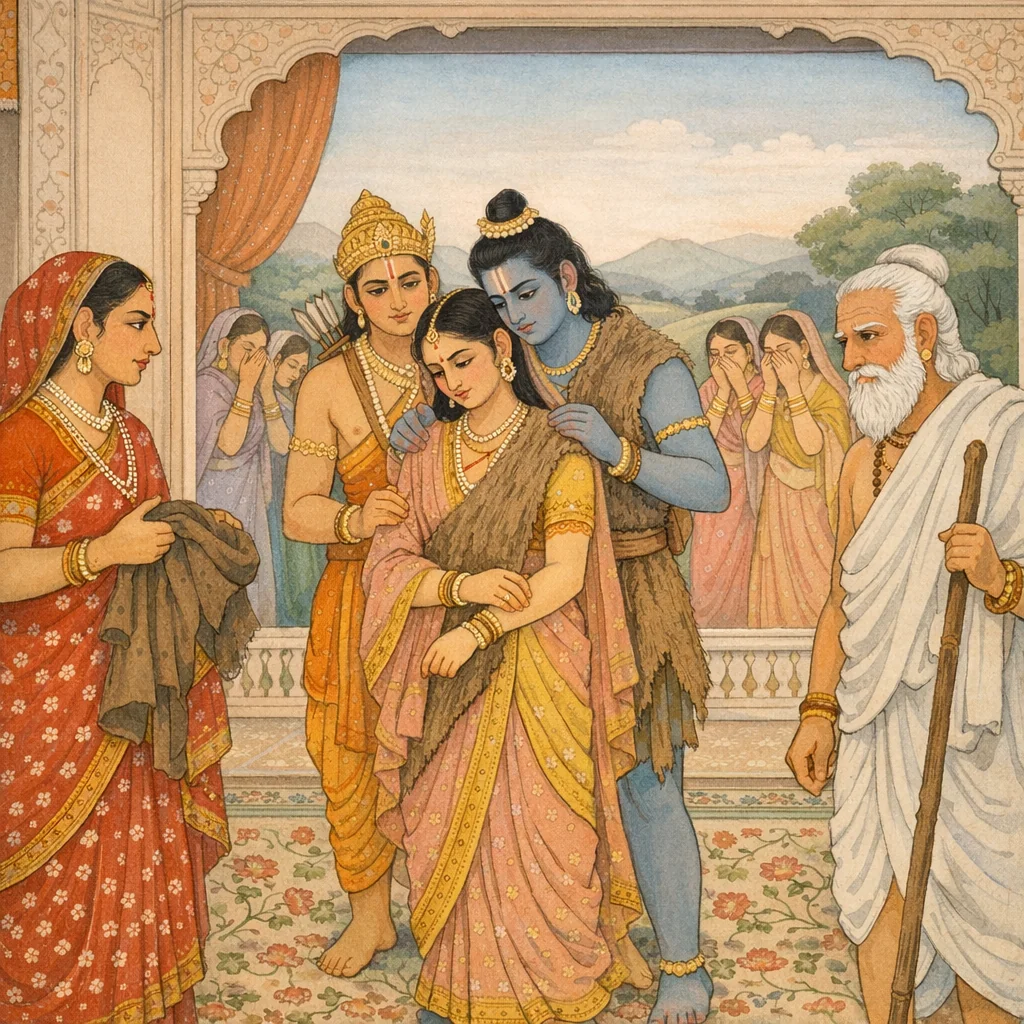
Sarga 37 stages the exile’s visible conversion from royal life to ascetic discipline through the ritualized act of donning bark garments (cīra). Rāma, hearing ministerial counsel, speaks with cultivated vinaya to Daśaratha and clarifies that, having renounced pleasures and attachments, he has no need of followers or military display; he requests only the minimal implements for forest life. Kaikeyī, publicly unashamed, produces bark robes and commands their use. Rāma and Lakṣmaṇa remove fine clothing and adopt ascetic dress. Sītā, still in silk, recoils at the bark robes, receives kuśa-fiber garments from Kaikeyī, and—tearful and abashed—attempts to wear them but is unskilled; she asks how forest sages wear such garments. Rāma himself fastens the bark over her silk, prompting the palace women to weep and plead that Sītā should not be compelled to forest hardship. As these laments continue, Vasiṣṭha intervenes: he rebukes Kaikeyī for exceeding decency and deception, argues Sītā need not go, and even proposes her as fit to occupy Rāma’s throne; he warns that if Sītā is forced, the city and kingdom will follow Rāma, leaving Kaikeyī to rule an emptied land. Despite Vasiṣṭha’s authoritative counsel, Sītā remains unwavering, intent on serving her beloved husband, reinforcing the chapter’s dharma of spousal solidarity and chosen austerity.
Shlokas
Verse 1
महामात्रवचः श्रुत्वा रामो दशरथं तदा।अभ्यभाषत वाक्यं तु विनयज्ञो विनीतवत्।।2.37.1।।
Having heard the minister’s words, Rāma—skilled in propriety—then addressed Daśaratha with humble speech.
Verse 2
त्यक्तभोगस्य मे राजन् वने वन्येन जीवतः।किं कार्यमनुयात्रेण त्यक्तसङ्गस्य सर्वतः।।2.37.2।।
O King, when I have renounced pleasures and wholly cast off attachments, and I am to live in the forest on what the wild provides, what need have I of any retinue following me?
Verse 3
यो हि दत्त्वा द्विपश्रेष्ठं कक्ष्यायां कुरुते मनः।रज्जुस्नेहेन किं तस्य त्यजतः कुञ्जरोत्तमम्।।2.37.3।।
For if a man, after giving away the best of elephants, still fixes his mind on the rope tied around its girth—what use is such attachment to the rope for one who has renounced the finest elephant itself?
Verse 4
तथा मम सतां श्रेष्ठ किं ध्वजिन्या जगत्पते।सर्वाण्येवानुजानामि चीराण्येवाऽनयन्तु मे।।2.37.4।।
O best among the righteous, O lord of the world—what need have I of an army? I relinquish everything (to Bharata); let them bring me only the bark garments.
Verse 5
खनित्रपिटके चोभे समानयत गच्छतः।चतुर्दश वने वासं वर्षाणि वसतो मम।।2.37.5।।
As I depart to dwell in the forest for fourteen years, bring me those two items as well—a digging tool and a basket.
Verse 6
अथ चीराणि कैकेयी स्वयमाहृत्य राघवम्।उवाच परिधत्स्वेति जनौघे निरपत्रपा।।2.37.6।।
Then Kaikeyī, shameless before the gathered crowd, herself brought the bark garments and said to Rāghava, “Put these on.”
Verse 7
स चीरे पुरुषव्याघ्रः कैकेय्या प्रतिगृह्य ते।सूक्ष्मवस्त्रमवक्षिप्य मुनिवस्त्राण्यवस्त ह।।2.37.7।।
Rāma, the best of men, received those bark garments from Kaikeyī; casting off his fine clothing, he put on the robes of an ascetic.
Verse 8
लक्ष्मणश्चापि तत्रैव विहाय वसने शुभे।तापसाच्छादने चैव जग्राह पितुरग्रतः।।2.37.8।।
Lakṣmaṇa too, right there, discarded his auspicious garments and, in his father’s presence, took up the covering of an ascetic.
Verse 9
अथाऽत्मपरिधानार्थं सीता कौशेयवासिनी।समीक्ष्य चीरं सन्त्रस्ता पृषती वागुरामिव।।2.37.9।।
Then Sītā, still clad in silk, saw the bark garment meant for her to wear and recoiled in fear—like a doe confronted by a hunter’s snare.
Verse 10
सा व्यपत्रपमाणेव प्रगृह्य च सुदुर्मनाः।कैकेयी कुशचीरे ते जानकी शुभलक्षणा।।2.37.10।।अश्रुसम्पूर्ण नेत्रा च धर्मज्ञा धर्मदर्शिनी।गन्धर्वराजप्रतिमं भर्तारमिदमब्रवीत्।।2.37.11।।
Jānakī, of auspicious marks, deeply distressed and as though ashamed, took those kuśa-bark garments from Kaikeyī. With eyes brimming with tears—she who knew dharma and perceived righteousness—she spoke these words to her husband, who appeared like the king of the Gandharvas.
Verse 11
सा व्यपत्रपमाणेव प्रगृह्य च सुदुर्मनाः।कैकेयी कुशचीरे ते जानकी शुभलक्षणा।।2.37.10।।अश्रुसम्पूर्ण नेत्रा च धर्मज्ञा धर्मदर्शिनी।गन्धर्वराजप्रतिमं भर्तारमिदमब्रवीत्।।2.37.11।।
Jānakī, of auspicious marks, deeply distressed and as though ashamed, took those kuśa-bark garments from Kaikeyī. With eyes brimming with tears—she who knew dharma and perceived righteousness—she spoke these words to her husband, who appeared like the king of the Gandharvas.
Verse 12
कथं नु चीरं बध्नन्ति मुनयो वनवासिनः।इति ह्यकुशला सीता सा मुमोह मुहुर्मुहुः।।2.37.12।।
“How indeed do sages who dwell in the forest fasten the bark-cloth?”—thus spoke Sītā; unskilled in such attire, she grew bewildered again and again.
Verse 13
कृत्वा कण्ठे च सा चीरमेकमादाय पाणिना।तस्थौ ह्यकुशला तत्र व्रीडिता जनकात्मजा।।2.37.13।।
Janaka’s daughter, Sita, placed one end of the bark-cloth at her neck and held the other in her hand; unaccustomed to such garb, she stood there, ashamed and uncertain what to do next.
Verse 14
तस्यास्तत्क्षिप्रमागम्य रामो धर्मभृतां वरः।चीरं बबन्ध सीतायाः कौशेयस्योपरि स्वयम्।।2.37.14।।
Rama—foremost among upholders of dharma—came quickly to her and himself fastened the bark garment upon Sita, over her silk dress.
Verse 15
रामं प्रेक्ष्य तु सीताया बध्नन्तं चीरमुत्तमम्।अन्तःपुरगता नार्यो मुमुचुर्वारि नेत्रजम्।।2.37.15।।
When the women of the inner chambers saw Rama fastening the excellent bark garment on Sita, they let fall tears born of their eyes.
Verse 16
ऊचुश्च परमायस्ता रामं ज्वलिततेजसम्।वत्स नैवं नियुक्तेयं वनवासे मनस्विनी।।2.37.16।।
Deeply distressed, they said to Rama of blazing splendour: “Dear child, this high-minded Sita has not been enjoined to live in the forest in this manner.”
Verse 17
पितुर्वाक्यानुरोधेन गतस्य विजनं वनम्।तावद्दर्शनमस्या नः सफलं भवतु प्रभो।।2.37.17।।
O Lord, as you depart for the lonely forest in obedience to your father’s word, let our seeing of her be fruitful—grant us her presence at least until then.
Verse 18
लक्ष्मणेन सहायेन वनं गच्छस्व पुत्रक।नेयमर्हति कल्याणी वस्तुं तापसवद्वने।।2.37.18।।
Go to the forest, dear son, with Lakshmana as your companion; but this auspicious Sita is not fit to live in the forest like an ascetic.
Verse 19
कुरु नो याचनां पुत्र सीता तिष्ठतु भामिनी।धर्मनित्यस्स्वयं स्थातुं न हीदानीं त्वमिच्छसि।।2.37.19।।
Grant our request, dear son: let the lovely Sita remain here. You, steadfast in dharma, do not wish to stay behind now for your own sake.
Verse 20
तासामेवंविधा वाच शृण्वन् दशरथात्मजः।बबन्धैव तदा चीरं सीतया तुल्यशीलया।।2.37.20।।
Even while listening to such words from them, Dasharatha’s son then fastened the bark garment on Sita—his equal in character.
Verse 21
चीरे गृहीते तु तया समीक्ष्य नृपतेर्गुरुः।निवार्य सीतां कैकेयीं वसिष्ठो वाक्यमब्रवीत्।।2.37.21।।
When he saw that she had taken up the bark garment, Vasistha—the king’s preceptor—restrained Sita and addressed Kaikeyi with these words.
Verse 22
अतिप्रवृत्ते दुर्मेधे कैकेयि कुलपांसनि।वञ्चयित्वा च राजानं न प्रमाणेऽवतिष्ठसे।।2.37.22।।
You have gone beyond all bounds, O Kaikeyi of wicked understanding, a blot upon your lineage. Having deceived the king, you do not stand within the measure of righteousness.
Verse 23
न गन्तव्यं वनं देव्या सीतया शीलवर्जिते।अनुष्ठास्यति रामस्य सीता प्रकृतमासनम्।।2.37.23।।
O Kaikeyi, you who are devoid of good conduct! The noble Sita need not go to the forest. Instead, she shall occupy the throne originally intended for Rama.
Verse 24
आत्मा हि दारास्सर्वेषां दारसङ्ग्रहवर्तिनाम्।आत्मेयमिति रामस्य पालयिष्यति मेदिनीम्।।2.37.24।।
For all those who lead the life of a householder, the wife is indeed their very self. As she is Rama's self, she shall rule the earth.
Verse 25
अथ यास्यति वैदेही वनं रामेण सङ्गता।वयमप्यनुयास्यामः पुरं चेदं गमिष्यति।।2.37.25।।
If Vaidehi (Sita) proceeds to the forest accompanied by Rama, then we too shall follow, and this entire city will go as well.
Verse 26
अन्तपालाश्च यास्यन्ति सदारो यत्र राघवः।सहोपजीव्यं राष्ट्रं च पुरं च सपरिच्छदम्।।2.37.26।।
The women’s quarters’ guards too will go wherever Rāghava dwells with his wife; the kingdom that lives by his patronage, and the city as well—together with all their attendants and belongings—will follow.
Verse 27
भरतश्च सशत्रुघ्नश्चीरवासा वनेचरः।वने वसन्तं काकुत्स्थ मनुवत्स्यति पूर्वजम्।।2.37.27।।
And Bharata, accompanied by Shatrughna, wearing bark robes and wandering as a forester, will dwell in the forest following his elder brother, the scion of Kakutstha.
Verse 28
तत श्शून्यां गतजनां वसुधां पादपै स्सह।त्वमेका शाधि दुर्वृत्ता प्रजानामहिते स्थिता।।2.37.28।।
Intent upon doing harm to the people through your vile conduct, you alone rule this earth—empty, deserted by its people, and populated only by trees.
Verse 29
न हि तद्भविता राष्ट्रं यत्र रामो न भूपतिः।तद्वनं भविता राष्ट्रं यत्र रामो निवत्स्यति।।2.37.29।।
That land is indeed no kingdom where Rama is not the King; that forest where Rama dwells will become the kingdom.
Verse 30
न ह्यदत्तां महीं पित्रा भरतः शास्तुमर्हति।त्वयि वा पुत्रवद्वस्तुं यदि जातो महीपतेः।।2.37.30।।
For if Bharata is truly born of the King, he ought not to rule the earth not bestowed by his father, nor indeed dwell with you as a son.
Verse 31
यद्यपि त्वं क्षितितलाद्गगनं चोत्पतिष्यसि।पितृर्वंशचरित्रज्ञः सोऽन्यथा न करिष्यति।।2.37.31।।
Even if you could leap from the earth up into the sky, Bharata—knower of the conduct and tradition of his father’s line—will not act otherwise.
Verse 32
तत्त्वया पुत्रगर्धिन्या पुत्रस्य कृतमप्रियम्।लोके हि स न विद्येत यो न राममनुव्रतः।।2.37.32।।
Thus, by your son-centered greed, you have done what is harmful to your own son; for in this world there is none who would not follow after Rāma.
Verse 33
द्रक्ष्यस्यद्यैव कैकेयी पशुव्यालमृगद्विजान्।गच्छतस्सह रामेण पादपांश्च तदुन्मुखान्।।2.37.33।।
Today itself, O Kaikeyī, you will see cattle, wild beasts, deer, and birds—indeed even the trees—turning toward him and following as Rāma departs.
Verse 34
अथोत्तमान्याभरणानि देविदेहि स्नुषायै व्यपनीय चीरम्।न चीरमस्याः प्रविधीयतेतिन्यवारयत्तद्वसनं वसिष्टः।।2.37.34।।
Then (Vasiṣṭha said): “O queen, remove the bark-cloth and give your daughter-in-law the finest ornaments.” Saying, “Bark-cloth has not been ordained for her,” Vasiṣṭha restrained her from donning that garment.
Verse 35
एकस्य रामस्य वने निवासस्त्वया वृतःकेकयराजपुत्री।विभूषितेयं प्रतिकर्मनित्या वसत्वरण्ये सह राघवेण।।2.37.35।।
O princess of Kekaya, you sought forest-dwelling for Rāma alone. Therefore let this Sītā—ever accustomed to adornment—live in the wilderness together with Rāghava, remaining well adorned.
Verse 36
यानैश्च मुख्यैः परिचारकैश्चसुसंवृता गच्छतु राजपुत्री।वस्त्रैश्च सर्वैस्सहितैर्विधानैर्नेयं वृता ते वरसम्प्रदाने।।2.37.36।।
Let the princess go surrounded by excellent conveyances and attendants, with garments and every requisite. When you sought your boons, you did not include her (Sītā) in what you demanded.
Verse 37
तस्मिंस्तथा जल्पति विप्रमुख्येगुरौ नृपस्याप्रतिमप्रभावे।नैव स्म सीता विनिवृत्तभावाप्रियस्य भर्तुः प्रतिकारकामा।।2.37.37।।
Even as that foremost Brahmin—Vasiṣṭha, the king’s guru of incomparable power—spoke thus, Sītā did not turn back from her resolve, desiring only to accompany and serve her beloved husband.
Frequently Asked Questions
The dilemma is whether exile’s austerity applies only to Rāma or must also encompass Sītā; it is dramatized through cīra-dhāraṇa, where Kaikeyī attempts to impose bark garments on Sītā, while others argue she is not bound by the boon-terms.
Dharma is shown as lived discipline: Rāma’s renunciation is practical (minimal needs, no retinue), and Sītā’s resolve expresses sāhacaraya-dharma (chosen companionship in hardship). Vasiṣṭha’s protest frames a counter-dharma of justice and social order, revealing how competing righteous claims are negotiated through counsel and conscience.
The cultural landmark is the Ayodhyā court and inner apartments as a public-ethical stage; materially, ascetic culture is signaled by bark/kuśa garments and simple tools (basket, crowbar), mapping the transition from palace luxury (silk, ornaments) to forest subsistence.