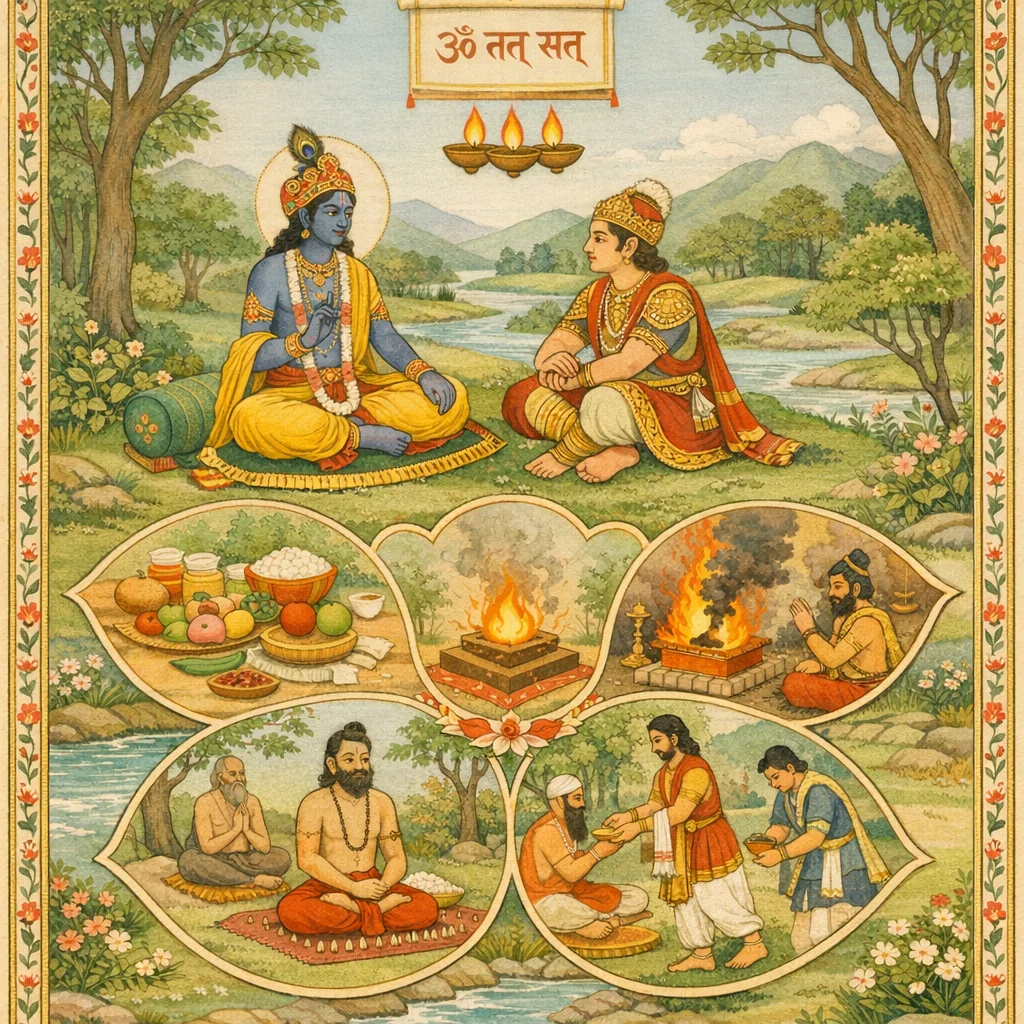
Chapter 17: Shraddhatraya Vibhaga Yoga
श्रद्धात्रयविभागयोग
The Yoga of Three Types of Faith
Chapter 17 opens with Arjuna’s epistemic and ethical question: when practitioners set aside scriptural injunctions yet act with conviction, what is the status of their faith? Krishna responds by mapping श्रद्धा (faith/intentional trust) onto the three guṇas—sattva, rajas, and tamas—showing that inner orientation is shaped by one’s psycho-ethical constitution. The chapter then extends this triadic analysis to the core disciplines of a dharmic life: food (āhāra), sacrifice/ritual action (yajña), austerity (tapas), and giving (dāna). Each can be sāttvika (clarifying and non-injurious), rājasa (instrumental and reward-seeking), or tāmasa (confused, negligent, or harmful). The arc culminates in the hermeneutic and soteriological formula “ॐ तत् सत्,” presented as a sanctifying orientation that purifies action by aligning it with Brahman and by removing possessiveness and craving for results. Thus, the chapter offers a diagnostic ethics of motivation and a practical taxonomy for transforming everyday practices into a disciplined Yoga of intention.
Speakers
Key Concepts
Philosophical Constructs
Shlokas in Chapter 17
Verse 1
अर्जुन उवाच । ये शास्त्रविधिमुत्सृज्य यजन्ते श्रद्धयान्विताः । तेषां निष्ठा तु का कृष्ण सत्त्वमाहो रजस्तमः ॥ १७.१ ॥
Arjuna said: O Krishna, those who, setting aside the injunctions of scripture, worship endowed with faith—what is their steadfastness? Is it of sattva, or of rajas, or of tamas?
Verse 2
श्रीभगवानुवाच । त्रिविधा भवति श्रद्धा देहिनां सा स्वभावजा । सात्त्विकी राजसी चैव तामसी चेति तां शृणु ॥ १७.२ ॥
The Blessed Lord said: Threefold is the faith of embodied beings, born of their own nature—sāttvika, rājasa, and tāmasa. Hear of it.
Verse 3
सत्त्वानुरूपा सर्वस्य श्रद्धा भवति भारत । श्रद्धामयोऽयं पुरुषो यो यच्छ्रद्धः स एव सः ॥ १७.३ ॥
O Bhārata, the faith of each is in accordance with his own sattva (inner disposition). This person is made of faith; whatever one’s faith is, that indeed he is.
Verse 4
यजन्ते सात्त्विका देवान्यक्षरक्षांसि राजसाः । प्रेतान्भूतगणांश्चान्ये यजन्ते तामसा जनाः ॥ १७.४ ॥
Sāttvika people worship the devas; rājasa people worship yakṣas and rākṣasas; others, the tāmasa people, worship pretas and hosts of bhūtas.
Verse 5
अशास्त्रविहितं घोरं तप्यन्ते ये तपो जनाः । दम्भाहंकारसंयुक्ताः कामरागबलान्विताः ॥ १७.५ ॥
Those people who perform dreadful austerities not enjoined by the śāstras, endowed with hypocrisy and egoism, and driven by desire, attachment, and force—
Verse 6
कर्षयन्तः शरीरस्थं भूतग्राममचेतसः । मां चैवान्तःशरीरस्थं तान्विद्ध्यासुरनिश्चयान् ॥ १७.६ ॥
Tormenting the aggregate of beings within the body, being without discernment, and also tormenting Me who dwells within the body—know them to be of demoniac resolve.
Verse 7
आहारस्त्वपि सर्वस्य त्रिविधो भवति प्रियः । यज्ञस्तपस्तथा दानं तेषां भेदमिमं शृणु ॥ १७.७ ॥
Even the food dear to each person is of three kinds; likewise sacrifice (yajña), austerity (tapas), and charity (dāna) are also of three kinds. Hear now this distinction among them.
Verse 8
आयुःसत्त्वबलारोग्यसुखप्रीतिविवर्धनाः । रस्याः स्निग्धाः स्थिरा हृद्या आहाराः सात्त्विकप्रियाः ॥ १७.८ ॥
Foods that increase longevity, purity (sattva), strength, health, happiness, and gladness—juicy, unctuous, nourishing, and pleasing to the heart—are dear to those of sattva.
Verse 9
कट्वम्ललवणात्युष्णतीक्ष्णरूक्षविदाहिनः । आहारा राजसस्येष्टा दुःखशोकामयप्रदाः ॥ १७.९ ॥
Foods that are bitter, sour, salty, excessively hot, pungent, dry, and burning are liked by those of rajas; they bring pain, grief, and disease.
Verse 10
यातयामं गतरसं पूति पर्युषितं च यत् । उच्छिष्टमपि चामेध्यं भोजनं तामसप्रियम् ॥ १७.१० ॥
Food that is stale, tasteless, putrid, decomposed, and left overnight; and that which is refuse and impure—such food is dear to those of tamas.
Verse 11
अफलाकाङ्क्षिभिर्यज्ञो विधिदृष्टो य इज्यते । यष्टव्यमेवेति मनः समाधाय स सात्त्विकः ॥ १७.११ ॥
That sacrifice which is performed according to scriptural ordinance by those who seek no fruit, with the mind firmly resolved that ‘this must be done’—that is sāttvika.
Verse 12
अभिसंधाय तु फलं दम्भार्थमपि चैव यत् । इज्यते भरतश्रेष्ठ तं यज्ञं विद्धि राजसम् ॥ १७.१२ ॥
But, O best of the Bharatas, that sacrifice which is performed with an eye to its fruit, and also for ostentation—know that sacrifice to be rājasa (of passion).
Verse 13
विधिहीनमसृष्टान्नं मन्त्रहीनमदक्षिणम् । श्रद्धाविरहितं यज्ञं तामसं परिचक्षते ॥ १७.१३ ॥
That sacrifice which is devoid of scriptural ordinance, without distribution of food, without mantra, without dakṣiṇā (sacrificial gift), and without faith—such a sacrifice is declared to be tāmasa (of darkness).
Verse 14
देवद्विजगुरुप्राज्ञपूजनं शौचमार्जवम् । ब्रह्मचर्यमहिंसा च शारीरं तप उच्यते ॥ १७.१४ ॥
Worship of the devas, the twice-born (brāhmaṇas), the guru, and the wise; purity, straightforwardness, brahmacarya, and ahiṃsā—this is called bodily tapas (austerity).
Verse 15
अनुद्वेगकरं वाक्यं सत्यं प्रियहितं च यत् । स्वाध्यायाभ्यसनं चैव वाङ्मयं तप उच्यते ॥ १७.१५ ॥
Speech that causes no agitation, that is truthful, pleasing and beneficial; and the practice of svādhyāya (study of sacred texts)—this is called tapas of speech.
Verse 16
मनः प्रसादः सौम्यत्वं मौनमात्मविनिग्रहः । भावसंशुद्धिरित्येतत्तपो मानसमुच्यते ॥ १७.१६ ॥
Serenity of mind, gentleness, silence, self-restraint, and purity of inner disposition—this is called mental tapas (austerity).
Verse 17
श्रद्धया परया तप्तं तपस्तत्त्रिविधं नरैः । अफलाकाङ्क्षिभिर्युक्तैः सात्त्विकं परिचक्षते ॥ १७.१७ ॥
That threefold austerity, performed with supreme faith by disciplined persons who seek no fruit, is called sāttvika.
Verse 18
सत्कारमानपूजार्थं तपो दम्भेन चैव यत् । क्रियते तदिह प्रोक्तं राजसं चलमध्रुवम् ॥ १७.१८ ॥
Austerity done for the sake of honor, respect, and worship, and with hypocrisy, is said to be rājasa—unstable and impermanent.
Verse 19
मूढग्राहेणात्मनो यत्पीडया क्रियते तपः । परस्योत्सादनार्थं वा तत्तामसमुदाहृतम् ॥ १७.१९ ॥
Austerity practiced with foolish obstinacy by tormenting oneself, or for the purpose of harming another, is declared tāmasa.
Verse 20
दातव्यमिति यद्दानं दीयतेऽनुपकारिणे । देशे काले च पात्रे च तद्दानं सात्त्विकं स्मृतम् ॥ १७.२० ॥
Charity given as a duty, to one who offers no return, at the proper place and time and to a worthy recipient, is remembered as sāttvika.
Verse 21
यत्तु प्रत्युपकारार्थं फलमुद्दिश्य वा पुनः । दीयते च परिक्लिष्टं तद्दानं राजसं स्मृतम् ॥ १७.२१ ॥
But charity given with the aim of getting something in return, or with reward in view, and given with reluctance, is remembered as rājasa.
Verse 22
अदेशकाले यद्दानमपात्रेभ्यश्च दीयते । असत्कृतमवज्ञातं तत्तामसमुदाहृतम् ॥ १७.२२ ॥
Charity that is given at an improper place and time, and to unworthy recipients, without honor or with contempt, is declared to be tāmasa (of darkness).
Verse 23
ॐतत्सदिति निर्देशो ब्रह्मणस्त्रिविधः स्मृतः । ब्राह्मणास्तेन वेदाश्च यज्ञाश्च विहिताः पुरा ॥ १७.२३ ॥
‘Om, Tat, Sat’—this is remembered as the threefold designation of Brahman; by that, in ancient times, the Brāhmaṇas, the Vedas, and the sacrifices were ordained.
Verse 24
तस्माद ॐ द्दत्युदाहृत्य यज्ञदानतपःक्रियाः । प्रवर्तन्ते विधानोक्ताः सततं ब्रह्मवादिनाम् ॥ १७.२४ ॥
Therefore, uttering ‘Om,’ the acts of sacrifice, charity, and austerity enjoined by scripture are always undertaken by the knowers who speak of Brahman.
Verse 25
तदित्यनभिसन्धाय फलं यज्ञतपःक्रियाः । दानक्रियाश्च विविधाः क्रियन्ते मोक्षकाङ्क्षिभिः ॥ १७.२५ ॥
Uttering ‘Tat,’ without aiming at the fruit, acts of sacrifice and austerity, and various acts of charity, are performed by those who seek liberation.
Verse 26
सद्भावे साधुभावे च सदित्येतत्प्रयुज्यते । प्रशस्ते कर्मणि तथा सच्छब्दः पार्थ युज्यते ॥ १७.२६ ॥
The word ‘Sat’ is used in the sense of true being (existence) and of the good (noble) disposition; and likewise, O Pārtha, the word ‘Sat’ is used for a praiseworthy act.
Verse 27
यज्ञे तपसि दाने च स्थितिः सदिति चोच्यते । कर्म चैव तदर्थीयं सदित्येवाभिधीयते ॥ १७.२७ ॥
Steadfastness in sacrifice, austerity, and charity is also called “sat”; and action done for the sake of that (sacrifice, austerity, and charity) is likewise designated “sat” alone.
Verse 28
अश्रद्धया हुतं दत्तं तपस्तप्तं कृतं च यत् । असदित्युच्यते पार्थ न च तत्प्रेत्य नो इह ॥ १७.२८ ॥
But whatever is offered, given, or practiced as austerity without faith—and whatever else is done—O Pārtha, is called “asat”; it bears no fruit here or hereafter.
Frequently Asked Questions
The chapter treats faith as a psychological orientation shaped by one’s guṇa-constitution: motivation, preferences, and habits are not neutral, and inner quality determines whether practices clarify the mind (sattva), agitate it through craving (rajas), or dull it through confusion and neglect (tamas).
Actions become spiritually meaningful when aligned with Brahman-oriented intention rather than egoic ownership; the formula “ॐ तत् सत्” signifies consecration, pointing beyond the doer’s self-interest toward reality as it is (sat) and toward liberation-oriented action.
Arjuna’s question about non-scriptural yet sincere practice is answered by a criterion: sincerity alone is insufficient—faith and practice must be assessed by their guṇa-based quality, their adherence to disciplined method, and their freedom from fruit-seeking or delusion.
Use the triadic lens to audit daily choices—nutrition, work rituals, self-discipline, and generosity—by asking: Does this increase clarity and steadiness (sattva), feed status/anxiety and reward-chasing (rajas), or promote avoidance and confusion (tamas)? Then consecrate outcomes by reducing attachment to results and prioritizing ethical intention.