
Bhagavad Gita — Shraddhatraya Vibhaga Yoga, Shloka 9
Shraddhatraya Vibhaga Yoga
कट्वम्ललवणात्युष्णतीक्ष्णरूक्षविदाहिनः । आहारा राजसस्येष्टा दुःखशोकामयप्रदाः ॥ १७.९ ॥
kaṭv-amla-lavaṇāty-uṣṇa-tīkṣṇa-rūkṣa-vidāhinaḥ | āhārā rājasasyeṣṭā duḥkha-śokāmaya-pradāḥ || 17.9 ||

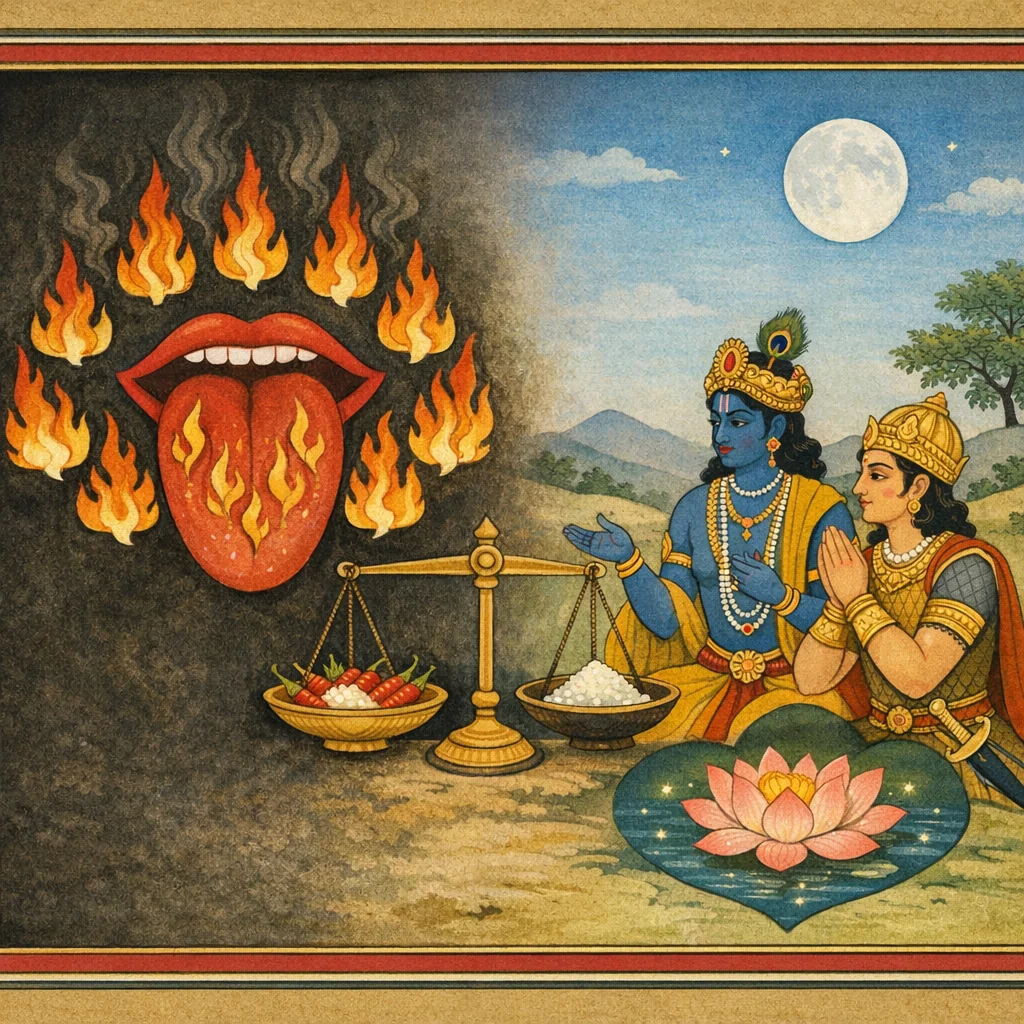
Foods that are bitter, sour, salty, excessively hot, pungent, dry, and burning are liked by those of rajas; they bring pain, grief, and disease.
जो भोजन कड़वे, खट्टे, लवणयुक्त, अत्यन्त गरम, तीखे, रूखे और जलाने वाले होते हैं, वे राजस पुरुषों को प्रिय हैं और वे दुःख, शोक तथा रोगों को देने वाले हैं।
Foods that are bitter, sour, salty, excessively hot, pungent, dry, and burning are liked by those of rajas; they tend toward discomfort, distress, and illness.
Some translations emphasize physiological effects (‘cause disease’), while academic renderings often treat the list as an Ayurvedic-style profile indicating agitation and imbalance; ‘duḥkha-śoka’ can be read broadly as discomfort and mental distress.
FAQs
The verse associates highly stimulating tastes with a more restless temperament, implying a feedback loop between sensory stimulation and mental agitation.
Rajas is the modality of activity and craving; the dietary description illustrates how rajas expresses itself through preference and how it conditions experience toward dissatisfaction.
It is the middle term in the diet triad, contrasting sattvic nourishment (17.8) with tamasic degeneration (17.10).
It can be read as cautioning against overreliance on intensely stimulating foods when seeking calm attention, while not necessarily condemning all strong flavors in moderation.