
Bhagavad Gita — Shraddhatraya Vibhaga Yoga, Shloka 4
Shraddhatraya Vibhaga Yoga
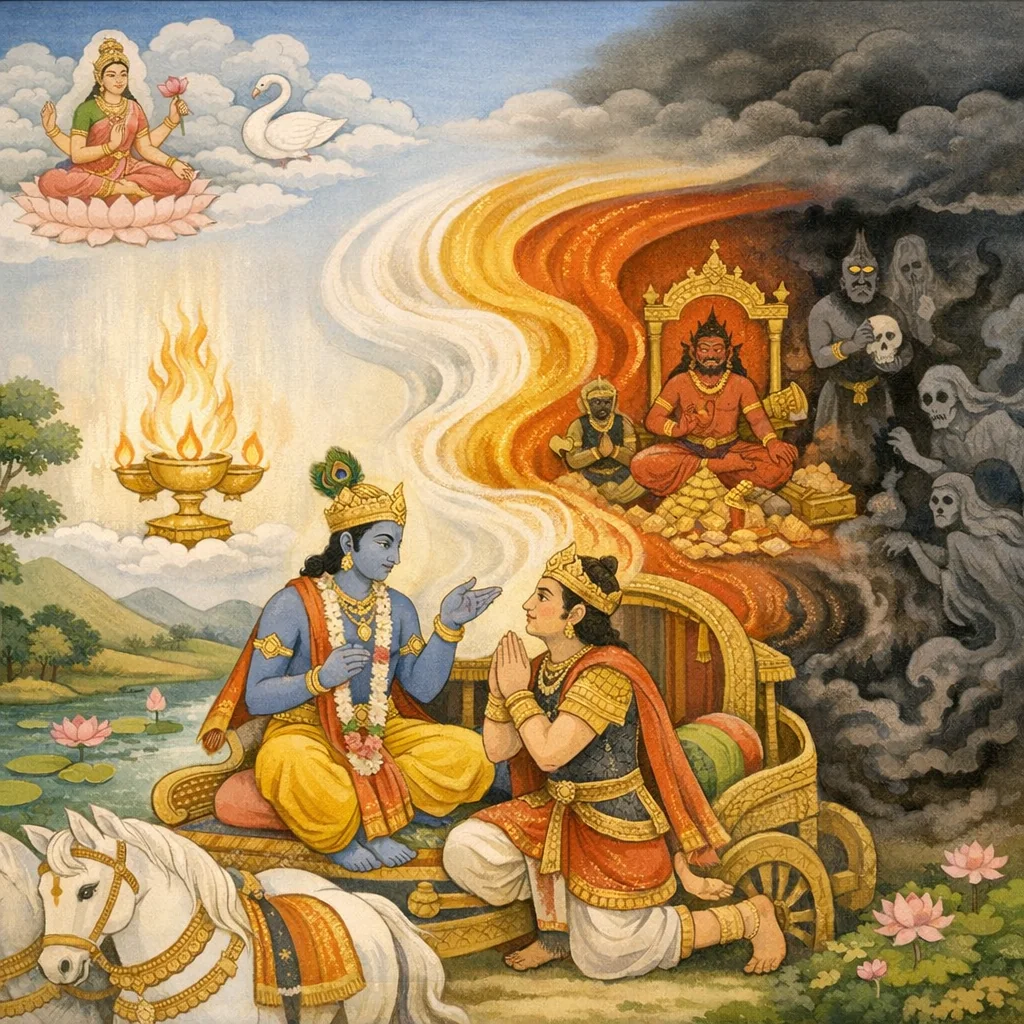
यजन्ते सात्त्विका देवान्यक्षरक्षांसि राजसाः । प्रेतान्भूतगणांश्चान्ये यजन्ते तामसा जनाः ॥ १७.४ ॥
yajante sāttvikā devān yakṣa-rakṣāṁsi rājasāḥ | pretān bhūta-gaṇāṁś cānye yajante tāmasā janāḥ || 17.4 ||

Sāttvika people worship the devas; rājasa people worship yakṣas and rākṣasas; others, the tāmasa people, worship pretas and hosts of bhūtas.
सात्त्विक लोग देवताओं को पूजते हैं, राजस लोग यक्षों और राक्षसों को; तथा अन्य तामस लोग प्रेतों और भूतगणों को पूजते हैं।
Sattvic people worship the gods; rajasic people worship yakṣas and rākṣasas; others, tamasic people, worship the departed (preta) and groups of spirits (bhūtas).
The verse reflects ancient South Asian religious plurality. Terms like yakṣa/rākṣasa/preta/bhūta function as culturally specific categories of beings; academically they can be read as markers of differing ritual aims (uplifting, power-seeking, or fear-driven) rather than a claim about a single ‘true’ cult.
FAQs
The classification can be read as mapping motivations: clarity and aspiration (sattva), ambition for power or results (rajas), and anxiety or confusion (tamas) influencing what one venerates.
Within the Gītā, the object of worship corresponds to the practitioner’s guṇa and shapes outcomes; devotion is not value-neutral but oriented by the quality of consciousness.
It operationalizes 17.2–3 by linking types of faith to concrete religious objects familiar in the period’s ritual landscape.
As a contemporary lens, it invites examination of what we ‘worship’—status, power, or ideals—and how those commitments reflect and reinforce our mental qualities.