
Bhagavad Gita — Shraddhatraya Vibhaga Yoga, Shloka 3
Shraddhatraya Vibhaga Yoga
सत्त्वानुरूपा सर्वस्य श्रद्धा भवति भारत । श्रद्धामयोऽयं पुरुषो यो यच्छ्रद्धः स एव सः ॥ १७.३ ॥
sattvānurūpā sarvasya śraddhā bhavati bhārata | śraddhā-mayo 'yaṁ puruṣo yo yac-chraddhaḥ sa eva saḥ || 17.3 ||

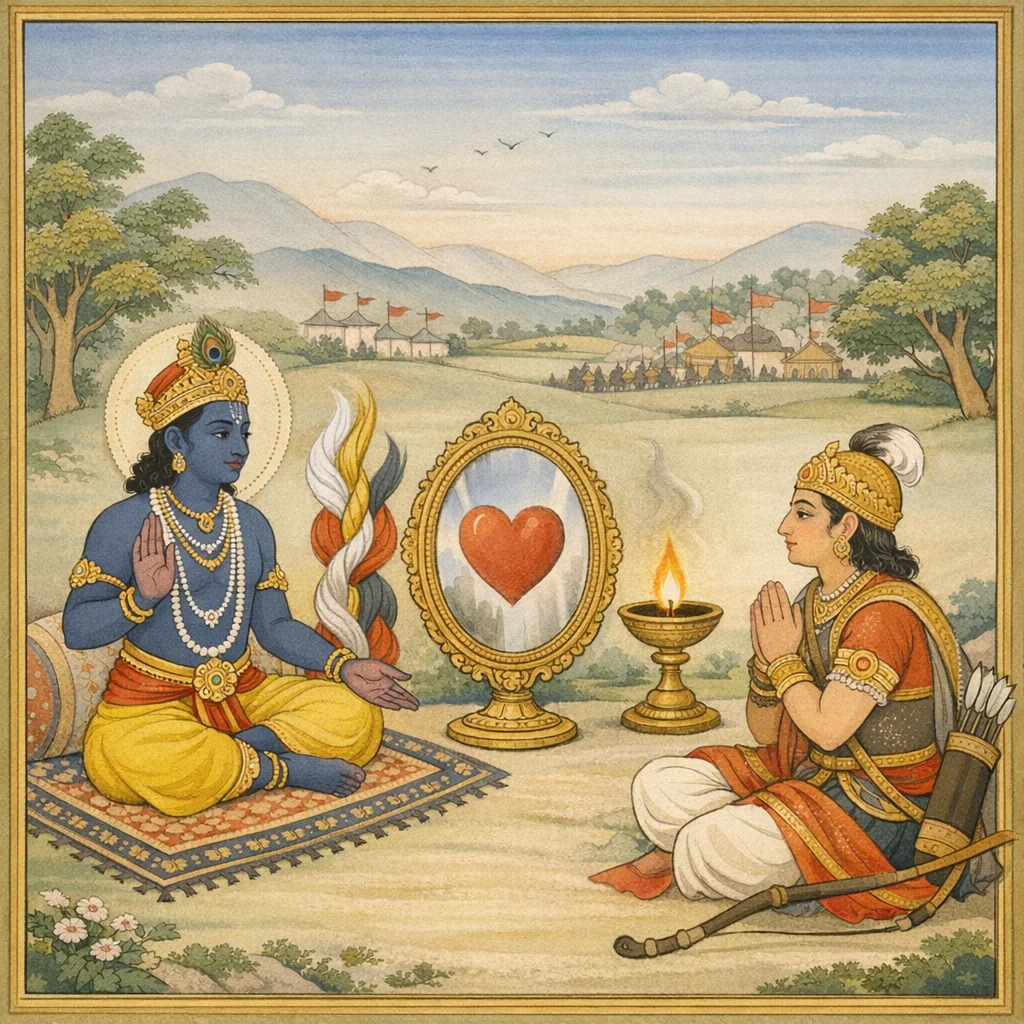
O Bhārata, the faith of each is in accordance with his own sattva (inner disposition). This person is made of faith; whatever one’s faith is, that indeed he is.
हे भारत! सबकी श्रद्धा उनके अन्तःकरण के अनुसार होती है। यह पुरुष श्रद्धामय है; जो जैसी श्रद्धा वाला है, वह वैसा ही है।
O Bhārata, everyone’s faith conforms to their inner constitution (sattva/being). A person is made of faith; whatever one’s faith is, that indeed one becomes/is.
‘सत्त्व’ here can mean ‘inner constitution/being’ and not only the guṇa ‘sattva’ in a narrow sense; translators vary. The aphoristic second line is often taken as a thesis about identity being shaped by deep commitments.
FAQs
The verse highlights that enduring commitments and valuations (‘faith’) shape perception and behavior, effectively forming one’s character and sense of self.
In a guṇa-conditioned world, the quality of faith influences one’s orientation toward the real and the good; thus spiritual trajectory depends on the refinement of faith.
It provides the principle behind the chapter’s classifications: practices and objects of devotion reflect the practitioner’s underlying disposition.
It can be used as reflective guidance: examine what you implicitly trust and value, since those commitments gradually become your habits and identity.