Adhyaya 14
Chapter 14: Divyāstra-Prayoga and Ṛṣi Intervention (दिव्यास्त्रप्रयोगः ऋषिसमागमश्च)
Upa-parva: Astra-Śamana (Pacification of the Divine Weapons) Episode
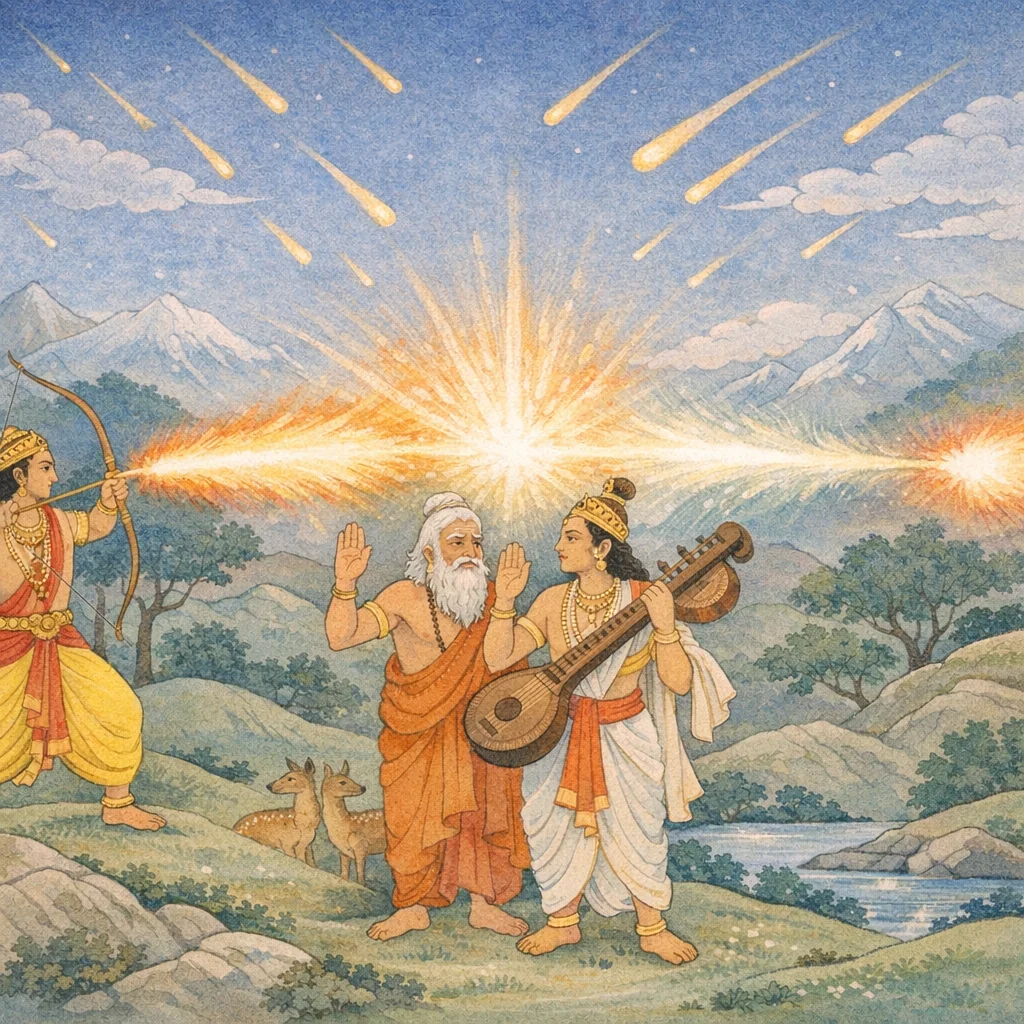
Vaiśaṃpāyana reports that Kṛṣṇa, reading the situation through signs, addresses Arjuna and instructs him to deploy the divine weapon residing ‘in his heart’—the one taught by Droṇa—specifically for the protection of his brothers and himself, as an astranivāraṇa countermeasure. Arjuna dismounts swiftly with Gāṇḍīva readied, offers formal assurances and salutations (to deities and gurus), and releases the weapon while meditating on Śiva, explicitly aiming to neutralize weapon-force with weapon-force. The two weapons—Arjuna’s and Droṇa’s son’s—ignite with apocalyptic radiance, producing thunderous sounds, meteor falls, fear among beings, and tremors across the earth. At the height of this destabilization, two sages—Nārada and the dharmic pitāmaha of the Bharatas—appear between the blazing energies, positioned as impartial stabilizers seeking the welfare of all beings, and begin to address the unprecedented nature of such weapon deployment among humans.
Chapter Arc: अश्वत्थामा के उन्मत्त, विनाशकारी संकल्प को श्रीकृष्ण पहले ही भाँप लेते हैं और अर्जुन को संकेत देते हैं कि अब केवल साधारण शस्त्र नहीं—अस्त्र-निवारक ब्रह्मास्त्र ही प्राण-रक्षा का उपाय है। → कृष्ण के वचन पर अर्जुन अपने आचार्यपुत्र (अश्वत्थामा) और स्वयं तथा समस्त भाइयों की रक्षा हेतु ब्रह्मास्त्र का संधान करते हैं; गाण्डीव से छूटा तेज युगान्त-अग्नि-सा प्रज्वलित होता है, आकाश में उल्कापात और वज्र-नाद जैसे निर्घात होने लगते हैं, और समस्त प्राणियों में महाभय व्याप्त हो जाता है। → दोनों ओर के ब्रह्मास्त्रों का तेज लोकों को संतप्त करने लगता है; तभी सर्वधर्मज्ञ, सर्वभूतहितैषी महर्षि वेदव्यास और देवर्षि नारद उन दीप्त अस्त्रों के मध्य प्रकट होकर इस महात्यय को रोकने के लिए खड़े होते हैं और दोनों वीरों को धिक्कारते हुए कहते हैं कि मनुष्यों में ऐसा अस्त्र-प्रयोग पूर्व महरथियों ने भी नहीं किया—यह साहस विनाश का द्वार है। → व्यास-नारद लोकहित के लिए अस्त्र-तेज शमन का उपदेश देते हैं—युद्ध-क्रोध को धर्म-बुद्धि से बाँधते हैं और संकेत करते हैं कि ब्रह्मास्त्र का मार्ग ‘विजय’ नहीं, ‘प्रलय’ है; अध्याय का स्वर अस्त्र-निवारण की ओर मुड़ता है। → अस्त्रों का तेज अभी भी दहक रहा है—अब प्रश्न यह है कि कौन अपने अस्त्र को वापस ले सकेगा, और जो न लौटा सका उसका दण्ड किस रूप में प्रकट होगा?
Shlokas
Verse 1
अप ह बछ। ] अत्ऑकाए:<ह चतुर्दशो 5 ध्याय: अश्वत्थामाके अस्त्रका निवारण करनेके लिये अर्जुनके द्वारा ब्रह्मास्त्रका प्रयोग एवं वेदव्यासजी और देवर्षि नारदका प्रकट होना वैशम्पायन उवाच इड्धितेनैव दाशा्हस्तमभिप्रायमादित: । द्रौणे्बुदध्वा महाबाहुरर्जुन॑ प्रत्यभाषत
Vaiśampāyana said: Having from the outset clearly grasped the intention behind Aśvatthāmā’s act, the mighty-armed Arjuna addressed him directly. The verse frames Arjuna’s response as deliberate and discerning—an ethical counter to a reckless escalation of violence, setting the stage for restraining destructive weaponry rather than answering rage with blind retaliation.
Verse 2
वैशम्पायनजी कहते हैं--राजन! दशार्हनन्दन महाबाहु भगवान् श्रीकृष्ण अश्व॒ृत्थामाकी चेष्टासे ही उसके मनका भाव पहले ही ताड़ गये थे। उन्होंने अर्जुनसे कहा -- || अश्वत्थामा एवं अर्जुनके छोड़े हुए ब्रह्मास्त्रोंको शान्त करनेके लिये नारदजी और व्यासजीका आगमन अर्जुनार्जुन यदिव्यमस्त्र ते हृदि वर्तते । द्रोणोपदिष्टं तस्थायं काल: सम्प्रति पाण्डव,“अर्जुन! अर्जुन! पाण्डुनन्दन! आचार्य द्रोणका उपदेश किया हुआ जो दिव्य अस्त्र तुम्हारे हृदयमें विद्यमान है, उसके प्रयोगका अब यह समय आ गया है
Vaiśampāyana said: O King, the mighty-armed Lord Śrī Kṛṣṇa, the delight of the Daśārhas, had already discerned Aśvatthāmā’s intention and the state of his mind. He then addressed Arjuna: “Arjuna, Arjuna—O son of Pāṇḍu! The divine weapon taught to you by Droṇa that abides within your heart—now is the time to employ it.”
Verse 3
भ्रातृणामात्मनश्वैव परित्राणाय भारत | विसृजैतत् त्वमप्याजावस्त्रमस्त्रनिवारणम्,“भरतनन्दन! भाइयोंकी और अपनी रक्षाके लिये तुम भी युद्धमें इस ब्रह्मास्त्रका प्रयोग करो। अभश्व॒त्थामाके अस्त्रका निवारण इसीके द्वारा हो सकता है”
Vaiśaṃpāyana said: “O descendant of Bharata, for the protection of your brothers and of yourself, you too should release this weapon in battle—the counter-weapon that can neutralize the oncoming missile. In the face of a destructive astric assault, the counsel given here frames retaliation not as vengeance but as a compelled act of defense, undertaken to preserve life and avert a greater calamity.”
Verse 4
केशवेनैवमुक्तो5थ पाण्डव: परवीरहा । अवातरद् रथात् तूर्ण प्रगृह्ा सशरं धनु:,भगवान् श्रीकृष्णके ऐसा कहनेपर शत्रुवीरोंका संहार करनेवाले पाण्डुपुत्र अर्जुन धनुष- बाण हाथमें लेकर तुरंत ही रथसे नीचे उतर गये
Vaiśampāyana said: Thus addressed by Keśava, the Pāṇḍava—Arjuna, slayer of hostile heroes—quickly descended from the chariot, taking up his bow together with arrows, ready to act in accordance with Kṛṣṇa’s directive amid the grim duties of war.
Verse 5
पूर्वमाचार्यपुत्राय ततो5नन्तरमात्मने । भ्रातृभ्यश्चैव सर्वेभ्य: स्वस्तीत्युक्त्वा परंतप:,शत्रुओंको संताप देनेवाले अर्जुनने सबसे पहले यह कहा कि “आचार्यपुत्रका कल्याण हो'। तत्पश्चात् अपने और सम्पूर्ण भाइयोंके लिये मंगल-कामना करके उन्होंने देवताओं और सभी गुरुजनोंको नमस्कार किया। इसके बाद “इस ब्रह्मास्त्रसे शत्रुका ब्रह्मास्त्र शान्त हो जाय' ऐसा संकल्प करके सबके कल्याणकी भावना करते हुए अपना दिव्य अस्त्र छोड़ दिया
Vaiśampāyana said: First he invoked well-being for the son of the teacher; next, for himself; and then for all his brothers. Having thus uttered “svasti” (a benediction), the scorcher of foes proceeded—acting with a mind set on the welfare of all, even amid the violence of war—toward the use of his divine weapon to quell the enemy’s Brahmāstra.
Verse 6
देवताभ्यो नमस्कृत्य गुरुभ्यश्चैव सर्वश: । उत्ससर्ज शिवं ध्यायन्नस्त्रमस्त्रेण शाम्पताम्,शत्रुओंको संताप देनेवाले अर्जुनने सबसे पहले यह कहा कि “आचार्यपुत्रका कल्याण हो'। तत्पश्चात् अपने और सम्पूर्ण भाइयोंके लिये मंगल-कामना करके उन्होंने देवताओं और सभी गुरुजनोंको नमस्कार किया। इसके बाद “इस ब्रह्मास्त्रसे शत्रुका ब्रह्मास्त्र शान्त हो जाय' ऐसा संकल्प करके सबके कल्याणकी भावना करते हुए अपना दिव्य अस्त्र छोड़ दिया
Having bowed in reverence to the gods and likewise to all his teachers, he released his divine weapon while meditating on auspiciousness, resolving: “May this weapon, by means of my weapon, be pacified.” The act is framed not as vengeance but as a disciplined, welfare-oriented restraint—neutralizing a destructive force while honoring divine and guru authority.
Verse 7
ततस्तदस्त्रं सहसा सृष्टं गाण्डीवधन्चना । प्रजज्वाल महार्चिष्मद् युगान्तानलसंनिभम्,गाण्डीवधारी अर्जुनके द्वारा छोड़ा गया वह ब्रह्मास्त्र सहसा प्रज्वलित हो उठा। उससे प्रलयाग्निके समान बड़ी-बड़ी लपटें उठने लगीं
Vaiśampāyana said: Then that missile, suddenly released by the wielder of Gāṇḍīva, blazed forth at once—radiant with immense flames, resembling the fire at the end of an age. The scene underscores how the unleashing of supreme weapons in war escalates destruction beyond human measure, pressing the combatants toward restraint and responsibility even amid vengeance and chaos.
Verse 8
तथैव द्रोणपुत्रस्य तदस्त्र॑ तिग्मतेजस: । प्रजज्वाल महाज्वालं तेजोमण्डलसंवृतम्,इसी प्रकार प्रचण्ड तेजस्वी द्रोणपुत्रका वह अस्त्र भी तेजोमण्डलसे घिरकर बड़ी-बड़ी ज्वालाओंके साथ जलने लगा
Vaiśaṃpāyana said: In the same manner, the terrible weapon of Droṇa’s son—keen in splendor—blazed forth, wrapped in a circle of radiance, flaring with great tongues of flame. The scene underscores how, in the night of slaughter, martial power escalates beyond human restraint, turning the battlefield into a moral and physical conflagration.
Verse 9
निर्घाता बहवश्चासन् पेतुरुल्का: सहस्रशः । महद् भयं च भूतानां सर्वेषां समजायत,उस समय बारंबार वज्रपातके समान शब्द होने लगे, आकाशसे सहस्रों उल्काएँ टूट- टूटकर गिरने लगीं और समस्त प्राणियोंपर महान् भय छा गया
Vaiśampāyana said: Many thunderous crashes resounded like lightning-strikes; thousands of meteors fell from the sky, and a great fear seized all living beings. The narrative frames these portents as nature’s ominous response to adharma and impending calamity, intensifying the moral darkness surrounding the night’s events.
Verse 10
सशब्दम भवद् व्योम ज्वालामालाकुलं भृशम् | चचाल च मही कृत्स्ना सपर्वतवनद्रुमा,सारा आकाश आगकी प्रचण्ड ज्वालाओंसे व्याप्त हो उठा और वहाँ जोर-जोरसे शब्द होने लगा। पर्वत, वन, और वृक्षोंसहित सारी पृथ्वी हिलने लगी
Vaiśampāyana said: The sky became filled with loud, ominous sounds and was thickly crowded with fierce garlands of flame. The entire earth, together with its mountains, forests, and trees, began to tremble—portents that mirror the moral disorder and the violent aftermath of the night’s deeds in the Sauptika episode.
Verse 11
ते त्वस्त्रतेजसी लोकांस्तापयन्ती व्यवस्थिते । महर्षी सहितौ तत्र दर्शयामासतुस्तदा
Vaiśampāyana said: Those two, established there, were blazing with the fiery power of weapons, scorching the worlds. At that moment, in that very place, they revealed themselves together as great seers—making their presence known to restrain the destructive force and restore moral order amid the aftermath of war.
Verse 12
उभौ शमयितुं वीरौ भारद्वाजधनंजयौ,सम्पूर्ण धर्मोके ज्ञाता तथा समस्त प्राणियोंके हितैषी वे दोनों परम तेजस्वी मुनि अश्वत्थामा और अर्जुन--इन दोनों वीरोंको शान्त करनेके लिये इनके प्रज्वलित अस्त्रोंके बीचमें खड़े हो गये
Vaiśampāyana said: To pacify those two heroes—Bhāradvāja’s son (Aśvatthāmā) and Dhanañjaya (Arjuna)—the two supremely radiant sages, fully grounded in dharma, wise in discernment, and devoted to the welfare of all living beings, stood between their blazing, readied weapons, seeking to restrain the conflict before it could bring wider ruin.
Verse 13
तौ मुनी सर्वधर्मज्ञौ सर्वभूतहितैषिणौ । दीप्तयोरस्त्रयोर्म ध्ये स्थितो परमतेजसौ,सम्पूर्ण धर्मोके ज्ञाता तथा समस्त प्राणियोंके हितैषी वे दोनों परम तेजस्वी मुनि अश्वत्थामा और अर्जुन--इन दोनों वीरोंको शान्त करनेके लिये इनके प्रज्वलित अस्त्रोंके बीचमें खड़े हो गये
Vaiśampāyana said: Those two sages, knowing the whole of dharma and devoted to the welfare of all beings, stood between the two blazing weapons—radiant with supreme splendor—so as to pacify the two heroes, Aśvatthāmā and Arjuna. The scene underscores that even amid apocalyptic force, the highest authority is restraint guided by dharma and compassion for all life.
Verse 14
तदन्तरमथाधृष्यावुपगम्य यशस्विनौ । आस्तामृषिवरीौ तत्र ज्वलिताविव पावकौ,उन अस्त्रोंके बीचमें आकर वे दुर्धर्ष एवं यशस्वी महर्षिप्रवर दो प्रज्वलित अग्नियोंके समान वहाँ स्थित हो गये इति श्रीमहाभारते सौप्तिकपर्वणि ऐषीकपर्वणि अर्जुनास्त्रत्यागे चतुर्दशो5ध्याय: ।। १४ || इस प्रकार श्रीमह्याभारत सौप्तिकपर्वके अन्तर्गत ऐषीकपर्वमें अर्जुनिके द्वारा ब्रह्मास्रका प्रयोगविषयक चौदहवाँ अध्याय पूरा हुआ
Then, in the midst of that perilous interval, the two unassailable and illustrious sages approached and stood there—like two blazing fires. Their sudden presence amid the clash of divine weapons signals a moral intervention: when destructive power threatens to exceed rightful limits, the authority of ascetic wisdom enters to restrain and restore dharma.
Verse 15
प्राणभृद्धिरनाधृष्यौ देवदानवसम्मतौ । अस्त्रतेज: शमयितुं लोकानां हितकाम्यया,कोई भी प्राणी उन दोनोंका तिरस्कार नहीं कर सकता था। देवता और दानव दोनों ही उनका सम्मान करते थे। वे समस्त लोकोंके हितकी कामनासे उन अस्त्रोंके तेजको शान्त करानेके लिये वहाँ आये थे
Verse 16
ऋषी ऊचतुः नानाशस्त्रविद: पूर्वे येडप्यतीता महारथा: । नैतदस्त्रं मनुष्येषु तैः प्रयुक्ते कथंचन । किमिदं साहसं वीरी कृतवन्तौ महात्ययम्,उन दोनों ऋषियोंने उन दोनों वीरोंसे कहा--“वीरो! पूर्वकालमें भी जो बहुत-से महारथी हो चुके हैं, वे नाना प्रकारके शस्त्रोंके जानकार थे, परंतु उन्होंने किसी प्रकार भी मनुष्योंपर इस अस्त्रका प्रयोग नहीं किया था। तुम दोनोंने यह महान् विनाशकारी दुःसाहस क्यों किया है?
The two sages said: “O heroes, even in former times many great chariot-warriors lived—masters of weapons of every kind—yet they never, in any circumstance, employed this missile against human beings. Why have you two committed this reckless act, bringing about a great and ruinous calamity?”
Verse 116
नारद: सर्वभूतात्मा भरतानां पितामह: । उन दोनों अस्त्रोंक तेज समस्त लोकोंको संतप्त करते हुए वहाँ स्थित हो गये। उस समय वहाँ सम्पूर्ण भूतोंके आत्मा नारद तथा भरतवंशके पितामह व्यास--इन दो महर्षियोंने एक साथ दर्शन दिया
Vaiśaṃpāyana said: As the blazing energy of those two weapons scorched the worlds, Nārada—called the very soul of all beings—and Vyāsa, the grandsire of the Bharata lineage, appeared there together. Their sudden presence signals that when destructive power threatens to exceed moral limits, the highest seers intervene to restore restraint and right order.
Frequently Asked Questions
Whether countering a catastrophic divyāstra with another divyāstra can be justified for protection without triggering uncontrolled harm to the wider world-order.
Force must be deployed with explicit protective intent, procedural discipline (salutations, dhyāna), and an orientation toward neutralization rather than vengeance.
Yes—ṛṣi intervention functions as an epic-level governance mechanism, indicating that supra-human technologies (divyāstras) require higher ethical arbitration when human conflict threatens collective existence.