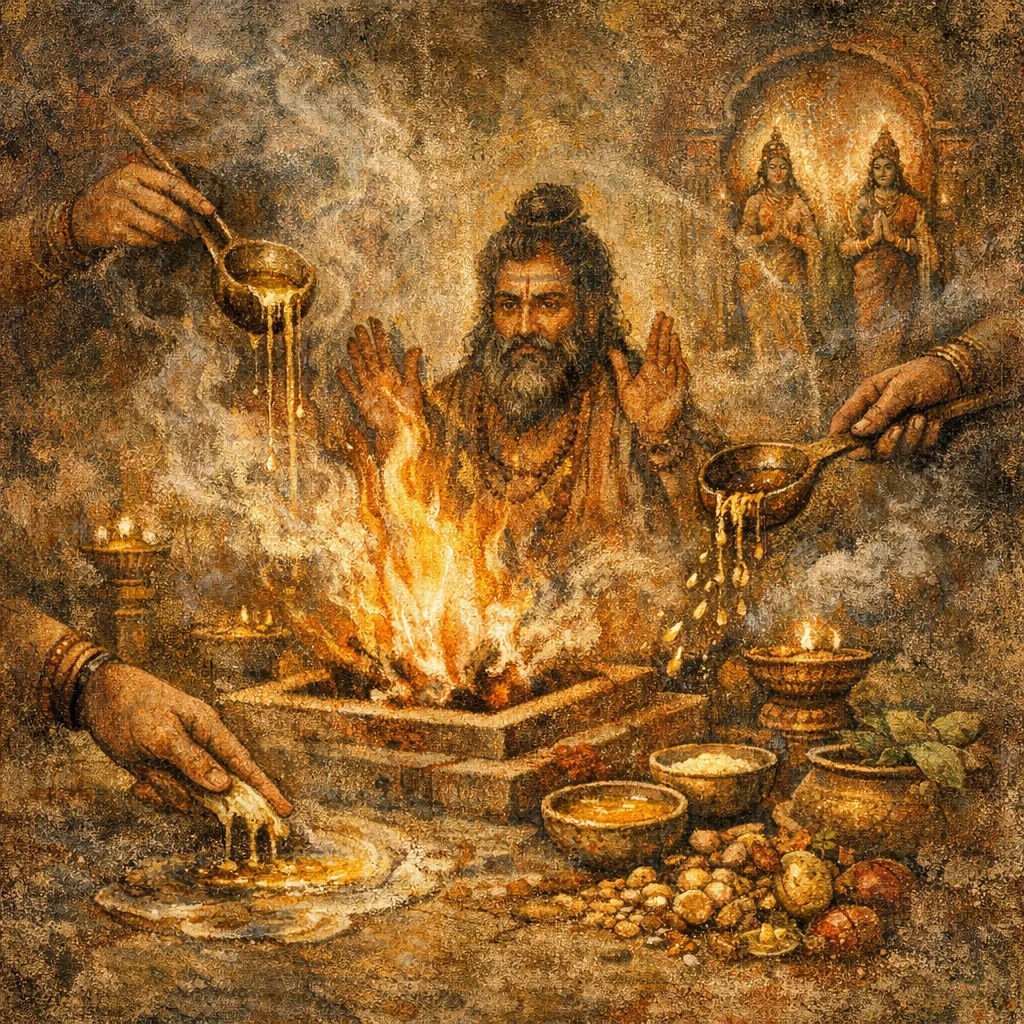
Sukta 27
Rishi: Traditionally Angiras/Atharvanic attribution for Agni-yajña material (exact r̥ṣi for AV 5.27 requires recension-specific anukramaṇī confirmation).
Devata: Agni
Chandas: Mixed; predominantly triṣṭubh/jagatī-like cadence in this hymn section (meter requires full pada scansion).
Mantras
Mantra 1
अग्निः। ऊर्ध्वा अस्य समिधो भवन्त्यूर्ध्वा शुक्रा शोचीष्यग्नेः । द्युमत्तमा सुप्रतीकः ससूनुस्तनूनपादसुरो भूरिपाणिः
Agni—upright rise his kindlings; upright, bright are the flames of Agni. Most splendid, fair of form, with offspring, Tanūnapāt, lordly, wide-handed is he.
Mantra 2
देवो देवेषु देवः पथो अनक्ति मध्वा घृतेन
The god, a god among the gods, anoints the paths with sweetness, with ghee.
Mantra 3
मध्वा यज्ञं नक्षति प्रैणानो नराशंसो अग्निः सुकृद् देवः सविता विश्ववारः
With sweetness he brings the sacrifice to attainment—Agni Nārāśaṃsa, impelling it onward; the well-doing god, Savitar, all-desirable.
Mantra 4
अछायमेति शवसा घृता चिदीडानो वह्निर्नमसा
Hither this bearer advances with might—ghee-fed indeed—praised with reverence.
Mantra 5
अग्निः स्रुचो अध्वरेषु प्रयक्षु स यक्षदस्य महिमानमग्नेः
Agni, amid the solemn rites, with ladles—sacrifice thou forth: may he indeed perform the offering, (making manifest) the majesty of Agni here.
Mantra 6
तरी मन्द्रासु प्रयक्षु वसवश्चातिष्ठन् वसुधातरश्च
Pass thou across, amid the gladdening strains; sacrifice thou forth: the Vasus have taken their station, and the wealth-upholders (stand) as well.
Mantra 7
द्वारो देवीरन्वस्य विश्वे व्रतं रक्षन्ति विश्वहा
The Doors, goddesses, attendant thereon—all of them—guard the holy ordinance, day by day for evermore.
Mantra 8
उरुव्यचसाऽग्नेर्धाम्ना पत्यमाने । आ सुष्वयन्ती यजते उपाके उषासानक्तेमं यज्ञमवतामध्वरं नः।
By Agni’s wide-spreading might, by his established splendour as he rules—hither, sweet-sounding, near unto the worshipper—let Dawn and Night protect this sacrifice, our solemn rite.
Mantra 9
दैवा होतार ऊर्ध्वमध्वरं नोऽग्नेर्जिह्वयाभि गृणत गृनता नः स्विऽष्टये । तिस्रो देवीर्बर्हिरेदं सदन्तामिडा सरस्वती मही भारती गृणाना
Ye divine Hotars, raise ye aloft our solemn rite; with Agni’s tongue sing forth upon it—praising, for our well-offering. Let the three goddesses sit down upon this sacred grass: Iḍā, Sarasvatī, great Bhāratī, hymning.
Mantra 10
तन्नस्तुरीपमद्भुतं पुरुक्षु। देव त्वष्टा रायस्पोषं वि ष्य नाभिमस्य
May that, for us, be swift in aid, a marvel among the many homes: let the god Tvaṣṭṛ spread abroad increase of wealth, even to the navel-centre of this (man).
Mantra 11
वनस्पतेऽव सृजा रराणः । त्मना देवेभ्यो अग्निर्हव्यं शमिता स्वदयतु
O Lord of the Wood, rejoicing, send it forth: of himself let Agni, the pacifier, make the oblation sweet for the Gods.
Mantra 12
अग्ने स्वाहा कृणुहि जातवेदः । इन्द्राय यज्ञं विश्वे देवा हविरिदं जुषन्ताम्
O Agni, Jātavedas, make (it) with Svāhā: for Indra (be) the sacrifice; let all the Gods accept with favour this oblation.
Frequently Asked Questions
To make the homa/sacrifice steady and successful by activating Agni as the carrier of offerings and pacifier of obstacles, so the oblation is accepted and yields prosperity.
Vanaspati represents the sacrificial wood/fuel that ‘releases’ and supports the offering-process; paired with Agni, it ensures the fire is properly sustained and the havis is properly conveyed.
A properly established fire (Agni), ghee (ghṛta), an offering ladle (srúc), suitable fuel/wood (vanaspati), and the intended oblation (havis), used in a simple homa sequence.