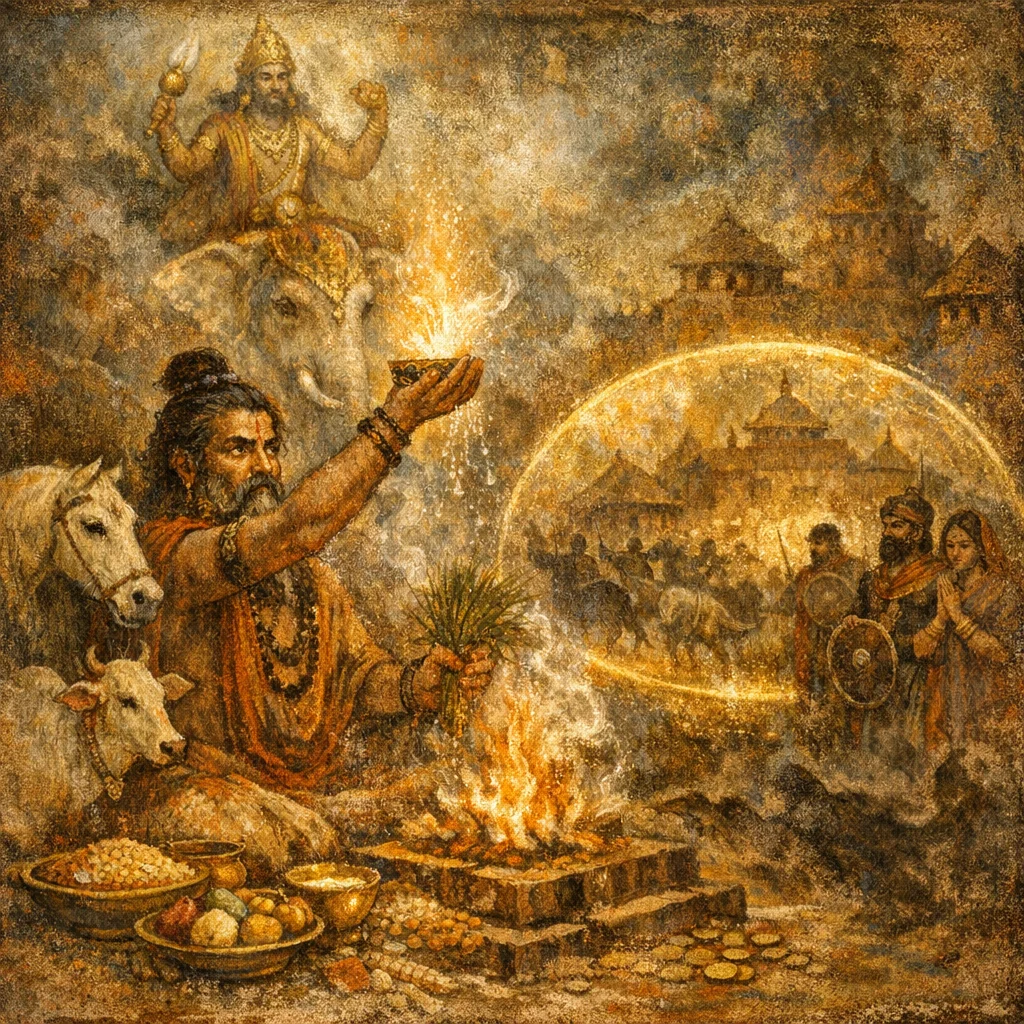
Sukta 21
Rishi: Traditionally Ṛgvedic provenance (Indra hymn material incorporated into AV 20); specific seer not determinable from the excerpt alone.
Devata: Indra
Chandas: Triṣṭubh/Jagatī-type cadence typical of RV Indra narratives (exact meter requires full pada scansion).
Mantras
Mantra 1
न्यू३षु वाचं प्र महे भरामहे गिर इन्द्राय सदने विवस्वतः । नू चिद्धि रत्नं ससतामिवाविदन्न दुष्टुतिर्द्रविणोदेषु शस्यते
Now, yea, in seemly wise, we bring forth speech for the Mighty—hymns unto Indra in the seat of Vivasvat. For even now he findeth the treasure, as for men that press in quest; but ill-praise is not commended among the givers of wealth.
Mantra 2
दुरो अश्वस्य दुर इन्द्र गोरसि दुरो यवस्य वसुन इनस्पतिः । शिक्षानरः प्रदिवो अकामकर्शनः सखा सखिभ्यस्तमिदं गृणीमसि
A door of the horse art thou, O Indra, a door of the cow; a door of barley, lord of riches, master of force. Teaching men, from lofty heaven, drawing at will—friend unto friends, thee with this we hymn.
Mantra 3
शचीव इन्द्र पुरुकृद् द्युमत्तम तवेदिदमभितश्चेकिते वसु । अतः संगृभ्याभिभूत आ भर मा त्वायतो जरितुः काममूनयीः
O Indra, skilled in might, much-doing, most resplendent—this wealth of thine is manifest on every side. Therefore, having gathered it, victorious, bring it hither; disappoint not the desire of the singer who draws near to thee.
Mantra 4
एभिर्द्युभिः सुमना एभिरिन्दुभिर्निरुन्धानो अमतिं गोभिरश्विना । इन्द्रेण दस्युं दरयन्त इन्दुभिर्युतद्वेषसः समिषा रभेमहि
With these bright powers, gracious in intent, with these Soma-drops, shutting out unwisdom; with kine and with horses—rending the Dasyu by Indra, with Soma-drops—(we), banded against the hateful, would wholly lay hold of refreshment and food.
Mantra 5
समिन्द्र राया समिषा रभेमहि सं वाजेभिः पुरुश्चन्द्रैरभिद्युभिः । सं देव्या प्रमत्या वीरशुष्मया गोअग्रयाश्वावत्या रभेमहि
Together, O Indra, with wealth, together with refreshment would we lay hold; together with prizes, with many splendors, with overpowering lights. Together with divine forethought, with hero-might, with cattle-leading, horse-possessing (plenty) would we lay hold.
Mantra 6
ते त्वा मदा अमदन् तानि वृष्ण्या ते सोमासो वृत्रहत्येषु सत्पते । यत् कारवे दश वृत्राण्यप्रति बर्हिष्मते नि सहस्राणि बर्हयः
Those raptures have exhilarated thee—those virile (powers), those Soma-pressings—in the slayings of Vṛtra, O lord of the true. When, for the singer, thou didst (overthrow) ten Vṛtras, irresistible; (when) for him of the sacred grass, thousands of barhis-stalks (were laid down).
Mantra 7
युधा युधमुप घेदेषि धृष्णुया पुरा पुरं समिदं हंस्योजसा । नम्या यदिन्द्र सख्या परावति निबर्हयो नमुचिं नाम मायिनम्
With battle upon battle thou surely advancest in boldness; this fort thou smitest utterly with might. When, O Indra, for friendship’s sake, in the far region, thou didst crush down Namuci—crafty, named (as such).
Mantra 8
त्वं करञ्जमुत पर्णयं वधीस्तेजिष्ठयातिथिग्वस्य वर्तनी। त्वं शता वङ्गृदस्याभिनत् पुरोऽनानुदः परिषूता ऋजिश्वना
Thou slewest Karañja and also Parṇaya with thy sharpest (force), upon the path of Atithigva. Thou didst shatter the hundreds of Vaṅgṛda’s forts, unyielding, though encompassed round about, with Ṛjiśvan (as ally).
Mantra 9
त्वमेतां जनराज्ञो द्विर्दशाबन्धुना सुश्रवसोपजग्मुषः । षष्टिं सहस्रा नवतिं नव श्रुतो नि चक्रेण रथ्या दुष्पदावृणक्
Thou didst perform this deed for the people’s king, when Suśravas, drawing near with his twice-tenfold band. Sixty thousand, and ninety and nine—men famed in story—thou didst cast down with the wheel upon the chariot-way, on that ill-footed ground.
Mantra 10
त्वमाविथ सुश्रवसं तवोतिभिस्तव त्रामभिरिन्द्र तूर्वयाणम्। त्वमस्मै कुत्समतिथिग्वमायुं महे राज्ञे यूने अरन्धनायः
Thou helpedst Suśravas with thine aids, with thy protections, O Indra, and Tūrvayāṇa. Thou, for him, didst bring Kutsa, Atithigva, and Āyu into subjection—unto the great king, the youthful one, to make all yield.
Mantra 11
य उदृचीन्द्र देवगोपाः सखायस्ते शिवतमा असाम । त्वां स्तोषाम त्वया सुवीरा द्राघीय आयुः प्रतरं दधानाः
We, who are in the northern quarter, god-guarded—thy comrades—would be most graciously befriended, O Indra. Thee will I praise; with thee for our companion, rich in good heroes, bearing onward a longer life and better fortune.
Frequently Asked Questions
It is used to invoke Indra for martial success—protection of a king and his host, rout of enemies, and the secure arrival of wealth and fame.
Naming Indra’s past victories functions as proof and pressure: it establishes precedent so the same conquering power is expected to appear in the present situation.
Soma is implicit in Indra worship but not always practically available; many traditions use a symbolic libation and a martial emblem (like a wheel/weapon token) while focusing on the hymn’s intent and disciplined recitation.