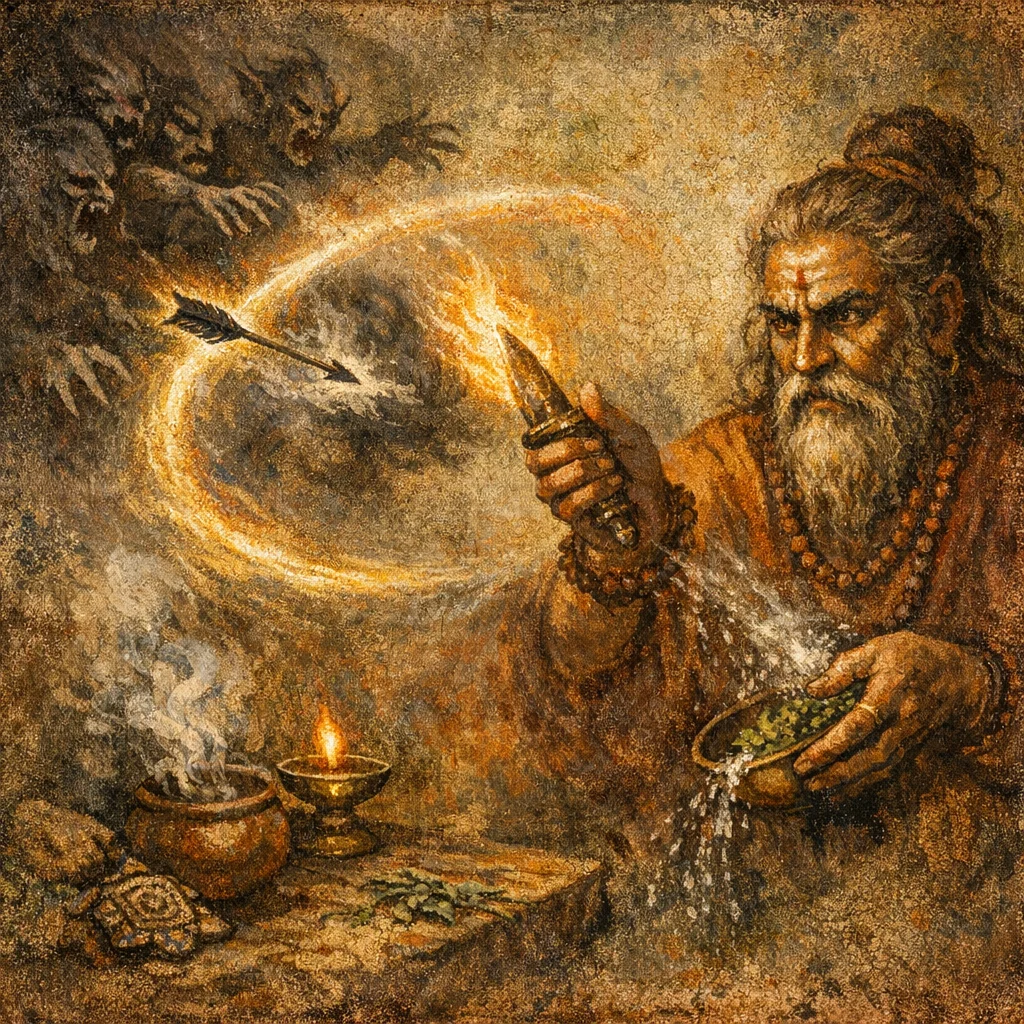
Sukta 24
Rishi: Atharvanic/Angiras-type attribution (hymn-level tradition; verse functions within a counter-sorcery complex).
Devata: Mantra-directed to hostile agents (yātavaḥ, kīmīdinīḥ) under the coercive power of brahman (effective speech).
Chandas: Anuṣṭubh (probable; confirm against pada-count in a metrical edition).
Mantras
Mantra 1
शत्रुनाशनम्। शेरभक शेरभ पुनर्वो यन्तु यातवः पुनर्हेतिः किमीदिनः । यस्य स्थ तमत्त यो वः प्राहैत् तमत्त स्वा मांसान्यत्त
Enemy-destruction. O Śerabhaka, O Śerabha! Back unto you let the sorcerers return; back the missile, (back) the Kīmīdin injurers. Whose ye are, him devour; who hath sent you forth, him devour; devour his own flesh.
Mantra 2
शेवृधक शेवृध पुनर्वो यन्तु यातवः पुनर्हेतिः किमीदिनः । यस्य स्थ तमत्त यो वः प्राहैत् तमत्त स्वा मांसान्यत्त
O Śevṛdhaka, O Śevṛdh, back let your Yātus go; back (go) the weapon-stroke, ye Kimīdins. Whose ye are, him devour; he who hath sent you forth—him devour; his own flesh-pieces devour.
Mantra 3
म्रोकानुम्रोक पुनर्वो यन्तु यातवः पुनर्हेतिः किमीदिनः । यस्य स्थ तमत्त यो वः प्राहैत् तमत्त स्वा मांसान्यत्त
O Mrok and after-Mrok, back let your sorcerous crew depart; back too the weapon, back the gnawing Kimīdins. Whose ye are, him devour; who hath sent you forth against us, him devour—eat ye your own flesh-meat.
Mantra 4
सर्पानुसर्प पुनर्वो यन्तु यातवः पुनर्हेतिः किमीदिनः । यस्य स्थ तमत्त यो वः प्राहैत् तमत्त स्वा मांसान्यत्त
Creep on, O Serpent; back again let your malignant wanderers go; back again the weapon-stroke, the Kīmīdin devourers. Him whose ye are, devour ye him; he who hath smitten you forth—devour ye him; devour your own flesh.
Mantra 5
जूर्णि पुनर्वो यन्तु यातवः पुनर्हेतिः किमीदिनीः । यस्य स्थ तमत्त यो वः प्राहैत् तमत्त स्वा मांसान्यत्त
Let wasting Destruction come again upon you, O sorcerers; let the missile come again—ye Kīmīdinī devourers. Whose ye are, him devour; he who hath sent you forth, him devour; your own flesh-meats—devour ye.
Mantra 6
उपब्दे पुनर्वो यन्तु यातवः पुनर्हेतिः किमीदिनीः । यस्य स्थ तमत्त यो वः प्राहैत् तमत्त स्वा मांसान्यत्त
At this adjuring word, back unto you let the sorcerous goers return—back, too, the missile, and the Kīmīdinī devourers. Whose ye are, him devour; who hath sent you forth, him devour; your own—his very flesh—devour ye.
Mantra 7
अर्जुनि पुनर्वो यन्तु यातवः पुनर्हेतिः किमीदिनीः । यस्य स्थ तमत्त यो वः प्राहैत् तमत्त स्वा मांसान्यत्त
O Arjunī, back let the sorcerers go—back, too, the missile, back the Kīmīdinī devourers. Whose ye are, him devour; he who hath sent you forth—him devour; devour your own flesh.
Mantra 8
भरूजि पुनर्वो यन्तु यातवः पुनर्हेतिः किमीदिनीः । यस्य स्थ तमत्त यो वः प्राहैत् तमत्त स्वा मांसान्यत्त
O Bharūji, back let your sorcerers depart; back, too, the weapon—ye Kimīdinī devourers. Whose ye are, him devour; who hath sent you forth against us, him devour: eat ye his own flesh.
Frequently Asked Questions
It reverses a hostile magical attack by commanding the agents of harm (yātus, the hetí ‘missile,’ and kīmīdinīs) to return to the person who sent them.
They are personified “devouring” afflictions—demonic or disease-like forces imagined as flesh-eaters—treated as obedient to the mantra’s coercive command.
Its primary use is defensive: it protects the victim by returning the attack to its source. The language is punitive, but the ritual logic is spell-reversal rather than initiating aggression.