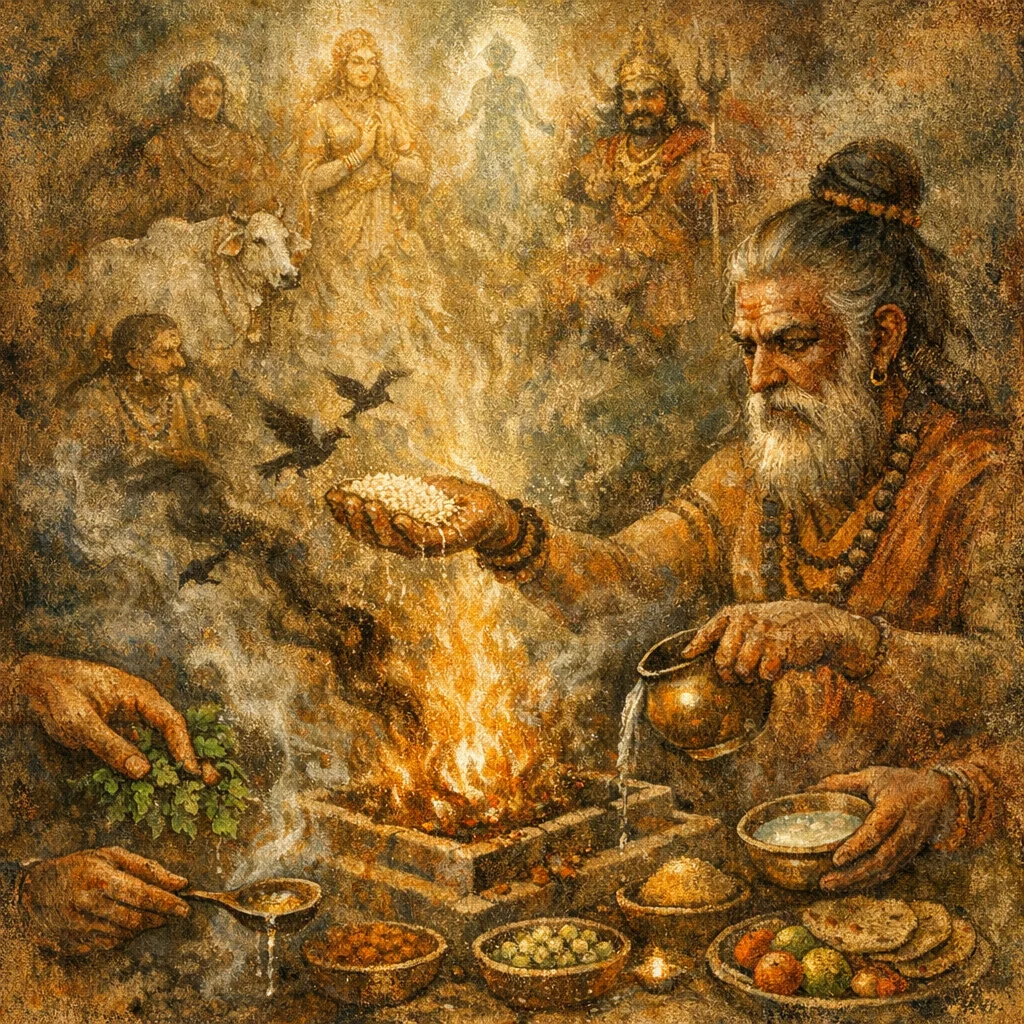
Sukta 14
Rishi: Traditionally treated as brāhmaṇa-style anonymous/collective Atharvanic exposition within AV 15 (often not assigned to a single ṛṣi in the manner of RV hymns).
Devata: Agni (as annāda) and the svāhā-formula personified as efficacious speech.
Chandas: Mixed/prose-like brāhmaṇa cadence (AV 15 frequently departs from strict metrical regularity).
Mantras
Mantra 1
स यत् प्राचीं दिशमनु व्यचलन्मारुतं शर्धो भूत्वानुव्यचलन्मनोऽन्नादं कृत्वा
When he advanced along the Eastern quarter, he, becoming a Marut-host, advanced on; having made the Mind a devourer of food.
Mantra 2
मनसान्नादेनान्नमत्ति य एवं वेद
With mind—made a devourer of food—he eateth food, whoso thus knoweth.
Mantra 3
स यद् दक्षिणां दिशमनु व्यचलदिन्द्रो भूत्वानुव्यऽचलद् बलमन्नादं कृत्वा
When he advanced along the Southern quarter, he, becoming Indra, advanced on; having made Strength a devourer of food.
Mantra 4
बलेनान्नादेनान्नमत्ति य एवं वेद
By strength—made a devourer of food—he eateth food, whoso thus knoweth.
Mantra 5
स यत् प्रतीचीं दिशमनु व्यचलद् वरुणो राजा भूत्वानुव्यऽचलदपोऽन्नादीः कृत्वा
When he moved forth following the western quarter, Varuṇa, having become King, moved forth thereafter, having made the Waters to be food-eaters.
Mantra 6
अद्भिरन्नादिभिरन्नमत्ति य एवं वेद
With the Waters, with the food-eaters, he eats food—who thus hath knowledge.
Mantra 7
स यदुदीचीं दिशमनु व्यचलद् सोमो राजा भूत्वानुव्यऽचलत् सप्तर्षिभिर्हुत आहुतिमन्नादीं कृत्वा
When he moved forth following the northern quarter, Soma, having become King, moved forth thereafter, having—by the Seven Ṛṣis—been offered, and having made the oblation a food-eater.
Mantra 8
आहुत्यान्नाद्यान्नमत्ति य एवं वेद
By the oblation—made a food-eater—he eats food, who thus hath knowledge.
Mantra 9
स यद् ध्रुवां दिशमनु व्यचलद् विष्णुर्भूत्वानुव्यऽचलद् विराजमन्नादीं कृत्वा
When he moved forth following the steadfast quarter, having become Viṣṇu he moved forth thereafter, having made Virāj a food-eater.
Mantra 10
विराजान्नाद्यान्नमत्ति य एवं वेद
He eateth food as the Food-eater by Virāj, who thus hath knowledge.
Mantra 11
स यत् पशूननु व्यचलद् रुद्रो भूत्वानुव्यऽचलदोषधीरन्नादीः कृत्वा
When he went after the cattle, becoming Rudra he followed after, having made the plants to be Food-eaters.
Mantra 12
ओषधीभिरन्नादीभिरन्नमत्ति य एवं वेद
He eateth food by means of the herbs, the Food-eaters, who thus hath knowledge.
Mantra 13
स यत् पितॄननु व्यचलद् यमो राजा भूत्वानुव्यऽचलत् स्वधाकारमन्नादं कृत्वा
When he went after the Fathers, becoming Yama the King he followed after, having made the Svadhā-call a Food-eater.
Mantra 14
स्वधाकारेणान्नादेनान्नमत्ति य एवं वेद
He eateth food by the Svadhā-call, the Food-eater, who thus hath knowledge.
Mantra 15
स यन्मनुष्या३ननु व्यचलदग्निर्भूत्वानुव्यऽचलत् स्वाहाकारमन्नादं कृत्वा
When he moved forth along after men, having become Agni he moved forth accordingly, having made the Svāhā-call a food-eater.
Mantra 16
स्वाहाकारेणान्नादेनान्नमत्ति य एवं वेद
By the Svāhā-call, by the food-eater, he eats food—who knoweth thus.
Mantra 17
स यदूर्ध्वां दिशमनु व्यचलद् बृहस्पतिर्भूत्वानुव्यऽचलद् वषट्कारमन्नादं कृत्वा
When he moved forth along the upward quarter, having become Bṛhaspati he moved forth accordingly, having made the Vaṣaṭ-call a food-eater.
Mantra 18
वषट्कारेणान्नादेनान्नमत्ति य एवं वेद
By the Vaṣaṭ-call, by the food-eater, he eats food—who knoweth thus.
Mantra 19
स यद् देवाननु व्यचलदीशानो भूत्वानुव्यऽचलन्मन्युमन्नादं कृत्वा
When he moved forth along after the gods, having become Īśāna he moved forth accordingly, having made Wrath a food-eater.
Mantra 20
मन्युनान्नादेनान्नमत्ति य एवं वेद
By Wrath, as Food-eater, he eateth food—he who thus knoweth.
Mantra 21
स यत् प्रजा अनु व्यचलत् प्रजापतिर्भूत्वानुव्यऽचलत् प्राणमन्नादं कृत्वा
Now when the creatures went forth in succession, he, becoming Prajāpati, went forth after them, having made Prāṇa to be the Food-eater.
Mantra 22
प्राणेनान्नादेनान्नमत्ति य एवं वेद
By Prāṇa, as Food-eater, he eateth food—he who thus knoweth.
Mantra 23
स यत् सर्वानन्तर्देशाननु व्यचलत् परमेष्ठी भूत्वानुव्यऽचलद् ब्रह्मान्नादं कृत्वा
And when he traversed, in order, all the inner regions, becoming Parameṣṭhin he traversed after them, having made Brahman to be the Food-eater.
Mantra 24
ब्रह्मणान्नादेनान्नमत्ति य एवं वेद
By Brahman, as Food-eater, he eateth food—he who thus knoweth.
Frequently Asked Questions
It means the uttered formula svāhā is treated as an active power: when spoken correctly with offering-intent, it ‘consumes’ the oblation through Agni and converts it into tangible nourishment and welfare.
The hymn works by correspondences (bandhu). Different cosmic domains—space (directions/Viṣṇu), measured splendour (Virāj), and ancestral order (Yama/svadhā)—are each shown to generate the same outcome: stable nourishment and continuity.
Recite it near a clean household fire, with a small ghee or food offering, focusing on clear pronunciation of svāhā (and svadhā when honoring ancestors). The rite is aimed at securing livelihood and the capacity to assimilate gains.