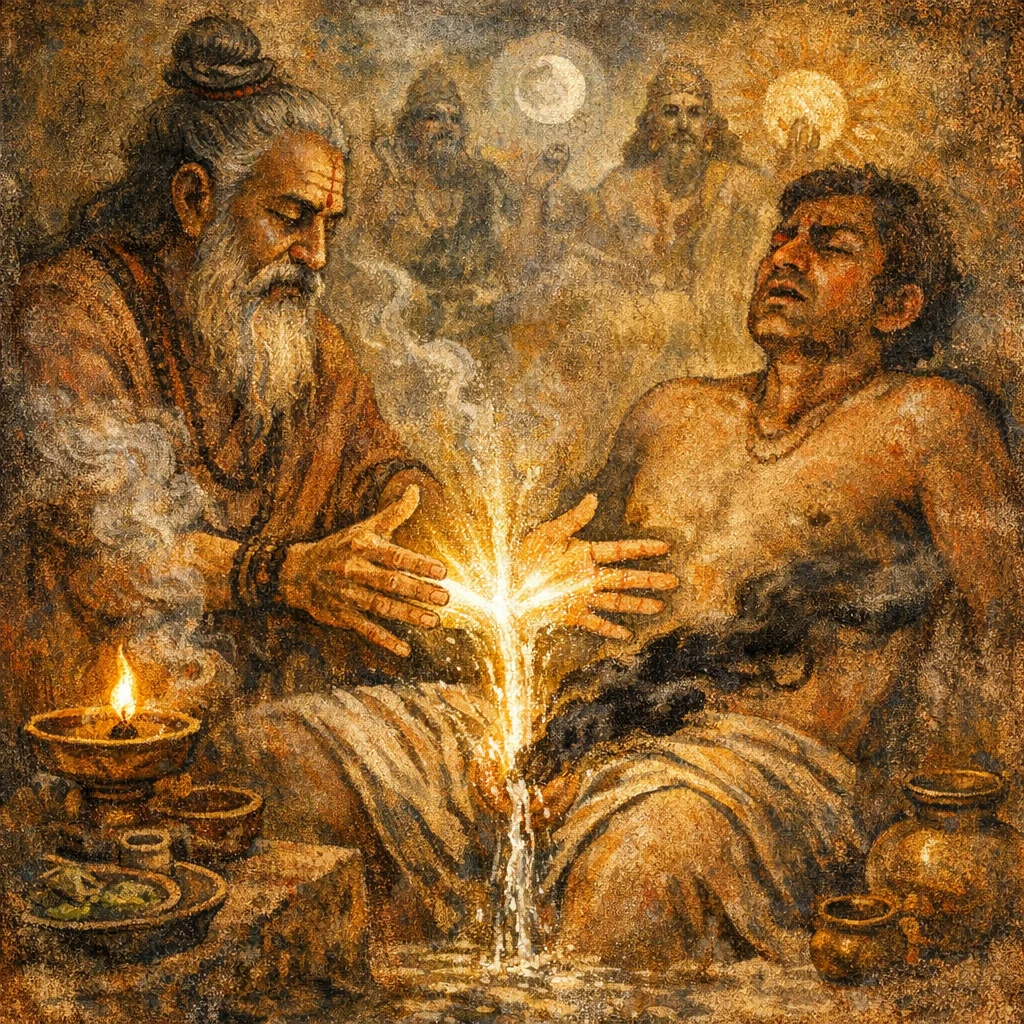
Sukta 3
Rishi: Atharvanic tradition (often transmitted without a single named ṛṣi for brief bhaiṣajya charms in AVŚ 1); attributed generically to Atharvan/Angiras lineages in later indices.
Devata: Parjanya (Rain), as releasing/effusive power.
Chandas: Anuṣṭubh (with Atharvanic irregularities/extended cadence in the closing).
Mantras
Mantra 1
मूत्रमोचनम्। विद्मा शरस्य पितरं पर्जन्यं शतवृष्ण्यम् । तेना ते तन्वे३शं करं पृथिव्यां ते निषेचनं बहिष्टे अस्तु बालिति
Urine-release. We know Parjanya, the Father of the reed, of hundredfold virile might. With that power for thy body I make refreshment: upon the earth let thine outpouring be—outward for thee—so be it. (bal.)
Mantra 2
विद्मा शरस्य पितरं मित्रं शतवृष्ण्यम् । तेना ते तन्वे३ शं करं पृथिव्यां ते निषेचनं बहिष्टे अस्तु बालिति
We know the Father of Śara, Mitra, of hundredfold might. Therewith, for thy body, making welfare—upon the earth—let thine in-sprinkling be without thee: so (be it).
Mantra 3
विद्मा शरस्य पितरं वरुणं शतवृष्ण्यम् । तेना ते तन्वे३ शं करं पृथिव्यां ते निषेचनं बहिष्टे अस्तु बालिति
We know the Father of the reed—Varuṇa of hundredfold virile might. By that (power) making welfare for thy body, upon the earth let thine outpouring be outside thee—so be it.
Mantra 4
विद्मा शरस्य पितरं चन्द्रं शतवृष्ण्यम् । तेना ते तन्वे३ शं करं पृथिव्यां ते निषेचनं बहिष्टे अस्तु बालिति
We know the Father of Śarás, the Moon, of hundredfold virile might. Therewith for thee, for thy body, I make welfare: upon the Earth let thy sprinkling be—let it be outside of thee—(so be it), Bāliti.
Mantra 5
विद्मा शरस्य पितरं सूर्यं शतवृष्ण्यम् । तेना ते तन्वे३ शं करं पृथिव्यां ते निषेचनं बहिष्टे अस्तु बालिति
We know the Father of the reed, the Sun, of hundredfold might. Therewith, for thy body, making welfare: upon the earth let thine infusion be; let it be outside of thee—bāliti.
Mantra 6
यदान्त्रेषु गवीन्योर्यद्वस्तावधि संश्रुतम् । एवा ते मूत्रं मुच्यतां बहिर्बालिति सर्वकम्
When in the bowels, in the two conduits, and when in the bladder there is that which hath settled and compacted—so, for thee, let the urine be loosed: forth with it, with the cry ‘bal!’—wholly.
Mantra 7
प्र ते भिनद्मि मेहनं वर्त्रं वेशन्त्या इव । एवा ते मूत्रं मुच्यतां बहिर्बालिति सर्वकम्
Forth for thee I cleave the urinary passage, the obstructing stopper, as one makes way for a woman entering. Even so let thy urine be loosed—outward let it go, with a gush, all of it.
Mantra 8
विषितं ते वस्तिबिलं समुद्रस्योदधेरिव । एवा ते मूत्रं मुच्यतां बहिर्बालिति सर्वकम्
Opened be for thee the bladder’s outlet, like that of ocean and of sea. Thus let thy urine be discharged—outward, the whole obstructing mass expelled.
Mantra 9
यथेषुका परापतदवसृष्टाधि धन्वनः । एवा ते मूत्रं मुच्यतां बहिर्बालिति सर्वकम्
As from the bow the little arrow, loosed, hath flown away,—even so let thy urine be loosed forth outward, wholly, with the cry ‘bāl!’
Frequently Asked Questions
It is recited to relieve difficulty or blockage in urination, treating the condition as an obstruction to be loosened and sent outward.
Parjanya embodies the power of releasing waters. The hymn uses rain as the cosmic model to compel the body’s retained fluid to pour out freely.
The text primarily works through mantra and simple rite: directing the flow outward and using water-sprinkling and earth-contact as symbols of discharge. A reed (śara) may be used as an emblem, but no specific drug is required by the verses cited.