Adhyaya 77
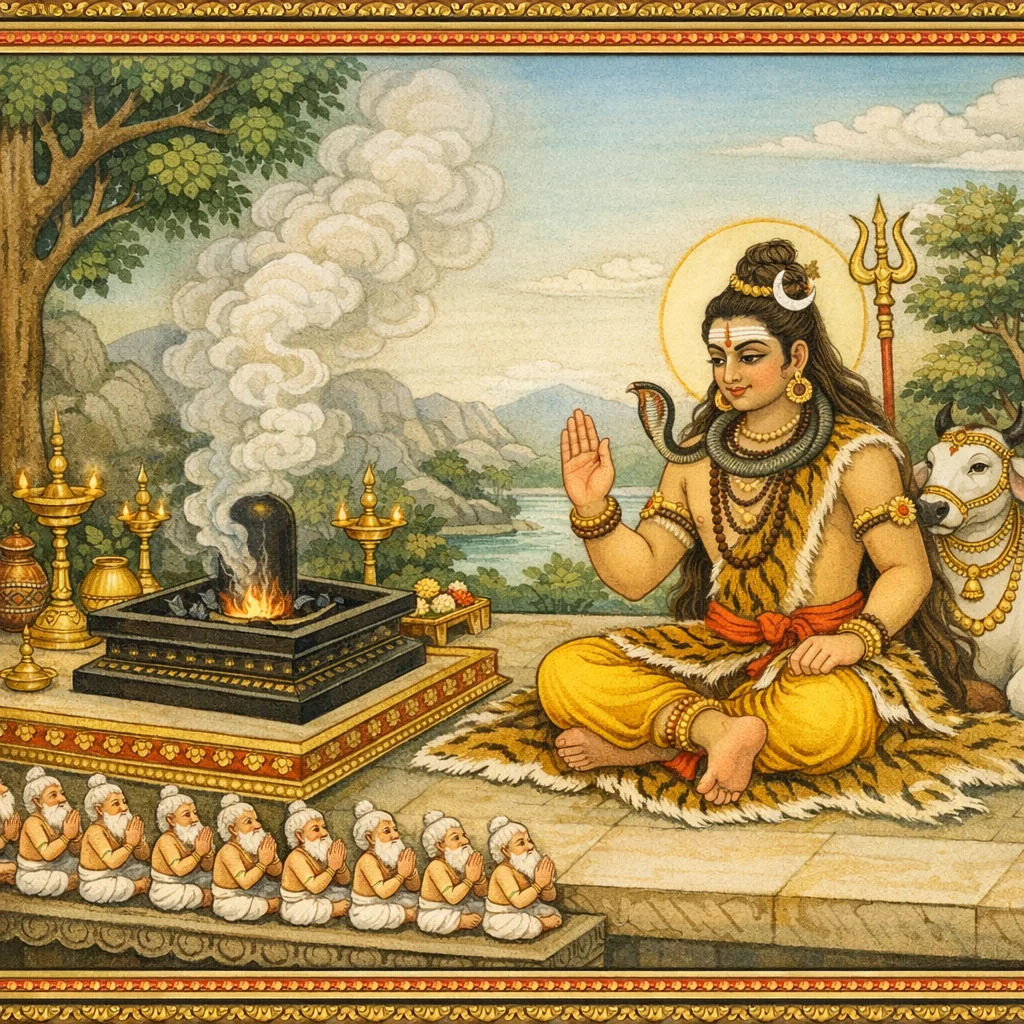
Chapter 77 is framed as a dialogue in which the Ṛṣis ask Sūta about an apparent inconsistency of time or place: Śiva and Umā/Pārvatī are said to be established in the altar’s center (vedimadhya), yet their marriage is also remembered as having occurred earlier at Oṣadhiprastha and, in fuller narration, at Hāṭakeśvara-kṣetra. Sūta resolves this by recounting an older cycle set in earlier manvantaras, and then narrates the marriage setting connected with Dakṣa. Dakṣa makes grand preparations and fixes the auspicious moment—Caitra śukla trayodaśī, under Bhaga-nakṣatra, on a Sunday—when Śiva arrives with vast assemblies of divine and semi-divine beings. A pointed ethical-theological episode follows: Brahmā, overcome by desire, seeks to behold Satī’s veiled face; aided by the smoke arising from the fire-ritual, he succeeds, and Śiva rebukes him and prescribes expiation. The fallen seed becomes the originating cause of the thumb-sized ascetics called Vālakhilyas, who ask for a pure place for tapas and attain siddhi there. The chapter culminates in a theology of the site: Śiva agrees to remain in the altar’s center with his consort for the purification of beings. Seeing him at the specified time is said to dissolve sins and bestow auspiciousness, including social well-being associated with marriage rites. The closing phalaśruti promises that those who listen attentively and worship Vṛṣabhadhvaja will complete marriage-related rituals without obstruction.
Shlokas
Verse 1
। ऋषय ऊचुः । यदेतद्भवता प्रोक्तं तत्र तौ परमेश्वरौ । उमामहेश्वरौ सूत हरिश्चन्द्रेण भूभुजा
The sages said: Concerning what you have spoken—those two Supreme Lords there, Umā and Maheśvara—O Sūta, tell us in what manner they were connected with King Hariścandra.
Verse 2
कृतौ कथयसीत्येवं वेदिमध्यं समाश्रितौ । उतान्यौ स्थापितौ तत्र चमत्कारपुरांतिकम्
They asked, “How were they made or established?”—thus it is said that the two took their station in the middle of the altar; and moreover, two others were installed there near the city called Camatkāra.
Verse 3
वेदिमध्यगतौ नित्यं पार्वतीपरमेश्वरौ । एतत्संश्रूयते सूत विवाहः प्रागभूत्तयोः । ओषधिप्रस्थमासाद्य पुरं हिम वतः प्रियम्
Pārvatī and the Supreme Lord (Śiva) are ever present in the middle of the altar. It is heard, O Sūta, that their marriage once took place in ancient times upon reaching Oṣadhiprastha, the city dear to Himavat.
Verse 4
अत्र नः संशयो जातः श्रद्धेयमपि ते वचः । श्रुत्वा किं वा भ्रमस्तेऽयं किं वाऽस्माकं प्रकीर्तय
Here a doubt has arisen in us, though your words are indeed trustworthy. Having heard this, is the confusion on your part or on ours? Please explain it clearly to us.
Verse 5
सूत उवाच । नास्माकं विभ्रमो जातो युष्माकं तु द्विजोत्तमाः । परं यत्कारणं कृत्स्नं तद्ब्रवीमि निबोध्यताम्
Sūta said: No confusion has arisen in me; O best of the twice-born, the doubt is in you. I shall tell the complete and true reason—listen and understand.
Verse 6
य एष ओषधिप्रस्थे विवाहः प्रागभू त्तयोः । उमात्रिनेत्रयो रम्यः सर्वदेवप्रमोदकृत्
That marriage which long ago took place for those two at Oṣadhiprastha—of Umā and the Three-eyed Lord—was radiant and splendid, bringing delight to all the gods.
Verse 7
वैवस्वतेऽन्तरे पूर्वं संजातो द्विजसत्तमाः । सप्तमस्य तु विख्यातो युष्माकं विदितोऽत्र यः
It arose earlier in the Vaivasvata Manvantara, O best among the twice-born; and in the seventh Manvantara as well it is famed—known here to you all.
Verse 8
हाटकेश्वरजे क्षेत्रे यश्चोद्वाहस्तयोरभूत् । स्वायंभुवमनोराद्ये स संजातः सुविस्तरः
That marriage of the two which took place in the sacred region of Hāṭakeśvara—first arising in the primeval age of Svāyaṃbhuva Manu—has become widely renowned and richly unfolded in holy tradition.
Verse 9
ऋषय ऊचुः । विवाह ओषधिप्रस्थे यः पुरा समभूत्तयोः । पार्वतीहरयोः सूत सोऽस्माभिर्विस्तराच्छ्रुतः
The sages said: O Sūta, we have heard in full detail of the ancient marriage of Pārvatī and Hara that took place at Oṣadhiprastha.
Verse 10
हाटकेश्वरजे क्षेत्रे दक्षयज्ञे मनोहरे । विवाहो वृषयानस्य मनौ स्वायंभुवे पुरा
In the sacred region of Hāṭakeśvara—at Dakṣa’s captivating sacrifice—long ago, in the time of Svāyaṃbhuva Manu, the marriage of Vṛṣayāna took place.
Verse 11
सोऽस्माकं कीर्तनीयश्च त्वया सूतकुलोद्वह । विस्तरेण यथा वृत्तः एतन्न कौतुकं परम्
Therefore, O foremost of the Sūta lineage, you should recount it to us—how it occurred in full detail; for this is a matter of supreme wonder.
Verse 12
सूत उवाच । अत्र वः कीर्तयिष्यामि सर्वपातकनाशनम् । विवाहसमयं सम्यग्देवदेवस्य शूलिनः
Sūta said: Here I shall recount to you, truly and in proper order, the marriage occasion of the trident-bearing Lord of Lords—a narration that destroys all sins.
Verse 13
ब्रह्मणो दक्षिणांगुष्ठाद्दक्षः प्राचेतसोऽभवत् । शतानि पञ्च कन्यानां तस्य जातानि च द्विजाः
From Brahmā’s right thumb arose Dakṣa Prācetasa; and, O twice-born sages, five hundred daughters were born to him.
Verse 14
तासां ज्येष्ठतमा साध्वी सतीनाम शुचिस्मिता । बभूव कन्यका सर्वैर्गुणैर्युक्ताऽयतेक्षणा
Among them, the eldest was the virtuous maiden named Satī, pure in her gentle smile—endowed with every excellence and possessing long, graceful eyes.
Verse 15
न देवी न च गंधर्वी नासुरी न च नागजा । तादृग्रूपाऽभवच्चान्या यादृशी सा सुमध्यमा
Neither among goddesses, nor among Gandharva maidens, nor among Asurīs, nor among Nāga-born women was there any other of such beauty as that slender-waisted Satī.
Verse 17
ततः पुण्यतमं क्षेत्रं कन्यादानस्य स क्षमम् । संध्याय ससुतामात्यः सभृत्यः समुपस्थितः
Then he chose a most holy kṣetra, fit for the rite of Kanyādāna, the sacred gifting of a daughter; and at twilight he arrived there with his daughter, his ministers, and his attendants.
Verse 18
ततश्चोद्वाहयोग्यानि वसुनि विविधान्यपि । आनयामास भूरीणि मांगल्यानि विशेषतः
Then he brought many kinds of wealth and goods suitable for the wedding—especially an abundance of auspicious items for the rites.
Verse 19
अथ चैत्रस्य शुक्लस्य नक्षत्रे भगदैवते । त्रयोदश्यां दिने भानोः समायातो महेश्वरः
Then, in the bright fortnight of Caitra, when the lunar mansion presided over by Bhaga prevailed, on the thirteenth day, on a Sunday, Maheśvara arrived.
Verse 20
सर्वैः सुरगणैः सार्धं देवविष्णुपुरःसरैः । आदित्यैर्वसुभी रुद्रैरश्विभ्यां च तथाऽपरैः
He arrived along with all the hosts of gods—led in front by Deva Viṣṇu—together with the Ādityas, the Vasus, the Rudras, the two Aśvins, and other divine beings as well.
Verse 21
सिद्धैः साध्यगणैर्भूतैः प्रेतैर्वैनायकैस्तथा । गन्धर्वैश्चारणौघैश्च गुह्यकैर्यक्षराक्षसैः
With Siddhas, companies of Sādhyas, Bhūtas and Pretas, and also the Vaināyakas; with Gandharvas and streams of Cāraṇas; with Guhyakas, Yakṣas, and Rākṣasas.
Verse 22
एतस्मिन्नंतरे दक्षः संप्रहृष्टतनूरुहः । प्रययौ संमुखस्तस्य युक्तः सर्वैः सुहृद्गणैः
Meanwhile, Dakṣa—his body-hairs standing on end with delight—went forth to meet him face to face, accompanied by all his circles of well-wishers.
Verse 23
वाद्यमानैर्महावाद्यैः सूतमागधबन्दिभिः । पठद्भिः सर्वतोऽनेकैर्गायद्भिर्गायनैस्तथा
As great instruments were being played, with sūtas, māgadhas, and bards reciting on all sides, and singers likewise singing.
Verse 24
ततः सर्वे सुरास्तत्र स्वयं दक्षेण पूजिताः । यथाश्रेष्ठं यथाज्येष्ठमुपविष्टा यथाक्रमम् । परिवार्याखिलां वेदिं मंडपांतरवर्तिनीम्
Then all the gods there were personally worshiped by Dakṣa, and they sat down in due order—according to rank and seniority—encircling the entire altar that stood within the pavilion.
Verse 25
ततः पितामहं प्राह दक्षः प्रीतिपुरःसरम् । प्रणिपत्य त्वया कर्म कार्यं वैवाहिकं विभोः
Then Dakṣa, full of affection, addressed Pitāmaha (Brahmā). Bowing down, he said: “O Lord, you must perform the rites of this marriage.”
Verse 26
स्वयमेव सुताऽस्माकं येन स्यात्सुभगा सती । पुत्र पौत्रवती नित्यं सुशीला पतिवल्लभा
“So that our own daughter Sati may indeed become fortunate—ever endowed with sons and grandsons, virtuous in conduct, and beloved of her husband.”
Verse 27
बाढमित्येव सोऽप्युक्त्वा प्रहृष्टेनांतरात्मना । समुत्थाय ततश्चक्रे कृत्यमर्हणपूर्वकम्
He too said, “So be it,” and, gladdened in his inmost heart, rose up and then performed what was to be done, beginning with due honoring.
Verse 28
संप्रदानक्रियां कृत्वा तत्रैव विधिपूर्वकम् । ततो हस्तग्रहं ताभ्यां मिथश्चक्रे यथाक्रमम् । मातॄणां पुरतो वेधाः सतीशाभ्यां यथोचितम्
Having performed there itself, in due form, the rite of formal giving (kanyādāna), he then arranged, in proper sequence, the mutual taking of hands by the two; and, before the Mothers (Mātṛs), Vedhā—the Creator (Brahmā)—conducted the rite for Satī and Īśa as was fitting.
Verse 29
अथ वेदिं समासाद्य गृह्योक्तविधिनाऽखिलम् । अग्निकार्यं यथोद्दिष्टं चकाराथ सुविस्तरम्
Then, approaching the sacrificial altar, he performed in full the fire-rite exactly as prescribed in the Gṛhya tradition, carrying out the entire ritual in elaborate detail.
Verse 30
यथायथा स रम्याणि वीक्षतेंऽगानि कौतुकात् । सत्याः पितामहो हृष्टः कामार्तोऽभूत्तथातथा
And as he, out of curiosity, kept gazing upon her lovely limbs, so too did Satyā’s grandsire become increasingly delighted—and, in the same measure, afflicted by desire.
Verse 31
तेनैकं वदनं मुक्त्वा तस्या वस्त्रावगुंठितम् । वीक्षिताऽतिस्मरार्तेन यथा कश्चिन्न बुद्ध्यते
With that intent, leaving only her face uncovered while the rest remained veiled by cloth, he stared—so stricken by overpowering passion that he could scarcely think clearly at all.
Verse 32
न शंभोर्लज्जया वक्त्रं प्रत्यक्षं स व्यलोकयत् । न च सा लज्जयाविष्टा करोति प्रकटं मुखम्
Out of modesty before Śambhu, he did not look directly upon her face; and she too, overcome with modesty, did not reveal her face openly.
Verse 33
ततस्तद्दर्शनार्थाय स उपायं व्यलो कयत् । धूमद्वारेण कामार्तश्चकार च ततः परम्
Then, seeking a way to see her, he devised a means; tormented by desire, he proceeded further, using smoke as his pretext and instrument.
Verse 34
आर्द्रेंधनानि भूरीणि क्षिप्त्वाक्षित्वा विभावसौ । स्वल्पाज्याहुतिविन्यासादार्द्रद्रव्योद्भव स्तथा
Casting abundant damp fuel into the fire (Vibhāvasu) and arranging only small oblations of ghee, he caused—just as intended—smoke to arise from the moist materials.
Verse 35
एतस्मिन्नंतरे धूमः प्रादुर्भूतः समंततः । तादृग्येन तमोभूतं वेदिमूलं विनिर्मितम्
In the meantime, smoke arose on every side; and by that very density, the base of the altar became as though wrapped in darkness.
Verse 36
ततो धूमाकुलेनेत्रे भगवांस्त्रिपु रान्तकः । हस्ताभ्यां छादयामास येऽन्ये तत्र व्यवस्थिताः
Then, with his eyes distressed by the smoke, the Blessed Lord—Tripurāntaka—covered them with his hands; and others who were present there did likewise.
Verse 37
ततो वस्त्रं समुत्क्षिप्य सतीवक्त्रं पितामहः । वीक्षयामास कामार्तः प्रहृष्टेनांतरात्मना
Then, lifting up the cloth, the grandsire—afflicted by desire—gazed upon Satī’s face, his inmost heart exulting and thrilled.
Verse 38
तस्य रेतः प्रचस्कन्द ततस्तद्वीक्षणाद्द्रुतम् । पतितं च धरापृष्ठे तुषारचयसंनिभम्
At that sight, his semen suddenly spilled forth and quickly fell upon the surface of the earth, resembling a heap of frost.
Verse 39
ततश्च सिकतौघेना तत्क्षणात्पद्मसंभवः । छादयामास तद्रेतो यथा कश्चिन्न बुद्ध्यते
Then, in that very moment, Padma-sambhava (Brahmā) covered that semen with a torrent of sand, so that no one might come to know of it.
Verse 40
अथ तद्भगवाञ्च्छंभुर्ज्ञात्वा दिव्येन चक्षुषा । रेतोऽवस्कन्दनात्तस्य कोपादेतदुवाच ह
Thereupon Bhagavān Śambhu (Śiva), perceiving it with divine sight, became wrathful at that act of causing the semen to fall and spoke as follows.
Verse 41
किमेतद्विहितं पाप त्वया कर्म विगर्हितम् । नैवार्हा मम कान्ताया वक्त्रवीक्षाऽनुरागतः
“What is this, O sinner—this censurable deed you have done? You are not fit to gaze upon the face of my beloved (Devī), being attached to such conduct.”
Verse 43
त्वं वेत्सि शंकरेणैतत्कर्मजालं न विंदितम् । त्रैलोक्येऽपि मयाऽप्यस्ति गूढं तत्स्यात्कथं विधे । यत्किञ्चित्त्रिषु लोकेषु जंगमं स्थावरं तथा । तस्याहं मध्यगो मूढ तैलं यद्वत्तिलांतगम्
“You think you know this, though even Śaṅkara has not fathomed this net of karma. Even within the three worlds there are things hidden from me—how then could I know all, O Vidhātṛ? Whatever exists in the three worlds, moving or unmoving—within it I abide in the midst, like oil concealed within a sesame seed, O deluded one.”
Verse 44
तस्मात्स्पृश निजं शीर्षं ब्रह्मन्नेतदसंशयम् । यावदेवं गते ब्रह्मा शिरः स्पृशति पाणिना । तावत्तत्र स्थितः साक्षात्तद्रूपो वृषवाहनः
“Therefore, O Brahman, touch your own head—of this there is no doubt.” As Brahmā thus proceeded and touched his head with his hand, at that very moment Vṛṣavāhana (Śiva, the Bull-bannered Lord) stood there manifest, assuming that very form.
Verse 45
ततो लज्जापरीतांगः स्थितश्चाधोमुखो द्विजाः । इन्द्राद्यैरमरैः सर्वैः सहितः सर्वतः स्थितैः
Then, his body overwhelmed with shame, he stood with face cast downward, O twice-born; and all the gods—Indra and the rest—were present all around.
Verse 46
अथाऽसौ लज्जयाविष्टः प्रणिपत्य महेश्वरम् । प्रोवाच च स्तुतिं कृत्वा क्षम्यतां क्षम्यतामिति
Then, seized by shame, he bowed down to Maheśvara (Śiva) and, having offered praise, said: “May I be forgiven, may I be forgiven.”
Verse 47
अस्य पापस्य शुद्ध्यर्थं प्राय श्चित्तं वद प्रभो । निग्रहं च यथान्यायं येन पापं प्रयाति मे
“For the purification of this sin, O Lord, declare the proper prāyaścitta (rite of expiation); and prescribe also the fitting discipline, by which my sin may depart.”
Verse 48
श्रीभगवानुवाच । अनेनैव तु रूपेण मस्तकस्थेन वै ततः । तपः कुरु समाधिस्थो ममाराधनतत्परः
The Blessed Lord said: “In this very form, with it set upon your head, perform austerity; abide in samādhi, wholly intent upon my worship.”
Verse 49
ख्यातिं यास्यति सर्वत्र नाम्ना रुद्रशिरः क्षितौ । साधकः सर्वकृत्यानां तेजोभाजां द्विजन्म नाम्
“It shall become renowned everywhere on earth by the name ‘Rudraśiraḥ’; and it will accomplish all sacred aims for the radiant twice-born.”
Verse 50
मानुषाणामिदं कृत्यं यस्माच्चीर्णं त्वयाऽधुना । तस्मात्त्वं मानुषो भूत्वा विचरिष्यसि भूतले
Because you have now performed this act—an act proper to human beings—therefore you shall become human and wander upon the earth.
Verse 51
यस्त्वां चानेन रूपेण दृष्ट्वा पृच्छां करिष्यति । किमेतद्ब्रह्मणो मूर्ध्नि भगवांस्त्रिपुरांतकः
And whoever, seeing you in this form, asks the question—‘What is this upon Brahmā’s head, O Blessed Tripurāntaka (Śiva)?’—
Verse 52
ततस्ते चेष्टितं सर्वं कौतुकाच्च शृणोति यः । परदारकृतात्पापात्ततो मुक्तिं प्रयास्यति
Then, whoever hears—out of reverent curiosity—this entire account of your deeds, will thereafter proceed to liberation from the sin committed through another’s spouse.
Verse 53
यथायथा जनस्त्वेतत्कृत्यं ते कीर्तयिष्यति । तथातथा विशुद्धिस्ते पापस्यास्य भविष्यति
To the very extent that people proclaim this deed of yours, to that same extent your purification from this sin shall come to pass.
Verse 54
एतदेव हि ते ब्रह्मन्प्रायश्चित्तं प्रकीर्तितम् । जनहास्यकरं लोके तव गर्हाकरं परम्
This indeed, O Brahman, is declared to be your prāyaścitta (expiation)—making you an object of public laughter in the world and bringing upon you the highest reproach.
Verse 55
एतच्च तव वीर्यं तु पतितं वेदिमध्यगम् । कामार्तस्य मया दृष्टं नैतद्व्यर्थं भविष्यति
And your virility—your seed—has fallen into the midst of the altar. I saw it when you were afflicted by desire; it shall not be without purpose.
Verse 56
यावन्मात्रैः परिस्पृष्टमेतत्सैकतरेणुभिः । तावन्मात्रा भविष्यंति मुनयः संशितव्रताः
In whatever measure this was touched by grains of sandy dust, in that same measure sages of firm vows shall come into being.
Verse 57
वालखिल्या इति ख्याताः सर्वेंऽगुष्ठप्रमाणकाः । तपोवीर्यसमोपेताः शापानुग्रहकारकाः
They are renowned as the Vālakhilyas—each one thumb-sized—endowed with the power born of tapas (austerity), able both to curse and to bestow favor.
Verse 58
एतस्मिन्नंतरे तस्माद्वेदिमध्याच्च तत्क्षणात् । अष्टाशीतिसहस्राणि मुनीनां भावितात्मनाम् । अंगुष्ठकप्रमाणानि निष्क्रान्तानि द्विजोत्तमाः
At that very moment, from the midst of the altar, eighty-eight thousand sages—munis of disciplined spirit—emerged, thumb-sized, O best of the twice-born.
Verse 59
ततस्ते प्रणिपत्योच्चैः प्रोचुर्देवं पितामहम् । स्थानं दर्शय नस्तात तपोऽर्थं कलिवर्जितम्
Then they bowed down and spoke aloud to the divine Pitāmaha (Brahmā): “Dear father, show us a place for tapas, free from the taint of Kali.”
Verse 60
पितामह उवाच । अस्मिन्क्षेत्रे मया सार्धं कुरुध्वं पुत्रकास्तपः । गमिष्यथ परां सिद्धिं येन लोके सुदुर्लभाम्
Pitāmaha (Brahmā) said: “O my sons, perform tapas here in this sacred kṣetra together with me. By this you shall attain the supreme siddhi, rare indeed to obtain in the world.”
Verse 61
ते तथेति प्रतिज्ञाय कृत्वा तत्राश्रमं शुभम् । वालखिल्यास्तपश्चक्रुः संसिद्धिं च परां गताः
Agreeing, “So be it,” they established a blessed hermitage there. The Vālakhilyas then performed tapas and attained the highest, consummate siddhi.
Verse 62
अथ ब्रह्मापि तत्कर्म सर्वं वैवाहिकं क्रमात् । समाप्तिमनयत्प्रोक्तं यच्छ्रुतौ तेन च स्वयम्
Then Brahmā too, in due order, brought that entire wedding rite to its conclusion—exactly as enjoined in the Śruti and as it had been prescribed.
Verse 63
पतत्सु पुष्पवर्षेषु समन्ताद्गगनांगणात् । वाद्यमानेषु वाद्येषु गीय मानैश्चगीतकैः
As showers of flowers fell all around from the expanse of the sky, instruments resounded, and songs were being sung.
Verse 64
पठत्सु विप्रमुख्येषु नृत्यमानासु रागतः । रंभादिषु पुरन्ध्रीषु देवानां दृङ्मनोहरम्
While foremost brāhmaṇas recited, and celestial maidens—Rambhā and the rest—danced with passion, the spectacle delighted the eyes and minds of the gods.
Verse 65
एवं महोत्सवो जज्ञे तत स्तुंबुरुपूर्वकैः । गीयमानेषु गीतेषु यथापूर्वं त्रिविष्टपे
Thus a great festival arose; and as songs were sung by Tumburu and others, it resembled the celebrations of Triviṣṭapa (heaven) as in former times.
Verse 66
अथ कर्मावसाने स भगवांस्त्रिपुरांतकः । प्रोवाच पद्मजं भक्त्या दक्षिणां ते ददामि किम्
Then, when the rite was completed, the Blessed Lord Tripurāntaka (Śiva) spoke to Padmaja (Brahmā) with devotion: “What priestly fee (dakṣiṇā) shall I give you?”
Verse 67
वैवाहिकी सुरश्रेष्ठ यद्यपि स्यात्सुदुर्लभा । ब्रूहि शीघ्रं महाभाग नादेयं विद्यते मम
“O best of gods, even if the wedding-fee be exceedingly rare—speak quickly, O greatly fortunate one; for there is nothing that is not to be given by me.”
Verse 68
पितामह उवाच । अनेनैव तु रूपेण वेद्यामस्यां सुरेश्वर । त्वया स्थेयं सदैवात्र नृणां पापविशुद्धये
Pitāmaha (Brahmā) said: “O Lord of the gods, in this very form remain here forever upon this sacred vedī, for the purification of men from sin.”
Verse 69
येन ते सन्निधौ कृत्वा स्वाश्रमं शशिशेखर । तपः करोमि नाशाय पापस्यास्य महत्तमम्
“So that, O Śaśiśekhara, moon-crested Lord, having established my own āśrama in Your presence, I may perform tapas for the utter destruction of this great sin.”
Verse 70
चैत्रशुक्लत्रयोदश्यां नक्षत्रे भगदैवते । सूर्यवारेण यो भक्त्या वीक्षयिष्यति मानवः । तदैव तस्य पापानि प्रयास्यन्ति च संक्षयम्
On Trayodaśī, the thirteenth day of the bright fortnight of Caitra, when the nakṣatra presided over by Bhaga prevails, whoever on a Sunday beholds (this sacred presence) with devotion—at that very time his sins depart and are exhausted.
Verse 71
या नारी दुर्भगा वन्ध्या काणा रूपविवर्जिता । साऽपि त्वद्दर्शनादेव भविष्यति सुरूपधृक् । प्रजावती सुभोगाढ्या सुभगा नात्र संशयः
Whatever woman may be unfortunate, barren, one-eyed, or bereft of beauty—by your mere darśana even she becomes fair of form; blessed with children, rich in rightful enjoyments and prosperity, and fortunate—of this there is no doubt.
Verse 72
महेश्वर उवाच । हिताय सर्वलोकानां वेद्यामस्यां व्यवस्थितः । स्थास्यामि सहितः पत्न्या सत्यात्व द्वचनाद्विधे
Maheśvara said: “For the welfare of all worlds, established upon this sacred vedī, I shall remain here together with my consort. O Vidhi (Brahmā), let this be made true by your word.”
Verse 73
सूत उवाच । एवं स भगवांस्तत्र सभार्यो वृषभध्वजः । विद्यते वेदिमध्यस्थो लोकानां पापनाशनः ०
Sūta said: “Thus the Blessed Lord, Vṛṣabhadhvaja (Śiva), together with his consort, is present there, abiding in the midst of the altar, the destroyer of the sins of the people.”
Verse 74
एतद्वः सर्वमाख्यातं यथा तस्य पुराऽभवत् । विवाहो वृषनाथस्य मनौ स्वायंभुवे द्विजाः
All this has been told to you, O twice-born, just as it happened long ago—the wedding of Vṛṣanātha in the time of Svāyambhuva Manu.
Verse 76
कन्या च सुखसौभाग्य शीलाचारगुणान्विता । तथा स्यात्पुत्रिणी साध्वी पतिव्रतपरायणा
And the maiden becomes endowed with happiness and good fortune, possessed of virtuous character and right conduct; she becomes a mother of children, a noble woman, devoted to the vow of fidelity to her husband.
Verse 79
विवाहसमये प्राप्ते प्रारम्भे वा शृणोति यः । एतदाख्यानमव्यग्रं संपूज्य वृषभध्वजम् । तस्याऽविघ्नं भवेत्सर्वं कर्म वैवाहिकं च यत्
Whoever, when the time of marriage has arrived—or at its very commencement—listens to this narrative with an undistracted mind, after duly worshipping Vṛṣabhadhvaja (Śiva), for him every wedding-related rite becomes free from obstacles.