Adhyaya 41
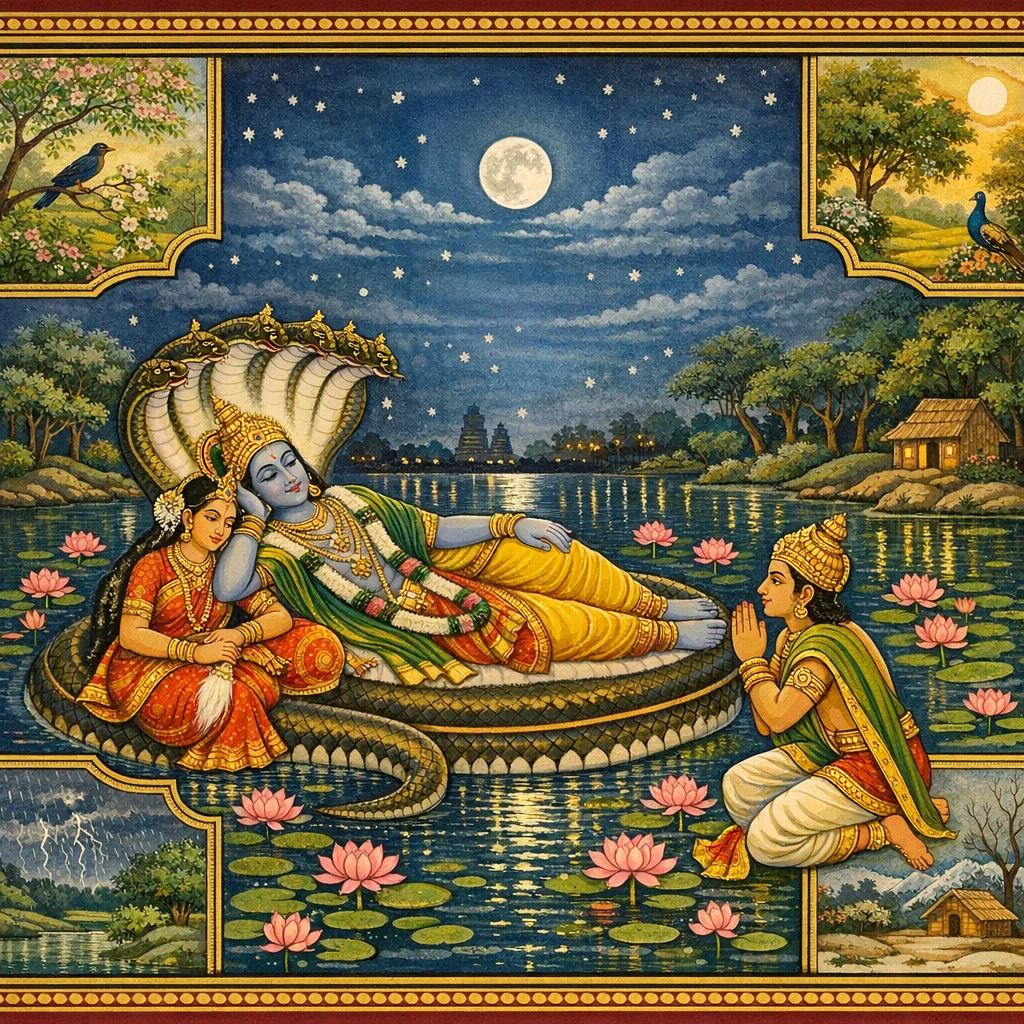
The chapter is framed as a Sūta-led theological narration in response to the ṛṣis’ questions. It first proclaims a renowned northern sacred site of “Jalaśāyī” Viṣṇu—Hari reclining upon the waters—praised as a remover of moral obstacles, and links His worship to the rite of śayana–bodhana, the liturgical “sleep” and “awakening” of Hari, observed with fasting and devotion. The calendrical focus is the second lunar day (dvitīyā) of the dark fortnight, called Ashūnyaśayanā, said to be especially dear to the Lord who rests in the waters. Asked about its origin and observance, the narrative turns to mythic history: the daitya-king Bāṣkali defeats Indra and the gods, who seek refuge with Viṣṇu in Śvetadvīpa, where He lies in yoganidrā on Śeṣa with Lakṣmī. Viṣṇu instructs Indra to perform severe tapas in a kṣetra named Cāmatkārapura and manifests an expanded water-body that recreates the archetypal Śvetadvīpa setting. There Viṣṇu is worshipped for four months (Cāturmāsya), beginning on Ashūnyaśayanā dvitīyā; through this vrata Indra gains tejas, and Viṣṇu sends Sudarśana with him, bringing about Bāṣkali’s defeat and the restoration of order. The chapter ends with a prescriptive phalaśruti: Viṣṇu remains present at the sacred lake for the world’s welfare, and those who worship with faith—especially during Cāturmāsya—are promised higher attainments and the fulfillment of desired aims. The narrative frame also associates the site with an identification as Dvārakā.
Shlokas
Verse 1
। सूत उवाच । तस्यैवोत्तरदिग्भागे देवस्य जलशायिनः । स्थानमस्ति सुविख्यातं सर्वपातकनाशनम्
Sūta said: In the northern quarter of that very region there is a renowned sacred place of the Lord who reclines upon the waters (Jalaśāyī). It is celebrated as a destroyer of all sins.
Verse 2
यस्तत्पूजयते भक्त्या शयने बोधने हरेः । उपवासपरो भूत्वा स गच्छेद्वैष्णवं पदम्
Whoever worships that Lord with devotion at the time of Hari’s reclining and awakening, and who is devoted to fasting, attains the supreme Vaiṣṇava abode.
Verse 3
अशून्यशयनानाम द्वितीया दयिता तिथिः । सदैव देवदेवस्य कृष्णा सुप्तस्य या भवेत्
The beloved lunar day called ‘Aśūnyaśayanā’ is the second tithi; it is ever associated with the Lord of gods—Kṛṣṇa—when He is in His state of sacred sleep.
Verse 4
तस्यां यः पूजयेत्तत्र तं देवं जलशायिनम् । शास्त्रोक्तेन विधानेन स गच्छति हरेः पदम्
On that tithi, whoever worships there the Lord who reclines upon the waters (Jalaśāyī), according to the procedure taught in the śāstras, attains the abode of Hari.
Verse 5
ऋषय ऊचुः । जलशायी कथं तत्र संप्राप्तः सूतनन्दन । पूज्यते विधिना केन तत्सर्वं विस्तराद्वद
The sages said: “O son of Sūta, how did Jalaśāyī come to be established there? By what ritual procedure is He worshiped? Tell us all of that in detail.”
Verse 6
सूत उवाच । पुरासीद्बाष्कलिर्नाम दानवेन्द्रो महाबलः । अजेयः सर्वदेवानां गन्धर्वोरगरक्षसाम्
Sūta said: “Long ago there was a mighty lord of the Dānavas named Bāṣkali—invincible to all the gods, and also to Gandharvas, Nāgas, and Rākṣasas.”
Verse 7
अथासौ भूतलं सर्वं वशीकृत्वा महाबलः । ततो दैत्यगणैः सार्द्धं जगाम त्रिदशालयम्
Then that mighty one, having brought the entire earth under his control, went together with hosts of Daityas to the dwelling of the Thirty (the gods).
Verse 8
तत्राभवन्महायुद्धं देवासुरविनाशकम् । देवानां दानवानां च क्रुद्धानामितरेतरम्
There a great war arose, destructive to gods and asuras alike—between the enraged Devas and Dānavas, each against the other.
Verse 9
वर्षाणामयुतं तावदहन्यहनि दारुणम् । तत्रासृक्कर्दमो जातः पर्वतश्चास्थि संभवः
For ten thousand years, day after day, the dreadful battle went on. There the mire turned to blood, and a mountain arose, formed of bones.
Verse 10
ततो वर्षसहस्रांते दशमे समुपस्थिते । जितस्तेन सहस्राक्षः ससैन्यः सपरिग्रहः
Then, when the tenth ten-thousand-year span had reached its end, Sahasrākṣa (Indra) was defeated by him—together with his armies and all his retinue.
Verse 11
ततः स्वर्गं परित्यज्य सर्वदेवगणैः सह । जगाम शरणं विष्णोः श्वेतद्वीपं प्रतिश्रयम्
Then, abandoning heaven, he—together with all the hosts of gods—went to seek refuge in Viṣṇu, to Śvetadvīpa, the sacred sanctuary.
Verse 12
यत्रास्ते भगवान्विष्णुर्योगनिद्रावशंगतः । शयानः शेषपर्यंके लक्ष्म्या संवाहितांघ्रियुक्
There abides Bhagavān Viṣṇu, overcome by yogic sleep—reclining upon the couch of Śeṣa, with his feet being gently attended by Lakṣmī.
Verse 13
ततो वेदोद्भवैः सूक्तैः स्तुतिं चक्रुः समंततः । तस्य देवस्य सद्भक्ताः सर्वे देवाः सवासवाः
Then, with hymns born of the Vedas, they offered praise on every side; indeed all the gods, with Vāsava (Indra) among them, were devoted worshippers of that Deity.
Verse 14
अथोत्थाय जगन्नाथः प्रोवाच बलसूदनम् । कच्चित्क्षेमं सहस्राक्ष सांप्रतं भुवनत्रये । यत्त्वं देवगणैः सार्द्धं स्वयमेव इहागतः
Then the Lord of the worlds rose and spoke to Balasūdana (Indra): “O Thousand-eyed one, is all well now in the three worlds—since you yourself have come here together with the hosts of gods?”
Verse 15
शक्र उवाच । बाष्कलिर्नाम देत्येन्द्रो हरलब्धवरो बली । अजेयः संगरे देवैस्तेनाहं विजितो रणे
Śakra (Indra) said: “There is a Daitya-lord named Bāṣkali, powerful, having obtained a boon from Hara (Śiva). Unconquerable in battle even by the gods, by him I have been defeated in war.”
Verse 16
संस्थितिश्च कृता स्वर्गे सांप्रतं मधु सूदन । तेनैष शरणं प्राप्तो देवैः सार्द्धं सुरोत्तम
“And now he has established his rule in heaven, O Madhusūdana. Therefore I, along with the gods, have come to you for refuge, O best of the gods.”
Verse 19
श्रीभगवानुवाच । अहं तं निग्रहीष्यामि संप्राप्ते समये स्वयम् । तस्मात्त्वं समयंयावत्कुरु शक्र तपो महत्
The Blessed Lord said: “At the proper time, I myself shall subdue him. Therefore, until that time, O Śakra, perform great austerity.”
Verse 20
येन ते जायते शक्तिस्तपोवीर्येण वासव । वधाय तस्य दैत्यस्य बलयुक्तस्य बाष्कलेः
“By the power born of austerity, O Vāsava, strength will arise in you—for the slaying of that mighty Daitya Bāṣkali.”
Verse 21
शक्र उवाच । कस्मिन्क्षेत्रे जगन्नाथ करोमि सुमहत्तपः । तस्य दैत्यस्य नाशार्थं तद स्माकं प्रकीर्तय
Śakra said: “In which sacred kṣetra, O Jagannātha, should I perform this very great austerity to destroy that Daitya? Please declare it to us.”
Verse 22
सूत उवाच । तच्छ्रुत्वा भगवान्विष्णुः प्रोवाचाथ पुरंदरम् । चिरं मनसि निश्चित्य क्षेत्राण्यायतनानि च
Sūta said: Hearing this, Bhagavān Viṣṇu then spoke to Purandara (Indra), after long deliberation in his mind upon the sacred regions and holy abodes.
Verse 23
चमत्कारपुरं क्षेत्रं शक्र सिद्धिप्रदायकम् । तस्मात्तत्र द्रुतं गत्वा तद्वधार्थं तपः कुरु
Camatkārapura is a sacred kṣetra that grants Śakra success and accomplishment. Therefore go there swiftly and undertake austerity for the slaying of that foe.
Verse 24
शक्र उवाच । न वयं भवता हीना यास्यामोऽन्यत्र केशव । बाष्कलेर्दानवेन्द्रस्य भयाद्भीताः कथंचन
Śakra (Indra) said: “O Keśava, without you we will not go anywhere else. For in every way we are terrified by fear of Bāṣkali, lord of the Dānavas.”
Verse 26
तस्मादागच्छ तत्र त्वं स्वयमेव सुरेश्वर । त्वया संरक्षितो येन करोमि सुमहत्तपः
Therefore, O Sureśvara, Lord of the gods, come there yourself; protected by you, I shall undertake a very great austerity.
Verse 27
अथ देवगणाः सर्वे तत्र गत्वा तदाऽश्रमान् । चक्रुः पृथक्पृथग्घृष्टास्तपोऽर्थं कृतनिश्चयाः
Then all the hosts of gods went there and set up hermitages, each in its own place, rejoicing in their vow and firmly resolved to undertake sacred austerity (tapas).
Verse 28
वासुदेवोऽपि संस्मृत्य क्षीरोदं तत्र सागरम् । आनिनायाशु विस्तीर्णं ह्रदे तस्मिन्पुरातने
Vāsudeva too, recalling the Ocean of Milk, swiftly brought that vast sea there and poured it into that ancient lake.
Verse 29
चकार शयनं तत्र श्वेतद्वीपे यथा पुरा । स्तूयमानः सुरैः सर्वैः समंताद्विनयान्वितैः
There he made his resting-place, just as formerly in Śvetadvīpa, while all the gods—humble on every side—praised him.
Verse 30
अथाषाढस्य संप्राप्ते द्वितीयादिवसे शुभे । कृष्णपक्षे सहस्राक्षं स्वयमेव बृहस्पतिः । प्रोवाच वचनं श्लक्ष्णं बाष्पव्याकुल लोचनम्
Then, when the auspicious second day of Āṣāḍha in the dark fortnight arrived, Bṛhaspati himself addressed Sahasrākṣa (Indra) with gentle words, his eyes troubled with tears.
Verse 31
बृहस्पतिरुवाच । अशून्यशयनानाम द्वितीयाद्य पुरंदर । अतीव दयिता विष्णोः प्रसुप्तस्य जलाशये
Bṛhaspati said: “O Purandara, today is the second lunar day called Aśūnyaśayanā, exceedingly dear to Viṣṇu as he lies asleep upon the waters.”
Verse 32
अस्यां संपूजितो विष्णुर्यावन्मासचतुष्टयम् । ददाति सकलान्कामान्ध्यातश्चेतसि सर्वदा । शास्त्रोक्तविधिना सम्यग्व्रतस्थो जलशायिनम्
If, beginning on this day, one duly worships Viṣṇu for four months, ever meditating upon Him within the heart, then—observing the vow rightly according to the rule of the śāstras and honoring the Lord who reposes upon the waters (Jalaśāyī)—one attains all desired aims.
Verse 33
एवं स चतुरो मासान्द्वितीयादिवसे हरिम् । पूजयित्वा सहस्राक्षस्तेजसा सहितोऽभवत्
Thus, having worshiped Hari for four months beginning on the second lunar day, Sahasrākṣa (Indra) became endowed with tejas—radiant power and splendor.
Verse 34
तं दृष्ट्वा तेजसा युक्तं परितुष्टो जनार्दनः । प्रोवाच शक्र गच्छाद्य वधार्थं तस्य बाष्कलेः । सर्वैर्देवगणैः सार्धं विजयस्ते भविष्यति
Seeing him endowed with radiant power, Janārdana was pleased and said: “O Śakra, go at once to slay that Bāṣkali. With all the hosts of the gods accompanying you, victory will surely be yours.”
Verse 35
शक्र उवाच । बिभेमि तस्य देवाहं दानवेन्द्रस्य दुर्मतेः । त्वया विना न गच्छामि सार्धं सर्वैः सुरैरपि
Śakra said: “O God, I fear that evil-minded lord of the Dānavas. Without You I will not go, even if all the gods were to go with me.”
Verse 36
श्रीभगवानुवाच । त्वया सह सहस्राक्ष चक्रमेतत्सुदर्शनम् । गमिष्यति वधार्थाय मदीयं सुरविद्विषाम्
The Blessed Lord said: “O thousand-eyed one, this Sudarśana discus of Mine shall go with you, for the destruction of the enemies of the gods.”
Verse 37
एवमुक्त्वा हरिश्चक्रं प्रमुमोच सुदर्शनम् । वधार्थं दानवेन्द्राणां शक्रेण सहितं तदा
Thus having spoken, Hari released the Sudarśana discus then and there, together with Śakra, for the slaying of the lords of the Dānavas.
Verse 38
शक्रोऽपि सहितस्तेन गत्वा चक्रेण कृत्स्नशः । सर्वानुत्सादयामास दानवान्रणमूर्धनि
Śakra too, accompanied by that (discus), went forth and, by the power of the Cakra, utterly crushed all the Dānavas at the very height of battle.
Verse 39
स चापि बाष्कलिस्तेन च्छिन्नश्चक्रेण कृत्स्नशः । पपात धरणीपृष्ठे वज्राहत इवाचलः
And Bāṣkali too, wholly cut down by that discus, fell upon the earth’s surface like a mountain struck by the thunderbolt.
Verse 40
तथान्ये बहवः शूरा दानवा बलदर्पिताः । हत्वा सुदर्शनं चक्रं भूयः प्राप्तं हरेः करम्
So too, many other heroic Dānavas, swollen with the pride of strength, were slain; and the Sudarśana discus returned once again to Hari’s hand.
Verse 41
तेऽपि शक्रादयो देवाः प्रहृष्टा गतसंशयाः । भूयो विष्णुं समेत्याथ प्रोचुर्नत्वा ततः परम्
Then those gods led by Śakra—delighted and freed from doubt—approached Viṣṇu once more; bowing, they spoke thereafter.
Verse 42
प्रभावात्तव देवेश हताः सर्वेऽमरारयः । प्राप्तं त्रैलोक्यराज्यं च भूयो निहतकंटकम्
By your might, O Lord of the gods, all the enemies of the immortals have been slain; and the sovereignty of the three worlds has been regained, once again free of thorns—free of obstructions.
Verse 43
तस्मात्कीर्तय यत्कृत्यं तच्च श्रेयस्करं मम । सदा स्यात्पुंडरीकाक्ष तथा शत्रुभयावहम्
Therefore, O Lotus-eyed One, declare what should be done—what would be for my welfare—so that it may ever remain so, and so that it may bring fear to enemies.
Verse 44
श्रीभगवानुवाच । मयात्रैव सदा स्थेयं रूपेणानेन वासव । सर्वलोकहितार्थाय ह्रदे पुण्य जलाश्रये
The Blessed Lord said: “O Vāsava, in this very place I shall ever remain, in this form, for the welfare of all the worlds—here in this lake, the sacred abode and refuge of holy waters.”
Verse 45
त्वया तस्मात्समागम्य चातुर्मास्यं शचीपते । प्रयत्नेन प्रकर्तव्यमशून्यशयनं व्रतम्
Therefore, O lord of Śacī, having come here, you must diligently undertake the Cāturmāsya observance—namely the vow of aśūnya-śayana, ‘not leaving the bed empty’.
Verse 46
न भवंति सहस्राक्ष येन ते परि पंथिनः । तथाभीष्टफलावाप्तिर्मत्प्रसादादसंशयम्
O thousand-eyed one, there will be no adversaries to obstruct your path; and the attainment of the desired fruits will come—without doubt—by My grace.
Verse 47
अन्योऽपि यो नरो भक्त्या पूजयिष्यति मामिह । संप्राप्स्यति स तांल्लोकान्दुर्लभांस्त्रि दशैरपि
And any other person who worships Me here with devotion shall attain those worlds—realms difficult to obtain even for the thirty gods.
Verse 48
तस्माद्गच्छ सहस्राक्ष कुरु राज्यं त्रिविष्टपे । भूयोऽप्यत्रैव देवेश द्रष्टव्योऽस्मि न संशयः । कार्यकाले समायाते श्वेतद्वीपे यथा तथा
Therefore go, O Sahasrākṣa, and rule in Triviṣṭapa (heaven). Again, O lord of the gods, you shall surely see Me here—when the time for action arrives—just as (you see Me) in Śvetadvīpa.
Verse 49
सूत उवाच । ततः प्रणम्य तं दृष्ट्वा प्रजगाम शतक्रतुः । वासुदेवोऽपि तत्रैव स्थितो लोकहिताय च
Sūta said: “Then Śatakratu (Indra), having bowed and beheld Him, departed. And Vāsudeva too remained right there, for the welfare of the world.”
Verse 50
एवं तत्र द्विजश्रेष्ठा जलशायी जनार्दनः । सर्वलोकहितार्थाय संस्थितः परमेश्वरः
Thus, O best of the twice-born, Janārdana—the Supreme Lord who reclines upon the waters—remains established there for the welfare of all the worlds.
Verse 51
यस्तं पूजयते भक्त्या श्रद्धया परया युतः । चातुर्मास्ये विशेषेण स याति परमां गतिम्
Whoever worships Him with devotion, endowed with supreme faith—especially during Cāturmāsya—attains the highest goal.
Verse 52
तथा देवगणैः सर्वैर्द्वारका तत्र सा कृता । संपूज्य तु नरा यांति चातुर्मास्ये त्रिविष्टपम्
Thus, by all the hosts of the gods, that place was made into “Dvārakā.” Having duly worshipped there, people go to Triviṣṭapa (heaven) during Cāturmāsya.
Verse 53
शेषकालेऽपि चित्तस्थान्कामान्मर्त्यः समाप्नुयात् । तस्मात्सर्वप्रयत्नेन पूज्या सा द्वारका नरैः । सर्वेष्वपि हि कालेषु चातुमास्ये विशेषतः
Even at other times, a mortal may obtain the cherished desires held in the mind. Therefore, with every effort, people should worship that Dvārakā—at all times indeed, but especially during Cāturmāsya.
Verse 54
एतद्वः सर्वमाख्यातं सर्वपातकनाशनम् । आख्यानं देवदेवस्य सुपुण्यं जलशायिनः
Thus I have narrated to you all this—an account that destroys every sin: the supremely meritorious sacred story of the God of gods, the Lord who reclines upon the waters.