Adhyaya 31
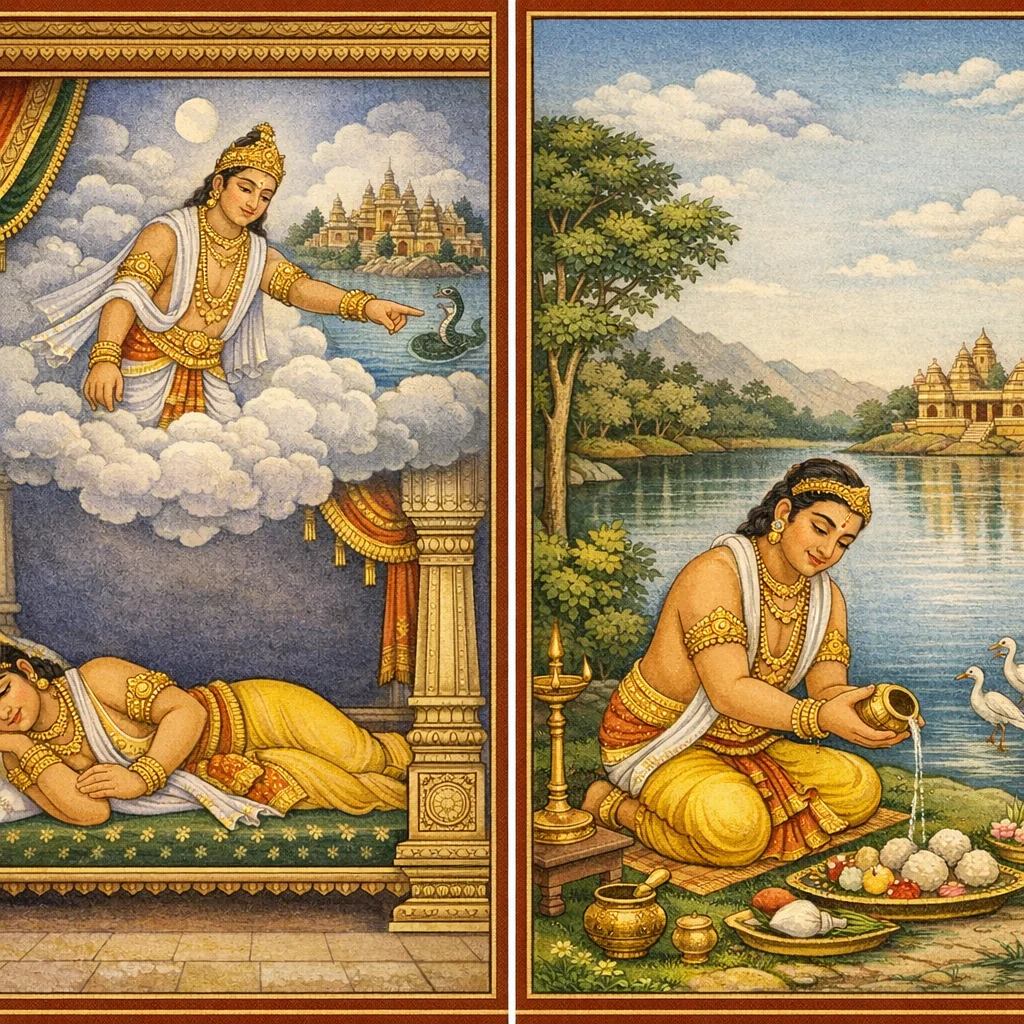
Chapter 31 proclaims the sanctity of the eminent Nāgatīrtha, where bathing is said to remove fear of serpents. It highlights the calendrical observance that bathing on Śrāvaṇa pañcamī—especially in the kṛṣṇa pakṣa—grants protection from serpent danger, extending even to one’s lineage. A mythic explanation follows: the great nāgas led by Śeṣa once performed austerities under the pressure of a mother’s curse, and their multiplying descendants became a threat to humans. Distressed beings appeal to Brahmā, who warns the nine nāga leaders to restrain their progeny; when restraint fails, Brahmā establishes order by assigning them a subterranean abode and by regulating time—pañcamī as their appointed day on earth—while laying down an ethical rule that blameless humans, especially those guarded by mantras and herbs, should not be harmed. The chapter then turns to ritual fruits: nāga worship on Śrāvaṇa pañcamī fulfills desired aims, and śrāddha performed at this place is portrayed as exceptionally efficacious, including for those seeking progeny and for deaths caused by serpents, where preta-status is said to persist until proper rites are done here. An illustrative tale recounts King Indrasena’s death by snakebite; his son’s ordinary rites elsewhere prove ineffective until, instructed in a dream, he performs śrāddha at Camatkārapura/Nāgahṛda. After difficulty finding a brāhmaṇa willing to partake of the śrāddha meal, Devasharmā accepts, and a confirming voice declares the father’s release. In the concluding phalāśruti, hearing or reciting this māhātmya on pañcamī removes serpent fear, lessens sins (including those arising from consumption), and grants śrāddha-fruit comparable to Gayā; it also neutralizes defects due to materials, weakness of vow, or officiant-related faults when recited at the time of śrāddha.
Shlokas
Verse 1
। सूत उवाच । तथान्यदपि तत्रास्ति नागतीर्थमनुत्तमम् । यत्र स्नातस्य सर्पाणां न भयं जायते क्वचित्
Sūta said: “Moreover, there is there another unsurpassed Nāga-tīrtha; by bathing there, fear of serpents does not arise for anyone at any time.”
Verse 2
तत्र श्रावणपञ्चम्यां यो नरः स्नानमाचरेत् । कृष्णायां न भयं तस्य कुलेऽपि स्यादहेः क्वचित्
Whoever performs the sacred bath there on Śrāvaṇa Pañcamī— even in Kṛṣṇā, the dark fortnight—shall never know fear of a serpent, not even within his lineage.
Verse 3
तत्र पूर्वं तपस्तप्तं मातुः शापप्रपीडितैः । शेष प्रभृतिनागैस्तु मुक्तिहेतोर्हुताशनात्
There, in ancient times, the Nāgas led by Śeṣa, tormented by their mother’s curse, undertook austerities; seeking liberation, they made Hutāśana—the sacred Fire (Agni)—their holy means.
Verse 4
कम्बलाश्वतरौ नागौ तथा ख्यातौ धरातले । तत्र तप्त्वा तपस्तीव्रं संसिद्धिं परमां गतौ
Upon the earth were famed the two Nāgas, Kambala and Aśvatara. There, having undertaken fierce austerities, they attained the supreme perfection.
Verse 5
अनंतो वासुकिश्चैव तक्षकश्च महावलः । कर्कोटश्चैव नागेन्द्रो मणिकण्ठस्तथापरः
Ananta and Vāsuki, and Takṣaka of mighty strength; and Karkoṭa, lord of the Nāgas, and Maṇikaṇṭha as well—another among them.
Verse 6
ऐरावतस्तथा शंखः पुण्डरीको महाविषः । शेषपूर्वाः स्मृता नागा एतेऽत्र नव नायकाः
So too are Airāvata, Śaṅkha, Puṇḍarīka, and Mahāviṣa. Remembered with Śeṣa at their head, these are the nine Nāga-leaders here.
Verse 7
एतेषां पुत्रपौत्राश्च तेषामपि विभूतिभिः । असंख्याभिरिदं व्याप्तं समस्तं धरणीतलम्
Their sons and grandsons as well, by countless powers, came to pervade the entire surface of the earth.
Verse 8
अथ ते कुटिला दुष्टा भक्षयंति सदा जनान् । बहुत्वादपि संस्पर्शादपराधं विनापि च
Then those crooked and wicked ones continually devoured people—through sheer multitude and mere contact, even without any offence on the part of humans.
Verse 9
ततः प्रजा इमाः सर्वा ब्रह्माणं शरणं गताः । पीडिताः स्म सुरश्रेष्ठ सर्पेभ्यो रक्ष सत्वरम्
Therefore all these people sought refuge in Brahmā, saying: “O best of the gods, we are afflicted—protect us swiftly from the serpents.”
Verse 10
यावन्न शून्यतां याति सकलं वसुधातलम् । व्याप्तं सर्वैस्ततः सर्पैर्विषाढ्यैरतिभीषणैः
Before the whole surface of the earth is emptied of people—for it has become filled with serpents everywhere, venom-laden and exceedingly terrifying—
Verse 11
अथ तानब्रवीद्ब्रह्मा शेषाद्यान्नवनायकान् । स्वसंततेः प्ररक्षध्वं भक्ष्यमाणा इमाः प्रजाः
Then Brahmā spoke to those nine chiefs, beginning with Śeṣa: “Restrain and protect your own lineage—these people are being devoured!”
Verse 13
अथ तेषां बहुत्वाच्च नैव रक्षा प्रजायते । वारिता अपि ते यस्मात्प्रकुर्वंति प्रजाक्षयम्
But because they were so many, true protection could not be secured; for even when restrained, they still brought about the destruction of the people.
Verse 14
ततः कोपपरीतात्मा तानाहूय कुलाधिपान् । तानुवाच स्वयं ब्रह्मा सर्वदेवसमागमे
Then Brahmā, his mind overtaken by righteous anger, summoned those clan-lords; and in the great assembly of all the gods, Brahmā himself addressed them.
Verse 15
भक्षयंति यतः सर्पा अपराधं विना प्रजाः । वारिता अपि ते तस्मात्तान्निगृह्णामि सांप्रतम्
“Because the serpents devour living beings even when there is no offence, and because they do not desist even when restrained, therefore I now proceed to punish and curb them.”
Verse 18
तच्छ्रुत्वा वेपमानास्ते सर्पाणां नवनायकाः । प्रोचुः प्रांजलयः सद्यः प्रणिपत्य पितामहम्
Hearing that, the nine leaders of the serpents trembled; with folded hands they at once bowed down to Pitāmaha (Brahmā) and spoke.
Verse 19
भगवन्कुटिला ज्ञातिरस्माकं भवता कृता । तत्कस्मात्कुरुषे कोपं जातिधर्मानुवर्तिनाम्
“O Blessed Lord, you have fashioned for us a crooked, winding line of kin; why then do you grow angry with those who merely follow the dharma of their kind—their natural disposition?”
Verse 20
ब्रह्मोवाच । यदि नाम मया सृष्टा यूयं दिष्ट्या विषोल्बणाः । अपराधं विना कस्माद्भक्षयध्व इमाः प्रजाः
Brahmā said: “Even if it is true that I created you, and by destiny you are fierce with poison—why do you devour these creatures when they have committed no offence?”
Verse 21
नागा ऊचुः । मर्यादां कुरु देवेश अस्माकं मानवैः सह । अथवा संप्रयच्छस्व स्थानं मानुषवर्जितम्
The Nāgas said: “O Lord of the gods, set a proper boundary for us in relation to humans; or else grant us a dwelling-place free from human presence.”
Verse 22
पारिक्षितमखे तस्मिन्सर्पाणां चित्रभानुना । समंताद्दह्यमानानां रक्षोपायं प्रचिंतय
“In that sacrifice of Parīkṣit, when the serpents are being burnt on every side by Citrabhānu, devise a means of protection.”
Verse 23
यथा न संततिच्छेदो जायते प्रपितामह । अस्माकं सर्वलोकेषु तथा त्वं कर्तुमर्हसि
“O Great-Grandfather, you should act so that our lineage is not cut off in any of the worlds.”
Verse 24
ब्रह्मोवाच । जरत्कारुरिति ख्यातो भविष्यति क्वचिद्द्विजः । स संतानकृते भार्यां भूमावन्वेषयिष्यति
Brahmā said: “Somewhere a twice-born man will arise, renowned as Jaratkāru. For the sake of offspring, he will seek a wife upon the earth.”
Verse 25
भाविनी च भवद्वंशे जरत्कन्या सुशोभना । सा देया चादरात्तस्मै पुत्रार्थं वरवर्णिनी
And in your lineage there shall arise a radiant maiden named Jaratkanyā. She, of excellent beauty, should be respectfully given to him for the sake of obtaining a son.
Verse 26
ताभ्यां यो भविता पुत्रः स शेषान्रक्षयिष्यति । सर्पाञ्छुद्धसमाचारान्मर्यादासु व्यवस्थितान्
The son who will be born from those two will protect the remaining serpents—those of pure conduct, established within proper bounds.
Verse 27
सुतलं नितलं चैव तथैव वितलं च यत् । तस्याधस्ताच्चतुर्थे च वसतिर्वो धरातले
Below Sutala, Nitala, and likewise Vitala, in the fourth region beneath them, your dwelling shall be established in the depths of the earth.
Verse 28
मया दत्तेऽतिरम्ये च सर्वभोगसमन्विते । तस्माद्व्रजत तत्रैव परित्यज्य महीतलम्
It has been granted by me—exceedingly delightful and endowed with every enjoyment. Therefore go to that very place, leaving the earthly plane behind.
Verse 29
तत्र भुंजथ सद्भोगा न्गत्वाऽशु मम शासनात् । पुत्रपौत्रसमोपेतांस्त्रिदशैरपि दुर्लभान्
Having quickly gone there in obedience to my command, enjoy noble pleasures—together with sons and grandsons—blessings difficult to obtain even for the gods.
Verse 30
नागा ऊचुः । भोगानपि प्रभुंजाना न वयं तत्र पद्मज । शक्नुमो वस्तुमुर्व्यां नस्तस्मात्स्थानं प्रदर्शय । मर्यादया वर्तयामो यत्रस्था मानवैः समम्
The Nāgas said: “O Lotus-born, even though we may partake of pleasures there, we cannot dwell upon the earth. Therefore show us a fitting place, where, abiding within due bounds, we may live together with human beings.”
Verse 31
ब्रह्मोवाच । एषा तिथिर्मया दत्ता युष्माकं धरणीतले । पंचमी शेषकालस्तु नेयस्तत्रं रसातले
Brahmā said: “This lunar day has been granted by me to you upon the earth. On the Pañcamī, the remaining time is to be spent there in Rasātala.”
Verse 32
तत्रागतैर्न हंतव्या मानवा दोषवर्जिताः । मंत्रसंरक्षितांगाश्च तथौषधिकृतादराः
Those humans who arrive there, free from wrongdoing, are not to be harmed; for their bodies are protected by mantras, and they are duly attended by medicinal remedies.
Verse 33
चमत्कारपुरे क्षेत्रे मया दत्ता स्थितिः सदा । पृथिव्यां कुलमुख्यानां नागानां नागसत्तमाः
In the sacred field of Cāmatkārapura, a perpetual abode has been granted by me on earth for the foremost Nāgas, the chiefs of their lineages—O best among Nāgas.
Verse 34
सूत उवाच । एवमुक्ताश्च ते नागा ब्रह्मणा सत्वरं ययुः । पातालं कुलमुख्याश्च तस्मिन्क्षेत्रे व्यवस्थिताः
Sūta said: Thus addressed by Brahmā, those Nāgas departed swiftly for Pātāla; and the lineage-chiefs became established in that sacred region.
Verse 35
तत्र श्रावणपंचम्यां यस्तान्पूजयते नरः । स प्राप्नोति नरोऽभीष्टं तेषामेव प्रसादतः
There, on Śrāvaṇa Pañcamī, the man who worships those Nāgas attains his desired aim—through their very grace.
Verse 36
तस्य वंशेऽपि सर्पाणां न भयं स्यान्न किल्बिषम् । न रोगो नोपसर्गश्च न च भूतभयं क्वचित्
Even in that devotee’s lineage there will be no fear of serpents, no sin; no disease, no affliction, and nowhere any fear from spirits.
Verse 37
अपुत्रस्तत्र यः श्राद्धं करोति सुतवांछया । पुत्रं विशिष्टमासाद्य पितॄणामनृणो हि सः
In that sacred place, a man who has no son, if he performs śrāddha with the longing for offspring, attains an excellent son—and thereby truly becomes free from his debt to the Pitṛs (ancestors).
Verse 38
तथा वंध्या च या नारी पंचम्यां भास्करोदये । श्रावणे कुरुते स्नानं कृष्णपक्षे विशेषतः । सा सद्यो लभते पुत्रं स्ववंशोद्धरणक्षमम्
Likewise, a barren woman who bathes there at sunrise on the fifth lunar day—especially in the dark fortnight of the month of Śrāvaṇa—quickly obtains a son, capable of sustaining and uplifting her lineage.
Verse 39
सर्वरोगविनिर्मुक्तं सुरूपं विनयान्वितम् । भ्रष्टराज्यो नरो यो वा तत्र स्नानं समाचरेत्
Whoever bathes there becomes freed from all diseases, gains comeliness and good character; even a man who has fallen from sovereignty, by bathing there, is restored in fortune.
Verse 40
ततः पूजयते नागाञ्छ्रावणे पंचमीदिने । स हत्वाऽरिगणा न्सर्वान्भूयोराज्यमवाप्नुयात्
Then, on the fifth day in the month of Śrāvaṇa, one should worship the Nāgas. Having overcome all hosts of enemies, he attains kingship again.
Verse 41
येषां मृत्युर्मनुष्याणां जायते सर्पभक्षणात् । न तेषां जायते मुक्तिः प्रेतभावात्कथंचन
For those humans whose death occurs due to a serpent’s bite, liberation does not arise for them in any way, because they fall into the state of a preta.
Verse 42
यावन्न क्रियते श्राद्धं तस्मिंस्तीर्थे द्विजोत्तमाः । तस्मात्सर्वप्रयत्नेन मृतस्याहिप्रदंक्षणात् । श्राद्धं कार्यं प्रयत्नेन तस्मिंस्तीर्थेऽहिसंभवे
O best of the twice-born, so long as śrāddha is not performed at that tīrtha, release is not attained. Therefore, with every effort, śrāddha must be performed diligently at that serpent-born holy place.
Verse 43
अत्र वः कीर्तयिष्यामि पुरावृत्तां कथां शुभाम् । इन्द्रसेनस्य राजर्षेः सर्वपातकनाशिनीम्
Here I shall recount to you an auspicious tale from ancient times—the story of the royal sage Indrasena—which destroys all sins.
Verse 44
इन्द्रसेनो महीपालः पुरासीद्रिपुदर्पहा । अश्वमेधसहस्रेण इष्टं तेन महात्मना
Indrasena was once a king, a crusher of the pride of enemies. That great-souled ruler had performed sacrifices—indeed, a thousand Aśvamedhas.
Verse 45
ततः स दैवयोगेन प्रसुप्तः शयने शुभे । दष्टः सर्पेण मुक्तश्च इन्द्रसेनो महीपतिः । वियुक्तश्चैव सहसा जीवितव्येन तत्क्षणात्
Then, by the power of destiny, as King Indrasena slept upon his auspicious bed, a serpent bit him and he was released from life; in that very instant he was suddenly severed from his allotted span.
Verse 46
ततस्तस्य सुतोऽभीष्टस्तस्योद्देशेन कृत्स्नशः । चकार प्रेतकार्याणि स्मृत्युक्तानि च भक्तितः
Thereafter, his beloved son, dedicating the rites to him, performed in full the funerary observances for the departed, exactly as enjoined in the Smṛtis, and with devotion.
Verse 47
गंगायामस्थिपातं च कृत्वा श्राद्धानि षोडश । गयां गत्वा ततश्चक्रे श्राद्धं श्रद्धासमन्वितः
After consigning the bones into the Gaṅgā, he performed the sixteen śrāddha rites; then, having gone to Gayā, he carried out śrāddha there as well, filled with faith.
Verse 48
अथ स्वप्नांतरे प्राप्तः पिता तस्य स भूपतिः । प्रोवाच दुःखितः पुत्रं बाष्पव्याकुललोचनम्
Then, appearing to him within a dream, his father—the king—spoke in sorrow to his son, whose eyes were troubled with tears.
Verse 49
सर्पमृत्योः सकाशान्मे प्रेतत्वं पुत्र संस्थितम् । तेन मे भवता दत्तं न किञ्चिदुपतिष्ठते
“O son, because of death by a serpent, I have fallen into the state of a preta. Therefore, nothing that has been offered by you is reaching me.”
Verse 50
चमत्कारपुरं क्षेत्रं तस्मात्त्वं गच्छ सत्वरम् । तत्र तीर्थे कुरु श्राद्धं सर्पाणां मत्कृते सुत
“Therefore go quickly to the sacred kṣetra of Cāmatkārapura. At that tīrtha, perform śrāddha addressed to the serpents (Nāgas), for my sake, my son.”
Verse 51
येन संजायते मोक्षः प्रेतत्वा द्दारुणान्मम । स ततः प्रातरुत्थाय तत्स्मृत्वा नृपतेर्वचः
By that rite and that tīrtha, liberation (mokṣa) is gained for me from this dreadful preta-state. Then he rose early in the morning, remembering the king’s words.
Verse 52
प्रेतरूपस्य दुःखार्तस्तत्तीर्थं सत्वरं गतः । चकार च ततः श्राद्धं श्रावणे पंच मीदिने
Afflicted by the suffering of his father in preta-form, he hurried to that tīrtha; and then, on the fifth day of the month of Śrāvaṇa, he performed the śrāddha.
Verse 53
स्नात्वा श्रद्धासमोपेतः संनिवेश्य पुरोधसम् । ततः स दर्शनं प्राप्तो भूयोऽपि च यथा पुरा
Having bathed and being filled with faith, he seated his family priest (purohita); then he again received a vision (darśana) as before.
Verse 55
फलं श्राद्धस्य चात्र त्वं कारणं शृणु पुत्रक । श्राद्धार्हा ब्राह्मणाश्चात्र चमत्कारपुरोद्भवाः
“Now, dear son, hear the reason why śrāddha bears fruit here: the Brāhmaṇas in this place, born of Cāmatkārapura, are truly fit recipients for śrāddha.”
Verse 56
क्षेत्रेऽपि गर्हिताः श्राद्धे येऽन्यत्र व्यंगकादयः । अत्र यत्क्रियते किञ्चिद्दानं वा व्रतमेव च
Even those who elsewhere are censured in matters of śrāddha—such as the deformed and the like—here in this kṣetra, whatever is done, whether a gift (dāna) or a vow (vrata), becomes meaningful and effective.
Verse 57
तथान्यदपि विप्रार्हं कर्म यज्ञसमुद्भवम् । तत्तेषां वचनात्सर्वं पूर्णं स्यादपि खंडितम् । परोक्षे वापि संपूर्णं वृथा संजायते स्फुटम्
So too, any other act fit for Brāhmaṇas and arising from sacrificial duty (yajña): by their very word, everything becomes complete—even if performed imperfectly. But if they are absent, even what is otherwise complete clearly turns fruitless.
Verse 58
तस्मादस्मात्पुराद्विप्रान्समानीय ततः परम् । मम नाम्ना कुरु श्राद्धं येन मुक्तिः प्रजायते
Therefore, gather learned brāhmaṇas from this very city; and thereafter perform the śrāddha in my name—by which liberation (mukti) is born.
Verse 59
अथासौ प्रातरुत्थाय स्मरमाणः पितुर्वचः । दुःखेन महताविष्टः प्रविवेश पुरोत्तमे
Then he rose at dawn, remembering his father’s words; overwhelmed by great sorrow, he entered the excellent city.
Verse 60
ततश्चान्वेषयामास श्राद्धार्हान्ब्राह्मणान्नृपः । यत्नतोऽपि न लेभे स धनाढ्या ब्राह्मणा यतः
Thereupon the king searched for brāhmaṇas fit to receive śrāddha; yet even with effort he found none—because the brāhmaṇas there were wealthy.
Verse 61
न तत्र दुःखितः कश्चिद्दरिद्रोऽपि न दुःखितः । नाकर्मनिरतो वापि पाखण्डनिरतोऽथवा
There none was sorrowful—nor even the poor were sorrowful; none were devoted to inaction, nor were any given to hypocrisy or heretical pretence.
Verse 62
स्थानेस्थाने महानादा उत्सवाश्च गृहेगृहे । वेदविद्याविनोदाश्च स्मृति वादास्तथैव च
In every quarter there were great sounds of celebration, and in every house festivals; there were delights in Vedic learning, and likewise discussions grounded in Smṛti.
Verse 63
श्रूयंते याज्ञिकानां च यज्ञकर्मसमुद्भवाः । न दुर्भिक्षं न च व्याधिर्नाकालमरणं नृणाम् । न मृत्युः कस्यचित्तत्र पुरे ब्राह्मण सेविते
There were heard the sounds born of sacrificial rites performed by the yajña-priests. There was no famine, no disease, and no untimely death among people; in that city, served and upheld by brāhmaṇas, death did not befall anyone.
Verse 64
यथर्तुवर्षी पर्जन्यः सस्यानि गुणवन्ति च । भूरिक्षीरस्रवा गावः क्षीराण्याजाविकानि च
The rains fell in due season, and the crops were excellent; cows yielded abundant milk, and so too did the milk of goats and sheep.
Verse 65
यंयं प्रार्थयते विप्रं स श्राद्धार्थं महीपतिः । स स तं भर्त्सयामास दुरुक्तैः कोपसंयुतः
Whichever brāhmaṇa the king requested for the sake of the śrāddha, that brāhmaṇa would scold him—hurling harsh words, filled with anger.
Verse 66
धिग्धिक्पापसमाचार क्षत्रियापसदात्मक । किं कश्चिद्ब्राह्मणोऽश्नाति प्रेतश्राद्धे विशेषतः
“Fie, fie—your conduct is sinful, you who are the very dregs of kṣatriyas! Would any brāhmaṇa eat your offering, especially in a preta-śrāddha?”
Verse 67
तस्माद्गच्छ द्रुतं यावन्न कश्चिच्छपते द्विजः । निहन्ति वा प्रकोपेन स्वर्गमार्गनिरोधकम्
“Therefore go quickly—before some brāhmaṇa curses you; or, in anger, strikes you down, blocking your path to heaven.”
Verse 68
सूत उवाच । ततः स दुःखितो राजा निश्चक्राम भयार्दितः । चमत्कारपुरात्तस्माद्वैलक्ष्यं परमं गतः
Sūta said: Then that sorrow-stricken king, overwhelmed by fear, went out from the city called Camatkārapura, falling into the deepest bewilderment and disquiet.
Verse 69
चिन्तयामास राजेंद्र स्मृत्वावस्थां पितुश्च ताम् । किं करोमि क्व गच्छामि कथं मे स्यात्पितुर्गतिः
Remembering his father’s condition, the king pondered: “What shall I do? Where shall I go? How may my father attain a true and blessed course hereafter?”
Verse 70
ततः स सचिवान्सर्वान्प्रेषयित्वा गृहं प्रति । एकाकी भिक्षुरूपेण स्थितस्तत्रैव सत्पुरे
Then, sending all his ministers back home, he remained there in that noble city, alone, disguised in the form of a mendicant.
Verse 71
स ज्ञात्वा नगरे तत्र ब्राह्मणं शंसितव्रतम् । सर्वेषां ब्राह्मणेंद्राणां मध्ये दाक्षिण्यभाजनम्
There he learned that in that city dwelt a brāhmaṇa famed for his sacred vows—among the foremost of brāhmaṇas, a worthy vessel for reverence and generous gifts.
Verse 72
देवशर्माभिधानं तु शरणागतवत्सलम् । आहिताग्निं चतुर्वेदं स्मृतिमार्गानुयायिनम्
His name was Devaśarmā—gentle to those who sought refuge; he had established the sacred fires, mastered the four Vedas, and walked the path enjoined by Smṛti.
Verse 73
ततस्तु प्रातरुत्थाय कृत्वांत्यजमयं वपुः । शोधयामास कृच्छ्रेण मलोत्सर्गनिकेतनम्
Then, rising at dawn and taking on a body like that of an outcaste, he toiled to cleanse the place set apart for the casting away of filth.
Verse 74
अथ यः कुरुते कर्म तत्र विष्ठाप्रशोधनम् । सोऽभ्येत्य तमुवाचेदं कोपसंरक्तलोचनः
Then the man whose duty it was to cleanse the excrement there came up to him and spoke these words, his eyes reddened with anger.
Verse 75
कुतस्त्वमिह संप्राप्तो मद्वृत्तेरुपघातकृत् । तस्माद्गच्छ द्रुतं नो चेन्नयिष्ये यमसादनम्
“From where have you come here, you who would ruin my livelihood? Go at once—otherwise I shall send you to Yama’s abode!”
Verse 76
तस्यैवं वदतोऽप्याशु बलात्स पृथिवीपतिः । शोधयामास तत्स्थानं देवशर्मसमुद्भवम्
Even as he spoke thus, the lord of the earth swiftly—by the sheer power of resolve—continued to cleanse that place connected with Devaśarmā.
Verse 77
ततः संवत्सरस्यांते चंडालेन द्विजोत्तमाः । स प्रोक्त उचिते काले प्रणिपत्य च दूरतः
Then, at the end of a year, O best of the twice-born, the caṇḍāla addressed him at the proper time; and he bowed down from a distance.
Verse 78
स्वामिंस्तव कुलेप्येवं गूथाशोधनकर्मकृत् । तदस्माकं न चान्यस्य तत्किमन्यः प्रवेशितः
“O master, even within your own lineage there is one who performs the work of cleaning filth. That task belongs to us and to none other—so why has another been brought in to take it up?”
Verse 79
अथ श्रुत्वा च तद्वाक्यं स प्राह द्विजसत्तमः । न मया कश्चिदन्योऽत्र निर्दिष्टो गोप्यकर्मणि । अधिकारस्त्वयात्मीयस्तथा कार्यो यथा पुरा
Hearing those words, the best of the twice-born replied: “I have not appointed anyone else here for this confidential duty. The authority is yours alone—carry it out just as before.”
Verse 80
तदान्यदिवसे प्राप्ते सोंऽत्यजः कोपसंयुतः । शस्त्रमादाय संप्राप्तो वधार्थं तस्य भूपतेः
On another day, that antyaja, seized with anger, took up a weapon and came there with the intent to kill that king.
Verse 81
शस्त्रोद्यतकरं दृष्ट्वा प्रहारेकृतनिश्चयम् । ततस्तं लीलया भूयो मुष्टिना मूर्ध्न्यताडयत्
Seeing him with weapon raised and resolved to strike, he then—almost effortlessly—struck him again on the head with his fist.
Verse 82
ततस्तस्य विनिष्क्रांते लोचने तत्क्षणाद्द्विजाः । सुस्राव रुधिरं पश्चात्पपात गतजीवितः
Then, as his eyes came out at that very moment, O brāhmaṇas, blood flowed forth; soon after, he fell down lifeless.
Verse 83
तं श्रुत्वा निहतं तेन चंडालं निजकिंकरम् । देवशर्मातिकोपेन तद्वधार्थमुपागतः
Hearing that his own servant, a caṇḍāla, had been slain by him, Devaśarmā—overcome with fierce anger—came there intending to kill him.
Verse 84
ततः पुत्रैश्च पौत्रैश्च सहितोऽन्यैश्च बन्धुभिः । लोष्टैस्तं ताडयामास भर्त्समानो मुहुर्मुहुः
Then, accompanied by his sons, grandsons, and other relatives, he beat him with clods of earth, repeatedly reviling him again and again.
Verse 85
सोऽपि संताड्यमानस्तु प्रहारैर्जर्जरीकृतः । वेदोच्चारं ततश्चक्रे दर्शयित्वोपवीतकम्
Though he was being beaten and battered by blows, he then began reciting the Veda, showing his sacred thread.
Verse 86
अथ ते विस्मिताः सर्वे देवशर्मपुरःसराः । ब्राह्मणास्तं समुद्वीक्ष्य वेदोच्चारपरायणम्
Then all of them—led by Devaśarmā—were astonished; the brāhmaṇas, seeing him, found him wholly devoted to Vedic recitation.
Verse 87
पृष्टश्च किमिदं कर्म तवांत्यजजनोचितम् । एषा वेदात्मिका वाणी स्पष्टाक्षरकलस्वना । तत्किं शापपरिभ्रष्टस्त्वं कश्चिद्ब्राह्मणोत्तमः
And he was asked: “Why do you perform this work suited to an antyaja? Yet your speech is Vedic in nature, with clear syllables and a melodious tone. Are you, then, some excellent brāhmaṇa who has fallen from his state due to a curse?”
Verse 88
येनैवं कुरुषे कर्म गर्हितं चांत्यजैरपि । ततः स प्रहसन्नाह क्षत्रियोऽहं महीपतिः । विष्णुसेन इति ख्यातो हैहयान्वयसंभवः
Hearing, “For what reason do you commit such a deed—condemned even by the lowest of men?”, he smiled and replied: “I am a Kṣatriya, a king. I am known as Viṣṇusena, born in the lineage of the Haihayas.”
Verse 89
सोहमाराधनार्थाय त्वस्मिन्स्थान उपागतः । अद्य संवत्सरो जातः कर्मण्यस्मिन्रतस्य च
“I have come to this place for the sake of worship and propitiation. Today a full year has passed while I have been devoted to this very observance.”
Verse 90
सूत उवाच । तस्य तद्वचनं श्रुत्वा स विप्रः कृपयान्वितः । कृतांजलिपुटो भूत्वा तमुवाच महीपतिम्
Sūta said: Hearing his words, that brāhmaṇa—moved with compassion—joined his palms in reverence and spoke to the king.
Verse 92
नास्ति मे किञ्चिदप्राप्तं तथाऽसाध्यं महीपते । तस्मात्तव करिष्यामि कृत्यं यद्यपि दुर्लभम्
O king, nothing is beyond my reach—nothing is impossible for me. Therefore I shall accomplish the rite you require, even if it is difficult to obtain.
Verse 93
राजोवाच । पिता ममाहिना दष्टः प्रेतत्वं समुपागतः । सोऽत्र नागह्रदे श्राद्धे कृते मुक्तिमवाप्नुयात्
The king said: “My father was bitten by a serpent and has fallen into the state of a preta. If śrāddha is performed here at Nāgahrada, he may attain liberation.”
Verse 94
तस्मात्तत्तारणार्थाय विप्रकृत्यं समाचर । एतदर्थं मयैतत्ते कृतं कर्म विगर्हितम्
“Therefore, for his deliverance, perform the rite proper to a brāhmaṇa. It was for this purpose that I committed this act toward you—though it is censurable.”
Verse 95
देवशर्मोवाच । एवं कुरु नृपश्रेष्ठ श्राद्धेऽहं ते पितुः स्वयम् । ब्राह्मणः संभविष्यामि तस्माच्छ्राद्धं समाचर
Devaśarman said: “Do so, O best of kings. In the śrāddha for your father, I myself shall serve as the brāhmaṇa (recipient/officiant). Therefore, perform the śrāddha.”
Verse 96
सूत उवाच । अथ ते सुहृदस्तस्य पुत्राः पौत्राश्च बांधवाः । प्रोचुर्नैतत्प्रयुक्तं ते श्राद्धं भोक्तुं विगर्हितम्
Sūta said: Then his friends—along with their sons, grandsons, and kinsmen—declared: “It is improper and blameworthy to partake of this śrāddha arranged by you.”
Verse 97
तस्माद्यदि भवानस्य श्राद्धे भोक्ता ततः स्वयम् । सर्वे भवन्तं त्यक्षामस्तथान्येऽपि द्विजोत्तमाः
Therefore, if you yourself become the one who partakes in his śrāddha, then we all shall abandon you—along with the other eminent brāhmaṇas as well.
Verse 98
देवशर्मोवाच । कामं त्यजत मां सर्वे यूयमन्येऽपि ये द्विजाः । मयैवास्य प्रतिज्ञातं भोक्तुं श्राद्धे महीपतेः
Devaśarman said: “You may all abandon me—yes, even you other brāhmaṇas if you wish. I have myself promised to partake in the king’s śrāddha.”
Verse 99
एवमुक्त्वा स विप्रेंद्रस्तेनैव सहितस्तदा । नागह्रदं समासाद्य श्राद्धे वै भुक्तवानथ
Having spoken thus, that foremost of brāhmaṇas then, accompanied by him, reached Nāgahrada; and there, in the śrāddha rite, he partook of the meal.
Verse 100
भुक्तमात्रे ततस्तस्मिन्वागुवाचाशरीरिणी । नादयंती जगत्सर्वं हर्षयंती महीपतिम्
As soon as the meal was finished, a bodiless voice spoke, resounding through the whole world and filling the king with joy.
Verse 101
प्रेतभावाद्विनिर्मुक्तः पुत्राहं त्वत्प्रभावतः । स्वस्ति तेऽस्तु गमिष्यामि सांप्रतं त्रिदिवालयम्
“Freed from the state of a preta by your power, I—your son—now bless you. May auspiciousness be yours; I shall now depart to the abode of the gods.”
Verse 102
तत्कृत्वा नृपतिर्हृष्टस्तं प्रणम्य द्विजोत्तमम् । प्रोवाच कुरु मे वाक्यं यद्ब्रवीमि द्विजोत्तम
When this had been done, the king, delighted, bowed to that foremost brāhmaṇa and said: “Carry out my word—what I am about to speak, O best of the twice-born.”
Verse 103
अस्ति माहिष्मतीनाम नगरी नर्मदातटे । सा चास्माकं राजधानी पितृपर्यागता विभो
“There is a city named Māhiṣmatī on the bank of the Narmadā. That is my capital, O venerable one, inherited through the line of my forefathers.”
Verse 104
अहं यच्छामि ते ब्रह्मन्समस्तविषयान्विताम् । मया भृत्येन तत्रस्थः कुरु राज्यमकंटकम्
“O brāhmaṇa, I grant you (that capital) together with all its districts. With me as your servant, dwelling there, rule the kingdom without obstruction.”
Verse 106
सूत उवाच । एवं विसर्जितस्तेन जगाम स महापतिः । स्वं देशं हर्षसंयुक्तः कृतकृत्यो द्विजोत्तमाः
Sūta said: “Thus dismissed by him, that great lord departed for his own country, filled with joy—his purpose fulfilled, O best of the twice-born.”
Verse 107
सोऽपि सर्वैः परित्यक्तो ब्राह्मणैः पुरवासिभिः । देवशर्मा समुद्दिश्य दोषं श्राद्धसमुद्भवम्
He too—Devaśarmā—was abandoned by all: by the brāhmaṇas and by the city-dwellers, who blamed him for a fault arising from the śrāddha.
Verse 108
ततो नागह्रदे तस्मिन्स कृत्वा निजमन्दिरम् । निवासमकरोत्तत्र स्वाध्यायनिरतः शुचिः
Then, at that Nāgahrada, he built a dwelling for himself and lived there—pure, devoted to svādhyāya, the sacred self-study.
Verse 109
तत्रस्थस्य निरस्तस्य ये पुत्राः स्युर्द्विजोत्तमाः । तेषां संततयो ऽद्यापि ते प्रोक्ता बाह्यवासिनः
“O best of Brāhmaṇas, the sons born to him while he lived there as one in banishment—their descendants even today are known as ‘Bāhyavāsins’, those who dwell outside.”
Verse 110
एतद्वः सर्वमाख्यातं नागतीर्थसमुद्भवम् । माहात्म्यं ब्राह्मणश्रेष्ठाः सर्वपातकनाशनम्
Thus have I fully narrated to you, O best of Brāhmaṇas, the greatness that arises from Nāga-tīrtha—a sacred account that destroys all sins.
Verse 111
यश्चैतत्पठते भक्त्या संप्राप्ते पंचमीदिने । शृणुयाद्वा न वंशेऽपि तस्य स्यात्सार्पजं भयम्
Whoever recites this with devotion when the fifth lunar day, Pañcamī, arrives—or even listens to it—will have no fear of serpent-born danger, not even within his lineage.
Verse 112
तथा विमुच्यते पापाद्भक्षजातान्न संशयः । कृतादज्ञानतो विप्राः सत्यमेतन्मयोदितम्
Likewise, one is freed from sins that arise from improper eating—there is no doubt. Even if such faults were committed in ignorance, O Brāhmaṇas, what I say is true.
Verse 113
तस्मात्सर्वप्रयत्नेन नागतीर्थमनुत्तमम् । माहात्म्यं पठनीयं वा श्रोतव्यं वा समाहितैः
Therefore, with every effort, one should revere the unsurpassed Nāga-tīrtha; its māhātmya should be recited—or at least heard—by those who are composed and attentive.
Verse 114
श्राद्धकाले तु संप्राप्ते यश्चैतत्पठते द्विजः । स प्राप्नोति फलं कृत्स्नं गयाश्राद्धसमुद्भवम्
When the time for Śrāddha has arrived, the twice-born who recites this attains the complete fruit that is said to arise from performing the Śrāddha at Gayā.
Verse 115
तथा ये कीर्तिता दोषाः श्राद्धे द्रव्यसमुद्भवाः । व्रतवैक्लव्यजाश्चापि तथा ब्राह्मणसंभवाः
Likewise, the defects spoken of in connection with Śrāddha—those arising from the materials used, those arising from shortcomings in vows, and those arising from the officiating Brāhmaṇas—
Verse 116
ते सर्वे नाशमायांति कीर्त्यमाने समाहितैः । नागह्रदस्य माहात्म्ये श्राद्धकाल उपस्थिते
All those defects come to destruction when, at the time of Śrāddha, the māhātmya of Nāgahrada is being recited by those who are attentive and composed.
Verse 117
तथा विनिहता गोभिर्ब्राह्मणैः श्वापदैरपि । एतस्मिन्पठिते श्राद्धे गच्छंति परमां गतिम्
Likewise, even those who have been killed by cows, by Brāhmaṇas, or even by wild beasts—when this is recited at the time of Śrāddha—attain the supreme state.