Adhyaya 19
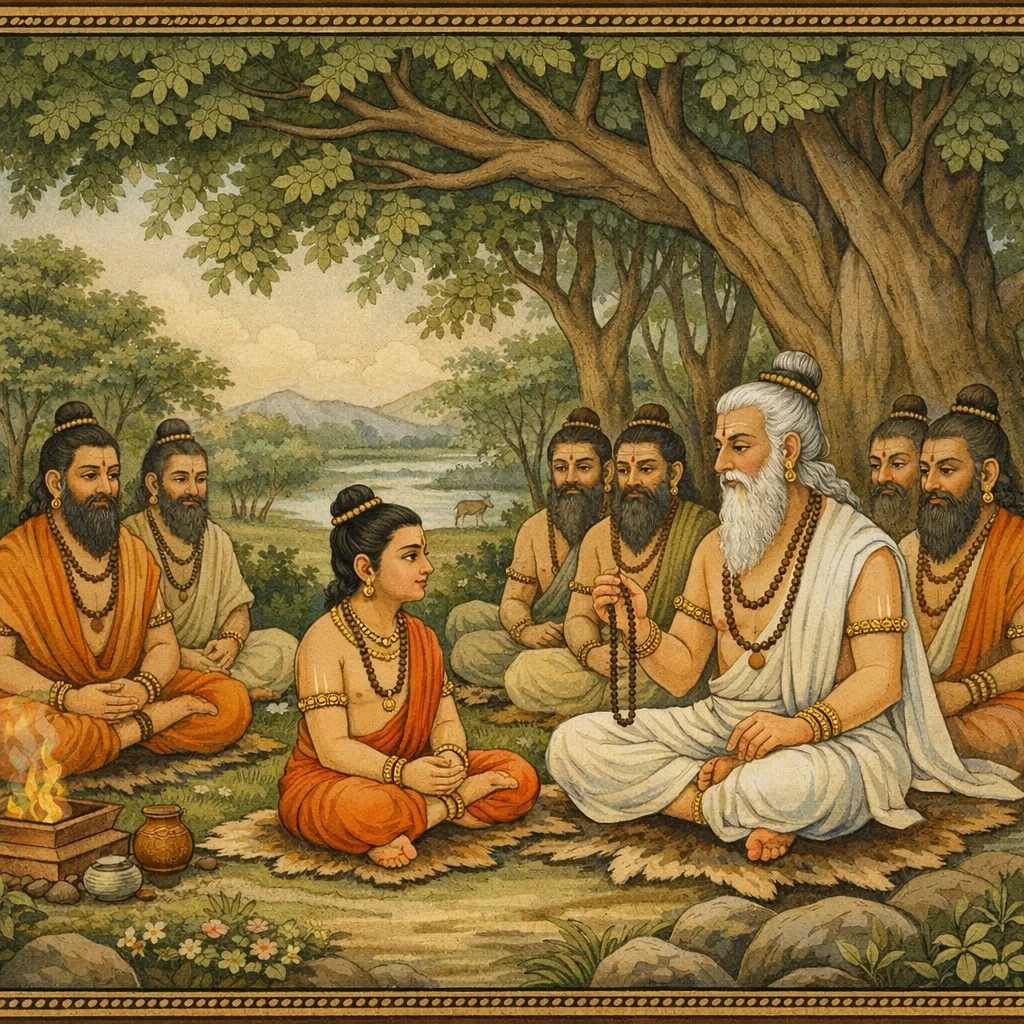
This adhyāya unfolds as a structured dialogue and exemplary tale centered on Dhruva. It opens with a question about a radiant, steadfast figure—evoking the support and measure of the cosmos—after which the gaṇas recount Dhruva’s origins: his birth in the line of Svāyambhuva Manu and King Uttānapāda, the household hierarchy between the queens Sunīti and Suruci, and the court incident where Dhruva is publicly denied the royal lap/seat. Sunīti then offers ethical and psychological counsel, explaining honor and dishonor through karmic causality and accumulated merit, urging restraint and acceptance of outcomes as fruits of prior deeds. Dhruva replies with tapas-filled resolve, seeking only permission and blessing to pursue a higher attainment. He departs for the forest and meets the Saptarṣi. Hearing his account, Atri redirects Dhruva’s aspiration toward devotion, declaring the supremacy of Govinda/Vāsudeva’s feet and teaching japa as the means by which both worldly aims and transcendent fulfillment are gained. The sages depart, and Dhruva continues his austerities with Vāsudeva as his sole center, moving from social injury to disciplined spiritual determination.
Shlokas
Verse 1
शिवशर्मोवाच । तिष्ठन्नेकेन पादेन कोयं भ्रमति सत्तमौ । अनेकरशनाव्यग्र हस्ताग्रो व्यग्रलोचनः
Śivaśarman said: “O best of the virtuous, who is this—standing upon a single foot—moving about, with many cords in agitation, his hands thrust forward, and his eyes restless?”
Verse 2
त्रिलोकीमंडपस्तंभ सन्निभोभाभिरावृतः । अतुलं ज्योतिषां राशिं तुलया तुलयन्निव
He appears like a pillar of the maṇḍapa of the three worlds, enveloped in radiance—as though, with a balance, he were weighing an immeasurable mass of heavenly lights.
Verse 3
सूत्रधार इव व्योम व्यायामपरिमापकः । त्रैविक्रमोंघ्रिदंडो वा प्रोद्दंडो गगनांगणे
Like a stage-manager measuring the expanse of the sky, he stands in the courtyard of heaven—like the upraised staff of Trivikrama’s foot.
Verse 4
अथवांबरकासारसारयूपस्वरूपधृक् । कोयं कथय तं देवौ कृपया परया मम
Or else he bears the form of a lofty sacrificial post, the very essence of the sky’s brilliance. Tell me, O divine ones—out of great compassion—who this is.
Verse 5
निशम्येति वचस्तस्य वयस्यस्य विमानगौ । प्रणयादाहतुस्तस्मै ध्रुवां ध्रुवकथां गणौ
Hearing the words of their companion, the two attendants—moving in their celestial car—affectionately narrated to him the steadfast tale of Dhruva.
Verse 6
गणावूचतुः । मनोः स्वायंभुवस्यासीदुत्तानचरणः सुतः । तस्य क्षितिपतेर्विप्र द्वौ सुतौ संबभूवतुः
The two attendants said: “From Svāyambhuva Manu was born a son, Uttānapāda. O brāhmaṇa, to that king of the earth two sons were born.”
Verse 7
सुरुच्यामुत्तमो ज्येष्ठः सुनीत्यां तु ध्रुवो परः । मध्ये सभं नरपतेरुपविष्टस्य चैकदा
From Suruci, the elder son Uttama was born; from Sunīti, the other was Dhruva. And once, when the king was seated in the midst of the assembly...
Verse 8
सुनीत्या राजसेवायै नियुक्तोऽलंकृतोर्भकः । ध्रुवो धात्रेयिकापुत्रैः समं विनयतत्परः
Appointed by Sunīti to serve in the royal household, the ornamented young boy Dhruva—devoted to proper conduct—served together with the sons of Dhātreyikā.
Verse 9
स गत्वोत्तानचरणं क्षोणीशं प्रणनाम ह । दृष्ट्वोत्तमं तदुत्संगे निविष्टं जनकस्य वै
He approached the lord of the earth, King Uttānapāda, and bowed down. Seeing the noble child Uttama seated upon his father’s lap, he understood where favor had been bestowed.
Verse 10
प्रोच्चसिंहासनस्थस्य नृपतेर्बाल्यचापलात् । आरोढुकामस्त्वभवत्सौनीतेयस्तदा ध्रुवः
Out of childish impulsiveness, Dhruva—the son of Sunīti—then wished to climb onto the king’s lofty throne.
Verse 11
आरुरुक्षुमवेक्ष्यामुं सुरुचिर्धुवमब्रवीत् । दौर्भगेय किमारोढुमिच्छेरंकं महीपतेः
Seeing him about to climb up, Suruci spoke to Dhruva: “Unfortunate one, why do you wish to mount the king’s lap?”
Verse 12
बालबालिशबुद्धित्वादभाग्या जठरोद्भव । अस्मिन्सिंहासने स्थातुं न त्वया सुकृतं कृतम्
“Through childish foolishness, O luckless one born of the womb, you have performed no merit that would entitle you to stand upon this throne.”
Verse 13
यदि स्यात्सुकृतं तत्किं दुर्भगोदरगोऽभवः । अनेनैवानुमानेन बुध्यस्व स्वाल्पपुण्यताम्
“If you truly had merit, why would you be born from an ‘unfortunate womb’? By this very inference, understand the smallness of your puṇya.”
Verse 14
भूत्वा राजकुमारोपि नालंकुर्या ममोदरम् । सुकुक्षिजममुं पश्य त्वमुत्तममनुत्तमम्
“Even though you are a prince, you are not fit to grace my lap. Look rather at this Uttama—unsurpassed—born from my fortunate womb.”
Verse 15
अधिजानुधराजानेर्मानेन परिबृंहितम् । प्रांशोः सिंहासनस्यास्य रुचिश्चेदधिरोहणे
The lofty throne—rising above the king’s knees—seemed all the more imposing in its grandeur; and Suruci delighted in exalting it as a seat to be ascended.
Verse 16
कुक्षिं हित्वा किमवसः सुरुचेश्च सुरोचिषम् । मध्ये भूपसभं बालस्तयेति परिभर्त्सितः
Abandoning the lap, the child—rebuked by Suruci with her cutting brilliance—was shamed there in the midst of the royal assembly.
Verse 17
पतन्निपीतबाष्पांबुर्धैर्यात्किंचिन्न चोक्तवान् । उचिताऽनुचितं किंचिन्नोचिवान्सोपि पार्थिवः
As he withdrew, he swallowed his tears; yet, through courage, he spoke nothing. And the king too uttered nothing—neither what was proper nor what was improper.
Verse 18
नियंत्रितो महिष्याश्च तस्याः सौभाग्यगौरवात् । विमृज्य च सभालोकं शोकं संमृज्य चेष्टितैः
Restrained by the queen—by the weight of her favored fortune—he mastered himself; he surveyed the assembly and, with outward gestures, sought to wipe away his sorrow.
Verse 19
शैशवैः स शिशुर्नत्वा नृपं स्वसदनं ययौ । सुनीतिर्नीतिनिलयमवलोक्याथ बालकम्
With the simple manners of childhood, the little boy bowed to the king and returned to his own dwelling. Then Sunīti, beholding her child—an abode of good conduct—looked upon him closely.
Verse 20
सुखलक्ष्म्यैवचाज्ञासीद्ध्रुवं समवमानितम् । अभिसृत्य च तं बालं मूर्ध्न्युपाघ्राय सा सकृत्
By the very loss of his ease and radiance she understood that Dhruva had been insulted. Hurrying to the boy, she once kissed (inhaled the scent of) the crown of his head.
Verse 21
किंचित्परिम्लानमिव ससांत्वं परिषस्वजे । अथ दृष्ट्वा सुनीतिं स रहोंतः पुरवासिनीम्
Seeing him as though somewhat wilted, she embraced him with soothing words. Then, seeing Sunīti—dwelling in the palace’s inner chambers—he drew near to her in private.
Verse 22
दीर्घं निःश्वस्य बहुशो मातुरग्रे रुरोद ह । सांत्वयित्वाश्रुनयना वदनं परिमार्ज्य च
Sighing deeply again and again, he wept before his mother. With tearful eyes she comforted him and wiped his face.
Verse 23
दुकूलांचल संपर्कैर्मृदुलैर्मृदुपाणिना । पप्रच्छ तनयं माता वद रोदनकारणम् । विद्यमाने नरपतौ शिशो केनापमानितः
With her soft hand, gently touching him with the edge of her fine cloth, the mother asked her son: “Tell me the cause of your weeping. While the king is present, by whom has the child been insulted?”
Verse 24
अपोथसमुपस्पृश्य तांबूलं परिगृह्य च । मात्रा पृष्टः सोपरोधं ध्रुवस्तां पर्यभाषत
After rinsing his mouth and taking betel, when questioned by his mother, Dhruva replied to her with restrained indignation.
Verse 25
संपृच्छे जननि त्वाहं सम्यक्शंस ममाग्रतः । भार्यात्वेपि च सामान्ये कथं सा सुरुचिः प्रिया
“Mother, I ask you—tell me plainly, here before me. Though both are equally wives, how is that Suruci dear (to the king)?”
Verse 26
कथं न भवती मातः प्रिया क्षितिपतेरसि । कथमुत्तमतां प्राप्त उत्तमः सुरुचेः सुतः
“Mother, how are you not dear to the lord of the earth? And how is Suruci’s son Uttama the one who has attained superiority?”
Verse 27
कुमारत्वेपि सामान्ये कथं त्वहमनुत्तमः । कथं त्वं मंदभाग्यासि सुकुक्षिः सुरुचिः कथम्
“Though we are alike in being princes, how am I not ‘Uttama’? How are you of lesser fortune, and how is Suruci of blessed womb (more fortunate)?”
Verse 28
कथं नृपासनं योग्यमुत्तमस्य कथं न मे । कथं मे सुकृतं तुच्छमुत्तमस्योत्तमं कथम्
“How is the royal throne fit for Uttama, and how is it not fit for me? How are my meritorious deeds paltry, and how are Uttama’s supremely excellent?”
Verse 29
इति श्रुत्वा वचस्तस्य सुनीतिर्नीतिमच्छिशोः । किंचिदुच्छ्वस्य शनकैः शिशुकोपोपशांतये
Hearing his words, Sunīti—skilled in wise conduct—paused and gently took a breath, intending to calm the child’s rising anger little by little.
Verse 30
स्वभावमधुरां वाणीं वक्तुं समुपचक्रमे । सापत्नं प्रतिघं त्यक्त्वा राजनीतिविदांवरा
That foremost knower of royal ethics began to speak in her naturally gentle voice, setting aside the sting of rivalry and the impulse to retaliate.
Verse 31
सुनीतिरुवाच । अयि तात महाबुद्धे विशुद्धेनांतरात्मना । निवेदयामि ते सर्वं माऽपमाने मतिं कृथाः
Sunīti said: “Dear son, O great-minded one—listen with a purified inner heart. I shall tell you everything; do not let your mind be fixed on insult.”
Verse 32
तया यदुक्तं तत्सर्वं तथ्यमेव न चान्यथा । सापत्युर्महिषीराज्ञो राज्ञीनामति वल्लभा
“Whatever she said is entirely true—there is no other way about it. She is indeed the king’s chief queen, and among the queens she is exceedingly dear.”
Verse 33
तया जन्मांतरे तात यत्पुण्यं समुपार्जितम् । तत्पुण्योपचयाद्राजा सुरुच्यां सुरुचिर्भृशम्
Dear child, whatever merit she gathered in a former birth—by the increase of that very merit, the king is deeply drawn to Surucī.
Verse 34
मादृश्यो मंदभाग्यायाः प्रमदासु प्रतिष्ठिताः । केवलं राजपत्नीत्ववादस्तासु न तद्रुचिः
Women like me, of meager fortune, may find a place among the palace ladies; yet for them it is only the title of “king’s wife”—there is no true delight or regard in it.
Verse 35
महा सुकृतसंभारैरुत्तमश्चोत्तमोदरे । उवास तस्याः पुण्या या नृपसिंहासनोचितः
With vast stores of good deeds, the noblest fortune has settled in her noble lot—she whose merit is truly fit for a king’s throne.
Verse 36
आतपत्रं च चंद्राभं शुभे चापि च चामरे । भद्रासनं तथोच्चं च सिंधुराश्च मदोद्धुराः
A moon-bright royal parasol, auspicious yak-tail fans, a lofty and splendid seat, and elephants from Sindhu—proud with rut—(all these honors attend her).
Verse 37
तुरंगमाश्च तुरगास्त्वनाधिव्याधिजीवितम् । निःसपत्नं शुभं राज्यं प्राज्यं हरिहरार्चनम्
Horses and swift steeds, a life free from mental distress and disease, an auspicious kingdom without rivals, abundant prosperity—and worship of Hari and Hara—(these are hers).
Verse 38
विपुलं च कलाज्ञानमधीतमपराजितम् । तथा जयोरिषड्वर्गे स्वभावात्सात्त्विकी मतिः
Vast knowledge of the arts, learning that cannot be overcome, victory over the six inner foes, and by nature a sāttvika—pure and luminous—disposition: these too are hers.
Verse 39
दृष्टिः कारुण्यसंपूर्णा वाणी मधुरभाषिणी । अनालस्यं च कार्येषु तथा गुरुजने नतिः
A gaze filled with compassion, speech that is sweet; diligence in one’s duties, and humble reverence toward elders and teachers—these are praised as dharmic marks of a noble person.
Verse 40
सर्वत्र शुचिता तात सा परोपकृतिः सदा । और्जस्वला मनोवृत्तिः सदैवादीनवादिता
Purity in every sphere, constant helpfulness to others, a mind-set radiant with vigor, and never speaking in a base or mean manner—these, dear one, are held to be enduring virtues.
Verse 41
सदोजिरे च पांडित्यं प्रागल्भ्यं चरणांगणे । आर्जवं बंधुवर्गेषु काठिन्यं क्रयविक्रये
Learning joined with steady vigor; confident competence in one’s sphere of action; straightforwardness among one’s kinsmen; and firmness in buying and selling—these are counted as practical virtues in worldly life guided by dharma.
Verse 42
मार्दवं स्त्रीप्रयोगेषु वत्सलत्वं प्रजासु च । ब्राह्मणेभ्यो भयं नित्यं वृद्धवृत्त्युपजीवनम्
Gentleness in dealings with women, affection toward one’s dependents and people, constant awe-filled restraint before brāhmaṇas, and living by the honorable livelihood of elders—these are praised as dharmic traits.
Verse 43
वासो भागीरथीतीरे तीर्थे वा मरणं रणे । अपराङ्मुखताऽर्थिभ्यः प्रत्यर्थिभ्यो विशेषतः
To dwell on the bank of the Bhāgīrathī, or to meet death at a sacred ford, or to fall in battle; and never to turn one’s back on those who seek refuge—especially before an opponent—these are praised as marks of valor and dharma.
Verse 44
भोगः परिजनैः सार्धं दानावंध्यदिनागमः । विद्याव्यसनिता नित्यं नित्यं पित्रोरुपस्थितिः
Enjoyment shared with family and companions; days that do not pass without charity; unwavering devotion to learning; and continual attendance upon one’s parents—these are celebrated as the dharmic excellences of the householder.
Verse 45
यशसः संचयो नित्यं नित्यं धर्मस्य संचयः । स्वर्गापवर्गयोः सिद्धिः सदा शीलस्य मंडनम्
Good fame ever increases, dharma is ever accumulated; heaven is attained and even liberation; and noble character is continually adorned—such are the fruits of righteous living.
Verse 46
सद्भिश्च संगतिर्नित्यं मैत्री च पितृमित्रकैः । इतिहासपुराणानामुत्कंठा श्रवणे सदा
Constant companionship with the good; friendship also with one’s father’s friends; and an abiding eagerness to hear the Itihāsas and Purāṇas—these are praised as supports of dharma.
Verse 47
विपद्यपि परं धैर्यं स्थैर्यं संपत्समागमे । गांभीर्यं वाग्विलासेषु औदार्यं पात्रपाणिषु
Even in calamity—supreme courage; when prosperity arrives—steadfastness; in playful speech—dignity and depth; and toward worthy recipients who extend their hands—generosity: these are honored as the balanced virtues of the righteous.
Verse 48
देहे परैका कृशता तपोभिर्नियमैर्यमैः । एतैर्मनोरथफलैः फलत्येव तपोद्रुमाः
In the body there may appear only one result—leanness—through austerities, observances, and restraints; yet the tree of tapas surely bears fruit through these, granting the desired ends and inner attainments.
Verse 49
तस्मादल्पतपस्त्वाद्वै त्वं चाहं च महामते । प्राप्यापि राजसांनिध्यं राजलक्ष्म्या न भाजनम्
Therefore, O noble-minded one, because both you and I possess only a little tapas, even though we have attained proximity to royalty, we are not fit vessels for the true splendor and fortune of kingship.
Verse 50
मानापमानयोस्तस्मात्स्वकृतं कारणं परम् । स्रष्टापि नापमार्ष्टुं तत्परीष्टे स्वकृतां कृतिम् । मा शोचस्त्वमतः पुत्र दिष्टमिष्टं समर्पयेत्
Therefore, for honor and dishonor, one’s own deeds are the supreme cause. Even the Creator does not erase it; he only examines the work fashioned by one’s own actions. So do not grieve, my son—accept what is ordained, and offer up even what is dear.
Verse 51
इत्याकर्ण्य सुनीत्यास्तन्महावाक्यं सुनीतिमत् । सौनीते यो ध्रुवोवाचमाददे वक्तुमुत्तरम्
Having thus heard Sunīti’s great and wise words, Dhruva—the son of Sunīti—began to speak in reply.
Verse 52
ध्रुव उवाच । जनयित्रि सुनीते मे शृणु वाक्यमनाकुलम् । मा बाल इति मत्वा मामवमंस्थास्तपस्विनि
Dhruva said: Mother Sunīti, listen to my words without anxiety. Do not, thinking ‘he is only a child,’ disregard me, O ascetic lady.
Verse 53
यद्यहं मानवे वंशे जातोस्म्यत्यंत पावने । उत्तानपादतनयस्त्वदीयोदर संभवः
If I have been born in the lineage of Manu, supremely pure—being the son of Uttānapāda, and born from your womb—
Verse 54
तप एव हि चेन्मातः कारणं सर्वसंपदाम् । तत्तदासादितं विद्विपदमन्यैर्दुरासदम्
If indeed, O Mother, austerity (tapas) alone is the cause of every excellence and prosperity, then that very state shall be attained—though it is a station difficult for others to reach.
Verse 55
एकमेव हि साहाय्यं कुरु मातरतंद्रिता । अनुज्ञा दानमात्रं च आशीर्भिरभिनंदय
Do just one help for me, Mother—without hesitation: grant your permission, give me only what little you can, and bless me with your good wishes.
Verse 56
सापि ज्ञात्वा महावीर्यं कुमारं कुक्षिसंभवम् । महत्योत्साहसं पत्त्या राजमानमुवाच तम्
She too, recognizing the great valor of the boy born from her womb, and seeing him radiant with abundant courage, spoke to him.
Verse 57
अनुज्ञातुं न शक्ताऽहं त्वामुत्तानशयांगज । साष्टैकवर्षदेशीयन्तथापि कथयाम्यहम्
I am not able to grant you permission, O child of Uttānaśayā; you are but about eight years of age. Still, I shall tell you what is to be done.
Verse 58
सपत्नीवाक्यभल्लीभिर्भिन्ने महति मे हृदि । तव बाष्पौघवारीणि न तिष्ठंति करोमि किम्
My heart is deeply wounded by the javelins of my co-wife’s words, and the torrents of your tears do not cease. What can I do?
Verse 59
तानि मन्येऽत्र मार्गेण स्रवंत्यविरतं शिशो । स्रवंतीश्च चिकीर्षंति प्रतिकूल जलाः किल
“Child, I think those waters are flowing ceaselessly along this very path; and as they flow, they seem as though they wish to run counter to the current.”
Verse 60
त्वदेकतनया तात त्वदाधारैकजीविता । त्वमंगयष्टिरसि मे त्वन्मुखासक्तलोचना
“Dear child, I have only you as my son; I live by leaning on you alone. You are the staff that supports my body, and my eyes are fixed upon your face.”
Verse 61
लब्धोसि कतिभिः कष्टैरिष्टाः संप्रार्थ्य देवताः । त्वन्मुखेंदूदये तात मन्मनः क्षीरनीरधिः
“My child, after how many hardships you were obtained—after worshipping and earnestly praying to the deities! When the moon of your face rises, my heart becomes an ocean of milk.”
Verse 62
आनन्दपयसापूर्य कुचावुद्वेलितो भवेत् । त्वदंगसंगसंभूत सुखसन्दोह शीतला
“Filled with the milk of joy, my breasts would swell; and, born from the touch of your limbs, a cool flood of gathered happiness arises.”
Verse 63
सुखंशये सुशयने प्रावृत्य पुलकांबरम् । अपोऽथ समुपस्पृश्य तांबूलं परिगृह्य च
I lie happily upon a fine bed, covered with a garment of gooseflesh (thrill). Then, having sipped water, I also take betel.
Verse 64
त्वदास्यस्यौष्ठपुटक दुग्धवार्धि विवर्धिताम् । सुधासुधांशुवदनधयत्यपि धिनोमि न
O nectar-moon-faced one, even while nursing at the little casket of lips of your mouth—swelled as though by an ocean of milk—I still do not feel satisfied.
Verse 65
त्वदीयः शीतलालापः प्राप श्रुतिपथं यदा । सपत्नीवाक्यदवथुस्तदैवत्यात्स वेपथुः
When your cool, gentle speech enters the path of my hearing, then—like the burning fever caused by a rival wife’s words—my trembling immediately subsides.
Verse 66
यदंग निद्रासिचिरं ध्यायंत्यस्मि तदेत्यहम् । कदा निद्रा दरिद्रोसौ भवितार्कोदयेऽब्जवत्
Beloved, while you sleep, I keep thinking of you for a long time, and my mind goes only to you. When will this wretched sleep depart—like a lotus at sunrise?
Verse 67
यदोपेया गृहान्वत्स खेलित्वा बालखेलनैः । तदानर्घ्यार्घ्यमुत्स्रष्टुं स्तनौस्यातामिवोन्मुखौ
Dear child, when you return home after playing childish games, then my breasts—as though to pour out a priceless offering—rise up, eager to give.
Verse 68
यदा सौधाद्विनिर्यायाः पद्मरेखांकितं पदम् । प्राणानां ते यियासूनां तदा तदवलंबनम्
When you step out from the palace, setting down a foot traced with lotus-like lines, that very step becomes the support of my life-breaths as they are about to depart.
Verse 69
यदायदा बहिर्यासि पुत्र त्रिचतुरं पदम् । तदातदा मम प्राणः कंठप्राघुणिकी भवेत्
Whenever you go outside, my son, even by three or four paces, at that very moment my life-breath becomes a guest lodged in my throat—ready to depart.
Verse 70
चित्रं पुत्र त्वरयति यातुं मे मानसांडजः । सुधाधाराधर इव बहिश्चिरयति त्वयि
Strange indeed, my son: the bird born of my mind hastens to fly away—yet, like a cloud that bears streams of amrita, it lingers outside because of you.
Verse 71
अथ तिष्ठंतु कठिनाः प्राणाः कंठाटवीतटे । तपस्यंतोतिसंतप्तास्तपसे त्वयि यास्यति
Then let my hardened life-breaths remain on the bank of the forest of my throat; burning in the heat of tapas, they will go with you to your austerity.
Verse 72
इत्यनुज्ञामनुप्राप्य जननी चरणांबुजौ । क्षणं मौलिजजंबाल जडौ कृत्वा ध्रुवो ययौ
Thus, having obtained permission, Dhruva bowed and clung to his mother’s lotus-feet; with the net of hair from his head he held them motionless for a moment, and then he departed.
Verse 73
तयापि धैर्यसूत्रेण सुनीत्या परिगुंफ्य च । नेत्रेंदीवरजामाला ध्रुवस्योपायनीकृता
And Sunīti too, threading it upon the cord of steadfastness, fashioned a garland born of her lotus-like eyes—her tears—and offered it to Dhruva as a parting gift.
Verse 74
मात्रातन्मार्गरक्षार्थं तदा तदनुगीकृताः । परैरवार्यप्रसराः स्वाशीर्वादाः परःशताः
Then, for the safeguarding of his path, the mother uttered countless blessings—blessings whose spreading none could restrain.
Verse 75
स्वसौधात्स विनिर्गत्य बालोऽबालपराक्रमः । अनुकूलेन मरुता दर्शिताध्वाऽविशद्वनम्
Leaving his own palace, the boy—whose valor surpassed childhood—entered the forest, with a favorable wind as though showing him the way.
Verse 76
समरुत्तरुशाखाग्र प्रसारणमिषेण सः । कृताहूतिरिव प्रेम्णा वनेन वनमाविशत्
With wind-driven branches stretching forth as if in welcome, he entered deeper into the forest—like one who has performed an invocation—drawn by the forest’s own affection.
Verse 77
समातृदैवतोभिज्ञः केवलं राजवर्त्मनि । न वेद काननाध्वानं क्षणं दध्यौ नृपात्मजः
Familiar only with the deities of home and mother, and only with royal roads, the king’s son did not know the forest-path; for a moment he reflected.
Verse 78
यावदुन्मील्य नयने पुरः पश्यति स ध्रुवः । तावद्ददर्श सप्तर्षीनतर्कित गतीन्वने
As soon as Dhruva opened his eyes and looked ahead, he beheld in the forest the Seven Rishis, moving in ways beyond ordinary imagining.
Verse 79
वालिशेष्वसहायेषु भवेद्भाग्यं सहायकृत् । अरण्यान्यां रणे गेहे ततो भाग्यं हि कारणम्
When one is left with only meagre remnants and no helper at all, fortune (bhāgya) becomes the helper. In the wilderness, in battle, or within one’s own home—there indeed fortune is the decisive cause.
Verse 80
क्व राजतनयो बालो गहनं क्व च तद्वनम् । बलात्स्वसात्प्रत्कुर्वत्यै नमस्ते भवितव्य ते
Where is a young prince, and where is that dense and fearsome forest? O irresistible Destiny that drives all onward by sheer force—salutations to you!
Verse 81
यत्र यस्य हि यद्भाव्यं शुभं वाऽशुभमेव च । आकृष्यभाविनी रज्जुस्तत्र तस्य हि दापयेत
Whatever is destined for someone—auspicious or inauspicious—toward that very place it draws that person, as though by a rope that pulls one in.
Verse 82
अन्यथा विदधात्येष मानवो बुद्धिवैभवात् । भगवत्या भवित्र्याऽसौ विदध्याद्विधिरन्यथा
A human being, by the display of intellect, may plan things one way; yet the divine power of Destiny arranges the very outcome in another way.
Verse 83
नवयो न च वै चित्र्यं न चित्रं विदधेहितम् । न बलं नोद्यमः पुंसां कारणं प्राक्कृतं कृतम्
Neither youth, nor clever stratagems, nor wondrous devices truly secure one’s welfare. Neither strength nor human exertion is the ultimate cause; rather, the deed done before—past karma—becomes the determining factor.
Verse 84
अथ दृष्ट्वा स सप्तर्षीन्सप्तसप्त्यतितेजसः । भाग्यसूत्रैरिवाकृष्योपनीतान्प्रमुमोद ह
Then, on seeing the Seven Sages—radiant beyond the brilliance of seven suns—he rejoiced, as though they had been drawn and brought there by the very threads of fortune.
Verse 85
तिलकांकित सद्भालान्कुशोपग्रहितांगुलीन् । कृष्णाजिनोपविष्टांश्च यज्ञसूत्रैरलंकृतान्
He saw them with auspicious foreheads marked with tilaka, their fingers holding kuśa-grass, seated upon black antelope-skins, and adorned with sacred yajñopavīta threads.
Verse 86
साक्षसूत्रकरान्किंचिद्विनिमीलितलो चनान् । सुधौतसूक्ष्मकाषायवासः प्रावरणान्वितान
Some held rosaries in their hands, their eyes gently half-closed in inward contemplation; they wore finely washed, delicate ochre garments, with proper upper coverings.
Verse 87
अकांडेपि महाभागान्मिलितान्सप्तनीरधीन् । चित्रं विपद्विनिर्मग्नानुद्दिधीर्षूनिव प्रजाः
Amazingly, those greatly fortunate ones had assembled even without any prior occasion—like seven oceans come together—appearing as though they wished to lift up beings who had sunk into calamity.
Verse 88
उपगम्य विनम्रः स प्रबद्धकरसंपुटः । ध्रुवो विज्ञापयांचक्रे प्रणम्य ललितं वचः
Approaching with humility, his palms joined in reverence, Dhruva bowed and then offered gentle, respectful words.
Verse 89
ध्रुव उवाच । अवैत मां मुनिवराः सुनीत्युदरसंभवम् । उत्तानपादतनयं ध्रुवं निर्विण्णमानसम्
Dhruva said: “O best of sages, know me as Dhruva—born from the womb of Sunīti, son of King Uttānapāda—whose mind has grown disenchanted with worldly life.”
Verse 90
इदं वनमनुप्राप्तं सनाथं युष्मदंघ्रिभिः । प्रायोनभिज्ञं सर्वत्र महर्द्ध्युषितमानसम्
“Having reached this forest, it has become blessed and protected by your very feet. I am, for the most part, unknowing in all matters—my mind still dwelling amid great royal prosperity.”
Verse 91
ते दृष्ट्वोर्जस्वलं बालं स्वभाव मधुराकृतिम् । अनर्घ्यनयनेपथ्यं मृदुगंभीरभाषिणम्
Seeing the radiant child—sweet in nature and pleasing in form, priceless to behold, speaking with gentle yet profound words—the sages were filled with admiration.
Verse 92
उपोपवेश्य शिशुकं प्रोचुर्वै विस्मिता भृशम् । अहोबालविशालाक्ष महाराज कुमारक
Seating the little child nearby, they spoke in great astonishment: “Ah, wide-eyed boy—O young prince, son of a great king!”
Verse 93
विचार्यापि न जानीमो वद निर्वेदकारणम् । अद्य ते ह्यर्थचिंता नो क्वापमानः प्रसूर्गृहे
Even after reflection we do not understand—tell us the cause of your disillusionment. Why are you troubled today? Were you insulted somewhere in your mother’s house?
Verse 94
नीरुक्छरीरसंपत्तिर्निवेदे किं नु कारणम् । अनवाप्ताभिलाषाणां वैराग्यं जायते नृणाम्
You possess an unimpaired body and every advantage—what, then, is the cause of your discontent? For in people, dispassion generally arises when desired aims are not attained.
Verse 95
सप्तद्वीपपतेराज्ञः कुमारस्त्वं तथा कथम् । स्वभावभिन्नप्रकृतौ लोकेस्मिन्न मनोगतम्
You are a prince of a king who rules the seven continents—how, then, has such a thought arisen in you, in this world whose nature is so different from renunciation?
Verse 96
अवगंतुं हि शक्येत यूनो वृद्धस्य वा शिशोः । इति श्रुत्वा वचस्तेषां सहजप्रेमनिर्भरम्
Such a thing might be understood in the case of a youth, an old man, or a small child. Hearing these words of theirs—overflowing with natural affection—
Verse 97
वाचं जग्राह स तदा शिशुः प्रांशुमनोरथः । ध्रुव उवाच । प्रेषितो राजसेवार्थं जनन्याऽहं मुनीश्वराः
Then that child, whose aspirations were lofty, began to speak. Dhruva said: “O lords of sages, my mother sent me for the sake of serving the king, seeking royal favor.”
Verse 98
राजांकमारुरुक्षुर्हि सुरुच्या परिभर्त्सितः । उत्तमं चोत्तमीकृत्य मां च मन्मातरं तथा
But when I wished to climb onto the king’s lap, Surucī harshly rebuked me—exalting Uttama as the “worthy one” and likewise belittling me and my mother.
Verse 99
धिक्कृत्य प्रशशंस स्वं निर्वेदे कारणं त्विदम् । निशम्येति शिशोर्वाक्यं परस्परमवेक्ष्य ते
Hearing the child’s words, they looked at one another and—reproaching themselves—praised their own remorse, saying, “Indeed, this is the very cause of our dispassion.”
Verse 100
क्षात्रमेव शशंसुस्तदहो बालेपि न क्षमा
They praised only the kṣatriya spirit, saying, “Alas—there is no forbearance, even in a mere child!”
Verse 110
अत्रिरुवाच । अनास्वादितगोविंदपदांबुजरजोरसः । मनोरथपथातीतं स्फीतं नाकलयेत्पदम्
Atri said: “One who has not tasted the nectar-like dust from Govinda’s lotus-feet cannot comprehend that expansive state which lies beyond the pathways of worldly desire.”
Verse 120
पुत्रान्कलत्रमित्राणि राज्यं स्वर्गापवर्गकम् । वासुदेवं जपन्मर्त्यः सर्वं प्राप्नोत्यसंशयम्
A mortal who chants the name of Vāsudeva attains everything without doubt—sons, spouse and friends, sovereignty, heaven, and even liberation (mokṣa).
Verse 124
इत्युक्त्वांऽतर्हिताः सर्वे महात्मानो मुनीश्वराः । वासुदेवमना भूत्वा ध्रुवोपि तपसे गतः
Having spoken thus, all those great sage-lords vanished from sight; and Dhruva too, fixing his mind upon Vāsudeva, departed to perform austerities.