Sukta 48
Sukta 5.48
Unclear in isolation; verse imagery suggests a cosmic formative power spreading waters in the cloud (often linked in RV diction to Parjanya/Indra’s rain-action or to a goddess-like māyā-power).
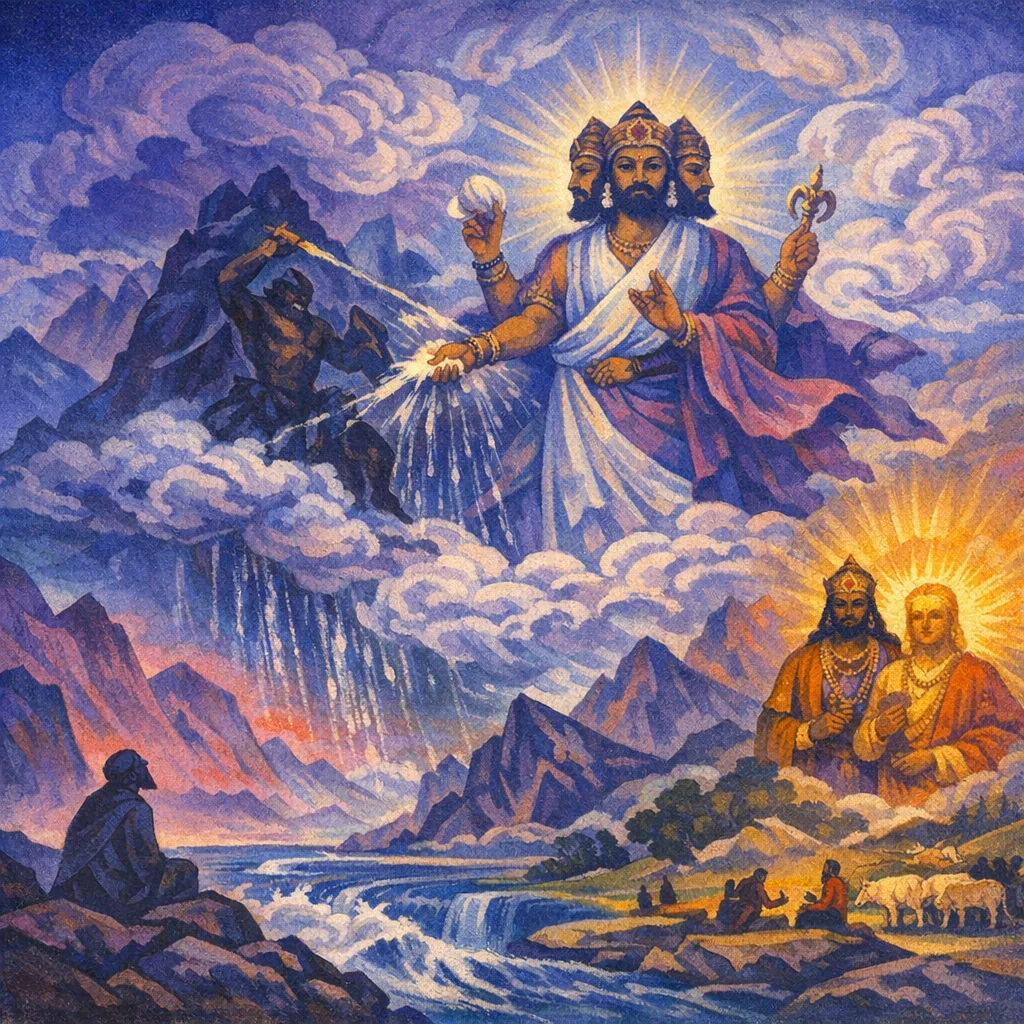
This brief hymn contemplates a “māyinī/māyin” formative power that gathers the waters in the cloud and spreads out the wide realm, while also evoking the thunderbolt-bearing force that orders day and night. It culminates by naming Varuṇa as the beautifully robed, four-faced power whose vastness cannot be measured, from whom the distributive and impelling deities (Bhaga and Savitṛ) grant desirable wealth.
Mantras
Mantra 1
कदु प्रियाय धाम्ने मनामहे स्वक्षत्राय स्वयशसे महे वयम् । आमेन्यस्य रजसो यदभ्र आँ अपो वृणाना वितनोति मायिनी ॥
When indeed shall we turn our thought toward the dear seat of the Great One, who has his own sovereign power and his own splendour? When the mighty Weaver, taking up the waters in the cloud, spreads out the wide realm by her formative power.
Mantra 2
ता अत्नत वयुनं वीरवक्षणं समान्या वृतया विश्वमा रजः । अपो अपाचीरपरा अपेजते प्र पूर्वाभिस्तिरते देवयुर्जनः ॥
They extend the working knowledge that bears the hero-force; by one common law they widen all the mid-realm. The waters, some flowing forward, some backward, move and surge; and the god-seeking people press on beyond the earlier limits.
Mantra 3
आ ग्रावभिरहन्येभिरक्तुभिर्वरिष्ठं वज्रमा जिघर्ति मायिनि । शतं वा यस्य प्रचरन्त्स्वे दमे संवर्तयन्तो वि च वर्तयन्नहा ॥
With the pressing-stones—by days and by nights—the Shaper lifts up the most mighty thunderbolt. In whose own house the forces move in their courses, turning the days together and again turning them apart.
Mantra 4
तामस्य रीतिं परशोरिव प्रत्यनीकमख्यं भुजे अस्य वर्पसः । सचा यदि पितुमन्तमिव क्षयं रत्नं दधाति भरहूतये विशे ॥
That course of his I behold, like the stroke of an axe, set face to face—his front of luminous form. And when he sets the treasure in a dwelling rich with nourishment, then for the clan that calls for support he establishes the boon.
Mantra 5
स जिह्वया चतुरनीक ऋञ्जते चारु वसानो वरुणो यतन्नरिम् । न तस्य विद्म पुरुषत्वता वयं यतो भगः सविता दाति वार्यम् ॥
He, with the tongue, the four-fronted one, sets himself in motion—Varuṇa, beautifully robed, striving against the hostile divider. We do not measure his full manhood and vastness; for from him Bhaga, Savitṛ, gives the desirable riches.
Frequently Asked Questions
The hymn’s final verse explicitly names Varuṇa, so Varuṇa is the clearest devatā. Earlier verses use ‘māyinī/māyin’ and rain-thunder imagery that can overlap with Indra/Parjanya language, but the culmination points to Varuṇa’s sovereignty and order.
In this context māyinī is a ‘shaper’ or ‘formative power’—the capacity that skillfully arranges and manifests, pictured as gathering the waters in the cloud and spreading out the wide realm.
Bhaga represents the apportioning of shares and good fortune, and Savitṛ represents the impelling power that sets things in motion. The verse presents their gift-giving as operating from, or grounded in, Varuṇa’s larger sovereignty and order.