Sukta 40
Sukta 4.40
Vāmadeva Gautama
Dadhikrāvan (primary); associated powers: Uṣas, Apas, Agni, Sūrya, Bṛhaspati, Angirasa
Triṣṭubh (probable)
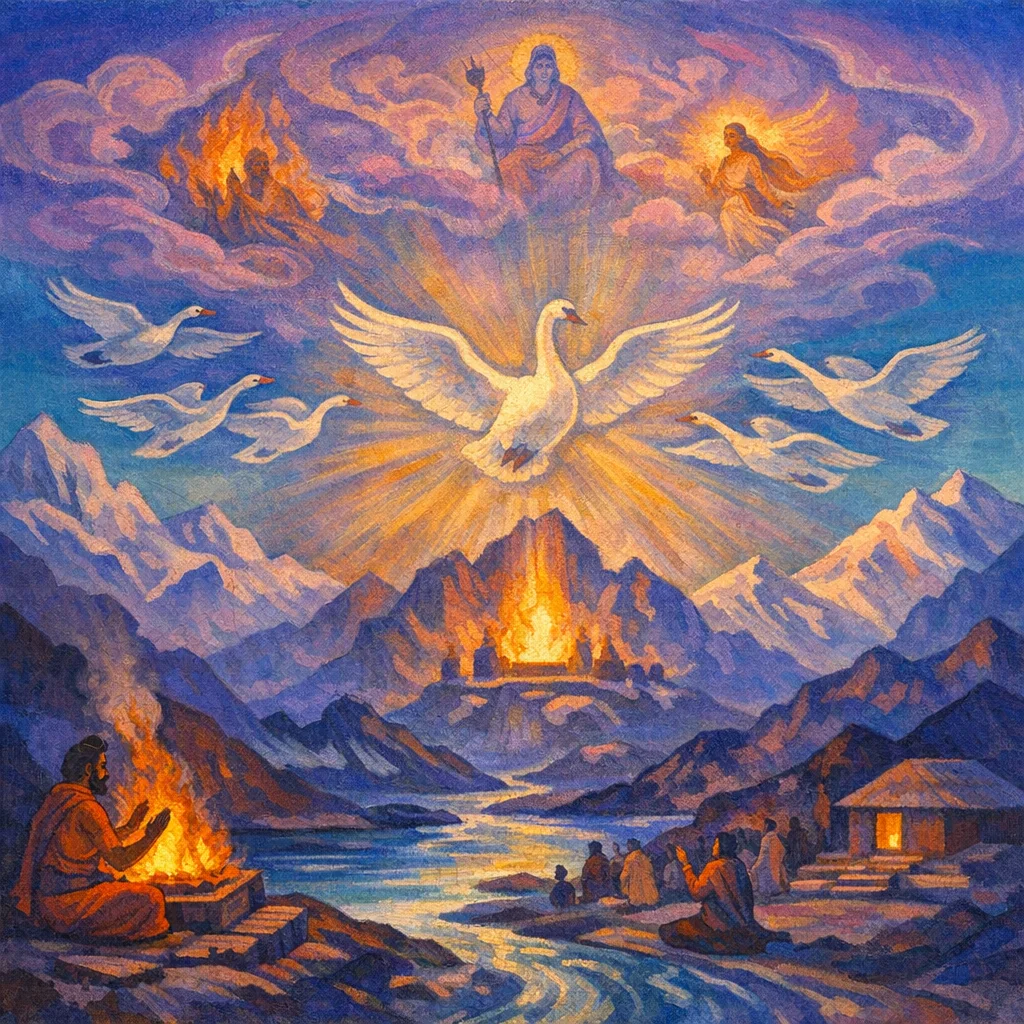
This brief hymn proclaims Dadhikrāvan—the swift, victorious power often envisioned as a divine steed or solar-bird force—urging the singer forward through the Dawns and allied deities (Waters, Agni, Sūrya, Bṛhaspati, Aṅgirasa). It celebrates his speed, wind-like momentum, and protective might, culminating in a profound symbolic verse of the “Swan” seated in many realms, identifying the deity with Ṛta (cosmic truth/order) itself.
Mantras
Mantra 1
दधिक्राव्ण इदु नु चर्किराम विश्वा इन्मामुषसः सूदयन्तु । अपामग्नेरुषसः सूर्यस्य बृहस्पतेराङ्गिरसस्य जिष्णोः ॥
Now indeed we would proclaim Dadhikrāvan; may all the Dawns urge me onward—Dawns of the Waters, of Agni, of the Sun, of Bṛhaspati, of the Angirasa, the victorious one.
Mantra 2
सत्वा भरिषो गविषो दुवन्यसच्छ्रवस्यादिष उषसस्तुरण्यसत् । सत्यो द्रवो द्रवरः पतंगरो दधिक्रावेषमूर्जं स्वर्जनत् ॥
A being of strength, bringing plenitude, seeking the luminous cattle (rays), he wins the desired fame; he is the impulsion of the Dawns, swift in movement. True in his running, a runner among runners, a winged-flier, Dadhikrāvan generates in us the nourishment and the force and the inner heaven-light.
Mantra 3
उत स्मास्य द्रवतस्तुरण्यतः पर्णं न वेरनु वाति प्रगर्धिनः । श्येनस्येव ध्रजतो अङ्कसं परि दधिक्राव्णः सहोर्जा तरित्रतः ॥
And indeed, as he runs in his swift urge, the wind follows him like a leaf in flight, driven by the strong one. Like a falcon’s quivering flight-feather, the mighty energy and force of Dadhikrāvan surround him as he crosses beyond.
Mantra 4
उत स्य वाजी क्षिपणिं तुरण्यति ग्रीवायां बद्धो अपिकक्ष आसनि । क्रतुं दधिक्रा अनु संतवीत्वत्पथामङ्कांस्यन्वापनीफणत् ॥
And this steed of plenitude hastens with quickening speed, bound at the neck, held close at the flank with the seat. Dadhikrā follows the will (kratu) in perfect discipline; along the path he bends and straightens the turns, mastering the curves of the way.
Mantra 5
हंसः शुचिषद्वसुरन्तरिक्षसद्धोता वेदिषदतिथिर्दुरोणसत् । नृषद्वरसदृतसद्व्योमसदब्जा गोजा ऋतजा अद्रिजा ऋतम् ॥
The Swan—dwelling in the pure— a radiant one seated in the mid-world; the Priest seated on the altar, the Guest seated in the home. Seated in man, seated in the highest, seated in the Truth, seated in the vast; born of the Waters, born of the Rays, born of Ṛta, born of the Rock—he is Ṛta itself.
Frequently Asked Questions
Dadhikrāvan is praised as a swift, victorious divine force—often pictured like a powerful steed or solar-bird energy—that carries the worshipper forward and protects the undertaking.
The hymn links Dadhikrāvan to a whole chain of supportive powers: dawn-renewal (Uṣas), purification (Waters), fiery will (Agni), illumination (Sūrya), and inspired sacred speech/priestly force (Bṛhaspati/Aṅgirasa).
It says the ‘Swan’—a symbol of pure, luminous consciousness—is present in many places (sky, altar, home, within people) and is born from waters and light; ultimately it is identified with Ṛta, the principle of truth and right order.