Sukta 10
Sukta 2.10
Gṛtsamada (Bhārgava)
Agni
Triṣṭubh
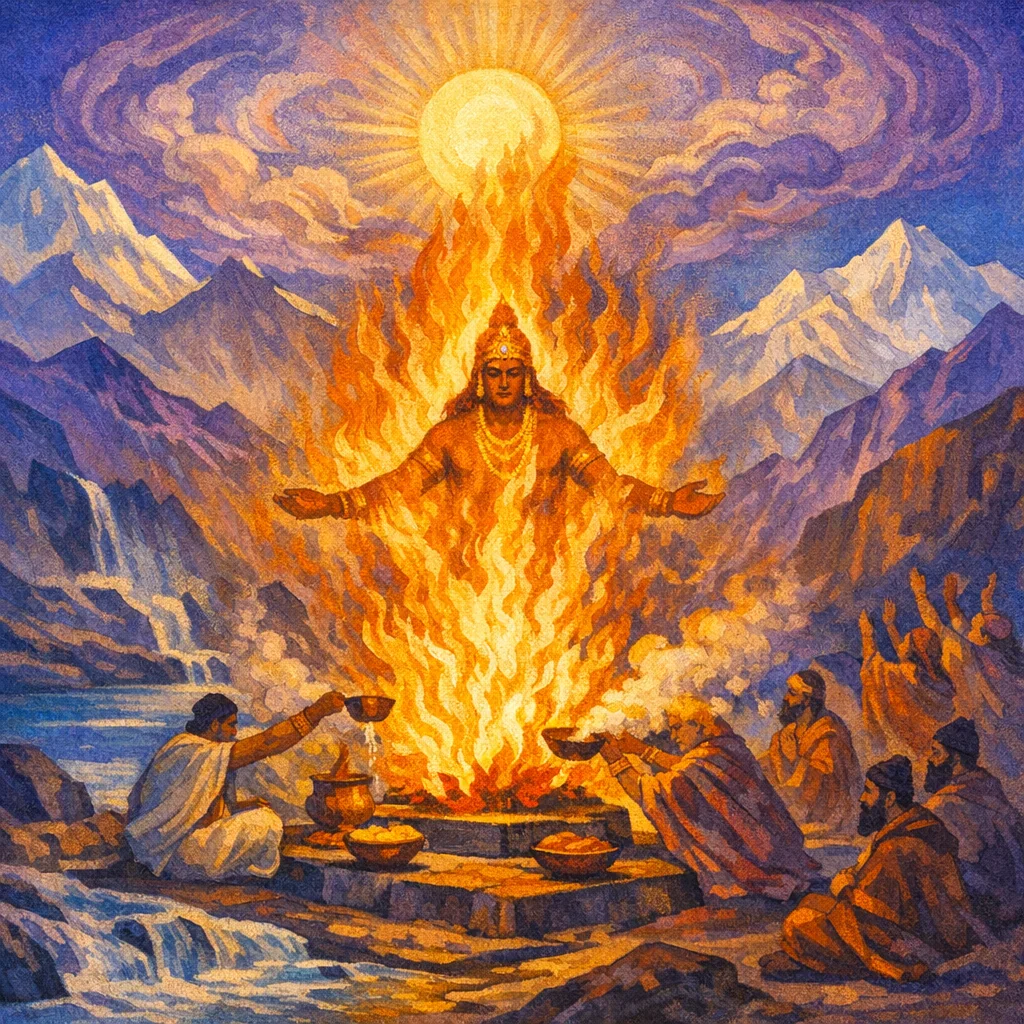
This short Triṣṭubh hymn to Agni praises him as the first and father-like presence in the sacrifice, kindled at the sacred seat of Iḷā and shining with plenitude and discernment. It emphasizes Agni’s all-pervading cosmic reach—taking possession of the worlds—while also presenting him as the purifier who is “rubbed bright” and anointed with ghee. The poet concludes by seeking a rightly apportioned share of the offering and invoking Agni as Manu’s-style messenger, called with the ladle of speech for sweetness and abundance.
Mantras
Mantra 1
जोहूत्रो अग्निः प्रथमः पितेवेळस्पदे मनुषा यत्समिद्धः । श्रियं वसानो अमृतो विचेता मर्मृजेन्यः श्रवस्यः स वाजी ॥
Agni, the much-invoking, is the first—like a father—when he is kindled by men in the place of Iḷā. Wearing the radiance of plenitude, immortal and discerning, he is the purifier who is to be rubbed bright; he is the bringer of victorious force and of worthy fame.
Mantra 2
श्रूया अग्निश्चित्रभानुर्हवं मे विश्वाभिर्गीर्भिरमृतो विचेताः । श्यावा रथं वहतो रोहिता वोतारुषाह चक्रे विभृत्रः ॥
May Agni of the varied radiance hear my call, the immortal discerner, with all my inspired words. Two dark ones and two ruddy ones draw his chariot—his yoked powers—bearing it with steady support.
Mantra 3
उत्तानायामजनयन्त्सुषूतं भुवदग्निः पुरुपेशासु गर्भः । शिरिणायां चिदक्तुना महोभिरपरीवृतो वसति प्रचेताः ॥
In the outstretched one they brought forth the well-born: Agni became the embryo in many-formed shapes. Even in the hard ground, by the night and by great powers, the conscious one dwells, uncovered and awake to the way.
Mantra 4
जिघर्म्यग्निं हविषा घृतेन प्रतिक्षियन्तं भुवनानि विश्वा । पृथुं तिरश्चा वयसा बृहन्तं व्यचिष्ठमन्नै रभसं दृशानम् ॥
I anoint Agni with the offering and with clarified butter—him who takes possession of all the worlds. Wide, spreading across, great in growth, most pervasive—seen as a swift power through the nourishments.
Mantra 5
आ विश्वतः प्रत्यञ्चं जिघर्म्यरक्षसा मनसा तज्जुषेत । मर्यश्रीः स्पृहयद्वर्णो अग्निर्नाभिमृशे तन्वा जर्भुराणः ॥
From every side I draw toward me (and make intimate) that which turns inward, with a mind free from the Rakṣasa-force; may That consent to be enjoyed. Agni, young in splendour, desiring the hue of light, presses close to the navel-centre with his body, restlessly working to purify and shape the being.
Mantra 6
ज्ञेया भागं सहसानो वरेण त्वादूतासो मनुवद्वदेम । अनूनमग्निं जुह्वा वचस्या मधुपृचं धनसा जोहवीमि ॥
May the share be truly known and discerned by the force that wins the chosen good; with you as messenger we would speak in the manner of Manu. With the ladle of the word I call the unfailing Agni, honey-mingled, the giver of plenitude in the riches of being.
Frequently Asked Questions
It presents Agni as the first power of the sacrifice—father-like, purifying, and discerning—who also pervades the cosmos and carries offerings as the divine messenger.
Ghee (ghṛta) is a primary Vedic oblation that strengthens and brightens the fire; symbolically it ‘feeds’ Agni so he can convey the offering and illuminate the rite.
Manu represents the archetypal human sacrificer and lawgiver of right ritual; invoking Agni ‘manuvat’ means following the ancient, proper tradition of speech and offering.