Sukta 135
Sukta 10.135
Yama (with the Devāḥ; ancestral-father principle also present)
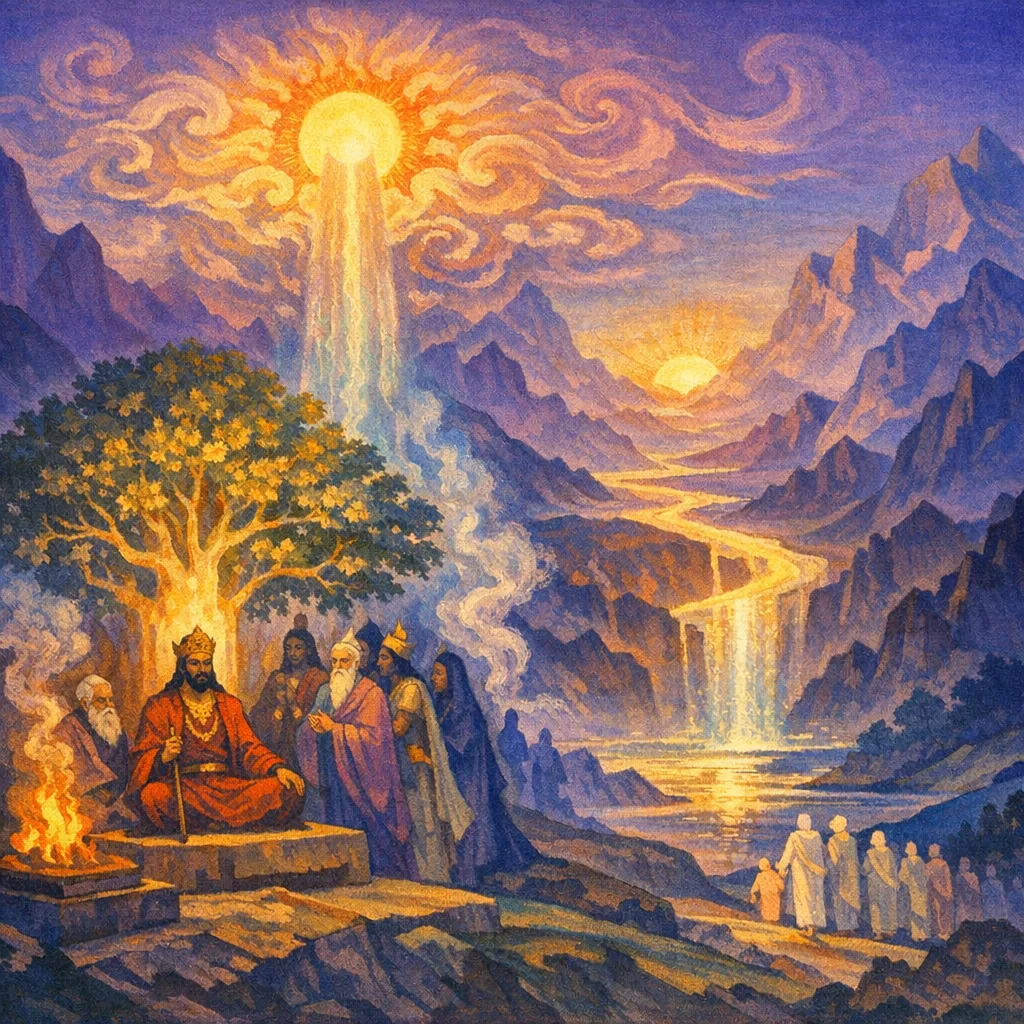
This brief, enigmatic hymn contemplates Yama’s realm and the ancestral way: the Fathers are envisioned in a “fair-leaved tree” where Yama communes with the gods, and the departed father delights in the ancient path. Through riddle-like imagery of a youth setting a chariot in motion and the Sāman-chant following as a carrier, the sukta hints at how ordered sacred speech and right offering guide the soul’s journey and release.
Mantras
Mantra 1
यस्मिन्वृक्षे सुपलाशे देवैः सम्पिबते यमः । अत्रा नो विश्पतिः पिता पुराणाँ अनु वेनति ॥
In that fair-leaved Tree where Yama drinks together with the gods, there our Father, the lord of the people, moves in delight following the Ancients—seeking the timeless ways of the forefathers of light.
Mantra 2
पुराणाँ अनुवेनन्तं चरन्तं पापयामुया । असूयन्नभ्यचाकशं तस्मा अस्पृहयं पुनः ॥
As he moved, delighting in the track of the Ancients, a perverse force assailed him; in envy it cast its hostile gaze. Yet toward that (true way) I long again—returning to the right desire beyond the jealousy of darkness.
Mantra 3
यं कुमार नवं रथमचक्रं मनसाकृणोः । एकेषं विश्वतः प्राञ्चमपश्यन्नधि तिष्ठसि ॥
O Youth, the new chariot you fashioned by mind alone—wheel-less, with a single pole, facing forward from every side—on it you stand, seeing: a vehicle of inner movement built out of thought.
Mantra 4
यं कुमार प्रावर्तयो रथं विप्रेभ्यस्परि । तं सामानु प्रावर्तत समितो नाव्याहितम् ॥
The chariot you set in motion, O Youth, around the seers—then the Sāman followed it and turned with it, placed like a treasure in the ship’s navel: the chant becomes the carrier of the journey.
Mantra 5
कः कुमारमजनयद्रथं को निरवर्तयत् । कः स्वित्तदद्य नो ब्रूयादनुदेयी यथाभवत् ॥
Who gave birth to the Youth? Who set the chariot forth? Who today will tell us that secret—how the following-gift (anu-deyī) came to be: the law by which the true transmission is made?
Mantra 6
यथाभवदनुदेयी ततो अग्रमजायत । पुरस्ताद्बुध्न आततः पश्चान्निरयणं कृतम् ॥
When the right ‘following-gift’ came into being, then the first point was born. The foundation was stretched out in front; behind, the outlet— the way of release—was made: thus the path is ordered from base to opening.
Frequently Asked Questions
It reflects on Yama and the realm of the Fathers, describing an ancient, established path for the departed and the role of sacred chant and right offering in guiding that passage.
The tree is a symbolic meeting-place of life and immortality: a luminous locus where Yama and the gods commune, and where the Fathers are imagined as moving in delight along timeless ancestral ways.
In context it points to an ‘outlet’ or ‘way of release’—the ordered opening that allows transition beyond death, framed as something established by cosmic order rather than random fate.