Sukta 146
Sukta 1.146
Agni
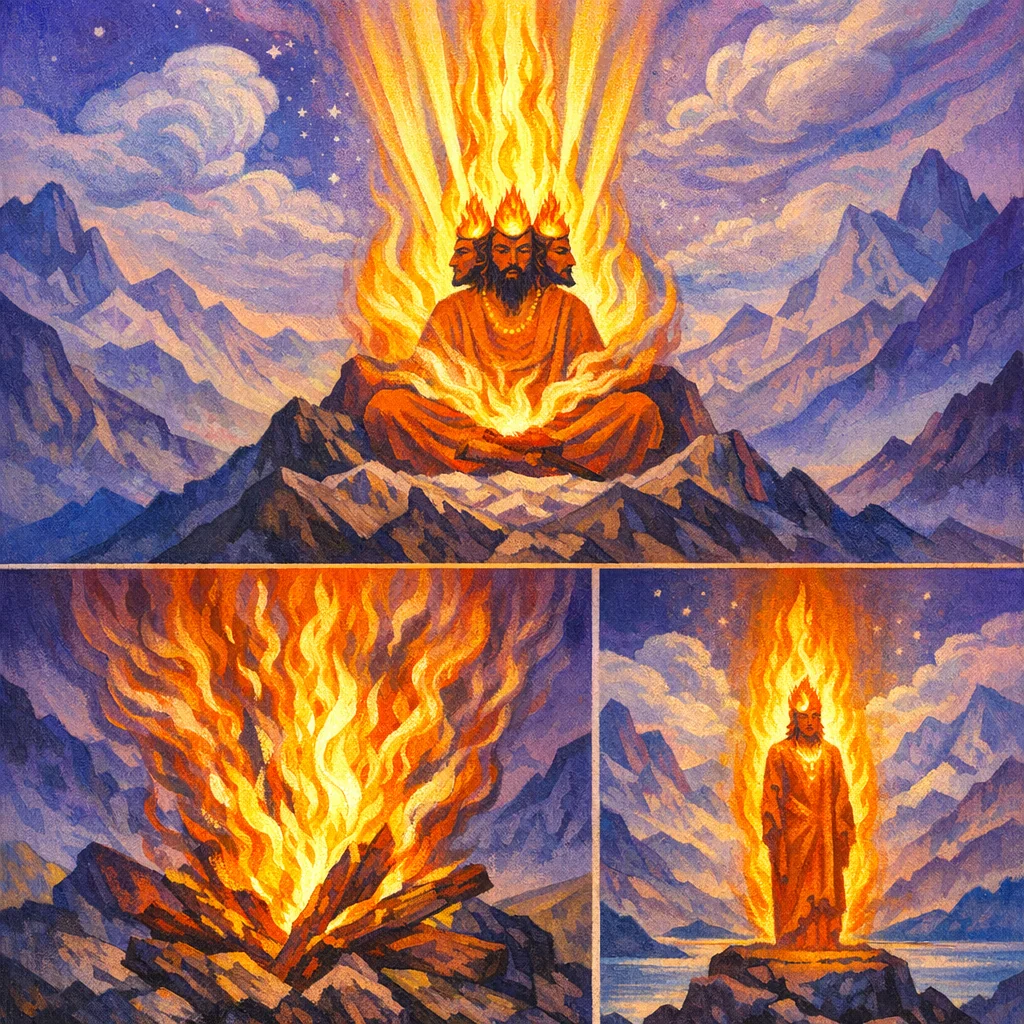
This short Agni hymn praises the Fire as a cosmic being—“three-headed” and “seven-rayed”—born in the lap of the two parents and filling the bright realms of heaven. It also hints at the hidden birth of Agni from the kindling-sticks and the nurturing “two cows” (dual powers) that move around one calf, suggesting the paired forces that sustain the sacrificial fire and the ordered path of the Vast.
Mantras
Mantra 1
त्रिमूर्धानं सप्तरश्मिं गृणीषेऽनूनमग्निं पित्रोरुपस्थे । निषत्तमस्य चरतो ध्रुवस्य विश्वा दिवो रोचनापप्रिवांसम् ॥
I hymn Agni, three-headed, seven-rayed, unimpaired, seated in the lap of the two parents. Firmly seated, he moves in the stable foundation, filling all the luminous regions of heaven.
Mantra 2
उक्षा महाँ अभि ववक्ष एने अजरस्तस्थावितऊतिॠष्वः । उर्व्याः पदो नि दधाति सानौ रिहन्त्यूधो अरुषासो अस्य ॥
The great Bull swells mightily with these; ageless, he stands, high, with his supporting powers. On the summit he sets the wide step; his ruddy powers lick the udder—drawing the nourishing essence.
Mantra 3
समानं वत्समभि संचरन्ती विष्वग्धेनू वि चरतः सुमेके । अनपवृज्याँ अध्वनो मिमाने विश्वान्केताँ अधि महो दधाने ॥
Two fostering powers move about one common calf; they range widely, well-paired. Measuring the path that cannot be turned aside, they set everywhere the signs of the Vast.
Mantra 4
धीरासः पदं कवयो नयन्ति नाना हृदा रक्षमाणा अजुर्यम् । सिषासन्तः पर्यपश्यन्त सिन्धुमाविरेभ्यो अभवत्सूर्यो नॄन् ॥
The steadfast seers lead to the true step, guarding the unaging power with hearts that differ in their workings. Seeking, they looked around and beheld the River; then to them the Sun became manifest for men.
Mantra 5
दिदृक्षेण्यः परि काष्ठासु जेन्य ईळेन्यो महो अर्भाय जीवसे । पुरुत्रा यदभवत्सूरहैभ्यो गर्भेभ्यो मघवा विश्वदर्शतः ॥
Worthy to be seen, he moves around in the pieces of wood, noble and adorable, for the child’s life in the Vast. When he came to be in many places from those sun-slaying wombs, the bountiful one became visible to all.
Frequently Asked Questions
These are symbolic epithets: “three-headed” can suggest Agni’s presence in three realms (earth, midspace, heaven) or three ritual forms, while “seven-rayed” points to his complete radiance—light spreading in all directions and through the ordered powers often counted as seven.
The phrase can mean Heaven and Earth as cosmic parents, and also the two fire-sticks used to kindle the sacrificial fire. The sukta intentionally allows both the cosmic and the ritual reading.
It is a riddle-like image for paired nurturing forces that sustain Agni—such as Heaven and Earth, day and night, or two complementary ritual powers—moving around the one ‘calf’, the newly born fire, as it is established on the straight path of order (ṛta).